Have you ever written “take effect” and suddenly wondered whether it should be “take affect” instead? You are not alone. These two words sound similar, but they have different meanings and grammatical functions.
When you mean “to become active,” “to start working,” or “to begin producing results,” the correct expression is take effect. The phrase “take affect” is not the standard expression for this meaning.
The good news is that the rule is easier than it first appears. Once you understand the difference between affect and effect, you can quickly determine which word belongs in your sentence.
Take Effect vs Take Affect: Which One Is Correct?
The correct expression is take effect.
Take Effect Means “Become Active”
Take effect means to begin working, become active, become operative, or start producing a result.
For example:
The new policy will take effect next Monday.
This means the policy will become active next Monday.
More examples include:
- The new law will take effect in January.
- The medicine should take effect within an hour.
- The updated rules will take effect immediately.
- The price increase will take effect next month.
- The agreement will take effect once both parties sign it.
Why “Take Affect” Is Incorrect
Take affect is generally incorrect when you are trying to say that something becomes active or starts working.
Compare:
❌ The new regulations will take affect tomorrow.
✅ The new regulations will take effect tomorrow.
The confusion happens because affect is also a real English word. However, it normally has a different function.
Why Do We Say “Take Effect”?
Understanding the basic difference between affect and effect makes the phrase much easier to remember.
Affect Usually Means “Influence”
Affect is most commonly used as a verb meaning to influence, change, or have an impact on something.
Examples:
Lack of sleep can affect your concentration.
Bad weather may affect our travel plans.
The new schedule could affect employees.
A useful memory shortcut is:
Affect = influence
When something affects something else, it has an influence on it.
Effect Usually Means “Result”
Effect is most commonly used as a noun meaning a result, outcome, or consequence.
Examples:
The medicine had a noticeable effect.
The new policy had a positive effect on productivity.
The storm had a serious effect on transportation.
The Grammar Behind “Take Effect”
Now consider:
The new rule will take effect tomorrow.
The expression take effect means the rule becomes operative or begins producing its intended result.
You can think of it as:
Take effect = become effective = start working
Therefore:
The new policy will take effect tomorrow. ✅
Not:
The new policy will take affect tomorrow. ❌
How to Use “Take Effect” Correctly
The phrase take effect appears in many everyday and professional situations.
Laws and Regulations
Laws and regulations commonly take effect on a particular date.
Examples:
The new tax regulations will take effect in July.
The revised law took effect last year.
The new parking rules will take effect tomorrow.
Here, the phrase means that the law or regulation becomes officially applicable.
Policies and Workplace Changes
Businesses also use take effect when announcing changes.
For example:
The company’s new leave policy will take effect on January 1.
The revised attendance policy takes effect next semester.
The new working hours will take effect immediately.
This is especially common in formal announcements, company emails, employee handbooks, and policy documents.
Medicine and Treatments
Take effect can also describe when medicine or treatment starts working.
Examples:
The painkiller should take effect within 30 minutes.
We waited for the anesthetic to take effect.
The treatment has finally taken effect.
Here, take effect means begin to produce the intended result.
Agreements and Decisions
You can also use the phrase for agreements, decisions, contracts, and other formal changes.
Examples:
The agreement will take effect once both parties sign it.
The decision took effect immediately.
The changes will take effect at the beginning of the next quarter.
The common idea is always the same: something begins to operate, apply, or produce results.
Take Effect vs Take Affect: A Simple Comparison
| Word or Phrase | Grammatical Role | Meaning | Example |
|---|---|---|---|
| Affect | Usually a verb | Influence or change | The weather may affect our plans. |
| Effect | Usually a noun | Result or outcome | The weather had an effect on travel. |
| Take effect | Verb phrase | Become active or start working | The new rule will take effect tomorrow. |
| Take affect | Not the standard phrase for this meaning | — | Avoid this construction. |
Compare These Three Sentences
Look at these examples:
The new law will take effect next month.
The law becomes active.
The new law may affect businesses.
The law influences businesses.
The new law could have a significant effect on businesses.
The law produces a result.
These sentences may discuss the same subject, but take effect, affect, and effect have different grammatical functions.
A Real-Life Example: A New Company Policy
Imagine that a company announces a new remote-work policy.
On March 1, management tells employees that starting April 1, workers may work from home two days per week.
The HR department might write:
“The company’s new remote-work policy will take effect on April 1.”
That sentence is correct because April 1 is the date when the policy becomes active.
However, HR might also write:
“The new policy may affect how teams schedule meetings.”
Here, affect is correct because the policy could influence employees’ behavior.
After several months, management might evaluate the results and report:
“The new policy has had a positive effect on employee productivity.”
Now effect is correct because the sentence refers to the result of the policy.
A manager could summarize the entire situation by saying:
“The policy took effect in April and affected how teams organized their schedules. Its overall effect was positive.”
This example demonstrates why the three forms can appear in the same paragraph without being interchangeable.
The policy takes effect because it becomes active. It affects employees because it influences their behavior. Its effect is the result produced by that change.
Once you understand these three ideas, the confusion between affect and effect becomes much easier to manage.
The “Become Effective” Test for Take Effect vs Take Affect
When you are unsure, try one simple substitution.
Replace It With “Become Effective”
Ask yourself:
Can I replace the phrase with “become effective”?
If yes, use take effect.
For example:
The new rules will take effect next month.
You could rewrite this as:
The new rules will become effective next month.
The meaning remains essentially the same.
Therefore:
Take effect ✅
Try the Test With Medicine
Consider:
The medicine should take effect soon.
Replace it:
The medicine should become effective soon.
The sentence still makes sense.
Therefore:
Take effect ✅
Use “Influence” for Affect
Now consider:
The new rule will affect employees.
Replace affect with influence:
The new rule will influence employees.
The meaning remains clear.
Therefore:
Affect ✅
This gives you a useful three-word test:
- Take effect → become effective
- Affect → influence
- Effect → result
A Simple Memory Trick You Can Actually Remember
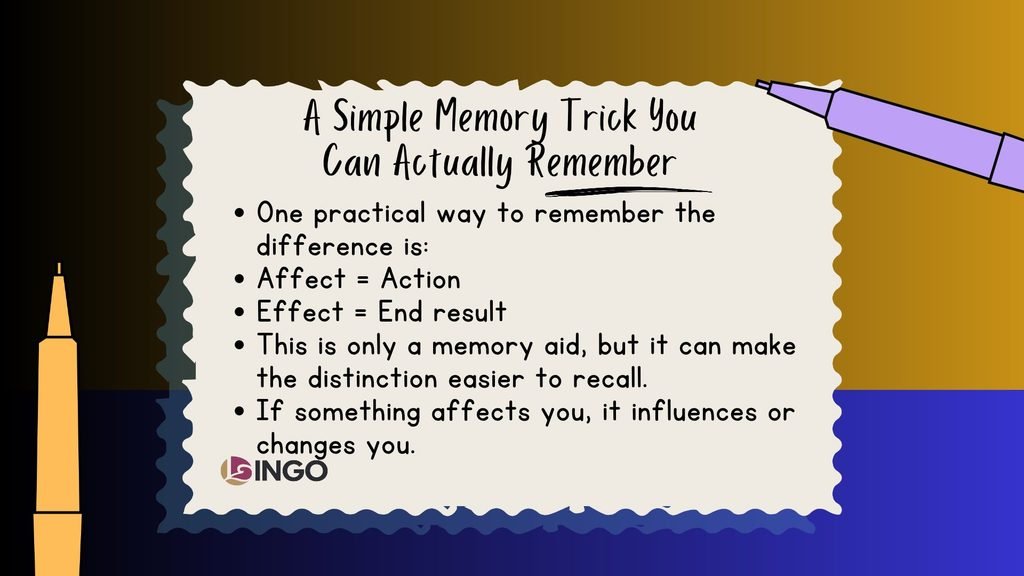
One practical way to remember the difference is:
Affect = Action
Effect = End result
This is only a memory aid, but it can make the distinction easier to recall.
If something affects you, it influences or changes you.
If something has an effect, you are talking about the result.
If something takes effect, it starts working.
The Three-Part Rule
Remember:
Affect → influence
Effect → result
Take effect → start working
For example:
The heat affected the workers.
The heat had an effect on productivity.
The new cooling system will take effect tomorrow.
That pattern is much more useful than simply memorizing that one word is a noun and the other is a verb.
Common Mistakes With Take Effect and Take Affect
Mistake #1: Writing “Take Affect”
Incorrect:
The new law will take affect next year.
Correct:
The new law will take effect next year.
The law becomes operative, so effect is required.
Mistake #2: Using “Effect” When You Mean “Influence”
Incorrect:
The new policy will effect employees.
Correct:
The new policy will affect employees.
If you mean “influence,” affect is the appropriate everyday verb.
Mistake #3: Writing “Have an Affect”
Incorrect:
The medication will have an affect on him.
Correct:
The medication will have an effect on him.
Here, you are describing a result, so effect is the appropriate noun.
Mistake #4: Forgetting the Fixed Expression
Incorrect:
The changes will take affect immediately.
Correct:
The changes will take effect immediately.
Rather than trying to reconstruct the phrase each time, remember take effect as a complete expression.
What Does Recent Data Tell Us About Writing Errors?
There is no reliable 2025–2026 global statistic showing exactly how often writers confuse take effect and take affect. Therefore, it would be misleading to invent a specific error percentage for this particular phrase.
However, recent research demonstrates that grammar, mechanics, vocabulary, and word choice continue to create difficulties for English learners.
A 2025 study of 40 student writing samples identified 78 grammatical and mechanical errors. Capitalization accounted for 23.08% of the errors, verbs for 16.67%, and nouns for 10.26%
Another study of undergraduate English writing recorded 80 vocabulary or word-choice errors, representing 10.66% of the errors analyzed.
These studies do not establish a specific rate for take effect/take affect. They do, however, highlight why learning precise word choice remains important for clear English writing.
For students, professionals, bloggers, and English learners, understanding commonly confused words can make writing more accurate and easier to understand.
Take Effect vs Take Affect: Quick Step-by-Step Guide
Use this checklist whenever you hesitate.
Step 1: Identify the Meaning
Ask:
Does the sentence mean “start working” or “become active”?
If yes, use:
take effect
Step 2: Check for Influence
Ask:
Does the word mean “influence” or “change”?
If yes, use:
affect
Step 3: Look for a Result
Ask:
Am I talking about an outcome or consequence?
If yes, use:
effect
Step 4: Test Your Sentence
Try these substitutions:
- take effect → become effective
- affect → influence
- effect → result
The substitution that preserves the intended meaning will usually reveal the correct choice.
Mini Quiz:Take Effect vs Take Affect
1. The new law will ______ next month.
A. take affect
B. take effect
C. affect
D. effected
Answer: B. take effect
2. The medicine should ______ within 30 minutes.
A. take affect
B. affect
C. take effect
D. effect
Answer: C. take effect
3. Bad weather can ______ our travel plans.
A. effect
B. take effect
C. affect
D. take affect
Answer: C. affect
4. The new policy had a positive ______ on employees.
A. affect
B. effect
C. take effect
D. taking affect
Answer: B. effect
5. The updated rules will ______ immediately.
A. take affect
B. affect
C. effect
D. take effect
Answer: D. take effect
6. Lack of sleep can ______ your concentration.
A. effect
B. affect
C. take effect
D. take affect
Answer: B. affect
7. The treatment finally began to ______.
A. take affect
B. affect
C. take effect
D. effected
Answer: C. take effect
8. The storm had a major ______ on transportation.
A. affect
B. effect
C. take effect
D. taking affect
Answer: B. effect
9. The new schedule may ______ how employees work.
A. effect
B. take effect
C. affect
D. take affect
Answer: C. affect
10. The price increase will ______ on January 1.
A. take affect
B. take effect
C. affect
D. effect
Answer: B. take effect
11. Which sentence is correct?
A. The new rules will take affect tomorrow.
B. The new rules will take effect tomorrow.
C. The new rules will affect tomorrow.
D. The new rules will effect tomorrow.
Answer: B. The new rules will take effect tomorrow.
12. Which word means “to influence”?
A. Effect
B. Affect
C. Take effect
D. Take affect
Answer: B. Affect
13. Which word usually means “result”?
A. Affect
B. Effect
C. Take affect
D. Affected
Answer: B. Effect
14. Which phrase means “to become active”?
A. Take affect
B. Affect
C. Take effect
D. Effect
Answer: C. Take effect
15. The noise had a noticeable ______ on my ability to concentrate.
A. affect
B. effect
C. take effect
D. take affect
Answer: B. effect
16. The new regulations will ______ next week.
A. take affect
B. affect
C. take effect
D. effect
Answer: C. take effect
17. The heat may ______ the workers’ productivity.
A. effect
B. take effect
C. affect
D. take affect
Answer: C. affect
18. The agreement will ______ once both sides sign it.
A. take affect
B. affect
C. take effect
D. effect
Answer: C. take effect
19. Which sentence uses “affect” correctly?
A. The medicine will take affect soon.
B. The new policy may affect employees.
C. The rule will take affect tomorrow.
D. The treatment had an affect on him.
Answer: B. The new policy may affect employees.
20. Which sentence uses “effect” correctly?
A. The new law will take affect next year.
B. The weather can effect our plans.
C. The medicine had a strong effect.
D. The policy will effect tomorrow.
Answer: C. The medicine had a strong effect.
21. Which sentence is grammatically correct?
A. The changes will take affect immediately.
B. The changes will take effect immediately.
C. The changes will take effected immediately.
D. The changes will affect immediately.
Answer: B. The changes will take effect immediately.
22. The new working hours may ______ employee routines.
A. effect
B. take effect
C. affect
D. take affect
Answer: C. affect
23. The medication is beginning to ______.
A. take affect
B. take effect
C. affect
D. effected
Answer: B. take effect
24. The new policy could have a significant ______ on productivity.
A. affect
B. take affect
C. effect
D. take effect
Answer: C. effect
25. Which sentence is completely correct?
A. The new law will take affect and effect businesses.
B. The new law will take effect and affect businesses.
C. The new law will take affect and affect businesses.
D. The new law will take effect and effect businesses.
Answer: B. The new law will take effect and affect businesses.
Frequently Asked Questions
Q1:Is “take effect” or “take affect” correct?
Take effect is correct when you mean “become active,” “start working,” or “begin producing results.”
Q2:Is “take affect” ever correct?
Not when you mean “become effective” or “start working.” In standard English, use take effect for that meaning.
Q3:What does “take effect” mean?
Take effect means to become operative, start working, or begin producing results.
Q4:What is the easiest way to remember “take effect”?
Remember:
Take effect = become effective.
If something is becoming active or starting to work, choose effect.
Q5:What is the difference between affect and effect?
Affect is usually a verb meaning “influence.”
Effect is usually a noun meaning “result” or “outcome.”
For example:
The noise affected my concentration.
The noise had an effect on my concentration.
Q6:Can I say “the new rule takes affect”?
No. If you mean that the rule becomes active, write:
The new rule takes effect tomorrow.
Q7:Is “take effect” used in American and British English?
Yes. Take effect is an established expression in both American and British English.
Q8:Is “come into effect” also correct?
Yes. Come into effect is another standard expression meaning that something begins to operate or apply.
For example:
The new regulations will come into effect next month.
Conclusion: Choose “Take Effect” With Confidence
When deciding between take effect vs take affect, remember this simple rule:
Use “take effect” when something becomes active, starts working, or begins producing results.
Use affect when something influences another person or thing.
Use effect when you are talking about a result or outcome.
So write:
The new policy will take effect on Monday. ✅
Not:
The new policy will take affect on Monday. ❌
When you hesitate, use the “become effective” test. If that replacement works, take effect is the right choice.
For more clear explanations of commonly confused English words and grammar rules, explore the other language guides on Lingorixa.
References

Maimoona Asghar is a grammar enthusiast and language writer who creates clear, practical content to help learners improve English grammar, writing, punctuation, and communication skills through easy-to-understand explanations and examples.