Thier or their? If you have ever paused while typing this word, you are not alone. The correct spelling is their, while thier is a misspelling. The confusion usually happens because English has many words in which the letters i and e appear in different orders.
The good news is that the difference is simple once you understand what their means and how it functions in a sentence.
Quick answer:
✅ Their = correct
❌ Thier = incorrect
For example:
- ✅ Their house is beautiful.
- ❌ Thier house is beautiful.
Cambridge Dictionary defines their as a word used to show that something belongs to or is connected with a group of people. It can also be used with a singular person when the person’s gender is unknown or when gender does not need to be specified.
Let’s look at the difference, understand why the mistake happens, and learn a simple trick that can help you remember the correct spelling permanently.
Thier or Their: Which Spelling Is Correct?
The correct spelling is their.
Thier is not a standard English word. It is simply a misspelling created by switching the positions of the e and i.
Their Is the Correct Spelling
Their is a possessive determiner used before a noun to show ownership, association, or connection.
Examples:
- The students finished their homework.
- The players celebrated their victory.
- The company changed their policy.
- We visited their new office.
- The children packed their bags.
In each example, their tells us that something belongs to, relates to, or is associated with someone or something.
Cambridge Dictionary lists their as a possessive form associated with they, including both plural and singular uses.
Thier Is a Spelling Mistake
Thier has no standard English meaning.
For example:
- ❌ The students submitted thier assignments.
- ✅ The students submitted their assignments.
- ❌ I like thier new car.
- ✅ I like their new car.
- ❌ Everyone should bring thier own notebook.
- ✅ Everyone should bring their own notebook.
If you see thier in a sentence, the intended word is almost certainly their.
What Does Their Mean?
Understanding the meaning of their makes it much easier to use correctly.
Their Shows Ownership
The most common function of their is to show that something belongs to a group.
For example:
The students brought their books.
Here, their books means the books belonging to the students.
More examples:
- The workers returned to their offices.
- The girls decorated their room.
- The dogs wagged their tails.
- The parents picked up their children.
The word does not necessarily mean physical ownership. It can also show a relationship or association.
Their Can Refer to One Person
Modern English also commonly uses their with a singular person when the person’s gender is unknown, irrelevant, or intentionally not specified.
For example:
Someone left their phone on the table.
Here, their refers to one unspecified person.
Another example:
Every student should bring their ID card.
Cambridge Dictionary specifically recognizes this singular use of their.
This means that their is not limited to situations involving multiple people.
Their Usually Comes Before a Noun
A useful grammar pattern is:
their + noun
Examples:
- their house
- their car
- their idea
- their teacher
- their family
- their business
- their decision
So, if you need a word before a noun to show that something belongs to or is associated with someone, their may be the word you need.
Why Do People Write Thier Instead of Their?
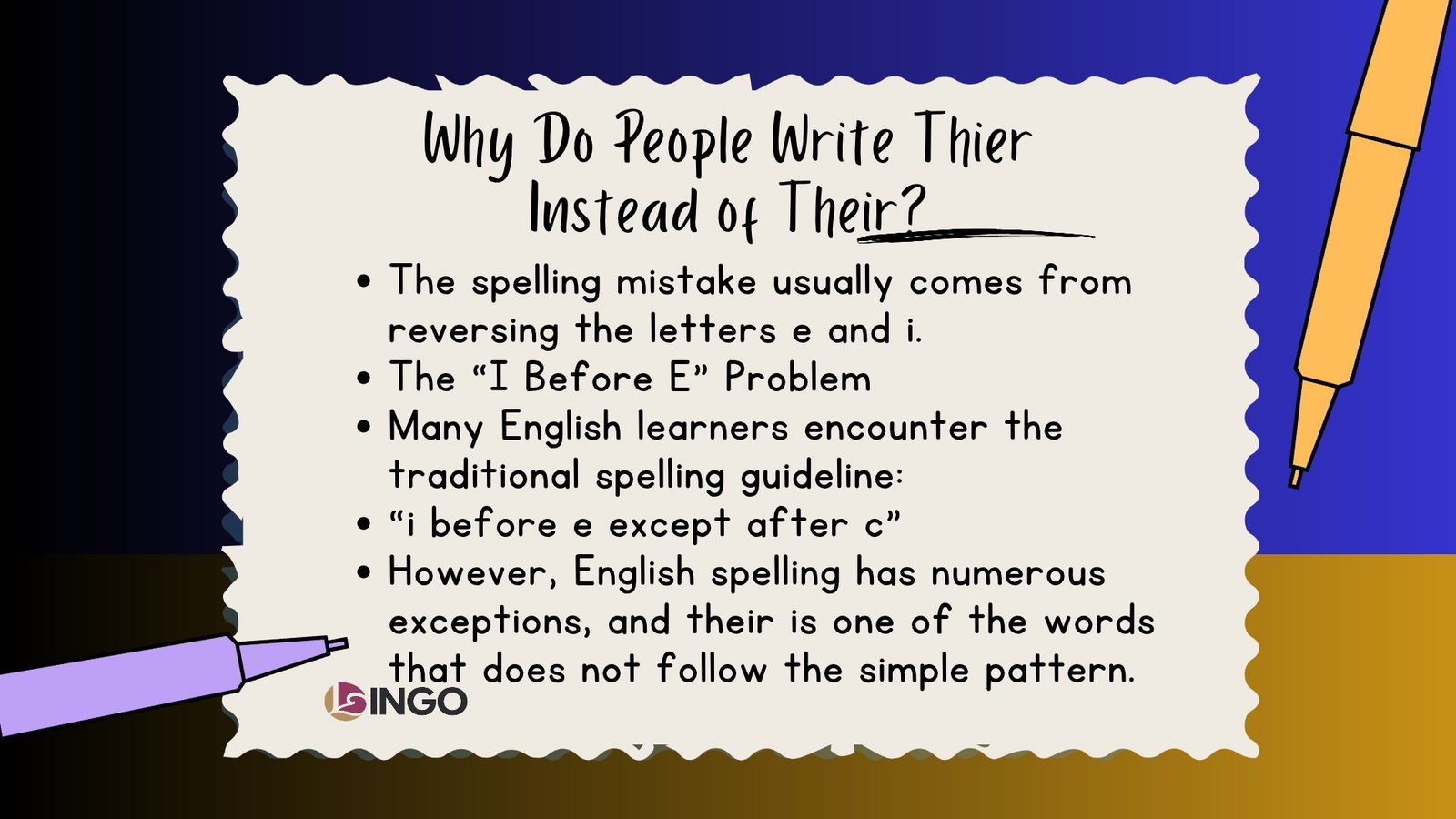
The spelling mistake usually comes from reversing the letters e and i.
The “I Before E” Problem
Many English learners encounter the traditional spelling guideline:
“i before e except after c”
However, English spelling has numerous exceptions, and their is one of the words that does not follow the simple pattern.
Compare:
- believe → ie
- field → ie
- receive → ei
- their → ei
- weird → ei
Therefore, trying to apply the rule mechanically can sometimes create mistakes.
Instead of relying on the rhyme, it is better to memorize the spelling of their as:
T-H-E-I-R
A Simple Memory Trick for Their
One useful trick is to remember that their contains the word heir:
their = t + heir
And:
heir = H-E-I-R
Therefore:
T + HEIR = THEIR
This gives you the correct letter order:
T-H-E-I-R
So when you are unsure whether to write their or thier, think:
Their has “heir” inside it.
This simple association can make the correct spelling easier to remember.
Their vs Thier: Easy Comparison
| Feature | Their | Thier |
|---|---|---|
| Correct English spelling? | ✅ Yes | ❌ No |
| Standard English word? | ✅ Yes | ❌ No |
| Shows possession? | ✅ Yes | ❌ No |
| Has a dictionary meaning? | ✅ Yes | ❌ No |
| Correct letter order | E before I | I before E |
| Example | Their house | Thier house ❌ |
Their vs Thier Examples
| Incorrect | Correct |
|---|---|
| Thier car is new. | Their car is new. |
| I like thier idea. | I like their idea. |
| Thier teacher arrived. | Their teacher arrived. |
| They forgot thier keys. | They forgot their keys. |
| Everyone brought thier lunch. | Everyone brought their lunch. |
The rule is straightforward:
Use “their,” never “thier,” in standard English writing.
Their, There, and They’re: Don’t Mix Them Up
Although thier is simply a misspelling, their is often confused with two real English words: there and they’re.
Their = Possession
Use their when something belongs to or is associated with someone.
They sold their house.
Think:
their = belonging to them
There = Place or Existence
Use there when referring to a place or introducing the existence of something.
Examples:
Put the book over there.
There are three chairs in the room.
A useful memory trick is:
there → here
Both relate to location.
They’re = They Are
They’re is a contraction of they are.
Examples:
They’re coming tomorrow.
This means:
They are coming tomorrow.
Another example:
They’re very happy.
= They are very happy.
Merriam-Webster explains the distinction clearly: their relates to possession, there commonly relates to location or existence, and they’re means they are.
The Three-Word Test
When you’re unsure, replace the word:
- If you mean belonging to them → their
- If you mean a place/existence → there
- If you mean they are → they’re
For example:
___ going to ___ house over ___.
Correct:
They’re going to their house over there.
This is one of the easiest ways to distinguish these commonly confused words.
A Real-Life Example: Catching the “Thier” Mistake
Imagine a university student named Sara preparing an important assignment. She writes the sentence:
“The students should submit thier assignments before Friday.”
Sara reads the sentence several times but does not notice anything unusual. The word looks familiar, and because she is writing quickly, her brain recognizes the intended word without carefully checking each letter.
Later, she runs the assignment through a spell checker. The program highlights thier as an error. Sara initially wonders whether the program is wrong because the word sounds exactly like their.
She checks a dictionary and discovers the problem: their is the correct possessive form, while thier is a spelling mistake.
She changes the sentence to:
“The students should submit their assignments before Friday.”
The important lesson is that pronunciation cannot always tell us how to spell an English word. Their, there, and they’re are pronounced alike or very similarly in many varieties of English, but they have different spellings and grammatical functions. Merriam-Webster identifies these as commonly confused words because they sound the same while carrying different meanings and functions.
Sara then uses a simple proofreading habit: whenever she writes their, she quickly checks whether it means “belonging to them.” She also remembers their = t + heir. After practicing this several times, the letter order becomes much easier to recall.
This example illustrates an important writing principle: spelling mistakes do not always happen because a writer does not know the word. Sometimes they happen because familiar words are typed quickly, letters are reversed, or pronunciation gives no clue about spelling.
2025–2026 Data and Evidence Snapshot
There is no reliable public 2025–2026 statistic showing exactly what percentage of English writers spell “their” as “thier.” Rather than inventing a number, it is better to use verifiable evidence from current language and search resources.
Here are useful evidence points:
- A 2025 QuillBot article explicitly identifies thier as a misspelling of their and explains the distinction between the two forms.
- Cambridge Dictionary currently lists their as an established English word and identifies it as a possessive determiner, including both plural and singular-reference usage.
- Merriam-Webster describes their, there, and they’re as commonly confused words because their pronunciation can make the distinctions difficult to remember.
- Google’s current Search Essentials guidance emphasizes using words that people actually search for and creating helpful, reliable, people-first content rather than content designed primarily to manipulate rankings.
The takeaway is more useful than an unsupported percentage: their is the established standard spelling, while thier is a spelling error.
How to Remember Their Correct Spelling Every Time
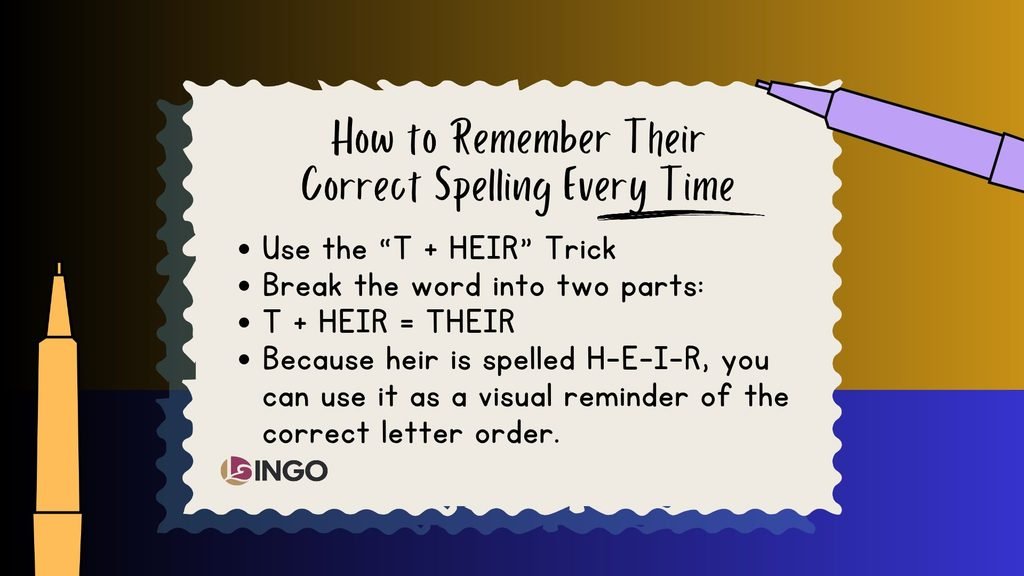
Use the “T + HEIR” Trick
Break the word into two parts:
T + HEIR = THEIR
Because heir is spelled H-E-I-R, you can use it as a visual reminder of the correct letter order.
Use the Meaning Test
Ask:
“Does this mean belonging to them?”
If yes, use their.
Example:
The children packed their bags.
The bags belong to or are associated with the children.
Use the Three-Word Test
When you see a confusing sentence, test the alternatives:
Their → belonging to them
There → place/existence
They’re → they are
And remember:
Thier → never the standard spelling
Common Mistakes to Avoid
Mistake 1: Writing Thier
❌ The company changed thier policy.
✅ The company changed their policy.
Mistake 2: Confusing Their With They’re
❌ Their going to the store.
✅ They’re going to the store.
Why?
They’re = they are
Mistake 3: Confusing Their With There
❌ Put the bags over their.
✅ Put the bags over there.
Here, the word refers to a location.
Mistake 4: Assuming “I Before E” Always Works
The spelling rule is useful in some cases, but it cannot reliably determine the spelling of every English word.
When in doubt, remember:
Their = T + HEIR
Mini Quiz:Thier or Their
1. Which spelling is correct?
A. Their
B. Thier
C. Thaire
D. Theirr
Answer: A. Their
2. Choose the correct word:
The students finished ___ homework.
A. Their
B. There
C. They’re
D. Thier
Answer: A. Their
3. Which sentence is correct?
A. Their car is outside.
B. Thier car is outside.
C. They’re car is outside.
D. There car is outside.
Answer: A. Their car is outside.
4. What does “their” usually express?
A. Location
B. Possession or association
C. An action
D. Time
Answer: B. Possession or association
5. Choose the correct word:
Someone left ___ phone here.
A. Their
B. There
C. They’re
D. Thier
Answer: A. Their
6. Which spelling is NOT correct?
A. Their
B. There
C. They’re
D. Thier
Answer: D. Thier
7. Which sentence is correct?
A. They’re going to their house.
B. Their going to there house.
C. Thier going to their house.
D. There going to they’re house.
Answer: A. They’re going to their house.
8. Which word means “they are”?
A. Their
B. There
C. They’re
D. Thier
Answer: C. They’re
9. Choose the correct word:
Put the books over ___.
A. Their
B. There
C. They’re
D. Thier
Answer: B. There
10. Which sentence contains a spelling mistake?
A. The children packed their bags.
B. The children packed thier bags.
C. The children packed their lunch.
D. The children packed their books.
Answer: B. The children packed thier bags.
11. Which memory trick can help you spell “their” correctly?
A. T + HEIR
B. T + HIER
C. TH + IER
D. THE + IR
Answer: A. T + HEIR
12. Choose the correct sentence:
A. The players celebrated their victory.
B. The players celebrated thier victory.
C. The players celebrated they’re victory.
D. The players celebrated there victory.
Answer: A. The players celebrated their victory.
13. Which sentence correctly uses singular “their”?
A. Every student should bring their ID.
B. Every student should bring thier ID.
C. Every student should bring they’re ID.
D. Every student should bring there ID.
Answer: A. Every student should bring their ID.
14. Choose the correct word:
I like ___ new office.
A. Their
B. There
C. They’re
D. Thier
Answer: A. Their
15. Which sentence correctly uses “their” and “there”?
A. Their house is over there.
B. There house is over their.
C. Thier house is over there.
D. Their house is over they’re.
Answer: A. Their house is over there.
16. Which sentence correctly uses “their” and “they’re”?
A. They’re bringing their books.
B. Their bringing they’re books.
C. Thier bringing their books.
D. There bringing their books.
Answer: A. They’re bringing their books.
17. What is “thier”?
A. A correct alternative spelling of their
B. A misspelling of their
C. A synonym for there
D. A contraction of they are
Answer: B. A misspelling of their
18. Choose the correct sentence:
A. The company updated their policy.
B. The company updated thier policy.
C. The company updated they’re policy.
D. The company updated there policy.
Answer: A. The company updated their policy.
19. Choose the correct replacement:
“I analyzed thier report.”
A. Their
B. There
C. They’re
D. Thaire
Answer: A. Their
20. Which spelling has the correct letter order?
A. Their
B. Thier
C. Thiered
D. Theeir
Answer: A. Their
21. Which sentence is correct?
A. Their teacher praised them.
B. Thier teacher praised them.
C. They’re teacher praised them.
D. There teacher praised them.
Answer: A. Their teacher praised them.
22. Choose the correct replacement:
“The team celebrated thier win.”
A. Their
B. There
C. They’re
D. Thaire
Answer: A. Their
23. Which sentence correctly uses “they’re”?
A. They’re ready to leave.
B. They’re bags are outside.
C. They’re house is large.
D. They’re books are on the desk.
Answer: A. They’re ready to leave.
24. Which sentence correctly uses “there”?
A. The keys are over there.
B. The keys are over their.
C. The keys are over they’re.
D. The keys are over thier.
Answer: A. The keys are over there.
25. What is the correct rule for “their”?
A. Use “their” to show possession or association.
B. Use “their” to mean “they are.”
C. Use “their” to identify a place.
D. Use “thier” as the formal spelling.
Answer: A. Use “their” to show possession or association.
FAQs About Thier or Their
Q1:Is “thier” a correct spelling?
No. Thier is a misspelling. The correct spelling is their.
Q2:What is the correct spelling: thier or their?
The correct spelling is their, with e before i:
T-H-E-I-R
Q3:What does their mean?
Their is a possessive determiner used to show that something belongs to, relates to, or is associated with people or things referred to by they. It can also refer to one person when gender is unknown or not specified.
Q4:Why do people spell their as thier?
People commonly write thier because they reverse the e and i. The traditional “i before e” spelling rule can also contribute to confusion because their is one of the many words that does not follow the simple version of that rule.
Q5:Is their a pronoun or adjective?
In modern grammar terminology, their is commonly classified as a possessive determiner when it comes before a noun, as in “their house.” It is also associated with the possessive forms of they. Cambridge Dictionary labels it a determiner in its main definition.
Q6:Can “their” refer to one person?
Yes. Singular their is widely used when referring to one person whose gender is unknown, unspecified, or intentionally not mentioned.
Example:
Someone left their phone here.
Cambridge Dictionary includes this usage in its current definition.
Q7:What is the difference between their, there, and they’re?
Their shows possession or association.
There usually refers to a place or introduces existence.
They’re means they are.
For example:
Their car is parked there, and they’re waiting inside.
Conclusion: Thier or Their?
So, thier or their—which spelling is correct? The answer is simple: their is correct, and thier is a misspelling.
Use their when you want to show possession, belonging, or association:
The students brought their books.
Remember the easy trick:
Their = T + HEIR
And when you are dealing with the three commonly confused forms, use this quick rule:
- Their = belonging to them
- There = place or existence
- They’re = they are
- Thier = incorrect spelling
Once you understand the meaning and remember the letter order, this spelling mistake becomes much easier to avoid.
If you’re improving your English grammar and writing skills, bookmark this guide and revisit the their / there / they’re rule whenever you need a quick refresher. Clear spelling and precise word choice can make your writing more professional, confident, and easier to understand.
For more clear explanations of commonly confused English words and grammar rules, explore the other language guides on Lingorixa.
References

Maimoona Asghar is a grammar enthusiast and language writer who creates clear, practical content to help learners improve English grammar, writing, punctuation, and communication skills through easy-to-understand explanations and examples.