Have you ever told someone, “I’ll do it soon,” and then realized they expected it much sooner than you did? If you have wondered how long is soon, the answer is surprisingly flexible. Soon does not describe a fixed number of minutes, hours, or days. Instead, it means that something is expected to happen within a relatively short time, with the exact timeframe determined by context.
For example, “I’ll call you soon” might mean in 10 minutes to one person but later that day to another. Cambridge Dictionary defines soon as happening “in or within a short time” or “before long,” confirming that it is a relative rather than exact time expression.
In this guide, you’ll learn what soon really means, how long it can mean in different situations, how to interpret it correctly, and how to communicate a clearer deadline when soon is too vague.
What Does “Soon” Mean?
The basic meaning of soon
Soon means within a short time or before too much time has passed. It refers to the near future but does not specify an exact point in time.
For example:
- “Dinner will be ready soon.”
- “I’ll call you soon.”
- “She’ll be here soon.”
- “We’ll announce the results soon.”
In each sentence, the listener understands that the event is expected relatively soon, but there is no precise deadline.
Cambridge also uses how soon to mean essentially “when,” as in “How soon can we sign the contract?”
Why “soon” is a vague time expression
The word soon is intentionally flexible.
Compare:
“I’ll call you at 3:00 p.m.”
with:
“I’ll call you soon.”
The first sentence provides a specific time. The second only communicates that the call should happen in the near future.
Therefore, soon is best understood as a relative time expression. Its meaning depends on the activity, context, urgency, and expectations of the people involved.
Is “soon” a specific amount of time?
No.
There is no universal rule saying:
Soon = 10 minutes.
or:
Soon = 24 hours.
Instead, the appropriate timeframe changes according to the situation.
That is why asking “How long is soon?” is reasonable when you need a more precise commitment.
How Long Is Soon in Different Situations?
Soon can mean minutes
For an immediate, everyday activity, soon can mean just a few minutes.
For example:
“The bus will arrive soon.”
If the bus is already nearby, soon might reasonably mean five or ten minutes.
Likewise:
“I’ll be ready soon.”
could mean the speaker needs another 5–15 minutes.
Soon can mean hours
For tasks that require more time, soon can refer to several hours.
For example:
“I’ll send you the report soon.”
If the person is working on the report, soon might mean later that afternoon.
Similarly:
“I’ll get back to you soon.”
could mean the person will respond after finishing other tasks.
Soon can mean days or longer
In professional or organizational contexts, soon can stretch considerably further.
For example:
“The company will announce the new policy soon.”
This could mean later this week or sometime in the coming weeks, depending on the circumstances.
A business might also say:
“Our new product is coming soon.”
Here, soon could refer to a launch happening weeks or even months later.
The larger the project, the more flexible the word can become.
How Long Is Soon? A Practical Timeframe Guide
Because soon has no fixed duration, the following ranges should be treated as practical interpretations rather than strict definitions.
| Situation | What “soon” may reasonably suggest |
|---|---|
| Someone is standing nearby | A few minutes |
| Getting ready to leave | 5–30 minutes |
| Returning a quick call | Minutes to a few hours |
| Sending a document | A few hours to a day |
| Customer-service response | Hours to several days |
| Business decision | Several days to weeks |
| Product announcement | Days to weeks |
| Major project | Weeks or longer |
The key principle is simple: the more immediate and simple the task, the shorter “soon” usually feels. The more complex the task, the longer the expected timeframe may be.
Why the Meaning of Soon Changes With Context
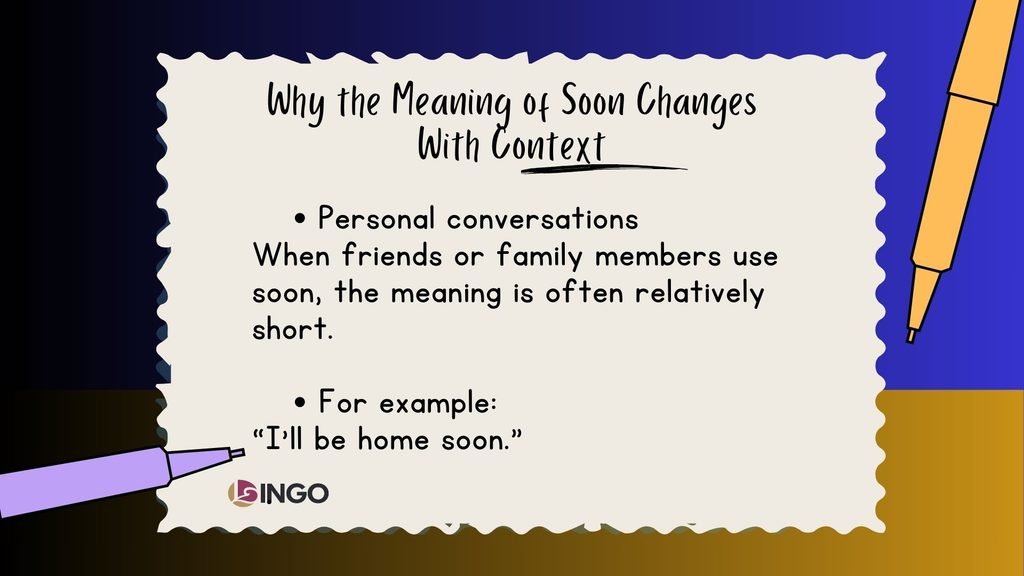
Personal conversations
When friends or family members use soon, the meaning is often relatively short.
For example:
“I’ll be home soon.”
If someone is already driving home, you might expect them within 15–30 minutes.
However:
“Let’s meet soon.”
is much less precise. It could mean later this week or simply sometime in the near future.
Workplace communication
In professional communication, soon can become problematic because different people may have different expectations.
Consider:
“I’ll send the proposal soon.”
Does that mean:
- within 30 minutes?
- by the end of the day?
- tomorrow?
- sometime this week?
Unless the context provides a clue, the recipient cannot know.
A clearer version would be:
“I’ll send the proposal by 4 p.m. today.”
This removes uncertainty.
Business and customer service
Businesses often use soon when they want to communicate progress without promising an exact deadline.
For example:
“We’ll contact you soon.”
That sounds reassuring, but the customer may reasonably wonder whether soon means one hour, one day, or one week.
This matters because modern customers often have relatively short response-time expectations.
A 2025 consumer-experience report found that 32% of consumers expected a response to a direct message within one hour, while another 17% expected a response within 12 hours and 17% within 24 hours.
Therefore, businesses can reduce confusion by replacing vague language with a realistic timeframe.
Instead of:
“We’ll respond soon.”
try:
“We’ll respond within one business day.”
“Soon” vs. Similar Time Expressions
Soon vs. shortly
Soon and shortly are very similar.
For example:
“The meeting will begin soon.”
“The meeting will begin shortly.”
Both suggest that the meeting will start in the near future.
However, shortly can sometimes sound slightly more formal or more immediate.
Soon vs. immediately
These words are not interchangeable.
Immediately means without meaningful delay.
Soon allows some waiting.
Compare:
“Please call me immediately.”
This suggests urgency.
“Please call me soon.”
This suggests that a relatively quick response is desired but does not necessarily require instant action.
Soon vs. later
Later simply means at a time after now.
Soon suggests that the event will happen relatively quickly.
Compare:
“I’ll call you later.”
This could mean later today, tomorrow, or another future time depending on context.
“I’ll call you soon.”
suggests a closer timeframe.
Soon vs. ASAP
ASAP means “as soon as possible.”
It generally communicates greater urgency than simply saying soon.
For example:
“Please send the document soon.”
is less urgent than:
“Please send the document ASAP.”
However, even ASAP does not always specify an exact deadline. If timing is important, a specific date or time is better.
Real-Life Case Study: When “Soon” Creates Confusion
A delayed work project
Consider a common workplace situation.
A manager asks an employee when a presentation will be ready. The employee responds, “I’ll finish it soon.” The manager interprets soon as meaning before lunch because the presentation is already mostly complete. The employee, however, has several other tasks to finish and means by the end of the working day.
At 11:30 a.m., the manager asks for the presentation. The employee says it is still being edited. Neither person necessarily acted unreasonably. The problem was the word soon.
The employee used soon to communicate intention, while the manager interpreted it as a specific deadline.
A better response would have been:
“I should have it ready by 4 p.m.”
Now both people have the same expectation.
This example shows why how long “soon” is depends heavily on context and shared expectations. In casual conversation, that ambiguity is usually harmless. In work, customer service, appointments, deliveries, or deadlines, it can create unnecessary frustration.
A useful rule is to use soon when the exact timing does not matter. When timing affects another person’s plans, replace soon with a concrete timeframe.
What Recent Communication Data Says About “Soon”
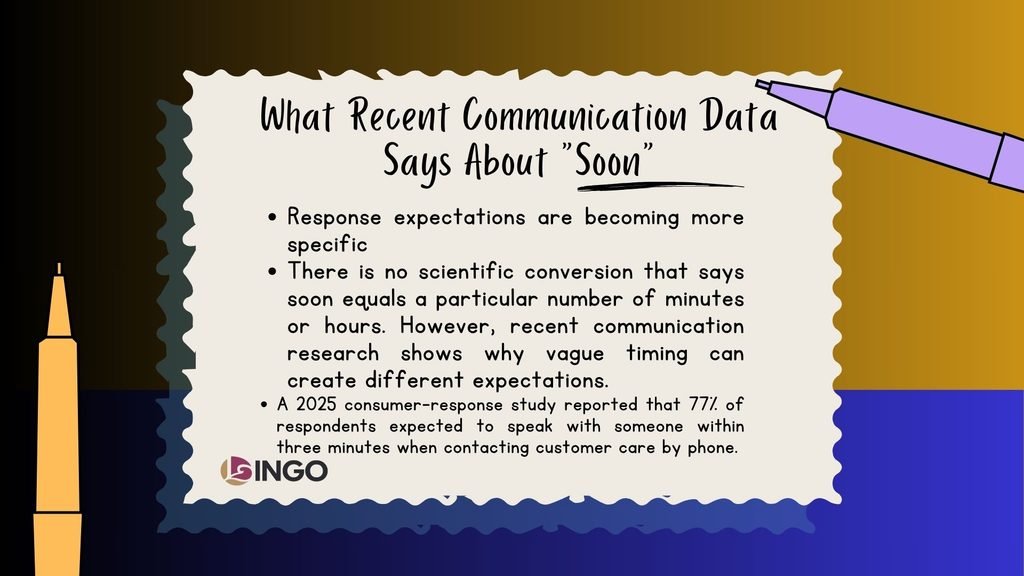
Response expectations are becoming more specific
There is no scientific conversion that says soon equals a particular number of minutes or hours. However, recent communication research shows why vague timing can create different expectations.
A 2025 consumer-response study reported that 77% of respondents expected to speak with someone within three minutes when contacting customer care by phone. For email, expectations were considerably slower: 32% were willing to wait more than 12 hours.
A separate 2026 study of prospective students found that 46% expected a response within 48 hours, while 32% said timing did not matter as long as they eventually received a response.
These findings don’t define the word soon. Instead, they demonstrate an important communication principle: people judge the meaning of a vague timeframe according to the situation and their expectations.
What this means for everyday English
If someone says:
“I’ll answer your email soon.”
the listener may use the communication channel to estimate the likely wait.
For a text message, soon may suggest minutes or hours.
For an email, it might reasonably suggest later today or within a day.
For a large business project, soon can mean considerably longer.
Therefore, context is essential.
How to Make “Soon” More Specific
Add a deadline
Instead of:
“I’ll send it soon.”
say:
“I’ll send it by 5 p.m.”
This is much clearer.
Give a range
If you cannot provide an exact time, use a range:
“I’ll send it within the next two hours.”
or:
“I’ll get back to you within two business days.”
This preserves flexibility while giving the other person useful information.
Ask what “soon” means
If someone tells you they’ll do something soon and the timing matters, simply ask:
“When do you expect to have it ready?”
or:
“Do you mean today or sometime this week?”
This is usually better than guessing.
Use the most appropriate time expression
| If you mean… | Say… |
|---|---|
| No delay | Immediately |
| Very quickly | Right away |
| Within a short period | Soon |
| In a short while | Shortly |
| At the earliest possible time | ASAP |
| At a specific time | At 3 p.m. |
| Before a specific deadline | By Friday |
| Within a flexible period | Within 24 hours |
The clearer your intended timeframe, the less likely your message is to be misunderstood.
Mini Quiz:How Long Is Soon?
1. What does “soon” generally mean?
A. After a very long time
B. In the near future
C. Yesterday
D. Never
Answer: B. In the near future
2. Does “soon” have a fixed number of minutes?
A. Yes, 5 minutes
B. Yes, 10 minutes
C. Yes, 30 minutes
D. No, it depends on context
Answer: D. No, it depends on context
3. Which sentence uses “soon” correctly?
A. I’ll call you soon.
B. I soon yesterday.
C. Soon I called yesterday.
D. I am soon the book.
Answer: A. I’ll call you soon.
4. “The food will be ready soon” most likely means:
A. In a few minutes
B. Next year
C. Next month
D. Never
Answer: A. In a few minutes
5. What type of word is “soon”?
A. Noun
B. Verb
C. Adverb
D. Adjective
Answer: C. Adverb
6. Which phrase means “immediately after something happens”?
A. As early as
B. As soon as
C. As quickly
D. As late as
Answer: B. As soon as
7. Which sentence is more precise than “I’ll send it soon”?
A. I’ll send it eventually.
B. I’ll send it later.
C. I’ll send it within an hour.
D. I’ll send it someday.
Answer: C. I’ll send it within an hour.
8. Can “soon” mean tomorrow?
A. Yes, depending on context
B. Never
C. Only in formal English
D. Only in British English
Answer: A. Yes, depending on context
9. Which sentence correctly uses “coming soon”?
A. The new product is coming soon.
B. The new product coming soon yesterday.
C. The new product soon came tomorrow.
D. Coming the product soon is.
Answer: A. The new product is coming soon.
10. What does “See you soon” usually communicate?
A. You will never meet again
B. You expect to see the person in the near future
C. You will meet exactly in five minutes
D. You met yesterday
Answer: B. You expect to see the person in the near future
11. Which word describes when something happens?
A. Quickly
B. Soon
C. Slowly
D. Carefully
Answer: B. Soon
12. Which word describes how fast something happens?
A. Soon
B. Early
C. Quickly
D. Tomorrow
Answer: C. Quickly
13. What does “early” usually mean?
A. Before the expected time
B. In the near future
C. At high speed
D. After a deadline
Answer: A. Before the expected time
14. Which sentence is best when an exact deadline matters?
A. I’ll finish it soon.
B. I’ll finish it someday.
C. I’ll finish it by 5 p.m.
D. I’ll finish it eventually.
Answer: C. I’ll finish it by 5 p.m.
15. “Please reply as soon as possible” means:
A. Reply whenever you want
B. Reply at the earliest practical opportunity
C. Reply next month
D. Never reply
Answer: B. Reply at the earliest practical opportunity
16. Which sentence correctly uses “soon”?
A. She soon realized her mistake.
B. She soonly realized her mistake.
C. She realized soonly her mistake.
D. She soon was realized her mistake.
Answer: A. She soon realized her mistake.
17. In “The train will arrive soon,” what does “soon” describe?
A. Where the train is
B. How fast the train moves
C. When the train is expected to arrive
D. The color of the train
Answer: C. When the train is expected to arrive
18. Why can “soon” cause misunderstandings?
A. It is difficult to spell
B. It has no meaning
C. Different people may expect different timeframes
D. It is only used in writing
Answer: C. Different people may expect different timeframes
19. Which is the clearest alternative to “I’ll call you soon”?
A. I’ll call you sometime.
B. I’ll call you eventually.
C. I’ll call you within 30 minutes.
D. I’ll call you later maybe.
Answer: C. I’ll call you within 30 minutes.
20. “The company will announce the results soon” could mean:
A. Only five minutes
B. Only one hour
C. A relatively near future time, depending on context
D. Exactly 24 hours
Answer: C. A relatively near future time, depending on context
21. Which situation requires the most precise timeframe?
A. “See you soon!”
B. A casual conversation
C. A work deadline
D. Saying goodbye to a friend
Answer: C. A work deadline
22. Choose the correct sentence.
A. I’ll be back soon.
B. I’ll be back quick soonly.
C. I soonly back will.
D. I be soon back yesterday.
Answer: A. I’ll be back soon.
23. What does “soon” mean in “She soon discovered the problem”?
A. She discovered it after a long period
B. She discovered it relatively shortly afterward
C. She discovered it yesterday
D. She never discovered it
Answer: B. She discovered it relatively shortly afterward
24. Which question can you ask when “soon” is unclear?
A. How soon?
B. How color?
C. How yesterday?
D. How person?
Answer: A. How soon?
25. Which statement about “soon” is correct?
A. “Soon” always means less than 24 hours.
B. “Soon” always means five minutes.
C. “Soon” is a fixed unit of time.
D. “Soon” is a relative expression whose timeframe depends on context.
Answer: D. “Soon” is a relative expression whose timeframe depends on context.
Common Questions About “How Long Is Soon?”
Q1:How long is soon exactly?
There is no exact length of time for “soon.” It generally means within a relatively short time, but the actual timeframe depends on context.
Q2:Can “soon” mean tomorrow?
Yes. Depending on the situation, soon can mean tomorrow.
For example:
“I’ll send you the documents soon.”
If the speaker is busy today, they may mean tomorrow.
However, if the person is already working on the documents, the listener might expect them today.
Q3:Can “soon” mean a week?
Yes, particularly when discussing a larger task, project, announcement, or event.
For example:
“The company will announce the changes soon.”
In this context, soon could reasonably refer to the coming week or weeks.
Q4:Does soon mean immediately?
No. Soon suggests a short wait, whereas immediately means without meaningful delay.
Therefore, if you need someone to act right now, immediately is clearer than soon.
Q5:Is “soon” vague?
Yes. Soon is intentionally or naturally vague because it does not identify a precise date or time.
That can be useful in casual conversation but problematic when a deadline matters.
Q6:How long should you wait when someone says “soon”?
It depends on the situation. For a quick text or phone call, waiting a short period may be reasonable. For work or customer service, the expected timeframe may be longer.
If the timing affects your plans, ask for clarification rather than guessing.
Q7:Is “shortly” faster than “soon”?
Usually, shortly can sound slightly more immediate, but there is no universal time limit for either word. Both are flexible expressions referring to the near future.
Q8:What is a better word than “soon”?
The best alternative depends on what you mean. You can say immediately, shortly, today, tomorrow, by Friday, within an hour, within 24 hours, or as soon as possible when you need greater precision.
Quick Checklist: How to Understand “Soon”
When someone says soon, ask yourself:
- What is happening? A text reply and a product launch have very different timelines.
- How urgent is it? Urgent tasks usually make soon feel shorter.
- What is the relationship? Friends may use soon differently from businesses.
- What is the communication channel? A text may imply faster action than a formal announcement.
- How complex is the task? Larger tasks naturally require more time.
- Does the timing affect your plans? If yes, ask for a specific deadline.
- Can the speaker give a range? “Within two hours” is clearer than “soon.”
Conclusion: How Long Is Soon?
So, how long is soon? There is no single answer. Soon means within a relatively short time or before long, but the actual timeframe depends on context, urgency, the task involved, and the expectations of the people communicating.
In casual situations, soon may mean minutes or hours. In professional settings, it could mean later today or within a few days. For business announcements or larger projects, it may even refer to weeks.
The safest approach is simple: use “soon” when an exact timeframe is not important. When timing matters, give a specific deadline or time range.
For example, instead of saying:
“I’ll send it soon.”
say:
“I’ll send it by the end of the day.”
Clear timing creates clearer communication.
For more clear explanations of commonly confused English words and grammar rules, explore the other language guides on Lingorixa.
References

Maimoona Asghar is a grammar enthusiast and language writer who creates clear, practical content to help learners improve English grammar, writing, punctuation, and communication skills through easy-to-understand explanations and examples.