Have you ever heard someone make a thoughtful point and wondered whether replying “well said” is grammatically correct? You are not alone. Because it is such a short expression, some English learners hesitate to use it or wonder whether “well said” sounds too formal, old-fashioned, or incomplete.
The good news is simple: “well said” is correct English. It is a natural expression used to praise the way someone has expressed an idea. Depending on the context and tone, it can mean “you expressed that very clearly,” “that was a good point,” or “I completely agree.”
In this guide, you will learn what “well said” means, why it is grammatically correct, when to use it, what alternatives sound natural, and which mistakes to avoid.
Quick Answer: Is “Well Said” Correct?
Yes, “well said” is grammatically correct and widely used in English.
It is an expression of approval used when someone communicates an idea clearly, effectively, intelligently, or persuasively. Oxford Learner’s Dictionaries lists “well said!” as an informal expression meaning that you agree completely.
Example:
“Good communication is not about saying more; it is about making your meaning clear.”
“Well said!”
Here, “well said” praises both the speaker’s point and the way the point was expressed.
What Does “Well Said” Mean?
“Well said” means that something was expressed clearly, appropriately, effectively, or eloquently.
It can communicate several related ideas:
- “You expressed that very well.”
- “That is a good point.”
- “I agree with what you said.”
- “You put that perfectly.”
- “That was clearly explained.”
However, the exact meaning depends on context.
For example:
“We should focus on solving the problem instead of blaming people.”
“Well said.”
This probably means both “I agree” and “you expressed that point effectively.”
Is “Well Said” a Complete Sentence?
In everyday communication, “well said” works perfectly well as a standalone response.
It is a shortened or elliptical expression. The listener understands the fuller meaning from context:
- “That was well said.”
- “You said that well.”
- “That was very well expressed.”
English commonly uses short expressions in conversation, so the absence of an explicit subject does not make “well said” incorrect.
What Does “Well Said” Mean in English?
The phrase “well said” focuses primarily on the quality of someone’s expression.
That distinction is important.
If you say “I agree,” you are directly expressing agreement with an idea. If you say “well said,” you are praising how the person communicated that idea, although agreement is often implied.
“Well Said” vs. “I Agree”
Consider this example:
“People need opportunities, not just advice.”
If you reply:
“I agree.”
You are confirming that you share the opinion.
If you reply:
“Well said.”
You are praising the way the person expressed the opinion, and you may also be signaling agreement.
Therefore, the two expressions overlap, but they are not identical.
“Well Said” vs. “Well Put”
“Well put” is one of the closest alternatives to “well said.”
Compare:
“Well said. That explains the problem perfectly.”
“Well put. That explains the problem perfectly.”
Both sound natural.
However, “well put” often emphasizes the wording or formulation of an idea, while “well said” can refer more broadly to something spoken or communicated.
Cambridge’s thesaurus lists “well-put” among terms related to “well-said,” along with words such as “apt,” “appropriate,” “effective,” and “well-chosen.”
“Well Said” vs. “Well Spoken”
These expressions should not be treated as exact synonyms.
Well said usually praises a particular statement:
“Your explanation of the issue was well said.”
Well spoken can describe someone’s general ability to communicate:
“She is a well-spoken presenter.”
So, if someone makes one excellent point, “well said” is usually the better choice.
Why “Well Said” Is Grammatically Correct
The grammar behind “well said” is actually quite simple.
“Well” Functions as an Adverb
In this expression, “well” describes how something was said.
For example:
“She explained the process well.”
Here, “well” modifies the verb “explained.”
The same basic idea appears in:
“You said that well.”
When shortened to:
“Well said!”
the meaning remains clear.
Merriam-Webster includes “well said” under a sense of well meaning “in a way appropriate to the facts or circumstances” or “fittingly, rightly.”
“Said” Comes From the Verb “Say”
Said is the past form and past participle of say.
Therefore:
- say → present
- said → past
- said → past participle
The construction works naturally because “well” describes the manner in which something was said.
That is why “well said” is correct, whereas “good said” is not standard English.
Why “Good Said” Is Incorrect
A common mistake is to say:
❌ “Good said.”
The natural expression is:
✅ “Well said.”
The reason is that good is primarily an adjective, while well is the appropriate adverb for describing how an action was performed.
Compare:
She is a good speaker.
She speaks well.
Likewise:
That was well said.
This follows the same general distinction between adjectives and adverbs.
When Should You Say “Well Said”?
You can use “well said” in many everyday and professional situations, provided the statement genuinely deserves recognition.
In Everyday Conversations
“well said” works naturally when a friend or family member expresses a thoughtful opinion.
Example:
“Sometimes taking a break is more productive than forcing yourself to keep working.”
“Well said. I definitely needed to hear that.”
This sounds warm and conversational.
In the Workplace
You can use “well said” during meetings, presentations, discussions, or professional conversations.
Example:
“We need to improve the customer experience instead of focusing only on short-term sales.”
“Well said. Customer loyalty should be part of the discussion.”
In a workplace, you can make the expression more specific:
“Well said. Your example makes the issue much clearer.”
That version sounds more thoughtful than simply repeating “well said” after every comment.
In Classrooms and Discussions
Teachers and students can also use the phrase.
Example:
Student: “The character’s decision shows how fear can influence people’s choices.”
Teacher: “Well said. You connected the character’s actions to the central theme.”
Here, the phrase works as positive feedback.
Is “Well Said” Formal or Informal?
“Well said” can work in both casual and professional communication, but it is generally conversational rather than highly formal.
Oxford classifies “well said!” as informal.
Casual Settings
In casual conversation, you can simply say:
“Well said!”
“Well said, my friend.”
“Very well said.”
The exclamation mark can make the response feel warmer and more enthusiastic.
Professional Settings
In a workplace conversation, “well said” is also acceptable.
For example:
“Well said. I think that should guide our next steps.”
However, if you are writing formal feedback, an academic paper, or an official report, a more specific response is often better.
Instead of:
“Well said.”
you could write:
“Your explanation clearly identifies the main issue.”
This tells the reader exactly what was effective.
“Well Said” Alternatives: What Can You Say Instead?
If you use “well said” frequently, varying your language can make your communication sound more natural and specific.
Common Alternatives
| Alternative | Tone | Best Use |
|---|---|---|
| Well put | Natural, conversational | Praising good wording |
| Nicely said | Warm, friendly | Casual appreciation |
| Very well said | Stronger, slightly formal | Emphasizing praise |
| That’s a great point | Neutral, professional | Meetings and discussions |
| Exactly right | Direct | Strong agreement |
| You put that perfectly | Warm, personal | Praising clear expression |
| That sums it up | Practical | Summarizing an idea |
| Well articulated | Professional | Presentations and written feedback |
| Spot on | Casual | Quick agreement |
| You nailed it | Informal | Friendly conversations |
Professional Alternatives to “Well Said”
If you are communicating in a professional environment, consider:
“That’s an excellent point.”
“You explained that very clearly.”
“That’s a well-articulated argument.”
“I think you captured the issue accurately.”
“That’s a strong observation.”
These alternatives are useful when you want your response to sound specific rather than automatic.
Friendly Alternatives
For casual conversations, try:
“Exactly!”
“So true.”
“You put that perfectly.”
“Absolutely.”
“That’s exactly what I was thinking.”
“You nailed it.”
The best alternative depends on whether you are praising clarity, wording, accuracy, agreement, or delivery.
A Real-Life Example: Using “Well Said” at Work
Imagine a project team is meeting to discuss why customers are leaving a service.
During the meeting, one employee says:
“We keep trying to attract new customers, but we are not paying enough attention to the people who already trust us. If we improve the experience for existing customers, retention should become part of our growth strategy rather than an afterthought.”
The room becomes quiet for a moment because the employee has summarized a complicated problem in a simple way.
The team leader responds:
“Well said. I think you have identified the gap in our current strategy.”
This is a natural use of “well said.”
The leader is not merely saying, “I agree.” Instead, the response recognizes that the employee expressed a complex business issue clearly and effectively.
The leader could also choose a more specific alternative:
“That’s an excellent point. You connected customer retention directly to our growth strategy.”
The second response provides more detail, while “well said” provides quick recognition.
This example also demonstrates why context matters. If the employee had shared a personal problem or emotional experience, replying only with “well said” could sound strangely detached. A more empathetic response would be appropriate.
For example:
“I’m sorry you had to go through that. Thank you for explaining it so clearly.”
Therefore, the phrase is not only about grammar. Tone, timing, and context determine whether it feels sincere, supportive, or dismissive.
Common Mistakes to Avoid With “Well Said”
Although the phrase itself is correct, it can still be used poorly.
Mistake 1: Saying “Good Said”
❌ “Good said!”
✅ “Well said!”
Use well because it functions adverbially to describe how something was said.
Mistake 2: Using It After Everything
If you respond with “well said” after every sentence, the expression can lose its meaning.
Instead, reserve it for genuinely strong observations.
For example:
“Well said. Your explanation makes the issue much easier to understand.”
Adding a reason makes the compliment feel more sincere.
Mistake 3: Ignoring Emotional Context
Suppose someone says:
“I have been struggling with this situation for months.”
Replying:
“Well said.”
may sound cold or inappropriate.
A better response might be:
“I understand. Thank you for sharing that.”
The expression is best suited to situations where you are praising someone’s statement, argument, explanation, or wording.
Mistake 4: Using “Well Spoken” Instead
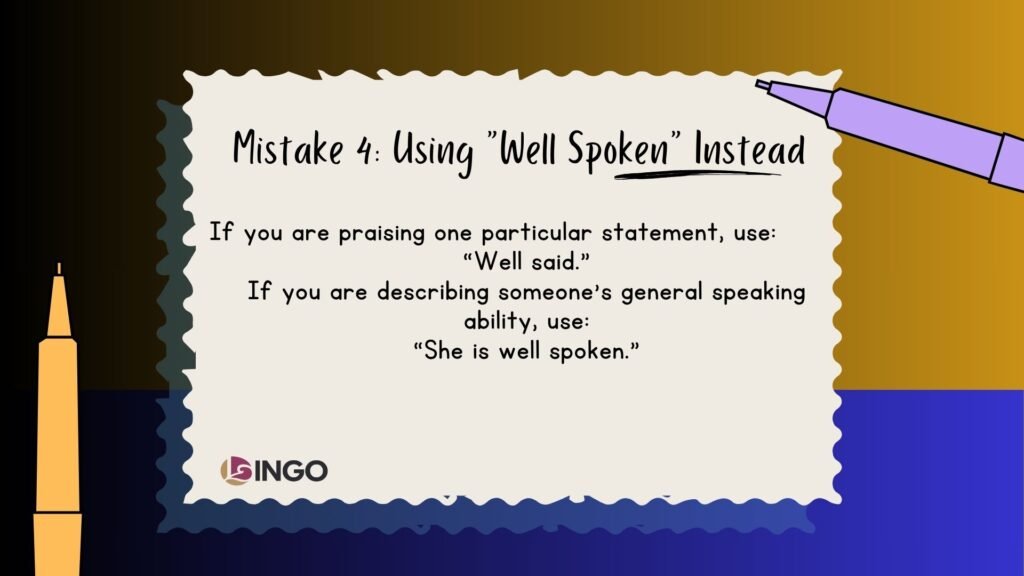
If you are praising one particular statement, use:
“Well said.”
If you are describing someone’s general speaking ability, use:
“She is well spoken.”
These expressions have related meanings but different uses.
2025–2026 Communication Data: Why Clear Expressions Matter
Although there is no meaningful industry statistic measuring how many people say “well said,” recent workplace research demonstrates why precise, effective communication remains valuable.
Grammarly’s 2025 Productivity Shift report describes communication and productivity as closely connected in modern workplaces. The report says that AI-fluent “power users” represented about 13% of the workforce in its research and reported saving more than 80% more time than their colleagues while also communicating more effectively.
The World Economic Forum’s Future of Jobs Report 2025, based on more than 1,000 employers representing over 14 million workers across 55 economies, also highlights human-centered skills alongside technical abilities. Analytical thinking was identified as the most sought-after core skill, while leadership and social influence, resilience, flexibility, and agility were also emphasized.
The practical lesson is important: effective communication is not simply about using grammatically correct words. It is also about choosing language that accurately communicates approval, disagreement, clarity, and intent.
A short phrase such as “well said” can therefore be useful when it precisely matches the situation.
A Simple Guide to Choosing the Right Response
When you want to respond to someone’s statement, ask yourself what you actually mean.
| What You Mean | Best Response |
|---|---|
| You completely agree | I agree. |
| You admire the wording | Well put. |
| You admire the expression | Well said. |
| You want to praise the idea | That’s a great point. |
| The explanation was exceptionally clear | You explained that perfectly. |
| You want a professional response | That’s an excellent observation. |
| You want an enthusiastic casual response | You nailed it! |
| You want to summarize agreement | Exactly right. |
This simple distinction helps you choose a response that sounds intentional rather than repetitive.
Mini Quiz:Is It Correct to Say “Well Said”?
1. Which sentence uses “well said” correctly?
A. Well said! You explained the issue clearly.
B. Good said! You explained the issue clearly.
C. Well say! You explained the issue clearly.
D. Good saying! You explained the issue clearly.
Answer: A
2. What does “well said” usually mean?
A. The speaker expressed an idea effectively.
B. The speaker spoke very loudly.
C. The speaker finished speaking late.
D. The speaker used difficult vocabulary.
Answer: A
3. Which is the closest natural alternative to “well said”?
A. Well put
B. Well arrived
C. Well happened
D. Well traveled
Answer: A
4. Which response directly expresses agreement?
A. I agree.
B. Well put.
C. Nicely said.
D. Well articulated.
Answer: A
5. Which sounds appropriate in a professional discussion?
A. Well said. Your point about customer retention is important.
B. Well said. Please send me your password.
C. Well said. The printer is beside the window.
D. Well said. The meeting starts at nine.
Answer: A
6. Why is “good said” incorrect?
A. “Well” appropriately functions as an adverb here.
B. “Said” can only follow adjectives.
C. “Good” can never describe communication.
D. “Said” is always a noun.
Answer: A
7. Which phrase best praises the wording of an idea?
A. Well put.
B. Well arrived.
C. I listened.
D. You started.
Answer: A
8. Which statement correctly distinguishes “well said” from “well spoken”?
A. “Well said” can praise one statement; “well spoken” can describe speaking ability.
B. They always have exactly the same meaning.
C. “Well spoken” only describes written language.
D. “Well said” only describes pronunciation.
Answer: A
9. Someone says, “We should solve the problem instead of blaming people.” What is a natural response?
A. Well said.
B. Well arrived.
C. Good say.
D. Well saying.
Answer: A
10. Which sounds most professional as presentation feedback?
A. You explained the issue very clearly.
B. You talked good.
C. Good said to you.
D. You say well yesterday.
Answer: A
11. What does “well said” emphasize?
A. How effectively something was expressed
B. How long someone spoke
C. How loudly someone spoke
D. How quickly someone spoke
Answer: A
12. Which is the most casual and enthusiastic response?
A. You nailed it!
B. Your proposition has been received.
C. Your statement is hereby documented.
D. Your utterance is acknowledged.
Answer: A
13. Which phrase best praises a strong observation?
A. That’s an excellent observation.
B. That’s an excellent arrival.
C. That’s an excellent beginning.
D. That’s an excellent departure.
Answer: A
14. Which sentence is grammatically correct?
A. Well said! That was exactly my point.
B. Good said! That was exactly my point.
C. Well say! That was exactly my point.
D. Well saying! That was exactly my point.
Answer: A
15. Someone shares a painful personal experience. Which response is more empathetic?
A. Thank you for sharing that.
B. Well said.
C. Nicely phrased.
D. Well articulated.
Answer: A
16. Which alternative works especially well in professional communication?
A. Well articulated.
B. Well arrived.
C. Well happened.
D. Well traveled.
Answer: A
17. Which works correctly as a standalone response?
A. “Well said!”
B. “Well saying!”
C. “Good said!”
D. “Good saying!”
Answer: A
18. Which response combines praise with a specific explanation?
A. Well said. Your example makes the issue much clearer.
B. Well said. Okay.
C. Well said. Anyway.
D. Well said. Goodbye.
Answer: A
19. Which response most directly expresses strong agreement?
A. Exactly!
B. Well arrived!
C. Good said!
D. Well speaking!
Answer: A
20. Which sentence uses “well said” naturally in a classroom?
A. Well said. You connected the example to the main theme.
B. Well said. Your pencil is blue.
C. Well said. The door is closed.
D. Well said. The bell rang.
Answer: A
21. Which phrase can mean “You expressed that perfectly”?
A. Well said.
B. I arrived.
C. I remember.
D. I noticed.
Answer: A
22. Which response provides more specific feedback than simply “well said”?
A. Your explanation clearly identifies the main problem.
B. Well said.
C. Okay.
D. Sure.
Answer: A
23. Which sentence correctly uses “well spoken”?
A. She is a well-spoken presenter.
B. Well-spoken! That was a great argument.
C. Well-spoken! You expressed that point perfectly.
D. Well-spoken! Your conclusion was excellent.
Answer: A
24. Which response works best after a persuasive argument?
A. Well said. That argument is very convincing.
B. Well arrived. That argument is very convincing.
C. Good said. That argument is very convincing.
D. Well say. That argument is very convincing.
Answer: A
25. Which statement about “well said” is most accurate?
A. It is correct English and can praise effective expression.
B. It is incorrect because every sentence needs a visible subject.
C. It is only correct when discussing written essays.
D. It always means complete agreement and nothing else.
Answer: A
Frequently Asked Questions About “Well Said”
Q1:Is “well said” grammatically correct?
Yes. “Well said” is grammatically correct. It is a conventional shortened expression used to praise how someone communicated an idea. Oxford lists “well said!” as an informal expression of complete agreement.
Q2:What does “well said” mean?
“Well said” generally means “you expressed that very well.” It can also imply agreement or approval, depending on the context.
Q3:Is “well said” formal or informal?
“Well said” is generally conversational and is classified as informal by Oxford. However, it can still be appropriate in professional discussions, meetings, presentations, and classroom conversations.
Q4:Can I say “well said” in an email?
Yes, especially when responding to someone’s thoughtful comment or argument.
For example:
“Well said. I agree that we should prioritize customer retention.”
For highly formal correspondence, however, a more specific response may sound more professional.
Q5:What is another way to say “well said”?
Common alternatives include “well put,” “nicely said,” “very well said,” “that’s a great point,” “you put that perfectly,” and “well articulated.”
Q6:Is “well said” the same as “I agree”?
Not exactly. “I agree” directly expresses agreement, while “well said” praises the way an idea was expressed. “Well said” can imply agreement, but it does not always mean complete agreement.
Q7:Is “well spoken” the same as “well said”?
No. “Well said” usually praises one specific statement, while “well spoken” generally describes someone’s speaking ability or manner of expression.
Q8:Is “good said” correct?
No. The standard expression is “well said,” not “good said.” “Well” is the appropriate adverb for describing how something was said.
Conclusion: Is “Well Said” the Right Phrase?
So, is it correct to say “well said”? Absolutely. It is a natural and grammatically correct English expression used to praise the way someone has communicated an idea.
Use “well said” when you want to recognize a clear, thoughtful, persuasive, or well-expressed statement. Remember that it is not exactly the same as “I agree”: the phrase often compliments the speaker’s expression as much as the underlying idea.
If you want variety, try alternatives such as “well put,” “that’s a great point,” “you put that perfectly,” or “well articulated.” Most importantly, match your response to the situation. A short “well said” can sound warm and encouraging when used sincerely, but it may feel dismissive if the context calls for empathy or a more detailed response.
Good communication is not only about knowing the correct grammar. It is also about choosing the right words for the right moment.
For more clear explanations of commonly confused English words and grammar rules, explore the other language guides on Lingorixa.
References
Oxford Learner’s Dictionaries — Well Said
Cambridge English Thesaurus — Well-Said

Maimoona Asghar is a grammar enthusiast and language writer who creates clear, practical content to help learners improve English grammar, writing, punctuation, and communication skills through easy-to-understand explanations and examples.