Have you ever typed “OK, thank you” and then wondered whether it sounds grammatically correct, too casual, or even slightly rude? You are not alone. This short expression is common in everyday English, but its tone can change depending on the situation.
So, is “OK, thank you” correct? Yes. “OK, thank you” is grammatically acceptable and natural in English. The word “OK” can acknowledge or accept information, while “thank you” expresses gratitude. Cambridge Dictionary explains that OK or okay can be used as a discourse marker to show understanding, acceptance, or agreement.
However, grammar is only part of the story. In an email to your manager, “OK, thank you” may feel more abrupt than “Thank you for letting me know.” In a text to a friend, it can sound perfectly natural.
This guide explains the grammar, punctuation, meaning, tone, and best alternatives so you can choose the right expression for every situation.
Is “OK, Thank You” Grammatically Correct?
Yes, “OK, thank you” is grammatically correct in ordinary English communication. It combines an acknowledgment with an expression of gratitude.
What Does “OK” Do in the Sentence?
Here, “OK” works as a conversational response or discourse marker. It can communicate that you understand, accept, or agree with something.
For example:
“The meeting has been moved to 3 p.m.”
“OK, thank you.”
The speaker is essentially saying, “I understand, and I appreciate the information.”
Cambridge Dictionary describes OK and okay as informal forms that can function as discourse markers, adjectives, and adverbs. As a discourse marker, okay can show that the speaker understands, accepts, or agrees with what someone has said.
What Does “Thank You” Add?
“Thank you” expresses appreciation or gratitude.
Therefore, the two parts perform different conversational functions:
OK → acknowledgment
Thank you → appreciation
Together:
“OK, thank you.” = “I understand/accept that, and I appreciate it.”
For example:
- “Your appointment is confirmed for Monday.”
- “OK, thank you.”
Or:
- “I’ll send the revised document this afternoon.”
- “OK, thank you.”
Both responses sound natural.
Is “Okay, Thank You” Also Correct?
Yes. “Okay, thank you” is equally acceptable.
The difference is mainly stylistic:
| Version | General impression |
|---|---|
| OK, thank you. | Concise and conversational |
| Okay, thank you. | Slightly more relaxed |
| OK. Thank you. | More separated and deliberate |
| Thank you. | Simple and polite |
| Thank you for letting me know. | More professional and specific |
There is no grammatical problem with choosing OK instead of Okay. Cambridge Dictionary recognizes both spellings.
Why the Comma Matters in “OK, Thank You”
Punctuation can influence how clearly the expression reads, even when the meaning remains obvious.
The Recommended Form Is “OK, Thank You.”
When OK is followed by a pause before “thank you,” a comma is a natural choice:
OK, thank you.
The comma helps separate the acknowledgment from the gratitude.
Compare:
- OK, thank you.
- OK thank you.
The second version can still be understood, particularly in casual texting, but it looks less polished.
Can You Write “OK. Thank You.”?
Yes.
Using two sentences creates a slightly stronger separation:
OK. Thank you.
This can sound more deliberate than:
OK, thank you.
For professional communication, however, an even clearer response may be preferable:
Thank you for the update.
or:
Thanks for letting me know.
What About “OK, Thank You!”?
An exclamation mark makes the response more energetic:
OK, thank you!
This can work well in friendly conversations.
However, punctuation can affect perceived tone. If you want a calm, professional response, a period is usually safer:
OK, thank you.
If you want warmth or enthusiasm:
OK, thank you!
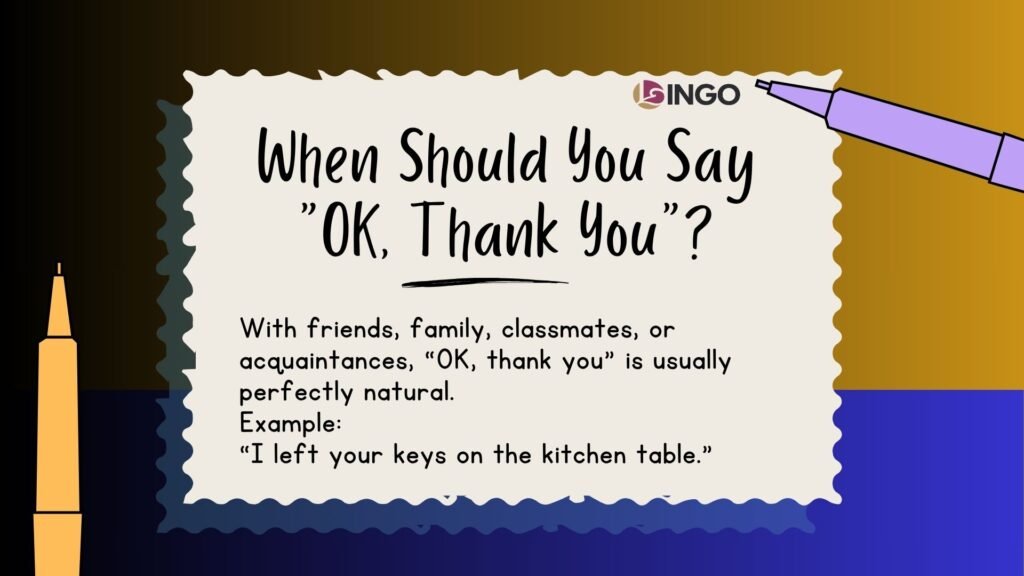
When Should You Say “OK, Thank You”?
The phrase is particularly useful when you need to acknowledge information and show appreciation at the same time.
In Casual Conversations
With friends, family, classmates, or acquaintances, “OK, thank you” is usually perfectly natural.
Example:
“I left your keys on the kitchen table.”
“OK, thank you.”
Another example:
“The movie starts at 8:30.”
“Okay, thank you!”
There is little risk of sounding overly formal in these situations.
In Text Messages and Chats
Short responses are common in messaging, so “OK, thank you” works well.
For example:
“I’ve sent the address.”
“OK, thank you.”
Or:
“Your order will arrive tomorrow.”
“OK, thank you.”
The exact tone depends on the relationship and the surrounding conversation.
In Professional Communication
The phrase can be acceptable at work, especially when the conversation is informal or routine.
For example:
“Please upload the file before 5 p.m.”
“OK, thank you.”
However, when writing to a client, senior executive, professor, or someone you do not know well, a more specific response can sound polished:
“Thank you for the clarification.”
“Thank you for the update. I’ll take care of it.”
“Understood. Thank you for letting me know.”
These alternatives make your response sound more intentional and professional.
Is “OK, Thank You” Polite or Rude?
“OK, thank you” is not inherently rude. Its tone depends heavily on context, punctuation, relationship, and the message that comes before it.
Why It Can Sometimes Sound Curt
Because the phrase is short, someone may interpret it as dismissive when the situation requires a warmer response.
Imagine a colleague writes:
“I spent an hour reviewing your proposal and added detailed comments to help strengthen it.”
Replying:
“OK, thank you.”
is grammatically fine, but it may feel underwhelming.
A better response could be:
“Thank you for taking the time to review it. I really appreciate your feedback.”
The second response recognizes the person’s effort.
Tone Depends on Context
Consider these examples:
Friendly:
“I’ll bring your book tomorrow.”
“OK, thank you!”
Neutral:
“Your appointment is confirmed for Thursday.”
“OK, thank you.”
Professional:
“I’ve attached the revised contract for your review.”
“Thank you for sending the revised contract.”
Warm and appreciative:
“I stayed late to finish the report for you.”
“Thank you so much. I really appreciate your help.”
The grammar doesn’t change. The amount of context and appreciation changes the tone.
A Simple Rule for Choosing the Right Tone
If the other person’s message requires only acknowledgment, “OK, thank you” is usually enough.
If they have provided substantial help, explanation, or effort, add a more specific expression of appreciation.
Short information → “OK, thank you.”
Meaningful help → “Thank you for your help. I really appreciate it.”
“OK, Thank You” vs. Better Alternatives
There is no single best alternative. The right phrase depends on what you want to communicate.
For Casual Situations
Use:
- “OK, thanks!”
- “Okay, thank you!”
- “Thanks!”
- “Got it, thanks.”
- “Sure, thank you.”
Example:
“I’ll text you when I arrive.”
“Got it, thanks!”
For Professional Emails
Consider:
- “Thank you for letting me know.”
- “Thank you for the update.”
- “Understood, thank you.”
- “Thanks for clarifying.”
- “I appreciate the information.”
These expressions sound more polished because they tell the recipient exactly what you are thanking them for.
For Formal or Respectful Situations
If you’re writing to a client, professor, official, or senior professional, try:
“Thank you for the clarification.”
or:
“Thank you for providing this information.”
Instead of simply:
“OK, thank you.”
The longer alternatives are not necessarily more grammatically correct. They are simply more explicit and context-sensitive.
A Real-Life Example: How a Short Reply Can Change Tone
Imagine that Sarah receives an email from her manager explaining that a deadline has changed.
Her manager writes:
Change block type or style
Move Paragraph block from position 142 up to position 141
Move Paragraph block from position 142 down to position 143
Change alignment
Change text alignment
Displays more block tools
“Hi Sarah, the client has requested that we submit the final report by Thursday rather than Friday. Please make sure the revised version is ready by 4 p.m. Thursday.”
Sarah replies:
“OK, thank you.”
The response is grammatically correct. It acknowledges the new deadline and expresses appreciation for the information. If Sarah and her manager normally communicate casually, there may be no problem at all.
However, the reply could appear slightly abrupt because the manager provided important information that affects Sarah’s work. A stronger professional response would be:
“Thank you for letting me know. I’ll make sure the revised report is ready by 4 p.m. Thursday.”
Notice what changed. The second reply does three things:
- Acknowledges the information.
- Expresses appreciation.
- Confirms the next action.
That makes the communication clearer and more professional.
This example illustrates an important principle: good communication is not only about grammatical correctness. It is also about matching your wording to the relationship, situation, and purpose.
That matters even more in modern workplaces, where much communication happens through short written messages. Microsoft’s Work Trend Index continues to track the growing role of digital communication in modern work, including email, chat, and meetings.
What Recent Communication Data Says About Tone
Digital communication has made short written responses an everyday part of professional and personal life.
2025–2026 Communication Statistics
Recent workplace research highlights how much communication employees handle digitally.
Microsoft’s Work Trend Index provides global research into changing workplace practices. Its 2025 research examined workplace communication and productivity at a large international scale, while Microsoft’s 2026 report continues to examine how work is changing as digital tools and AI become more integrated into everyday workflows.
Microsoft has also reported that employees spend a substantial portion of their work time communicating through meetings, email, and chat. Earlier Work Trend Index research found that 57% of time across Microsoft 365 apps was spent communicating, compared with 43% spent creating documents, spreadsheets, and presentations.
These statistics do not mean that “OK, thank you” is bad. Instead, they show why short written responses need to be clear and appropriate. When people exchange large volumes of digital messages, concise wording can save time—but an overly brief reply can sometimes leave the wrong impression.
A Simple Step-by-Step Guide to Choosing the Right Reply
When you’re unsure whether to use “OK, thank you,” follow these steps.
Step 1: Ask What You Are Acknowledging
If someone simply gives you information, “OK, thank you” may be enough.
“The office closes at 6.”
“OK, thank you.”
Step 2: Consider Your Relationship
Ask whether you’re talking to:
- a close friend,
- a colleague,
- a manager,
- a customer,
- a professor, or
- someone you don’t know.
The more formal the relationship, the more useful a specific response may be.
Step 3: Consider How Much Effort They Provided
If someone gave you a quick piece of information:
“OK, thank you.”
If someone spent considerable time helping you:
“Thank you so much for your help. I really appreciate it.”
Step 4: Match the Tone
Use this quick guide:
| Situation | Recommended response |
|---|---|
| Friend | “OK, thanks!” |
| Casual text | “Okay, thank you!” |
| Colleague | “OK, thank you.” |
| Professional email | “Thank you for letting me know.” |
| Client communication | “Thank you for the update.” |
| Detailed assistance | “Thank you for your help. I really appreciate it.” |
| Formal situation | “Thank you for providing this information.” |
Step 5: Add a Next Step When Necessary
If the information requires action, don’t stop at “OK, thank you.”
Instead, say:
“Thank you for letting me know. I’ll send the document by Friday.”
This removes ambiguity and demonstrates that you understood what needs to happen next.
Common Mistakes to Avoid
Writing “OK Thank You” in Formal Communication
While understandable, leaving out punctuation can make a professional message look rushed.
Prefer:
OK, thank you.
Or, better for formal communication:
Thank you for letting me know.
Using “OK” When You Need to Show Strong Appreciation
If someone has gone out of their way to help you, a bare “OK, thank you” may sound insufficient.
Instead:
“Thank you so much for your assistance.”
Assuming “OK” Always Sounds Friendly
“OK” is context-dependent. A message such as:
“OK.”
can feel neutral, dismissive, or even annoyed depending on the conversation.
Adding “thank you” usually softens it:
“OK, thank you.”
But in sensitive situations, a fuller response is still better.
Using Too Many Exclamation Marks
This:
“OK, thank you!!!”
may be appropriate among close friends, but it is usually unnecessary in professional writing.
A simple:
“Thank you for the update.”
is cleaner.
Mini Quiz: “OK, Thank You”
1. Which version is correctly punctuated?
A. OK thank you.
B. OK, thank you.
C. OK; thank you.
D. OK: thank you.
Answer: B
2. Is “OK, thank you” grammatically correct?
A. Yes
B. No
C. Only in emails
D. Only in questions
Answer: A
3. What does “OK” usually communicate in “OK, thank you”?
A. Anger
B. Confusion
C. Acknowledgment
D. Apology
Answer: C
4. Which sounds more professional?
A. OK, thanks!
B. Cool, thanks!
C. Thank you for letting me know.
D. Gotcha!
Answer: C
5. Which is more casual?
A. Thank you for the clarification.
B. I appreciate the information.
C. OK, thanks!
D. Thank you for providing this information.
Answer: C
6. Which phrase is best for a professional email?
A. Okay cool!
B. Thanks a bunch!
C. Thank you for the update.
D. Got it!
Answer: C
7. Which punctuation makes “OK, thank you” sound friendly and enthusiastic?
A. Period
B. Comma
C. Exclamation mark
D. Colon
Answer: C
8. Which sentence is the most natural?
A. OK, thank you.
B. OK thank you?
C. OK: thank you?
D. OK; thank you?
Answer: A
9. “OK, thank you” combines acknowledgment with what?
A. A warning
B. Gratitude
C. A question
D. An apology
Answer: B
10. Which response may sound too brief after someone gives you substantial help?
A. I really appreciate your help.
B. Thank you so much for your assistance.
C. OK, thank you.
D. Thank you for taking the time to help me.
Answer: C
11. Which is a good alternative to “OK, thank you”?
A. Whatever.
B. Thank you for letting me know.
C. Never mind.
D. Fine.
Answer: B
12. Which version is generally more casual?
A. OK, thanks.
B. Thank you for the information.
C. I appreciate your clarification.
D. Thank you for your assistance.
Answer: A
13. What can “OK” mean in everyday conversation?
A. I understand.
B. I disagree completely.
C. I am apologizing.
D. I am asking a question.
Answer: A
14. Which response is best after a friend tells you the meeting starts at 7?
A. Thank you for providing this information.
B. OK, thanks!
C. I appreciate your detailed clarification.
D. Thank you for your professional assistance.
Answer: B
15. Which response is warmer?
A. OK.
B. Fine.
C. Thank you so much!
D. Whatever.
Answer: C
16. Which sentence is most suitable for a client?
A. Cool, got it!
B. OK, buddy!
C. Thank you for the update.
D. Yep, thanks!
Answer: C
17. Can “Okay, thank you” be used instead of “OK, thank you”?
A. Yes
B. No
C. Only in British English
D. Only in texting
Answer: A
18. Which response clearly confirms that you understand and will take action?
A. OK.
B. Thanks.
C. Thank you for letting me know. I’ll take care of it.
D. Fine.
Answer: C
19. Which phrase sounds potentially dismissive when used alone?
A. Thank you so much.
B. I appreciate your help.
C. OK.
D. Thank you for the update.
Answer: C
20. Which option is best when someone clarifies something you misunderstood?
A. Whatever.
B. Thank you for the clarification.
C. OK then.
D. Sure.
Answer: B
21. Which expression is most appropriate for a close friend?
A. OK, thanks!
B. Thank you for providing the requested information.
C. I sincerely appreciate your assistance.
D. Thank you for your clarification.
Answer: A
22. Which sentence uses “OK” as an acknowledgment?
A. OK, I understand.
B. OK? What happened?
C. Is everything OK?
D. Are you OK?
Answer: A
23. Which response sounds the most appreciative?
A. OK.
B. Thanks.
C. OK, thank you.
D. Thank you so much for your help. I really appreciate it.
Answer: D
24. Which punctuation is least natural in “OK, thank you”?
A. Comma
B. Period
C. Exclamation mark
D. Colon
Answer: D
25. What is the main lesson about “OK, thank you”?
A. It is always rude.
B. It is grammatically incorrect.
C. It is correct, but the best choice depends on context and tone.
D. It should only be used with friends.
Answer: C
FAQs About “OK, Thank You”
Q1:Is “OK, thank you” grammatically correct?
Yes. “OK, thank you” is grammatically acceptable and natural in conversational English. “OK” acknowledges or accepts information, while “thank you” expresses gratitude.
Q2:Should there be a comma in “OK, thank you”?
Yes, “OK, thank you” is a clear and natural punctuation choice when the two expressions appear together. You can also write “OK. Thank you.” as two separate sentences.
Q3:Is “Okay, thank you” better than “OK, thank you”?
Neither is grammatically better. “OK” and “okay” are both accepted forms. Your choice is mainly a matter of style and preference.
Q4:Is “OK, thank you” rude?
Not normally. However, the phrase can sound curt in some professional or sensitive situations because it is very brief. If you want to sound warmer, try “Thank you for letting me know” or “I really appreciate your help.”
Q5:Can I use “OK, thank you” in a professional email?
Yes, especially for short, routine communication. However, “Thank you for the update” or “Thank you for letting me know” often sounds more polished in formal workplace emails.
Q6:What is a more professional way to say “OK, thank you”?
Good alternatives include:
- “Thank you for letting me know.”
- “Thank you for the update.”
- “Understood, thank you.”
- “Thank you for the clarification.”
- “I appreciate the information.”
Q7:Is “OK thank you” without a comma correct?
It is understandable in casual texting, but “OK, thank you” is clearer and more polished. The comma represents the natural pause between the acknowledgment and the expression of gratitude.
Q8:Should I say “OK, thanks” or “OK, thank you”?
Both are correct. “OK, thanks” is generally more casual, while “OK, thank you” can sound slightly more polite or neutral.
Conclusion: Is “OK, Thank You” Correct?
Yes, “OK, thank you” is correct English and is widely used to acknowledge information while expressing gratitude. The phrase is especially natural in everyday conversations, texts, chats, and routine workplace communication.
The key issue is not grammar it is tone and context.
Use “OK, thank you” when you want a short, polite acknowledgment. For more formal or meaningful communication, consider alternatives such as “Thank you for letting me know,” “Thank you for the update,” or “I really appreciate your help.”
In other words, don’t worry about whether “OK, thank you” is grammatically valid. It is. Instead, focus on choosing the response that best matches your relationship, purpose, and level of formality.
For more practical English grammar, punctuation, and communication guides, keep exploring Lingorixa and improve your everyday English one expression at a time.
For more clear explanations of commonly confused English words and grammar rules, explore the other language guides on Lingorixa.
References

Maimoona Asghar is a grammar enthusiast and language writer who creates clear, practical content to help learners improve English grammar, writing, punctuation, and communication skills through easy-to-understand explanations and examples.