If you’ve ever wondered about trash vs garbage, you’re not alone. In everyday American English, the two words are often used interchangeably to describe unwanted things that people throw away. Cambridge Dictionary lists trash and garbage as synonyms for waste material, while also giving both words additional meanings.
So, is there actually a difference between trash and garbage?
Usually, no major difference exists in everyday American English. However, there are differences in regional preference, context, word combinations, and additional meanings.
This guide explains what trash and garbage mean, how they compare, when to use each word, and how real speakers use them in everyday sentences.
What Does Trash Mean?
Trash meaning and definition
Trash is an informal American English word for things that are no longer wanted or needed and are thrown away.
For example:
- Please take out the trash.
- The kitchen trash is full.
- Don’t leave trash on the floor.
- We collected the trash after the party.
Cambridge Dictionary defines trash as waste material or things that are no longer wanted or needed. It also notes that trash can describe something considered worthless or low quality.
Therefore, trash can refer to both physical waste and, in informal contexts, something considered poor or worthless.
Trash as a verb
Trash can also function as a verb.
For example:
I need to trash these old papers.
Here, trash means throw away.
It can also mean to damage something severely:
The children trashed the room.
In informal speech, trash may also mean to criticize someone or something harshly.
Common expressions with trash
Some common combinations include:
- trash can
- trash bag
- trash pickup
- trash collection
- take out the trash
- trash bin
- trash truck
These expressions are especially common in American English.
What Does Garbage Mean?
Garbage meaning and definition
Garbage is another common American English word for unwanted material that is thrown away.
For example:
- Please take out the garbage.
- The garbage smells terrible.
- Put the food scraps in the garbage.
- The garbage truck comes every Tuesday.
Cambridge Dictionary defines garbage as waste material or unwanted things that are thrown away. It also identifies unwanted food as a particularly common sense of the word.
Garbage can mean nonsense
Unlike physical waste, garbage can also describe something considered nonsense, incorrect, worthless, or very poor quality.
For example:
That’s a load of garbage.
Depending on context, this could mean the speaker thinks something is nonsense rather than actual waste.
Similarly:
This article is garbage.
Here, garbage is being used figuratively to criticize the quality of the article.
Common expressions with garbage
You may hear:
- garbage can
- garbage bag
- garbage truck
- garbage collection
- take out the garbage
- garbage disposal
- garbage collector
These combinations are widely understood in American English.
Trash vs Garbage: What’s the Difference?
Trash vs garbage in everyday American English
For ordinary household waste, trash and garbage are usually interchangeable.
Consider these sentences:
Please take out the trash.
Please take out the garbage.
Both are natural American English sentences.
The main difference is often personal preference, regional usage, or context, rather than a strict difference in meaning.
Cambridge specifically lists trash as also meaning garbage and garbage as also meaning trash in American English.
Trash vs garbage comparison table
| Feature | Trash | Garbage |
|---|---|---|
| Basic meaning | Unwanted material | Unwanted material |
| Common in American English | Yes | Yes |
| Household waste | Yes | Yes |
| Food waste | Yes | Especially common |
| Can mean nonsense | Yes | Yes |
| Can be a verb | Yes | Generally less common |
| Common phrase | Take out the trash | Take out the garbage |
| British English equivalent | Rubbish | Rubbish |
| Formal technical term | Usually not | Usually not |
The important point is that neither word is automatically more correct than the other when you’re talking about ordinary household waste.
When Should You Use Trash or Garbage?
Use trash for everyday American English
Trash is a very natural choice when talking about everyday waste.
For example:
- I need to empty the trash.
- There’s trash all over the sidewalk.
- Where is the trash can?
- The trash needs to go outside.
It is also common when referring to unwanted non-food items.
For example:
I found a pile of old magazines and threw them in the trash.
Use garbage when talking about discarded food or household waste
Garbage is particularly natural when discussing food waste or general household waste.
For example:
Don’t forget to put the leftover food in the garbage.
The garbage needs to be collected tomorrow.
However, this is a usage tendency rather than an absolute grammar rule. Americans can naturally say trash for food waste and garbage for paper, packaging, or other household items.
Remember regional differences
American speakers commonly use trash and garbage.
British speakers generally prefer rubbish for this meaning. Cambridge Dictionary identifies rubbish as the UK equivalent in its entries for both trash and garbage.
For example:
American English:
Take out the trash.
British English:
Take out the rubbish.
This doesn’t mean that British speakers never understand trash or garbage. It simply means rubbish is the more characteristic everyday term in British English.
Real-Life Examples of Trash vs Garbage
Example 1: At home
Imagine you’re cleaning your kitchen after dinner.
You might say:
The trash is full. Can you take it outside?
You could also say:
The garbage is full. Can you take it outside?
Both are natural in American English.
Example 2: At work
Suppose you’re cleaning your office.
You could say:
Please throw those old papers in the trash.
Here, trash sounds completely natural.
You could also say:
Those old papers are garbage.
However, the second sentence could sometimes sound stronger because garbage can have a figurative meaning of something worthless.
Example 3: In a restaurant
A restaurant worker might say:
Put the food scraps in the garbage.
Here, garbage is a natural choice because the context involves discarded food.
Still, trash would not necessarily be grammatically wrong.
Example 4: Talking about quality
Consider:
That movie is trash.
This doesn’t mean someone literally threw the movie away.
Instead, trash is being used figuratively to say that the movie is very poor quality.
Likewise:
That idea is garbage.
means the speaker thinks the idea is worthless or nonsensical.
These figurative meanings are important because they show that trash and garbage aren’t limited to physical waste.
Case Study: How Context Changes the Meaning
A workplace conversation about trash and garbage
Imagine an American office where employees are cleaning up after a company lunch.
At first, an employee says:
“Can you take out the trash?”
Another employee gathers the bags containing paper plates, wrappers, napkins, and food leftovers.
A few minutes later, someone says:
“The garbage truck is here.”
Nobody finds this confusing. The first speaker used trash to describe the bags of unwanted material, while the second used garbage to describe the waste being collected by the municipal service.
Later, an employee tastes a dish left over from lunch and says:
“This food is garbage.”
Now the meaning has changed. The person is not necessarily saying the food belongs in a garbage container. Instead, they’re criticizing its quality.
This example demonstrates why context matters more than trying to memorize a rigid distinction between the two words. In everyday American English, trash and garbage overlap heavily when they refer to physical waste, but both can also have figurative meanings.
The practical lesson is simple: if you’re talking about ordinary household waste, either word will usually work. If you’re describing something as worthless or terrible, context determines whether trash or garbage is being used figuratively.
Trash vs Garbage: 2025–2026 Waste Statistics
What current data tells us
The words trash and garbage may sound like simple vocabulary, but the waste they describe represents a significant global issue.
The World Bank’s latest What a Waste 3.0 assessment, released in 2026, draws on data from 217 countries and economies and 262 cities. It reports that the world generated approximately 2.56 billion tonnes of municipal waste in 2022. Without major policy and investment changes, annual waste generation could reach approximately 3.86 billion tonnes by 2050—a projected increase of about 50%.
The World Bank also reports that collection rates remain particularly challenging in lower-income regions, making effective waste management an important environmental, public-health, and infrastructure issue.
A 2026 UNEP update likewise notes that humanity generates up to 2.3 billion tonnes of municipal solid waste each year.
Why these statistics matter
These figures show that trash, garbage, rubbish, and waste are not merely vocabulary terms. They describe materials that require collection, recycling, composting, treatment, or disposal.
Therefore, understanding the language surrounding waste can also help people communicate more clearly about environmental issues.
Trash, Garbage, Rubbish, Waste, and Litter Compared
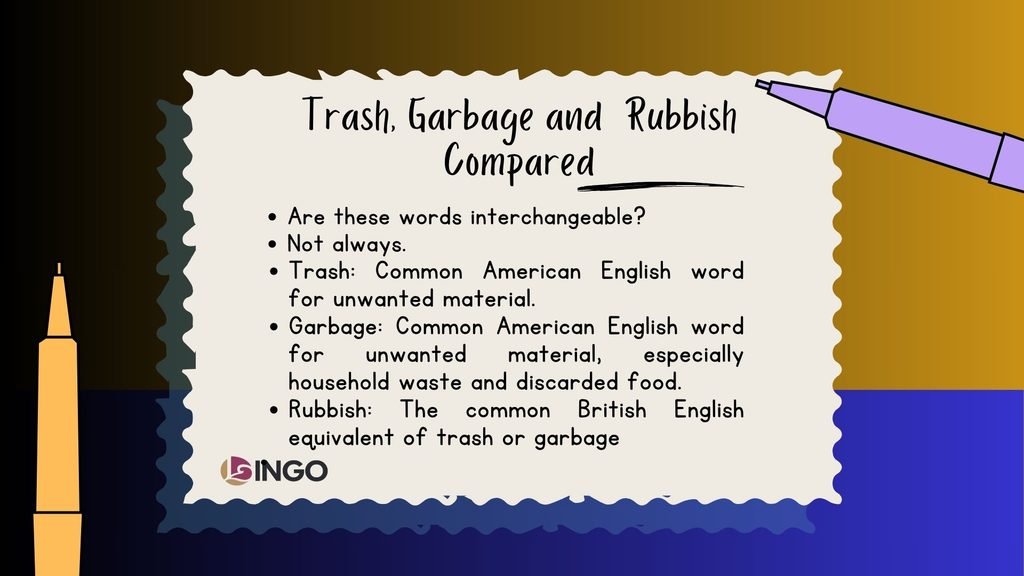
Are these words interchangeable?
Not always.
Trash: Common American English word for unwanted material.
Garbage: Common American English word for unwanted material, especially household waste and discarded food.
Rubbish: The common British English equivalent of trash or garbage.
Waste: A broader and more formal term frequently used in environmental, industrial, and government contexts.
Litter: Waste that has been improperly left in a public or open place.
Junk: Unwanted or useless items, often referring to old possessions rather than ordinary household waste.
For example:
Please put the trash in the bin.
But:
Don’t litter in the park.
The second sentence specifically describes leaving waste where it should not be.
A simple way to remember the difference
Think of the words this way:
Trash/Garbage → unwanted material you throw away
Rubbish → common British equivalent
Waste → broader/formal term
Litter → waste left carelessly in a public/open place
Junk → unwanted or useless objects
This distinction makes everyday vocabulary much easier to use accurately.
Common Mistakes to Avoid
Mistake 1: Thinking trash and garbage are completely different
They aren’t in ordinary American usage.
❌ Trash must always mean paper.
❌ Garbage must always mean food.
These are oversimplifications.
Both words can describe general household waste.
Mistake 2: Assuming one word is grammatically correct
Both are grammatically correct when used appropriately.
Please take out the trash.
Please take out the garbage.
Both sentences are correct.
Mistake 3: Confusing litter with trash
Although litter is a type of waste, the word usually emphasizes waste that has been left improperly.
Don’t leave trash in the park.
Don’t litter in the park.
The second sentence focuses more specifically on the act of leaving waste behind.
Mistake 4: Ignoring regional English
If you’re learning British English, rubbish may sound more natural than trash or garbage.
If you’re learning American English, trash and garbage are both standard everyday choices.
Mini Quiz:Trash vs Garbage
1. What is the usual relationship between “trash” and “garbage” in everyday American English?
A. They are usually interchangeable
B. They always mean different materials
C. Trash means only food
D. Garbage means only paper
Answer: A — They are usually interchangeable
2. Which sentence uses “trash” naturally?
A. Please take out the trash.
B. Please take trash the out.
C. Please trash out the yesterday.
D. Please take the yesterday trash.
Answer: A — Please take out the trash.
3. Which word is generally preferred in British English for ordinary household waste?
A. Rubbish
B. Trash
C. Garbage
D. Junk
Answer: A — Rubbish
4. What does “garbage” commonly mean?
A. Unwanted household material
B. Only food
C. Only paper
D. Only recyclable items
Answer: A — Unwanted household material
5. Which word specifically refers to waste left improperly in a public place?
A. Litter
B. Garbage
C. Junk
D. Waste
Answer: A — Litter
6. Which sentence is natural American English?
A. The garbage truck comes every Tuesday.
B. The garbage every truck Tuesday comes.
C. The truck garbage yesterday comes.
D. The garbage comes Tuesday yesterday truck.
Answer: A — The garbage truck comes every Tuesday.
7. What does “trash” mean as a verb in “I need to trash these old papers”?
A. Throw away
B. Repair
C. Organize
D. Purchase
Answer: A — Throw away
8. Which sentence uses “garbage” figuratively?
A. That idea is garbage.
B. Put the garbage in the bin.
C. The garbage truck arrived.
D. The garbage bag is full.
Answer: A — That idea is garbage.
9. Which is a common American English expression?
A. Take out the trash
B. Take trash outly
C. Take the out trash
D. Take trash yesterday out
Answer: A — Take out the trash
10. Which term is broader and more formal in environmental contexts?
A. Waste
B. Trash
C. Junk
D. Litter
Answer: A — Waste
11. What is the main difference between trash and garbage?
A. They are usually completely different categories
B. They overlap heavily in everyday American English
C. Trash always means food
D. Garbage always means paper
Answer: B — They overlap heavily in everyday American English
12. Which sentence sounds natural when talking about discarded food?
A. Put the food scraps in the garbage.
B. Put the food scraps in the deadline.
C. Put the food scraps in the immediately.
D. Put the food scraps in the calendar.
Answer: A — Put the food scraps in the garbage.
13. What does “junk” usually refer to?
A. Unwanted or useless objects
B. Waste left on sidewalks only
C. Formal municipal waste
D. Recyclable material only
Answer: A — Unwanted or useless objects
14. Which sentence uses “trash” to describe poor quality?
A. That movie is trash.
B. Put the trash in the bin.
C. The trash bag is outside.
D. The trash truck is full.
Answer: A — That movie is trash.
15. Which pair is commonly used for household waste in American English?
A. Trash and garbage
B. Rubbish and litter
C. Junk and debris
D. Waste and rubbish only
Answer: A — Trash and garbage
16. Which statement correctly compares American and British English?
A. Americans often say “trash,” while Britons often say “rubbish.”
B. Americans never say “trash.”
C. Britons always say “garbage.”
D. Americans use only “litter.”
Answer: A — Americans often say “trash,” while Britons often say “rubbish.”
17. Which word best completes the sentence?
“Don’t leave □□□□ in the park.”
A. Litter
B. Deadline
C. Grammar
D. Punctuation
Answer: A — Litter
18. Which phrase refers to a household waste container?
A. Trash can
B. Trash clock
C. Trash calendar
D. Trash notebook
Answer: A — Trash can
19. Which sentence is grammatically correct?
A. The garbage smells terrible.
B. The garbage smell terrible.
C. The garbage are terrible smell.
D. The garbage smelling terrible yesterday tomorrow.
Answer: A — The garbage smells terrible.
20. Which word is most appropriate for a formal environmental discussion?
A. Waste
B. Junk
C. Trashy
D. Garbagey
Answer: A — Waste
21. Which statement about “trash” and “garbage” is true?
A. Both can be used figuratively.
B. Neither can describe something negatively.
C. Only trash can mean household waste.
D. Only garbage is used in American English.
Answer: A — Both can be used figuratively.
22. Which sentence uses “rubbish” naturally in British English?
A. Please take out the rubbish.
B. Please rubbish take out the.
C. Please take rubbish the out.
D. Please take the rubbish yesterday tomorrow.
Answer: A — Please take out the rubbish.
23. What does “That article is garbage” most likely mean?
A. The article is considered very poor or worthless.
B. The article is made of household waste.
C. The article is being recycled.
D. The article is being delivered by a garbage truck.
Answer: A — The article is considered very poor or worthless.
24. Which statement about food waste is accurate?
A. Garbage is especially natural for discarded food, but usage overlaps.
B. Garbage can never refer to food.
C. Trash can never refer to food.
D. Only litter refers to food waste.
Answer: A — Garbage is especially natural for discarded food, but usage overlaps.
25. What is the best practical rule for choosing between “trash” and “garbage”?
A. Use either for ordinary household waste and consider the context.
B. Use trash only for paper.
C. Use garbage only for food.
D. Use garbage only in formal writing.
Answer: A — Use either for ordinary household waste and consider the context
Frequently Asked Questions
Q:1Is trash and garbage the same thing?
In everyday American English, trash and garbage generally mean the same thing when referring to unwanted material that people throw away. The choice often depends on personal or regional preference.
Q2:Is garbage more formal than trash?
No. Neither word is especially formal. Both are common everyday words. In formal, technical, or environmental writing, waste or municipal solid waste may be more appropriate.
Q3:Is trash American or British English?
Trash is strongly associated with American English for the meaning “waste.” British English generally uses rubbish instead.
Q4:Is garbage American or British English?
Garbage is commonly used in American English. British English generally prefers rubbish for ordinary household waste.
Q5:Do Americans say trash can or garbage can?
Americans use both trash can and garbage can. Neither expression is incorrect.
Q6:Can trash and garbage describe something bad?
Yes. Both can be used informally to criticize something as worthless, poor quality, or nonsensical.
For example:
That movie is trash.
That’s complete garbage.
The intended meaning comes from context.
Q7:Which is better: trash or garbage?
Neither is universally better. For ordinary American English, both are natural and correct. Choose the word that fits your regional variety and the expression you’re using.
Q8:What is the British English equivalent of trash and garbage?
The usual British English equivalent is rubbish.
For example:
American: Take out the trash.
British: Take out the rubbish.
Quick Checklist: Which Word Should You Use?
Use this simple guide:
- American English + household waste: Trash or garbage
- Discarded food: Garbage is especially natural, but trash can also work
- British English: Rubbish
- Formal environmental writing: Waste
- Waste left in public places: Litter
- Old or useless possessions: Junk
- Something considered very poor quality: Trash or garbage
Conclusion: Trash vs Garbage
The main lesson about trash vs garbage is simple: in everyday American English, the two words are usually interchangeable when they refer to unwanted material that is thrown away.
Trash is extremely common in everyday expressions such as take out the trash and trash can, while garbage is also common and can be especially natural when discussing household or food waste. Both words can also be used figuratively to describe something considered worthless, bad, or nonsensical.
Regional English matters, too. British speakers generally use rubbish, while American speakers commonly use trash and garbage.
So, if you are learning American English, don’t worry about finding a strict dividing line between the two. Learn the common expressions, pay attention to context, and use the word that sounds natural in your variety of English.
For more clear explanations of commonly confused English words and grammar rules, explore the other language guides on Lingorixa.
References
Cambridge Dictionary: Trash
Cambridge Dictionary: Garbage

Maimoona Asghar is a grammar enthusiast and language writer who creates clear, practical content to help learners improve English grammar, writing, punctuation, and communication skills through easy-to-understand explanations and examples.