Introduction: Is It “Years of Experience” or “Years’ Experience”?
Here is the short answer:
Both “years of experience” and “years’ experience” can be grammatically correct.
For example:
- She has five years of experience in marketing.
- She has five years’ experience in marketing.
The first version uses the “of” construction, while the second uses a possessive construction. Cambridge Dictionary provides examples of both patterns, including phrases such as “three years of experience” and “many years’ experience.”
However, there is an important practical difference. “Years of experience” is often the clearest and safest choice, particularly for professional documents and learners of English.
Let’s break down the grammar so you never have to guess again.
What Does “Years of Experience” Mean?
“Years of experience” is a standard noun phrase
The phrase years of experience follows this structure:
number + plural noun + of + uncountable noun
For example:
- I have three years of experience in teaching.
- She has eight years of experience in finance.
- They have 20 years of experience in software development.
- He gained two years of experience before becoming a manager.
Here, experience refers to knowledge or skill gained through doing something. Cambridge identifies this professional meaning of experience as an uncountable noun.
This makes “years of experience” particularly straightforward because the grammatical relationship is explicitly shown by of.
Why is “experience” usually uncountable?
When you mean knowledge, skill, or professional background, experience is generally uncountable.
Compare:
- She has five years of experience.
- He has considerable experience in sales.
- We need someone with relevant experience.
You normally would not say:
- ❌ She has five years of experiences.
However, experiences can be correct when you mean individual events or things that happened to someone:
- Traveling abroad gave him many interesting experiences.
- The children shared their experiences from the trip.
So, when discussing professional knowledge or skills, experience is normally the appropriate form.
Examples of “years of experience”
Here are some natural examples:
Maria has 10 years of experience in digital marketing.
Our teacher has 15 years of experience working with children.
The company requires applicants to have three years of experience.
I have two years of experience in customer service.
These sentences are clear, natural, and appropriate for résumés, applications, and professional communication.
What Does “Years’ Experience” Mean?
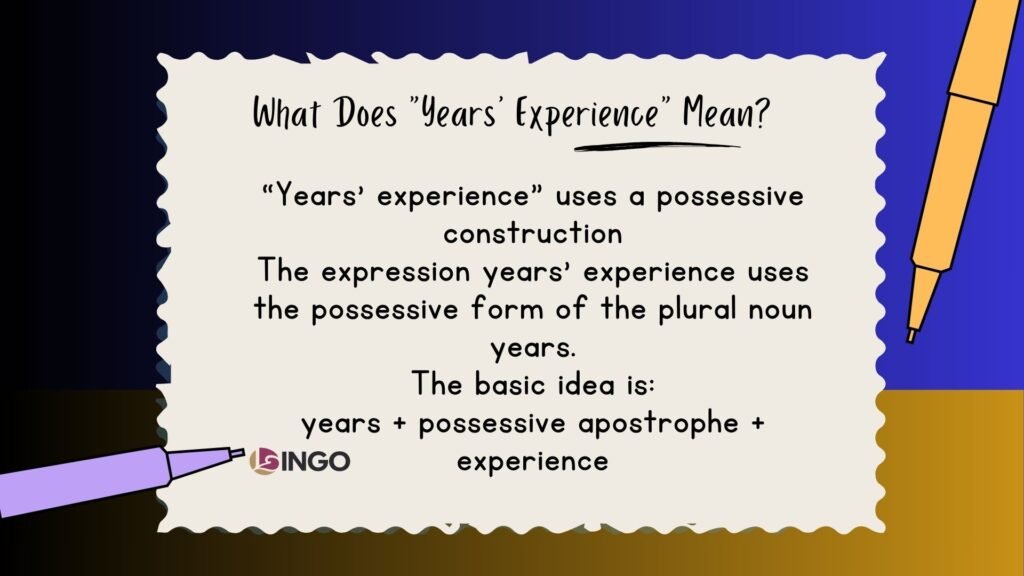
“Years’ experience” uses a possessive construction
The expression years’ experience uses the possessive form of the plural noun years.
The basic idea is:
years + possessive apostrophe + experience
Because years is plural and already ends in -s, the possessive form normally takes an apostrophe after the s:
years → years’
Cambridge’s grammar guidance explains that possessive nouns generally use ’s with singular nouns and an apostrophe after –s with plural nouns. It also specifically gives examples involving time and duration.
Therefore:
- one year’s experience
- two years’ experience
- five years’ experience
- ten years’ experience
Years’ experience is not automatically wrong
Some people assume that years’ experience is incorrect because “years of experience” sounds more familiar.
That is not the case.
For example:
She has five years’ experience in teaching.
This is a valid possessive construction.
The same grammatical idea appears in expressions such as:
- two weeks’ holiday
- three days’ notice
- five years’ service
- ten years’ experience
The apostrophe indicates a possessive relationship involving a period of time.
Singular and plural forms matter
This is where many writers make mistakes.
When you have one year, use:
one year’s experience
When you have more than one year, use:
two years’ experience
five years’ experience
ten years’ experience
Notice the difference:
- one year’s → singular possessive
- two years’ → plural possessive
So these are correct:
She has one year’s experience.
She has five years’ experience.
And these are incorrect:
❌ She has one years’ experience.
❌ She has five year’s experience.
Years of Experience vs Years’ Experience: The Key Difference
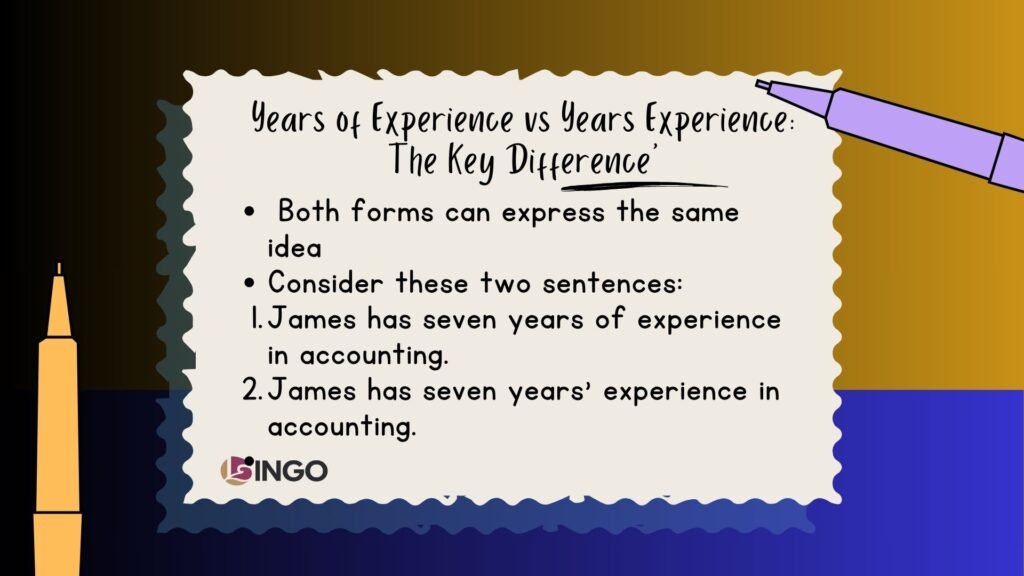
Both forms can express the same idea
Consider these two sentences:
James has seven years of experience in accounting.
James has seven years’ experience in accounting.
The meaning is essentially the same: James has professional experience accumulated over seven years.
The difference is grammatical structure rather than a major difference in meaning.
| Form | Structure | Example | Correct? |
|---|---|---|---|
| Years of experience | years + of + experience | 7 years of experience | Yes |
| Years’ experience | plural possessive + noun | 7 years’ experience | Yes |
| Year’s experience | singular possessive | 1 year’s experience | Yes |
| Years experience | missing connector/apostrophe | 7 years experience | Usually avoid |
For most general and professional writing, “years of experience” is the easiest form to understand.
Which form is more common in professional writing?
Both constructions appear in real English. Cambridge Dictionary’s professional examples include both “many years’ experience” and “three years of experience.”
In practical writing, however, years of experience is an excellent default because it leaves little room for confusion.
For example:
Preferred for clarity: I have 12 years of experience in content writing.
This is especially useful on:
- Résumés
- Cover letters
- LinkedIn profiles
- Job applications
- Business websites
- Professional biographies
Common Mistakes With Years of Experience
Mistake 1: Writing “years experience”
A common informal construction is:
❌ I have five years experience.
This version lacks the of found in the standard “years of experience” construction and lacks the apostrophe required for the possessive construction.
Better choices are:
✅ I have five years of experience.
or
✅ I have five years’ experience.
Mistake 2: Using “year’s” after a plural number
Remember that year’s is singular possessive.
Therefore:
❌ I have five year’s experience.
should be:
✅ I have five years’ experience.
The number five requires the plural noun years, and the plural possessive is years’.
Mistake 3: Adding an apostrophe to “years” in the “of” construction
If you use of, you do not need the possessive apostrophe:
✅ five years of experience
Not:
❌ five years’ of experience
The apostrophe belongs to the possessive construction, not the “of” construction.
Mistake 4: Confusing “experience” with “experiences”
When discussing professional knowledge or skills, use experience:
✅ She has six years of experience in education.
When referring to separate events or personal situations, experiences may be appropriate:
✅ Her travel experiences changed her perspective.
These are two different meanings of the word.
A Real-Life Professional Example
How the choice can affect clarity
Imagine two candidates applying for the same content-writing position.
Candidate A writes on their résumé:
Professional Experience: 6 years of experience in content writing, editing, and SEO.
Candidate B writes:
Professional Experience: 6 years experience in content writing, editing, and SEO.
The first version immediately looks polished and grammatically complete. The second may cause a reader to pause because it omits the expected of or possessive apostrophe.
Now consider another version:
Professional Experience: 6 years’ experience in content writing, editing, and SEO.
This is also grammatically acceptable.
From a practical editing perspective, the first version—6 years of experience—is often the safest recommendation for a broad audience because the structure is transparent. A recruiter does not need to think about the possessive construction; the relationship between “years” and “experience” is immediately visible.
This illustrates an important lesson in professional English: grammatical correctness and stylistic clarity are not always exactly the same thing. Two expressions can be correct while one is easier for a particular audience to process. For résumés, applications, websites, and professional profiles, straightforward wording is usually advantageous.
What Does Current Grammar Guidance Say?
Modern grammar treats both structures as legitimate
Current reference material does not support the idea that years’ experience is simply wrong.
Cambridge Dictionary’s English Grammar Today explicitly gives professional examples using both constructions. Its guidance also explains that experience can function as an uncountable noun when referring to knowledge or skill gained through activity.
This means the real question is not:
“Is years’ experience grammatically correct?”
It can be.
A better question is:
“Which construction is clearer and more appropriate for my audience?”
For most learners and general professional writing, years of experience is an excellent default.
A note on SEO and professional content
Grammar content should prioritize usefulness rather than simply repeating a keyword. Google’s current Search guidance emphasizes helpful, reliable, people-first content and recommends that pages provide substantial value, original information, and clear expertise.
That principle applies here too: explaining the actual grammar rule is more useful than merely declaring one version “right” and the other “wrong.”
Quick Guide: Which Form Should You Use?
Use “years of experience” when you want maximum clarity
Choose this form in most situations:
I have 10 years of experience in marketing.
She has three years of experience as a teacher.
The candidate has five years of experience in customer service.
This is especially useful for professional documents.
Use “years’ experience” when a possessive style fits your sentence
The possessive version is also acceptable:
I have 10 years’ experience in marketing.
She has three years’ experience as a teacher.
The candidate has five years’ experience in customer service.
The important thing is to place the apostrophe correctly.
Follow this simple rule
Use:
- 1 year of experience
- 1 year’s experience
- 2 years of experience
- 2 years’ experience
- 10 years of experience
- 10 years’ experience
Avoid:
- ❌ 2 year’s experience
- ❌ 10 years’ of experience
- ❌ 5 years experience
Data & Style Snapshot for 2025–2026
What the evidence tells us
There is no meaningful “2025–2026 statistic” showing that one grammatical construction is universally correct while the other is incorrect. Grammar references instead demonstrate that both constructions occur in standard English.
Cambridge’s current dictionary and grammar resources provide examples of “three years of experience” as well as professional constructions such as “many years’ experience.”
For SEO content published in 2025–2026, the practical takeaway is therefore not to chase a supposed percentage split between the two phrases. Instead:
- Use grammatically correct constructions.
- Prefer clarity when your audience is broad.
- Explain variations rather than incorrectly labeling acceptable English as wrong.
- Keep the wording natural rather than repeating the target phrase excessively.
Google’s December 2025 guidance similarly emphasizes original, useful, people-first content rather than content created primarily to manipulate search rankings.
FAQs About Years of Experience vs Years’ Experience
Q1:Is “years of experience” grammatically correct?
Yes. Years of experience is a standard and widely used construction. For example: “She has five years of experience in teaching.”
Q2:Is “years’ experience” correct?
Yes. Years’ experience can be grammatically correct because it uses the plural possessive form of “years.” For example: “She has five years’ experience in teaching.”
Q3:Is it “5 years experience” or “5 years’ experience”?
Use 5 years’ experience if you want the possessive construction, or 5 years of experience for the clearer “of” construction. Avoid 5 years experience in careful formal writing.
Q4:Is it “one year’s experience” or “one year of experience”?
Both are correct. For example:
- I have one year’s experience.
- I have one year of experience.
The first uses a possessive construction; the second uses an “of” construction.
Q5:Is “10 years’ experience” better than “10 years of experience”?
Neither is inherently better grammatically. 10 years of experience is often preferable when clarity is the main goal, while 10 years’ experience is a valid possessive alternative.
Q6:Should I use “years of experience” on my résumé?
Yes. Years of experience is a clear, professional choice for résumés and job applications. For example: “Marketing specialist with eight years of experience in digital strategy.”
Q7:Why does “years’” have an apostrophe after the s?
Because years is a plural noun ending in s. Its possessive form is therefore years’. Cambridge’s possessive guidance explains this general plural possessive pattern.
Q8:Can “experience” be plural?
Yes, but the meaning changes. Experience is generally uncountable when it means knowledge or skill gained through work or activity. Experiences refers to separate events or things someone has lived through.
Mini Quiz:Years of Experience vs Years’ Experience
1. Which sentence uses the clearest standard construction?
A. She has five years of experience.
B. She has five year experience.
C. She has five year’s experience.
D. She has five years’ of experience.
Answer: A
2. Which sentence correctly uses the plural possessive form?
A. He has ten years’ experience.
B. He has ten year’s experience.
C. He has ten years experience.
D. He has ten years’ of experience.
Answer: A
3. Which form is correct when the amount is exactly one year?
A. one year’s experience
B. one years’ experience
C. one years experience
D. one year experience
Answer: A
4. Which sentence is best for a professional résumé when clarity is the priority?
A. I have eight years of experience in finance.
B. I have eight year’s experience in finance.
C. I have eight years experience in finance.
D. I have eight years’ of experience in finance.
Answer: A
5. Which sentence contains the correctly placed apostrophe?
A. The teacher has three years’ experience.
B. The teacher has three year’s experience.
C. The teacher has three years experience.
D. The teacher has three years’ of experience.
Answer: A
6. Complete the sentence: “She has 15 □ experience in education.”
A. years of
B. year’s of
C. years’ of
D. year of
Answer: A
7. Which sentence is correctly punctuated?
A. She has six years’ experience.
B. She has six year’s experience.
C. She has six years experience.
D. She has six years’ of experience.
Answer: A
8. Which sentence correctly uses the “of” construction?
A. They have four years of experience.
B. They have four years’ of experience.
C. They have four year’s of experience.
D. They have four year experience.
Answer: A
9. Which sentence is grammatically acceptable?
A. He has seven years’ experience.
B. He has seven year’s experience.
C. He has seven years’ of experience.
D. He has seven years experience.
Answer: A
10. Which sentence correctly distinguishes one year from multiple years?
A. One year’s; five years’
B. One years’; five year’s
C. One years; five years’
D. One year’s; five year
Answer: A
11. Which phrase is most suitable for a professional profile focused on clarity?
A. 12 years of experience
B. 12 year’s experience
C. 12 years’ of experience
D. 12 years experience
Answer: A
12. Complete the sentence: “Our manager has 20 □ in sales.”
A. years of experience
B. year’s experience
C. years’ of experience
D. year experience
Answer: A
13. What does the apostrophe in “five years’ experience” indicate?
A. A plural possessive construction
B. A contraction of “years of”
C. A singular noun form
D. A plural form of “experience”
Answer: A
14. Which sentence should be chosen for a polished cover letter?
A. I bring five years of experience in customer service.
B. I bring five year’s experience in customer service.
C. I bring five years experience in customer service.
D. I bring five years’ of experience in customer service.
Answer: A
15. Which sentence uses “experience” correctly as professional knowledge or skill?
A. She has considerable experience in teaching.
B. She has considerable experiences in teaching.
C. She has an experience in teaching.
D. She has experiences of teaching skills.
Answer: A
16. Which sentence correctly uses “experiences” to mean separate events?
A. Her travel experiences changed her perspective.
B. Her travel experiences is valuable.
C. Her travel experience were memorable.
D. Her travel experience changed perspectives were.
Answer: A
17. Which sentence correctly uses the singular possessive form?
A. After one year’s experience, she applied for the role.
B. After one years’ experience, she applied for the role.
C. After one years experience, she applied for the role.
D. After one year’s of experience, she applied for the role.
Answer: A
18. Which sentence avoids an unnecessary apostrophe?
A. He has nine years of experience.
B. He has nine years’ of experience.
C. He has nine year’s of experience.
D. He has nine year experience.
Answer: A
19. Which phrase is correctly written for a job advertisement?
A. Minimum of three years of experience required.
B. Minimum of three year’s experience required.
C. Minimum of three years’ of experience required.
D. Minimum of three year experience required.
Answer: A
20. Which statement about “years’ experience” is accurate?
A. It can be a correct possessive construction.
B. It is always grammatically wrong.
C. It must always contain “of” afterward.
D. It can only be used with one year.
Answer: A
21. Which option is incorrect in careful standard writing?
A. I have four years experience.
B. I have four years of experience.
C. I have four years’ experience.
D. I have four year’s experience.
Answer: A
22. Which sentence is correctly punctuated?
A. She has 25 years’ experience as a designer.
B. She has 25 year’s experience as a designer.
C. She has 25 years’ of experience as a designer.
D. She has 25 years experience as a designer.
Answer: A
23. Which rewrite is clearest?
“He has 6 years’ of experience in IT.”
A. He has 6 years of experience in IT.
B. He has 6 year’s experience in IT.
C. He has 6 years experience in IT.
D. He has 6 years’ of experiences in IT.
Answer: A
24. Which sentence correctly uses both a number and the possessive form?
A. The role requires two years’ experience.
B. The role requires two year’s experience.
C. The role requires two years’ of experience.
D. The role requires two year experience.
Answer: A
25. Which sentence is the best overall choice for a general English learner?
A. I have ten years of experience.
B. I have ten year’s experience.
C. I have ten years’ of experience.
D. I have ten years experience.
Answer: A
Conclusion: Years of Experience vs Years’ Experience
So, years of experience vs years’ experience is not really a battle between a correct form and an incorrect one.
Both can be correct.
Use years of experience when you want a clear, straightforward expression:
I have five years of experience in teaching.
Use years’ experience when you choose the possessive construction:
I have five years’ experience in teaching.
The key rule is simple: one year’s, but two years’, five years’, or ten years’ when using the possessive form.
For most professional writing, years of experience is an excellent default because it is direct, familiar, and easy to understand.
For more clear explanations of commonly confused English words and grammar rules, explore the other language guides on Lingorixa.
References

Maimoona Asghar is a grammar enthusiast and language writer who creates clear, practical content to help learners improve English grammar, writing, punctuation, and communication skills through easy-to-understand explanations and examples.