Have you ever written realise and wondered whether realize is the correct spelling? Or perhaps your spell checker accepts one version but flags the other? You are not making a grammar mistake. Realise vs. realize is primarily a difference between British and American spelling conventions.
In British English, realise is commonly used, while realize is the standard spelling in American English. However, the story is slightly more interesting because -ize is also an established spelling in British English, particularly in Oxford-style writing.
This guide explains the difference between realise and realize, their meanings, pronunciation, related forms, examples, and when to use each spelling.
What Is the Difference Between Realise and Realize?
The short answer is simple: realise and realize have the same meaning and pronunciation; the main difference is the spelling convention being followed.
Realise is traditionally associated with British English, while realize is standard American English. Oxford’s learner dictionary lists realise as a British English form of realize.
For example:
- British English: I didn’t realise how late it was.
- American English: I didn’t realize how late it was.
Both sentences mean exactly the same thing.
Realise vs. Realize at a Glance
| Feature | British English | American English |
|---|---|---|
| Common spelling | realise | realize |
| Meaning | Same | Same |
| Pronunciation | Same | Same |
| Past tense | realised | realized |
| -ing form | realising | realizing |
| Noun | realisation | realization |
| Main difference | s spelling | z spelling |
The important point is that neither spelling changes the meaning of the word.
Is Realise a Correct Spelling?
Yes. Realise is a correct spelling, particularly in British English and other varieties that commonly follow British spelling conventions.
Likewise, realize is completely correct in American English.
The choice depends on the variety of English you are using rather than on whether one form is grammatically correct and the other is incorrect.
Realise vs. Realize: British and American English Rules
Understanding the broader British vs. American spelling pattern makes this difference much easier to remember.
British English Usually Uses -ise
Traditional British usage commonly spells many verbs with -ise:
- realise
- organise
- recognise
- apologise
- specialise
- emphasise
- modernise
For example:
She finally realised that she had left her phone at home.
The University of Oxford’s general style guide recommends -ise/-yse/-isation in its own British-facing style and gives examples such as organise/organize and analyse/analyze.
American English Uses -ize
American English normally uses -ize:
- realize
- organize
- recognize
- apologize
- specialize
- emphasize
- modernize
For example:
She finally realized that she had left her phone at home.
The American spelling therefore follows a consistent -ize pattern for these verbs.
An Important British English Exception: Oxford Spelling
There is one detail that often surprises learners.
-ize is not necessarily wrong in British English.
Oxford University Press uses -ize for certain words because its spelling convention reflects the historical Greek origin of the suffix. As a result, you may encounter realize, organize, and recognize in British publications.
So the more accurate rule is:
Realise is common in British English, while realize is standard in American English; -ize is also an accepted British convention in some styles, especially Oxford style.
What Does Realise or Realize Mean?
Although the spelling differs, realise and realize have the same meanings.
Meaning 1: To Become Aware of Something
The most common meaning is to suddenly understand or become aware of a fact.
Examples:
- I realised I had forgotten my keys.
- I realized I had forgotten my keys.
- She suddenly realised what was happening.
- He realized that he had made a mistake.
Oxford lists this meaning as understanding or becoming aware of a particular fact or situation.
Meaning 2: To Achieve Something
The verb can also mean to achieve something you have wanted or planned.
For example:
- She realised her dream of becoming a writer.
- She realized her dream of becoming a writer.
- He finally realized his ambition.
- They realised their long-term goal.
Here, the word does not mean simply “understand.” It means to achieve or make something desired become real.
Meaning 3: To Make Something Real
In formal contexts, realize can also mean to produce or make something real based on an idea, plan, or design.
For example:
The architect successfully realized the client’s vision.
Again, the British spelling can be written as:
The architect successfully realised the client’s vision.
Realise vs. Realize Examples in Everyday Writing
The easiest way to understand the difference is to see both forms side by side.
Everyday Examples
| British English | American English |
|---|---|
| I realised my mistake. | I realized my mistake. |
| She realised the truth. | She realized the truth. |
| We realised it was too late. | We realized it was too late. |
| He realised his dream. | He realized his dream. |
| They realised the problem. | They realized the problem. |
The meaning remains unchanged.
Academic Writing Example
British:
The researchers realised that the initial results required further investigation.
American:
The researchers realized that the initial results required further investigation.
Both versions are grammatically correct.
Professional Email Example
British:
I have just realised that I attached the wrong document.
American:
I have just realized that I attached the wrong document.
The important thing is consistency. If your document follows British spelling, use realised throughout. If it follows American spelling, use realized.
Realise, Realized, Realising, and Realisation: Which Forms Are Correct?
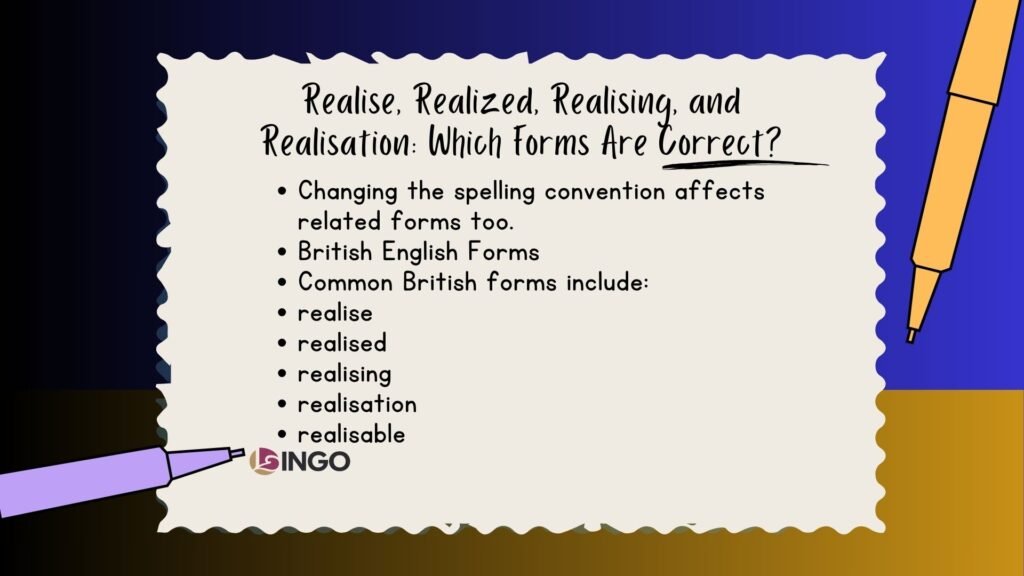
Changing the spelling convention affects related forms too.
British English Forms
Common British forms include:
- realise
- realised
- realising
- realisation
- realisable
Examples:
I realise the importance of this decision.
She realised her mistake.
He is realising how difficult the task is.
The realisation came suddenly.
American English Forms
American English uses:
- realize
- realized
- realizing
- realization
- realizable
Examples:
I realize the importance of this decision.
She realized her mistake.
He is realizing how difficult the task is.
The realization came suddenly.
Oxford specifically lists realisation as the British form alongside realization and identifies realise as the British English form.
Why Do British and American English Spell These Words Differently?
The difference comes from the historical development and standardisation of English spelling.
The -ise and -ize Pattern
The endings -ise and -ize developed as competing spelling forms in English. Over time, different English varieties developed different preferences.
American English standardised -ize much more strongly, whereas British English developed a strong preference for –ise in many common words.
However, British English never completely eliminated -ize. Some publishers and institutions continue to use it.
This is why you may see:
- British newspaper: realise
- American newspaper: realize
- Oxford-style British publication: realize
That does not mean the writers are using different vocabulary. They are following different spelling conventions.
A Useful Memory Trick
Think of it this way:
British → usually S → realiSE
American → usually Z → realiZE
This is not an absolute rule for every English word, but it is a useful shortcut for remembering this particular spelling difference.
2025–2026 Data and Usage: What Does Current English Show?
Current reference sources continue to recognise the distinction between British and American spelling rather than treating one form as a simple spelling error.
Oxford’s current dictionary entry identifies realise as a British English form of realize, while its American dictionary gives realize as the American form.
A useful corpus-based comparison also shows how frequently both forms can occur in British English. In a British National Corpus analysis covering 399 verbs with competing -ise/-ize spellings, realise accounted for 63.2% (9,442 occurrences) while realize accounted for 36.8% (5,492 occurrences) among the examined forms. The same analysis found organise at 62.3% versus organize at 37.7%.
These figures are corpus-specific rather than a 2025–2026 worldwide percentage, so they should not be interpreted as saying that exactly 63.2% of all modern British writing uses realise. They do, however, illustrate an important point: both spellings have a real presence in British English.
A 2025 corpus-based study of The Dawn likewise found British spellings occurring more frequently than American alternatives in the analysed material; for example, it recorded 12 instances of organise versus 1 organize, and 17 apologise versus 1 apologize.
What the Data Means for Writers
The practical lesson is more important than memorising percentages:
- American English → choose -ize.
- Traditional British English → commonly choose -ise.
- Oxford style → -ize may be preferred.
- Do not randomly alternate between the two in one document.
Real-Life Case Study: One Writer, Two Audiences
Imagine a content writer preparing two versions of the same website article for a global company.
The first version is intended for customers in the United Kingdom. The writer chooses British English throughout the page:
“We realise that choosing the right software can be difficult. Our team helps businesses recognise their needs and organise their workflow more efficiently.”
The second version is prepared for an American audience:
“We realize that choosing the right software can be difficult. Our team helps businesses recognize their needs and organize their workflow more efficiently.”
Notice what happened. The writer did not rewrite the message or change its meaning. The writer simply changed the spelling convention to match the target audience.
Now imagine that the first paragraph says realise, the second says organize, and the third says recognize. A reader can understand everything, but the writing looks inconsistent. This is particularly noticeable in professional websites, academic papers, reports, and edited content.
The British Council also recommends consistency when using British or American English, noting that writers should avoid mixing the two spelling systems within the same written text.
The lesson is straightforward: choose your variety of English before you begin, then apply it consistently. If your audience is British, realise is a natural choice. If your audience is American, realize is the safest choice. If you are following a specific publisher’s style guide, follow that guide instead.
Which Spelling Should You Use?
The right choice depends on your audience, publication, institution, or style guide.
Use Realise When Writing in British English
Choose realise when your writing follows a traditional British English style.
This may include:
- UK-focused websites
- British school assignments
- British publications
- UK business communication
- Content aimed primarily at British readers
Example:
We realise that our customers expect fast and reliable service.
Use Realize When Writing in American English
Choose realize for American English.
This is generally appropriate for:
- US websites
- American academic writing
- US business communication
- American publications
- Content targeting American readers
Example:
We realize that our customers expect fast and reliable service.
Follow the Required Style Guide
If a university, employer, publisher, or client provides a style guide, follow it even if you personally prefer the other spelling.
For example, Oxford University uses an -ise house style, while Oxford University Press has historically used -ize in relevant words.
This is an excellent reminder that “British English” is not always synonymous with “-ise.”
British vs. American Spelling: Quick Checklist
Before publishing, use this simple checklist:
- Identify your target audience.
- Decide whether the document uses British or American English.
- Choose realise for a traditional British spelling style.
- Choose realize for American English.
- Check related forms such as realised/realized.
- Check realisation/realization.
- Look for other -ise/-ize words in the same document.
- Follow your organisation’s or publisher’s style guide.
- Do not mix spelling systems unnecessarily.
Common Related Spelling Pairs
| British English | American English |
|---|---|
| realise | realize |
| organise | organize |
| recognise | recognize |
| apologise | apologize |
| specialise | specialize |
| emphasise | emphasize |
| modernise | modernize |
| summarise | summarize |
This pattern is useful, but remember that not every word ending in -ise changes to -ize in American English. Words such as advertise, advise, revise, and supervise retain their s spelling. Collins specifically notes such exceptions.
Common Mistakes to Avoid
Mistake 1: Thinking Realise Is Incorrect
If your American spell checker flags realise, that does not mean the word is universally wrong.
It is a standard British spelling.
Mistake 2: Thinking Realize Is Always American
Although realize is the standard American spelling, it can also appear in British English, particularly under Oxford spelling conventions.
Mistake 3: Mixing British and American Spelling
A document that uses:
realise → organize → recognise → apologize
may look inconsistent because it switches conventions.
Choose one style and maintain it.
Mistake 4: Changing the Meaning
There is no difference in meaning between realise and realize.
The spelling changes; the definition does not.
Mistake 5: Forgetting Related Words
If you choose realise, remember related British forms such as:
- realised
- realising
- realisation
If you choose realize, use:
- realized
- realizing
- realization
Mini Quiz: Realise vs. Realize
1. Which spelling is most commonly associated with traditional British English?
A) Realise
B) Realize
C) Reelise
D) Realiese
Answer: A) Realise
2. Which spelling is standard in American English?
A) Realise
B) Realize
C) Reallize
D) Realiese
Answer: B) Realize
3. What do “realise” and “realize” mean?
A) They have the same meaning
B) They have opposite meanings
C) One means remember
D) One means explain
Answer: A) They have the same meaning
4. Choose the traditional British spelling:
“I didn’t ___ how late it was.”
A) Realized
B) Realised
C) Realize
D) Realisied
Answer: B) Realised
5. Choose the American spelling:
“She finally ___ her mistake.”
A) Realised
B) Realizing
C) Realized
D) Realise
Answer: C) Realized
6. Which pair correctly matches British and American spelling?
A) British realise — American realize
B) British realize — American realise
C) British realised — American realise
D) British realising — American realization
Answer: A) British realise — American realize
7. Which is the British spelling of “recognize”?
A) Recognise
B) Recognize
C) Recognice
D) Recognizee
Answer: A) Recognise
8. Which is the American spelling of “organise”?
A) Organise
B) Organize
C) Organice
D) Organizee
Answer: B) Organize
9. Which noun is the traditional British form?
A) Realization
B) Realisation
C) Realizement
D) Realisement
Answer: B) Realisation
10. Which noun is standard in American English?
A) Realisation
B) Realization
C) Realizeation
D) Realisasion
Answer: B) Realization
11. Which sentence uses traditional British spelling consistently?
A) I realised and organised the files.
B) I realized and organised the files.
C) I realised and organized the files.
D) I realize and organised the files.
Answer: A) I realised and organised the files.
12. Which sentence uses American spelling consistently?
A) She realized and organized the event.
B) She realised and organized the event.
C) She realized and organised the event.
D) She realises and organized the event.
Answer: A) She realized and organized the event.
13. Is “realize” necessarily wrong in British English?
A) Yes, always
B) No, some British styles use -ize
C) Yes, because Z is never British
D) No, because the words have different meanings
Answer: B) No, some British styles use -ize
14. Which spelling would usually suit an American business website?
A) Realise
B) Realize
C) Realiise
D) Realiese
Answer: B) Realize
15. Which spelling would commonly suit traditional British business writing?
A) Realize
B) Realise
C) Reallise
D) Realiese
Answer: B) Realise
16. Choose the correct British form:
“She is ___ her potential.”
A) Realising
B) Realised
C) Realization
D) Realizes
Answer: A) Realising
17. Choose the correct American form:
“She is ___ her potential.”
A) Realised
B) Realizing
C) Realization
D) Realize
Answer: B) Realizing
18. Which pair contains two British-style spellings?
A) Realise and organise
B) Realize and organize
C) Realise and organize
D) Realize and organise
Answer: A) Realise and organise
19. Which pair contains two American-style spellings?
A) Realise and recognise
B) Realize and recognize
C) Realise and recognize
D) Realize and recognise
Answer: B) Realize and recognize
20. What is the best rule when writing for a specific audience?
A) Mix both styles freely
B) Choose one variety and stay consistent
C) Always use British spelling
D) Always use American spelling
Answer: B) Choose one variety and stay consistent
21. Which word does NOT normally switch from -ise to -ize in American English?
A) Advertise
B) Organise
C) Recognise
D) Apologise
Answer: A) Advertise
22. Which sentence uses the traditional British spelling?
A) I realise the importance of practice.
B) I realize the importance of practice.
C) I realice the importance of practice.
D) I reallise the importance of practice.
Answer: A) I realise the importance of practice.
23. Which sentence uses the American spelling of the past tense?
A) He realised the truth.
B) He realize the truth.
C) He realized the truth.
D) He realizing the truth.
Answer: C) He realized the truth.
24. What mainly changes between “realise” and “realize”?
A) Their pronunciation
B) Their spelling convention
C) Their basic meaning
D) Their grammatical category
Answer: B) Their spelling convention
25. Which sentence is the best choice for a traditional British audience?
A) We realized your concern.
B) We realised your concern.
C) We realyzed your concern.
D) We realiseded your concern.
Answer: B) We realised your concern.
FAQs About Realise vs. Realize
Q1:Is realise British or American?
Realise is primarily associated with British English. American English normally uses realize. However, –ize spellings can also be used in some British styles, including Oxford’s convention.
Q2:Is realize British English?
Yes. Realize can be used in British English, particularly in Oxford-style writing. However, realise is the more familiar spelling in many traditional British contexts.
Q3:Is realize or realise correct?
Both are correct. Use realise when following a British spelling convention and realize when following American English or a style guide that prefers -ize.
Q4:Do realise and realize mean the same thing?
Yes. They have the same meanings and are pronounced the same way in standard usage. They can mean to become aware of something, achieve something, or make something real.
Q5:Is realised British and realized American?
Generally, yes. Realised is the common British spelling, while realized is the standard American spelling. The same spelling distinction applies to realisation/realization.
Q6:Which spelling should I use in academic writing?
Follow your institution’s or publication’s style guide. If no specific style is required, choose one English variety and use it consistently throughout your paper.
Q7:Can I use realise and realize in the same article?
You can, but it is usually better not to mix them without a reason. Consistency makes professional and academic writing easier to read and edit.
Q8:Why does Oxford use realize instead of realise?
Oxford University Press uses an -ize convention for certain words based partly on their historical Greek roots. This is why British readers may encounter realize even though realise is very common in British English.
Conclusion: Realise vs. Realize Made Simple
The realise vs. realize difference is much simpler once you understand the English variety behind it.
Realise is the common British spelling, while realize is the standard American spelling. Both forms have the same meaning and pronunciation. British English can also use -ize, particularly in Oxford-style writing, so calling realize “wrong in British English” would be misleading.
The most important rule is consistency. Decide which English variety your audience expects, check the relevant style guide, and use that spelling throughout your content.
Whether you write “I realised my mistake” or “I realized my mistake,” your sentence is correct. The key is knowing which spelling fits your audience and writing style.
For more clear explanations of commonly confused English words and grammar rules, explore the other language guides on Lingorixa.
Authoritative References

Maimoona Asghar is a grammar enthusiast and language writer who creates clear, practical content to help learners improve English grammar, writing, punctuation, and communication skills through easy-to-understand explanations and examples.