Have you ever stopped while writing and wondered whether it should be skillset or skill set? You’re not alone. Both forms appear in resumes, job descriptions, professional profiles, and everyday online writing.
So, which one is correct: skillset or skill set?
The safest answer is skill set, written as two words. However, skillset is also recognized as an alternative form by Cambridge Dictionary. Both forms refer to the same basic idea: a collection or combination of skills that someone has.
In this guide, you’ll learn the difference between skillset and skill set, discover when to use each form, see practical examples, and learn a simple rule that makes the choice easy..
What Does Skill Set Mean?
Skill Set Definition
A skill set is a collection or combination of abilities, knowledge, and competencies that a person has developed.
For example:
She has a strong skill set in writing, research, and communication.
In this sentence, skill set refers to several abilities considered together.
Cambridge Dictionary defines skill set as the range of things someone is good at, particularly abilities useful for a particular job. It also lists skillset as an alternative form.
Examples of Skill Set in Sentences
Here are some natural examples:
- His skill set includes programming and data analysis.
- She has an impressive skill set for the position.
- The training program helps employees develop a valuable skill set.
- Good communication is an important part of a manager’s skill set.
- My professional skill set includes writing, editing, and SEO.
- The company needs candidates with a diverse skill set.
The expression is particularly common in professional, educational, and career-related contexts.
Skill vs. Skill Set
A skill is generally one specific ability.
Writing is an important skill.
A skill set, on the other hand, is a collection of abilities.
Writing, editing, research, and communication form part of her professional skill set.
Therefore, the two terms are related but not interchangeable in every sentence.
Skillset or Skill Set: Which Is Correct?
Skill Set Is the Safest Choice
If you’re unsure whether to write skillset or skill set, use:
skill set
The two-word form is the safest choice for formal, academic, and professional writing.
For example:
The candidate has a strong skill set in project management.
This position requires a specialized technical skill set.
She developed an impressive skill set during her internship.
This form is particularly appropriate for resumes, cover letters, academic assignments, reports, and business communication.
Skillset Is Also an Established Form
Skillset is a closed, one-word variant. It appears in modern English, particularly in professional and digital communication.
For example:
He has a diverse skillset.
The company is looking for someone with the right skillset.
Importantly, Cambridge Dictionary currently includes skillset as an alternative form alongside skill set.
Therefore, it would be too broad to claim that skillset is always wrong.
The more useful rule is:
Use “skill set” as your default, especially when writing formally.
Skill Set vs. Skillset: Quick Comparison
| Form | Meaning | Recommended Use |
|---|---|---|
| skill set | A collection of skills | Best general and formal choice |
| skillset | A collection of skills | Accepted alternative |
| skills set | Intended to mean a collection of skills | Usually avoid |
| skill-set | Hyphenated form | Generally avoid |
The main difference between skill set and skillset is the form of the compound, not the basic meaning.
When Should You Use “Skill Set”?
Use Skill Set in Formal Writing
When precision and conventional usage matter, skill set is the safest option.
Use it in:
- Resumes
- Cover letters
- Academic papers
- Business reports
- Job descriptions
- Professional emails
- Training documents
- Career profiles
For example:
The applicant’s skill set closely matches the requirements of the role.
This sounds natural and professional.
Use Skill Set When Describing Multiple Abilities
The phrase works especially well when several skills are considered together.
For example:
Her skill set includes leadership, communication, problem-solving, and project management.
Instead of listing each ability separately, skill set provides a concise way to describe the complete group.
Skill Set in Career and Workplace English
The term has become particularly important in professional language because employers increasingly focus on the combination of abilities people can bring to a role.
For example:
The position requires a broad digital skill set.
Candidates should demonstrate a strong analytical skill set.
Employees can expand their skill sets through training.
This is why the term appears frequently in resumes, job advertisements, career advice, and professional development content.
Skill Set vs. Skillset in Different Contexts
Resume Example
For a resume, the safest choice is:
Professional Skill Set
rather than:
Professional Skillset
A resume is a formal professional document, so using the conventional two-word form is a sensible editorial choice.
Casual Example
In an informal message, you might see:
Your skillset would be perfect for this project.
The meaning is perfectly understandable.
However, if you are editing the sentence for a formal document, you can change it to:
Your skill set would be perfect for this project.
Academic Example
For academic writing, consistency and conventional usage are especially important.
Preferred:
The researchers examined the participants’ skill set.
You should generally avoid unnecessarily using the closed form when the two-word form is readily available.
A Real-Life Example: Choosing the Right Form
Imagine that Sarah is applying for a digital marketing position. Her experience includes SEO, content writing, keyword research, social media management, analytics, and email marketing.
While preparing her resume, Sarah writes:
I have developed a strong skillset through years of professional experience.
The sentence is understandable, and skillset is an established variant. However, because Sarah is preparing a formal professional document, she decides to use the more conventional form:
I have developed a strong skill set through years of professional experience.
She then lists the individual abilities under a section called Professional Skills.
During an interview, the hiring manager says:
Your skillset is a good match for this position.
Sarah doesn’t need to wonder whether the manager made a serious spelling error. The one-word form is recognized and commonly encountered, particularly in modern workplace communication.
This example demonstrates the practical difference between the two forms. Skill set is the safer editorial choice, especially in formal documents, while skillset can appear naturally in less formal contexts. The meaning remains essentially the same.
For job seekers, students, writers, and professionals, the easiest approach is therefore to use skill set by default. You don’t need to treat every occurrence of skillset as an error; instead, consider the context, audience, and level of formality.
Types of Skill Sets
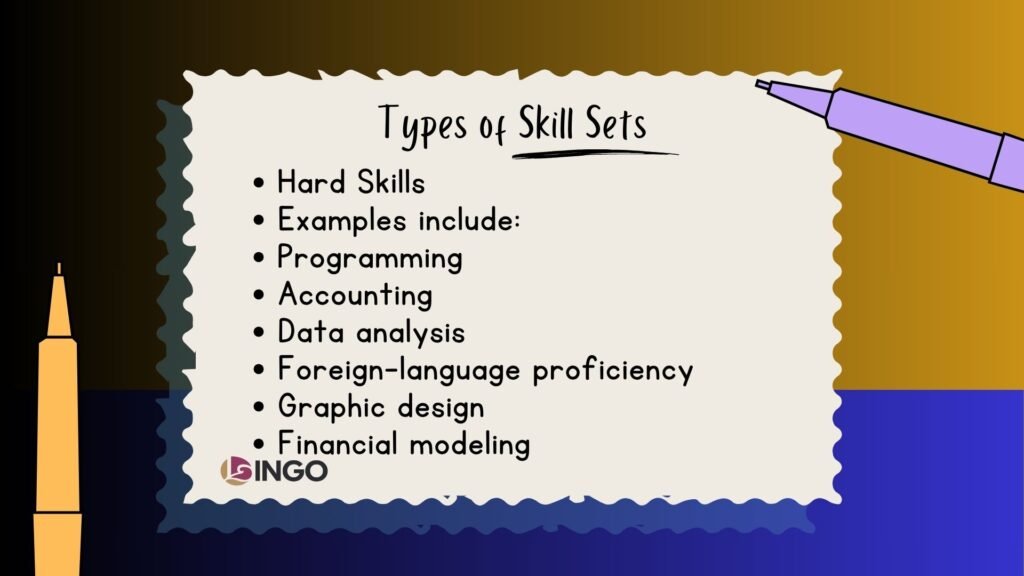
Hard Skills
Hard skills are specific abilities that can often be taught, tested, or measured.
Examples include:
- Programming
- Accounting
- Data analysis
- Foreign-language proficiency
- Graphic design
- Financial modeling
A sentence might be:
Her technical skill set includes Python, SQL, and data visualization.
Soft Skills
Soft skills relate to communication, behavior, collaboration, and interpersonal effectiveness.
Examples include:
- Communication
- Teamwork
- Adaptability
- Leadership
- Time management
- Problem-solving
For example:
Employers often value a balanced skill set that combines technical and interpersonal abilities.
Transferable Skills
Transferable skills can be used across different jobs or industries.
Examples include:
- Critical thinking
- Organization
- Leadership
- Communication
- Project management
For someone changing careers, identifying transferable skills can make a professional skill set easier to communicate to employers.
Why Skill Sets Matter in 2025–2026
Current Workplace Data
The importance of developing a broad skill set is not merely a matter of career advice. Recent workforce research shows that employers expect significant changes in the skills required at work.
The World Economic Forum’s Future of Jobs Report 2025 surveyed more than 1,000 employers representing over 14 million workers across 55 economies. The report found that 63% of employers identified skills gaps as a major barrier to business transformation.
The same report projects that nearly 40% of workers’ existing skill requirements are expected to change by 2030. It also identifies AI and big data, networks and cybersecurity, technological literacy, creative thinking, and resilience among skills expected to increase in importance.
The report also found that 85% of surveyed employers expect to prioritize workforce upskilling between 2025 and 2030.
These figures provide useful context for why the term skill set appears so frequently in modern workplace discussions. A person’s abilities are not necessarily fixed. As technology and job requirements change, workers increasingly need to develop, update, and combine new skills.
What This Means for Your Skill Set
A modern professional may need both technical and human abilities.
For example, a digital marketer might need:
- SEO
- Data analysis
- Content writing
- AI literacy
- Communication
- Creative thinking
- Adaptability
Therefore, a strong professional skill set is often broader than one technical specialty.
Skill Set vs. Related Terms
Skill Set vs. Competency
A skill set describes a broader collection of abilities.
A competency usually refers to a particular ability or capability, often measured against a specific performance standard.
Her leadership skill set includes several competencies.
Skill Set vs. Qualification
A qualification usually refers to formal evidence such as a degree, certificate, or credential.
For example:
A master’s degree is a qualification.
Data analysis is part of her skill set.
Having a qualification does not necessarily mean that someone has mastered every skill associated with a profession.
Skill Set vs. Expertise
Expertise generally suggests a high level of specialized knowledge or ability.
His skill set includes programming, testing, and system design.
His expertise is cybersecurity.
These words overlap, but they emphasize different aspects of professional ability.
Common Mistakes to Avoid
Mistake 1: Assuming Skillset Is Always Wrong
It is not accurate to say that skillset never occurs in correct English. Cambridge Dictionary recognizes it as an alternative form.
The better advice is to use skill set as your default.
Mistake 2: Writing “Skills Set”
For the intended meaning, skills set is usually not the correct form.
Incorrect:
She has a strong skills set.
Correct:
She has a strong skill set.
Mistake 3: Using a Hyphen
Avoid unnecessarily writing:
skill-set
The conventional choice is:
skill set
or, as an alternative:
skillset
Mistake 4: Mixing Spellings
Don’t switch between forms without a reason.
For example, avoid:
Our team has a diverse skill set. We regularly improve our skillset.
For consistency, choose one style:
Our team has a diverse skill set. We regularly improve our skill set.
A Simple Step-by-Step Guide
Step 1: Check the Context
Ask yourself whether you’re writing formally or casually.
Step 2: Choose the Conventional Form
For resumes, academic work, reports, and professional documents, choose:
skill set
Step 3: Use Skillset When Appropriate
If you’re writing casual or digital content and your chosen style permits it, skillset can be used as an established alternative.
Step 4: Stay Consistent
Once you choose one spelling, use it consistently throughout the document.
Step 5: Remember the Plural
The plural of skill set is:
skill sets
Example:
Different jobs require different skill sets.
Quick Comparison Table
| Question | Answer |
|---|---|
| Is skill set correct? | Yes |
| Is skillset used in English? | Yes |
| Is skillset recognized by Cambridge? | Yes, as an alternative form |
| Which form is safer for formal writing? | Skill set |
| Which should I use on a resume? | Skill set |
| What is the plural? | Skill sets |
| Should I write “skills set”? | Generally no |
| Should I hyphenate it? | No; use skill set |
Mini Quiz:Skillset or Skill Set
1. Which spelling is the safest choice for formal English writing?
A. skill set
B. skillset
C. skill-set
D. skills set
Answer: A. skill set
2. What does “skill set” mean?
A. A single ability
B. A collection of skills
C. A job title
D. A training course
Answer: B. A collection of skills
3. Which sentence uses “skill set” correctly?
A. She has a strong skill set.
B. She has a strong skills set.
C. She has a strong skill-set.
D. She has a strong skill sets.
Answer: A. She has a strong skill set.
4. What is the plural of “skill set”?
A. skill set
B. skillset
C. skill sets
D. skills set
Answer: C. skill sets
5. Which form is best for a professional resume?
A. I have a strong skill set in marketing.
B. I have a strong skills set in marketing.
C. I have a strong skill-set in marketing.
D. I have a strong skill sets in marketing.
Answer: A. I have a strong skill set in marketing.
6. Is “skillset” used in modern English?
A. No, never
B. Yes, it is an alternative form
C. Only with a hyphen
D. It means a single skill
Answer: B. Yes, it is an alternative form
7. Which form is generally unnecessary as an ordinary noun?
A. skill set
B. skillset
C. skill-set
D. skill sets
Answer: C. skill-set
8. Which sentence correctly uses the plural?
A. Different jobs require different skill sets.
B. Different jobs require different skills sets.
C. Different jobs require different skill-set.
D. Different jobs require different skillset.
Answer: A. Different jobs require different skill sets.
9. What is the difference between a skill and a skill set?
A. A skill is one ability; a skill set combines abilities.
B. A skill is a job; a skill set is a degree.
C. A skill is a course; a skill set is an exam.
D. A skill is always technical; a skill set is always social.
Answer: A. A skill is one ability; a skill set combines abilities.
10. Which form is appropriate for an academic assignment?
A. The student developed a useful skill set.
B. The student developed a useful skills set.
C. The student developed a useful skill-set.
D. The student developed a useful skill sets.
Answer: A. The student developed a useful skill set.
11. Which sentence correctly describes multiple abilities?
A. Writing is one skill.
B. Writing and editing form a skill set.
C. Writing and editing form a skills set.
D. Writing and editing form a skill-set.
Answer: B. Writing and editing form a skill set.
12. Which phrase is correctly written?
A. Required skill set
B. Required skills set
C. Required skill-set
D. Required skill sets
Answer: A. Required skill set
13. Which sentence correctly uses “skill set” in a technical context?
A. His technical skill set includes coding.
B. His technical skills set includes coding.
C. His technical skill-set includes coding.
D. His technical skill sets includes coding.
Answer: A. His technical skill set includes coding.
14. When you’re unsure about the spelling, which form should you generally choose?
A. skillset
B. skill set
C. skill-set
D. skills-set
Answer: B. skill set
15. Which sentence is grammatically correct?
A. Her skill set includes leadership and communication.
B. Her skills set includes leadership and communication.
C. Her skill sets includes leadership and communication.
D. Her skill-set includes leadership and communication.
Answer: A. Her skill set includes leadership and communication.
16. Which sentence correctly discusses multiple people’s abilities?
A. Their skill sets differ.
B. Their skills set differ.
C. Their skill-set differ.
D. Their skillset differs.
Answer: A. Their skill sets differ.
17. Which phrase is correct?
A. A diverse skill set
B. A diverse skills set
C. A diverse skill-set
D. A diverse skill sets
Answer: A. A diverse skill set
18. Which sentence correctly uses “skillset” as a closed form?
A. She has a strong skillset.
B. She has a strong skills-set.
C. She has a strong skill sets.
D. She has a strong skills set.
Answer: A. She has a strong skillset.
19. Which term describes abilities that can be useful across different jobs?
A. Transferable skills
B. Job titles
C. Workplaces
D. Credentials
Answer: A. Transferable skills
20. Which sentence uses “skill set” naturally?
A. She wants to expand her skill set.
B. She wants to expand her skills set.
C. She wants to expand her skill-set.
D. She wants to expand her skill sets.
Answer: A. She wants to expand her skill set.
21. Which statement about “skill-set” is most accurate?
A. Skill-set is always required.
B. Skill-set is generally unnecessary as a noun.
C. Skill-set is the only accepted form.
D. Skill-set means one individual skill.
Answer: B. Skill-set is generally unnecessary as a noun.
22. Which sentence is most suitable for a formal business report?
A. The employee developed a broader skill set.
B. The employee developed a broader skills set.
C. The employee developed a broader skill-set.
D. The employee developed a broader skill sets.
Answer: A. The employee developed a broader skill set.
23. Complete the sentence: “Different careers require different ____.”
A. skill set
B. skillset
C. skill sets
D. skills set
Answer: C. skill sets
24. Which statement about formal writing is most accurate?
A. Skill set is the safer conventional choice.
B. Skillset must always be used.
C. Skill-set is always preferred.
D. None of these forms can be nouns.
Answer: A. Skill set is the safer conventional choice.
25. If you’re writing a professional article and want the safest spelling, which should you choose?
A. skill set
B. skillset
C. skill-set
D. skills-set
Answer: A. skill set
Frequently Asked Questions
Q1:Is skillset one word?
Yes. Skillset is used as a one-word variant of skill set, and Cambridge Dictionary lists it as an alternative form.
Q2:Is skill set two words?
Yes. Skill set is written as two separate words and is the safest conventional form.
Q3:Which is correct: skillset or skill set?
Both forms are used, but skill set is the safer default, particularly for formal and professional writing.
Q4:Is skill set grammatically correct?
Yes. Skill set is a standard noun phrase meaning a collection or combination of skills.
Q5:What is the plural of skill set?
The plural is skill sets.
The candidates have different skill sets.
Q6:Should I write skill set or skillset on my resume?
Use skill set as the safer professional choice. Most importantly, remain consistent throughout your resume.
Q7:Can skillset be used in formal writing?
Yes, skillset does appear in professional writing and is recognized by Cambridge as an alternative. However, skill set remains the safer choice when conventional usage is your priority.
Q8:What is the difference between skill and skill set?
A skill is an individual ability, while a skill set is a collection of abilities.
Conclusion: Skillset or Skill Set?
So, skillset or skill set—which one should you use?
The safest answer is skill set. Write it as two words when you’re preparing a resume, academic assignment, business document, professional email, or other formal content.
However, skillset is not simply meaningless or incomprehensible. Cambridge Dictionary recognizes it as an alternative form, which reflects its established use in modern English.
The easiest rule to remember is:
When in doubt, use “skill set.”
Also remember that the plural is skill sets, not skills sets.
Beyond spelling, developing a strong skill set is increasingly important in today’s changing workplace. The World Economic Forum reports that 63% of surveyed employers see skills gaps as a major barrier to business transformation, while 85% expect to prioritize workforce upskilling through 2030.
So whether you’re improving your English or building your professional skill set, choosing clear and conventional language is always a smart move.
For more clear explanations of commonly confused English words and grammar rules, explore the other language guides on Lingorixa.
References

Maimoona Asghar is a grammar enthusiast and language writer who creates clear, practical content to help learners improve English grammar, writing, punctuation, and communication skills through easy-to-understand explanations and examples.