If you have ever wondered about the past tense of run, you are not alone. Should you say, “I ran five miles yesterday,” or “I run five miles yesterday”? And what about “I have ran five miles”?
The answer is straightforward once you understand the three main forms of this irregular verb:
run → ran → run
Run is the base form, ran is the simple past tense, and run is the past participle. Cambridge Dictionary lists ran as the past tense and run as the past participle.
In this guide, you will learn exactly when to use run, ran, and running, see practical examples, avoid common mistakes, and understand the difference between the simple past and past participle.
What Is the Past Tense of Run?
The past tense of run is ran.
Unlike regular verbs such as walk → walked or play → played, run is an irregular verb. Its past form changes completely rather than taking the regular -ed ending.
Run, Ran, and Run: The Basic Forms
| Verb form | Correct word | Example |
|---|---|---|
| Base form | run | I run every morning. |
| Simple past | ran | I ran yesterday. |
| Past participle | run | I have run today. |
| Present participle | running | I am running now. |
The most important rule is:
The simple past of “run” is “ran.”
For example:
- I ran five miles yesterday.
- She ran to catch the bus.
- They ran across the field.
- We ran home after school.
Cambridge’s current dictionary entry gives the same conjugation: running as the present participle, ran as the past tense, and run as the past participle.
Is “Ran” the Past Tense of Run?
Yes. Ran is the simple past tense of run.
Use ran when you are describing a completed action in the past.
For example:
I ran three miles yesterday.
Sarah ran to the station last night.
The children ran outside when the rain stopped.
The word ran can also appear in expressions where run has a meaning other than physically moving:
She ran a successful business.
The newspaper ran an article about the event.
The meeting ran for two hours.
Therefore, the rule applies to the verb run regardless of which meaning is intended.
Is “Runned” the Past Tense of Run?
No. Runned is not the standard past tense of run.
Because run is an irregular verb, you cannot simply add -ed.
Incorrect:
I runned five miles yesterday.
Correct:
I ran five miles yesterday.
This is similar to other irregular verbs such as:
- go → went
- eat → ate
- see → saw
- take → took
- run → ran
Run vs. Ran: When Should You Use Each One?
The easiest way to understand run vs. ran is to consider whether you are describing the present, a simple past event, or a perfect tense.
Use “Run” as the Base Form
Use run as the base form in the present tense and after modal verbs or certain auxiliary constructions.
Examples:
I run every morning.
They run a small restaurant.
She can run very fast.
We should run another test.
Do you run every day?
Notice that after can and should, the base form run is required.
Correct:
She can run five miles.
Incorrect:
She can ran five miles.
Use “Ran” for the Simple Past
Use ran when the action happened in the past.
Examples:
I ran yesterday.
He ran to the bus stop.
We ran five kilometers last Saturday.
She ran away when she heard the noise.
They ran across the road.
Past-time expressions often make the choice especially clear:
- yesterday
- last night
- last week
- two days ago
- last year
- when I was younger
- in 2025
For example:
I ran five miles yesterday.
The sentence describes one completed action in the past, so ran is the correct form.
Use “Run” as the Past Participle
This is where many learners make mistakes.
The past participle of run is also run. It is normally used with helping verbs such as have, has, and had in perfect constructions.
Examples:
I have run five miles today.
She has run this race before.
They had run out of water.
We have run into this problem before.
Therefore:
Simple past:
I ran five miles.
Present perfect:
I have run five miles.
Past perfect:
I had run five miles.
The spelling changes in the first sentence but stays the same in the perfect constructions.
How to Use the Past Tense of Run Correctly
Once you know that ran is the simple past, the next step is recognizing the sentence structure around it.
Use “Ran” With Finished Past Events
Use ran when you are simply reporting something that happened before now.
Examples:
I ran yesterday.
She ran in the school race last Friday.
We ran to the store after dinner.
He ran five miles before breakfast.
The action may have happened recently or long ago. What matters is that the sentence uses the simple past.
Use “Run” After Have, Has, or Had
When have, has, or had is functioning as the auxiliary verb for a perfect construction, use run.
Examples:
I have run three miles today.
She has run this route many times.
They had run out of food before the guests arrived.
A useful memory trick is:
I ran. I have run. I had run.
Never use ran after have, has, or had in standard English.
Incorrect:
I have ran five miles.
Correct:
I have run five miles.
Use “Running” for Continuous Tenses
The present participle of run is running.
Examples:
I am running now.
She is running in the park.
They were running toward the finish line.
He was running when I called.
So the complete pattern is:
run → ran → run → running
This distinction helps you identify the correct form even when the sentence becomes more complicated.
A Quick Comparison: Run vs. Ran vs. Running
| Sentence | Correct form | Reason |
|---|---|---|
| I run every morning. | Run | Present/base form |
| I ran yesterday. | Ran | Simple past |
| I have run five miles. | Run | Past participle |
| I had run before sunset. | Run | Past participle |
| I am running now. | Running | Present continuous |
| She was running earlier. | Running | Past continuous |
| She can run quickly. | Run | Base form after modal |
| She runned yesterday. | Incorrect | Runned is not the standard form |
A Real-Life Example: Correcting “Run” and “Ran”
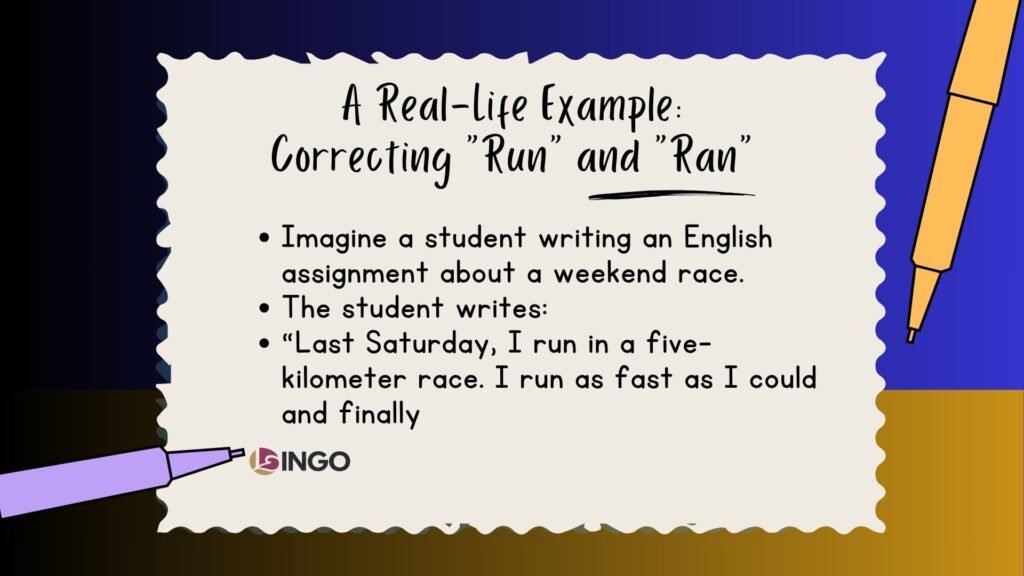
Imagine a student writing an English assignment about a weekend race.
The student writes:
“Last Saturday, I run in a five-kilometer race. I run as fast as I could and finally finish the race in thirty minutes. I have ran in many races before, but this was the most exciting.”
There are two different problems here.
First, the student uses run where the simple past ran is required. The events happened last Saturday, so the simple past is appropriate:
“Last Saturday, I ran in a five-kilometer race. I ran as fast as I could and finally finished the race in thirty minutes.”
However, the final sentence has a different structure:
“I have ran in many races before.”
Here, have requires the past participle. The past participle of run is run, not ran.
Therefore, the corrected version is:
“I have run in many races before, but this was the most exciting.”
The final paragraph would read:
“Last Saturday, I ran in a five-kilometer race. I ran as fast as I could and finally finished the race in thirty minutes. I have run in many races before, but this was the most exciting.”
This example demonstrates why simply memorizing that run is a past-tense verb is not enough. You need to identify the tense and grammatical construction. A finished event described in the simple past takes ran, while a perfect construction using have takes run.
The same distinction appears in everyday conversation:
“Did you run yesterday?”
“Yes, I ran yesterday.”
“Have you run this route before?”
“Yes, I have run it several times.”
The question and answer change because the grammatical structures change.
Current Grammar Data and Reference Check for 2025–2026
Grammar rules do not normally change from year to year in the way prices, populations, or technology statistics do. Therefore, it would be misleading to invent a “2026 statistic” claiming that a certain percentage of English speakers use ran correctly.
Instead, the most useful current data point is the documented verb-form information in authoritative dictionaries.
Cambridge Dictionary’s current entry records four relevant forms:
- run — base form
- running — present participle
- ran — past tense
- run — past participle
The same entry provides examples of run in several meanings, including movement, operation, management, and continuation.
Cambridge’s separate entry for ran explicitly defines it as the past simple of run.
This gives us a reliable current reference point for 2025–2026: the standard conjugation remains:
run → ran → run
This is more useful than an unsupported usage percentage because it directly answers the grammatical question readers are searching for.
For SEO and educational content, Google also recommends creating helpful, reliable, people-first content rather than content produced primarily to manipulate search rankings. That makes authoritative dictionary references particularly valuable for a grammar article.
Common Mistakes With Run and Ran
Mistake 1: “I Run Yesterday”
Incorrect:
I run five miles yesterday.
Correct:
I ran five miles yesterday.
The word yesterday places the action in the past, so the simple past form ran is needed.
Mistake 2: “I Have Ran”
Incorrect:
I have ran five miles.
Correct:
I have run five miles.
After have, use the past participle run.
Mistake 3: “I Had Ran”
Incorrect:
I had ran before breakfast.
Correct:
I had run before breakfast.
The structure is had + past participle, so run is required.
Mistake 4: “She Runned”
Incorrect:
She runned to school.
Correct:
She ran to school.
Run is irregular, so its simple past is ran, not runned.
Mistake 5: “She Was Ran”
Incorrect:
She was ran when I saw her.
Correct:
She was running when I saw her.
For an ongoing past action, use the past continuous:
was/were + running
A Simple Step-by-Step Guide to Choosing the Correct Form
When you are unsure whether to use run, ran, or running, use this checklist.
Step 1: Ask When the Action Happened
If it is a simple completed action in the past, use ran.
I ran yesterday.
Step 2: Check for “Have,” “Has,” or “Had”
If one of these is forming a perfect tense, use run.
I have run today.
She had run five miles.
Step 3: Look for “Am,” “Is,” “Are,” “Was,” or “Were”
If the sentence describes an action in progress, use running.
He was running.
They are running.
Step 4: Look for a Modal Verb
After can, could, should, would, or will, use the base form run.
She can run fast.
We should run now.
They will run tomorrow.
Step 5: Read the Whole Sentence
Do not choose a verb form simply because you see a past-time word. Look at the entire grammatical structure.
For example:
I ran yesterday.
But:
I have run today.
Both refer to running that occurred before now, but they use different grammatical constructions.
Mini Quiz:Run or Ran
1. Choose the correct word:
I ___ five miles yesterday.
A) run
B) ran
C) running
D) runs
Answer: B) ran
2. Choose the correct sentence:
A) I run yesterday.
B) I ran yesterday.
C) I runned yesterday.
D) I running yesterday.
Answer: B) I ran yesterday.
3. What is the simple past tense of run?
A) Runned
B) Runs
C) Ran
D) Running
Answer: C) Ran
4. Complete the sentence:
She ___ to catch the bus last morning.
A) run
B) runs
C) ran
D) running
Answer: C) ran
5. Choose the correct form:
I have ___ three kilometers today.
A) ran
B) run
C) running
D) runs
Answer: B) run
6. Which sentence is grammatically correct?
A) He has ran five miles.
B) He have run five miles.
C) He has run five miles.
D) He has runned five miles.
Answer: C) He has run five miles.
7. Complete the question:
Did you ___ yesterday?
A) ran
B) run
C) runs
D) running
Answer: B) run
8. Choose the correct sentence:
A) Did she ran home?
B) Did she run home?
C) Did she running home?
D) Did she runs home?
Answer: B) Did she run home?
9. Complete the sentence:
They didn’t ___ in the race.
A) ran
B) runs
C) run
D) running
Answer: C) run
10. Which form is the past participle of run?
A) Ran
B) Running
C) Runs
D) Run
Answer: D) Run
11. Choose the correct sentence:
A) We ran around the park last Sunday.
B) We runned around the park last Sunday.
C) We run around the park last Sunday.
D) We running around the park last Sunday.
Answer: A) We ran around the park last Sunday.
12. Complete the sentence:
She ___ every morning.
A) ran
B) run
C) runs
D) running
Answer: C) runs
13. Which sentence uses run as a past participle?
A) I run every day.
B) I ran yesterday.
C) I have run five miles.
D) I will run tomorrow.
Answer: C) I have run five miles.
14. Complete the sentence:
He ___ a marathon last year.
A) run
B) runs
C) ran
D) running
Answer: C) ran
15. Choose the correct sentence:
A) They had ran out of time.
B) They had run out of time.
C) They had runned out of time.
D) They have ran out of time.
Answer: B) They had run out of time.
16. Which word is NOT a correct form of the verb run?
A) Run
B) Ran
C) Running
D) Runned
Answer: D) Runned
17. Complete the sentence:
I ___ every morning before work.
A) ran
B) run
C) runs
D) running
Answer: B) run
18. Choose the correct sentence:
A) She ran to the store yesterday.
B) She run to the store yesterday.
C) She runned to the store yesterday.
D) She running to the store yesterday.
Answer: A) She ran to the store yesterday.
19. Complete the sentence:
We have ___ into several problems.
A) ran
B) run
C) runs
D) running
Answer: B) run
20. Which sentence is incorrect?
A) I ran yesterday.
B) I have run today.
C) Did you run yesterday?
D) I have ran today.
Answer: D) I have ran today.
21. Choose the correct form:
She didn’t ___ fast enough.
A) ran
B) run
C) runs
D) running
Answer: B) run
22. Complete the sentence:
By the time the rain started, they had ___ five miles.
A) ran
B) run
C) runs
D) running
Answer: B) run
23. What is the correct verb pattern?
A) Run → Runned → Running
B) Run → Ran → Run
C) Run → Runs → Ran
D) Run → Running → Runned
Answer: B) Run → Ran → Run
24. Which sentence correctly describes a completed past action?
A) I run five miles yesterday.
B) I ran five miles yesterday.
C) I have ran five miles yesterday.
D) I running five miles yesterday.
Answer: B) I ran five miles yesterday.
25. Final Challenge: Choose the correct sentence.
A) I ran yesterday, but I have run every day this week.
B) I run yesterday, but I have ran every day this week.
C) I ran yesterday, but I have ran every day this week.
D) I runned yesterday, but I have run every day this week.
Answer: A) I ran yesterday, but I have run every day this week.
FAQs About the Past Tense of Run
Q1:What is the past tense of run?
The simple past tense of run is ran.
Present: I run.
Past: I ran.
Past participle: I have run.
Q2:Is “ran” a correct word?
Yes. Ran is the standard simple past form of run. Cambridge Dictionary explicitly identifies ran as the past simple of run.
Q3:Is “run” the past tense of run?
No, not in standard simple-past usage. The simple past is ran.
However, run is the past participle.
I ran yesterday.
I have run today.
Q4:Is “runned” correct?
No. Runned is not the standard past tense of run.
Use ran instead.
Incorrect: She runned home.
Correct: She ran home.
Q5:What is the past participle of run?
The past participle is run.
The three principal forms are:
run – ran – run
For example:
She has run three miles.
Q6:Should I say “I ran” or “I have run”?
Both can be correct, but they are used differently.
Use I ran for the simple past:
I ran five miles yesterday.
Use I have run for the present perfect:
I have run five miles today.
The choice depends on the tense and the meaning you want to express.
Q7:Can “run” be used when talking about the past?
Yes. Run can be the past participle in perfect constructions.
Examples:
I have run five miles.
She had run before breakfast.
But if you are using the simple past by itself, use ran:
I ran yesterday.
Q8:What are the four forms of the verb “run”?
The main forms are:
- Base form: run
- Simple past: ran
- Past participle: run
- Present participle: running
A useful memory pattern is:
run → ran → run → running
Conclusion
The answer to “What is the past tense of run?” is simple: ran.
The complete pattern is:
Run → Ran → Run → Running
Use run as the base form:
I run every morning.
Use ran for the simple past:
I ran yesterday.
Use run as the past participle:
I have run five miles.
And use running for continuous forms:
I am running now.
The most important distinction is between ran and run. If you are describing a straightforward completed action in the past, choose ran. If run follows have, has, or had as a past participle, choose run.
So, when you’re deciding between run or ran, remember one simple rule:
Yesterday, I ran. I have run today.
Keep this pattern in mind, and you will avoid some of the most common mistakes with this irregular English verb. For more practical English grammar explanations, continue exploring clear examples and authoritative language references.
For more clear explanations of commonly confused English words and grammar rules, explore the other language guides on Lingorixa.
References
Cambridge Dictionary – Run
Merriam-Webster – Run

Maimoona Asghar is a grammar enthusiast and language writer who creates clear, practical content to help learners improve English grammar, writing, punctuation, and communication skills through easy-to-understand explanations and examples.