Have you ever wondered whether to write unaffected or uneffected? These spellings look similar, so it is easy to confuse them when writing an email, school assignment, blog post, or professional document. However, only one is the standard spelling for the meaning most people intend.
Unaffected is the correct word when you mean not influenced, changed, harmed, or interrupted. Uneffected is generally considered a misspelling when used with this meaning.
In this guide, you will learn the difference between unaffected and uneffected, understand the meaning of unaffected, explore practical examples, and discover a simple way to remember the correct spelling.
What Is the Difference Between Unaffected and Uneffected?
Unaffected: The Correct Spelling
Unaffected is an adjective that describes something or someone that has not been changed, influenced, harmed, or interrupted by an event or situation. It can also describe a person’s natural and sincere behavior.
Examples:
- The school remained unaffected by the storm.
- Her confidence was unaffected by the criticism.
- The new policy left existing customers unaffected.
- He maintained an unaffected manner during the interview.
Uneffected: Why Is It Incorrect?
Uneffected is not the standard spelling for the meaning of not being influenced or changed. Writers sometimes use this form because they associate the word with effect and assume that adding the prefix un- should produce uneffected.
However, the conventional word is formed from affected, giving us unaffected.
Incorrect: The new rules left our schedule uneffected.
Correct: The new rules left our schedule unaffected.
Quick Comparison Table
| Feature | Unaffected | Uneffected |
|---|---|---|
| Standard spelling | Yes | No, for the intended meaning |
| Meaning | Not changed or influenced | Generally a misspelling in this context |
| Suitable for formal writing | Yes | No |
| Example | The service remained unaffected. | The service remained uneffected. |
What Does Unaffected Mean?
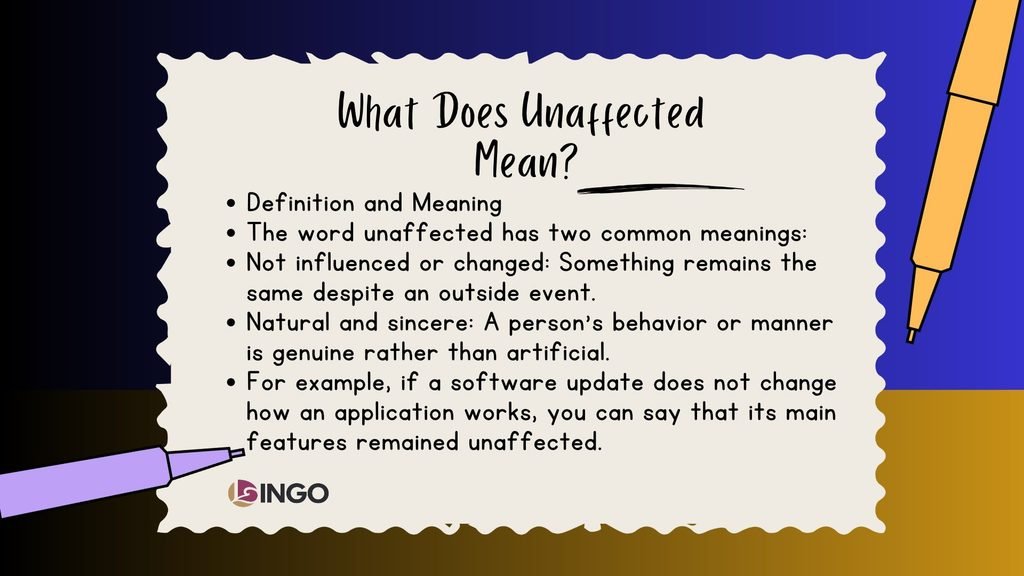
Definition and Meaning
The word unaffected has two common meanings:
- Not influenced or changed: Something remains the same despite an outside event.
- Natural and sincere: A person’s behavior or manner is genuine rather than artificial.
For example, if a software update does not change how an application works, you can say that its main features remained unaffected.
Examples of Unaffected in Everyday English
In school and education
- The student’s grade was unaffected by the classroom change.
- Most classes remained unaffected by the schedule adjustment.
At work
- Our team’s deadlines were unaffected by the new policy.
- The employee remained unaffected by the negative comments.
In daily life
- The garden remained unaffected by the light rain.
- Her friendship with Sarah was unaffected by the disagreement.
In technology
- The update left all saved files unaffected.
- Internet access remained unaffected during maintenance.
How to Use Unaffected in a Sentence
Common patterns include:
- Remain unaffected by: The village remained unaffected by the flooding.
- Be unaffected by: Our plans were unaffected by the delay.
- Appear unaffected by: She appeared unaffected by the criticism.
- Largely unaffected: The local business was largely unaffected by the changes.
Why Do People Confuse Unaffected and Uneffected?
The Confusion Between Affect and Effect
One major reason for this spelling mistake is the similarity between affect and effect.
- Affect is usually a verb meaning to influence something.
- Effect is usually a noun meaning a result or consequence.
Examples:
- The weather can affect your travel plans.
- The weather had an unexpected effect on our travel plans.
Because effect is a familiar word, some writers mistakenly assume that uneffected is the correct form of unaffected. The standard adjective, however, is unaffected.
A Simple Memory Trick
Remember this rule:
Affect → affected → unaffected.
Think of the word affected first. Add un- to express the opposite, and you get unaffected.
Examples:
- The decision affected the schedule.
- The decision did not affect the schedule.
- The schedule remained unaffected.
Common Mistakes to Avoid
| Incorrect | Correct |
|---|---|
| The team was uneffected by the loss. | The team was unaffected by the loss. |
| Her plans remained uneffected. | Her plans remained unaffected. |
| The files were uneffected by the update. | The files were unaffected by the update. |
Real-Life Example: Choosing the Correct Word at Work
The Situation
Imagine that a small company introduces a new computer system to improve its daily operations. The management team sends an email to employees explaining how the update will affect different departments.
One employee drafts the following message:
“The new system has been installed successfully. However, some employees may experience a brief interruption, while the accounting department will remain uneffected.”
The employee understands the intended meaning: the accounting department will continue working as usual. However, the spelling of uneffected is incorrect for that meaning.
Correcting the Message
The revised version reads:
“The new system has been installed successfully. However, some employees may experience a brief interruption, while the accounting department will remain unaffected.”
The corrected sentence is clearer and more professional. It communicates that the accounting department will not experience a noticeable change as a result of the installation.
What Can We Learn From This Example?
This example demonstrates why choosing the correct spelling matters in workplace communication. A spelling error may not prevent readers from understanding a message, but it can distract them from its main purpose and make a document appear less polished.
The same principle applies to business reports, customer announcements, academic assignments, and blog posts. When describing a person, process, or system that remains unchanged, use unaffected.
Spelling and Usage Facts for 2025–2026
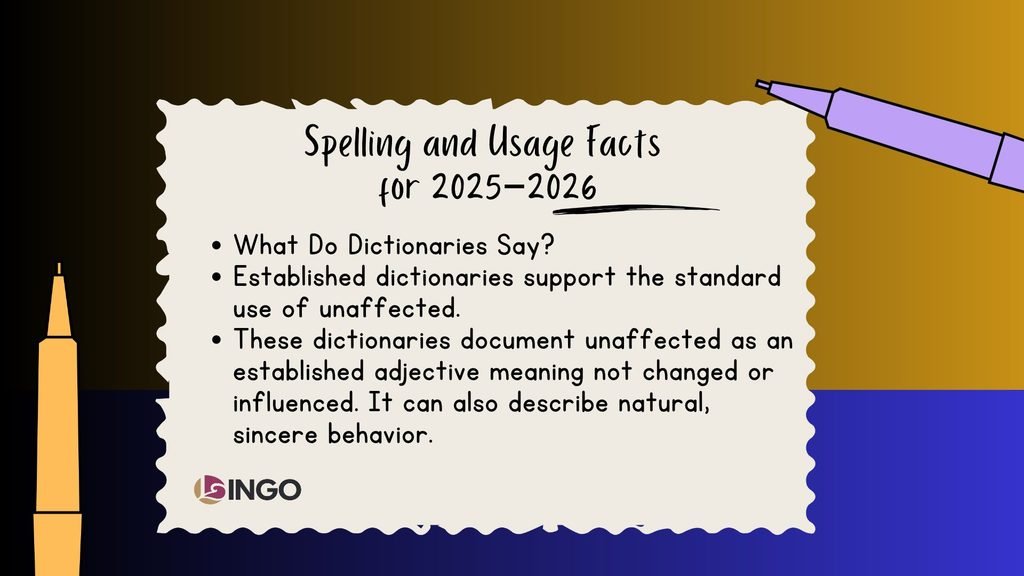
What Do Dictionaries Say?
Established dictionaries support the standard use of unaffected.
These dictionaries document unaffected as an established adjective meaning not changed or influenced. It can also describe natural, sincere behavior.
Are There Recent Statistics About This Spelling Error?
There is no verified statistic included here measuring how frequently English writers confuse unaffected with uneffected in 2025–2026. It would be misleading to invent a percentage or claim that a particular number of people make this mistake.
For writers and editors, the practical takeaway is simple: use established dictionary spellings, proofread carefully, and prioritize clarity.
How to Check Your Writing
- Check whether you mean “not influenced” or “not changed.”
- Replace uneffected with unaffected when appropriate.
- Read the complete sentence to ensure it communicates your meaning.
- Consult a reputable dictionary if you are unsure.
- Proofread the final version before publishing.
Mini Quiz:
25 Mini Quiz: Unaffected vs. Uneffected
Multiple-Choice Questions
1. Which is the correct spelling?
A. Uneffected B. Unaffected C. Unaffectted D. Unaffectid
Answer: B. Unaffected
2. What does “unaffected” mean?
A. Strongly influenced B. Not influenced or changed C. Completely damaged D. Emotionally upset
Answer: B. Not influenced or changed
3. Choose the correct sentence.
A. She remained uneffected by the criticism. B. She remained unaffected by the criticism. C. She remained unaffectted by the criticism. D. She remained unafected by the criticism.
Answer: B. She remained unaffected by the criticism.
4. Which word should you use in formal writing?
A. Uneffected B. Unaffected C. Both are standard spellings D. Neither word is correct
Answer: B. Unaffected
5. The students were ___ by the sudden announcement.
A. uneffected B. unaffected C. unaffectted D. unefected
Answer: B. unaffected
6. Which sentence uses “unaffected” correctly?
A. The storm left the building unaffected. B. The storm left the building uneffected. C. The storm left the building unaffectted. D. The storm left the building unafect.
Answer: A. The storm left the building unaffected.
7. What is the opposite of “affected” in this context?
A. Unaffected B. Effected C. Affecting D. Affectation
Answer: A. Unaffected
8. Which spelling is incorrect in standard English?
A. Unaffected B. Unaffectedness C. Uneffected D. Affect
Answer: C. Uneffected
9. Choose the correct phrase.
A. Unaffected by the news B. Uneffected by the news C. Unaffectted by the news D. Unafected by the news
Answer: A. Unaffected by the news
10. Which sentence is grammatically correct?
A. His confidence remained unaffected. B. His confidence remained uneffected. C. His confidence remained unaffectted. D. His confidence remained unefectted.
Answer: A. His confidence remained unaffected.
Fill-in-the-Blank Questions
11. Despite the pressure, she remained ______.
Answer: unaffected
12. The new policy had no impact on the company; it remained ______.
Answer: unaffected
13. He appeared completely ______ by the negative comments.
Answer: unaffected
14. The nearby village was ______ by the earthquake.
Answer: unaffected
15. Her mood was ______ by the disappointing results.
Answer: unaffected
16. The machine continued working, apparently ______ by the power fluctuation.
Answer: unaffected
17. The child’s enthusiasm remained ______ after the setback.
Answer: unaffected
18. The surrounding area was largely ______ by the construction work.
Answer: unaffected
19. Choose the correct word: “The decision left our plans ______.”
Answer: unaffected
20. The report showed that sales were ______ by the temporary closure.
Answer: unaffected
True or False Questions
21. “Unaffected” is the standard spelling in English.
Answer: True
22. “Uneffected” is the usual correct spelling when you mean “not influenced or changed.”
Answer: False
23. “The painting remained unaffected by sunlight” is a correct sentence.
Answer: True
24. “Unaffected” can describe someone who does not show a reaction to criticism.
Answer: True
25. When writing a professional email, “unaffected” is generally the better choice than “uneffected.”
Answer: True
Quick reminder: Use unaffected when you mean not influenced, changed, or harmed. Uneffected is not the standard spelling for this meaning.
Frequently Asked Questions
Q1: Is unaffected or uneffected correct?
Unaffected is correct when you mean not changed, influenced, harmed, or interrupted. Uneffected is generally a misspelling when used with this intended meaning.
Q2: What does unaffected mean?
Unaffected means that something has not been changed or influenced by an event. It can also describe someone whose behavior is natural and sincere.
Example: Her decision was unaffected by outside pressure.
Q3: Why is uneffected incorrect?
The standard adjective is formed from affected, producing unaffected. The spelling uneffected is not the conventional form for this meaning.
Q4: Can I use unaffected in formal writing?
Yes. Unaffected is appropriate for academic writing, business emails, professional reports, and everyday communication.
Example: The proposed changes will leave existing contracts unaffected.
Q5: What is the difference between affected and unaffected?
Affected means influenced or changed by something. Unaffected means not influenced or changed by it.
Example: The storm affected the northern region, but the southern region remained unaffected.
Q6: Does unaffected mean the same as unchanged?
The meanings overlap, but they are not always identical. Unaffected emphasizes the absence of influence or impact, while unchanged emphasizes that something stayed the same.
Q7: What are some synonyms for unaffected?
Depending on the context, useful alternatives include unchanged, uninfluenced, unharmed, untouched, and unaltered. For a person’s natural behavior, genuine or sincere may be more appropriate.
Q8: How can I remember the correct spelling?
Remember the sequence affect → affected → unaffected. If your sentence means that something was not influenced or changed, write unaffected, not uneffected.
Conclusion: Unaffected vs Uneffected
When comparing unaffected vs uneffected, the correct choice is clear: use unaffected to describe something that has not been influenced, changed, harmed, or interrupted.
The confusion usually comes from mixing up affect and effect. Once you remember that unaffected is formed from affected, the spelling becomes much easier to recognize.
Whether you are writing a school assignment, a professional email, or an SEO-friendly blog post, choosing the standard spelling helps make your writing clear and credible.
For more clear explanations of commonly confused English words and grammar rules, explore the other language guides on Lingorixa.
References

Maimoona Asghar is a grammar enthusiast and language writer who creates clear, practical content to help learners improve English grammar, writing, punctuation, and communication skills through easy-to-understand explanations and examples.