Have you ever wondered whether to write stich or stitch? A single missing letter can make a word look unfamiliar or incorrect, especially when you are writing an email, completing a school assignment, or creating online content.
In the comparison of stich vs stitch, stitch is the correct spelling for the everyday English word related to sewing, knitting, repairing fabric, and closing wounds. The spelling stich is generally a misspelling of this word.
In this guide, you will learn the meaning of stitch, why stich is usually incorrect, how to use stitch in sentences, and how to avoid this common spelling mistake.
What Is the Difference Between Stich and Stitch?
The main difference between stich and stitch is their spelling and standard usage. Stitch is the standard English word, while stich is not the correct spelling when you mean sewing or a small piece of thread.
What Does Stitch Mean?
The word stitch can function as both a noun and a verb.
As a noun, it refers to a loop or line of thread used in sewing, a particular knitting pattern, or a thread used to close a wound. It can also describe a sharp pain in the side of the body, especially during exercise.
As a verb, stitch means to sew, join, repair, or decorate something using thread.
Examples:
- My grandmother taught me how to make a stitch by hand.
- The tailor will stitch the torn sleeve.
- The doctor used several stitches to close the wound.
- I developed a stitch in my side while running.
These examples show that the correct spelling is stitch, with a t before the final ch.
Is Stich Ever Correct?
In ordinary English writing, stich is usually a spelling mistake when the intended meaning involves sewing or thread.
However, stich can appear as a rare specialist or historical term in certain contexts, including terminology associated with lines of verse. This uncommon usage does not make it an alternative spelling of the everyday word stitch.
For general communication, use stitch unless you have verified that a specialized context requires stich.
Quick Comparison Table
| Feature | Stich | Stitch |
|---|---|---|
| Standard spelling for sewing | Incorrect | Correct |
| Common everyday word | No, not for this meaning | Yes |
| Meaning related to sewing | Usually a misspelling | A line of thread or an act of sewing |
| Can be a verb? | Not for ordinary sewing usage | Yes |
| Example | Incorrect: I will stich the shirt. | Correct: I will stitch the shirt. |
What Does Stitch Mean in Different Contexts?
The word stitch has several meanings, depending on the situation. Understanding these meanings makes it easier to use the word accurately.
Stitch in Sewing and Embroidery
In sewing, a stitch is a single movement of a needle and thread through fabric or the resulting line of thread. Different stitches create different patterns, textures, and levels of strength.
Examples:
- She used a straight stitch to repair her trousers.
- The embroidery has beautiful decorative stitches.
- I need to stitch the loose button back onto my shirt.
The word also appears in expressions such as cross-stitch, which refers to a type of embroidery.
Stitch in Knitting and Crochet
In knitting, a stitch is a loop of yarn worked with knitting needles. Crochet also uses stitches to create patterns and shapes.
Examples:
- I accidentally dropped a stitch while knitting.
- This blanket requires a simple crochet stitch.
- She learned a new stitch from an online tutorial.
In these contexts, stitch is the correct spelling because it describes a specific part of the craft.
Stitch in Medical and Everyday Language
In medical language, stitches are used to close certain wounds. The word can also describe a sharp pain in the side of the body.
Examples:
- The nurse explained how to care for the stitches.
- The doctor stitched the cut after examining it.
- He stopped running because he had a stitch in his side.
The meaning depends on the context, but the spelling remains the same.
Stich vs Stitch: Correct Usage With Real-Life Examples
Learning the spelling rule is easier when you see how the word works in everyday situations.
Example 1: Repairing Clothes
Imagine that a student notices a small tear in a school uniform before leaving for class. The student asks a parent to repair the damaged sleeve.
Correct: “Could you stitch the sleeve before I leave?”
Incorrect: “Could you stich the sleeve before I leave?”
The first sentence is correct because stitch describes joining the torn fabric with thread.
Example 2: Writing About a Knitting Project
A person is knitting a scarf and discovers that one loop has slipped off the needle.
Correct: “I need to fix the dropped stitch before continuing.”
Incorrect: “I need to fix the dropped stich before continuing.”
The correct spelling is stitch because the sentence refers to a loop in knitting.
Example 3: Describing a Medical Procedure
Suppose someone writes a short account of a visit to a clinic after receiving a cut.
Correct: “The doctor used three stitches to close the wound.”
Incorrect: “The doctor used three stiches to close the wound.”
In this example, stitches is the plural of stitch. The spelling keeps the letter t and adds es to form the plural.
A Practical Case Study: Correcting a Spelling Mistake in a Blog Post
Consider a fictional blogger preparing an article about basic sewing techniques. During the first draft, the blogger writes sentences such as “How to stich a button” and “The best way to repair a stich in your shirt.” Both sentences contain spelling errors because the intended word is stitch.
At first, these mistakes might seem minor. However, they can affect the article’s professionalism and make readers question whether the instructions have been carefully reviewed. They may also create an inconsistent experience when readers encounter the correct spelling elsewhere on the page.
The blogger begins by searching the draft for every occurrence of stich. Each result is checked individually rather than automatically replaced, because an unusual term could occasionally be intentional in a specialized context. In this particular article, every occurrence refers to sewing, so each one is corrected to stitch.
Next, the blogger reviews related forms, including stitches, stitched, and stitching. This step matters because correcting the base word alone does not guarantee that every related spelling is accurate. Finally, the blogger reads the revised sentences aloud and uses a spelling checker to identify any remaining errors.
The result is a clearer article with consistent terminology and more natural instructions. This example illustrates a useful editing principle: correct the spelling, verify the meaning, and then review the entire sentence.
How to Remember the Correct Spelling of Stitch
A simple memory technique can help you avoid repeating this mistake.
Use a Spelling Mnemonic
Remember the phrase:
“Stitch has a T for Thread.”
The extra t in stitch can remind you that the word is associated with sewing and thread.
Examples:
- Stitch the torn fabric.
- Stitch the button onto the shirt.
- Stitch the edges together.
Whenever you write about sewing, think of thread and remember the letter t in stitch.
Follow This Quick Proofreading Checklist
Before publishing or submitting your writing, check the following:
- Does the sentence refer to sewing, knitting, embroidery, a wound, or side pain?
- Have I spelled the word as stitch?
- If I am using the plural, have I written stitches?
- If I am using the past tense, have I written stitched?
- Have I checked the sentence for meaning as well as spelling?
This quick review can help students, bloggers, and everyday writers maintain accurate spelling.
Stich vs Stitch: What Do Dictionaries and Recent Data Tell Us?
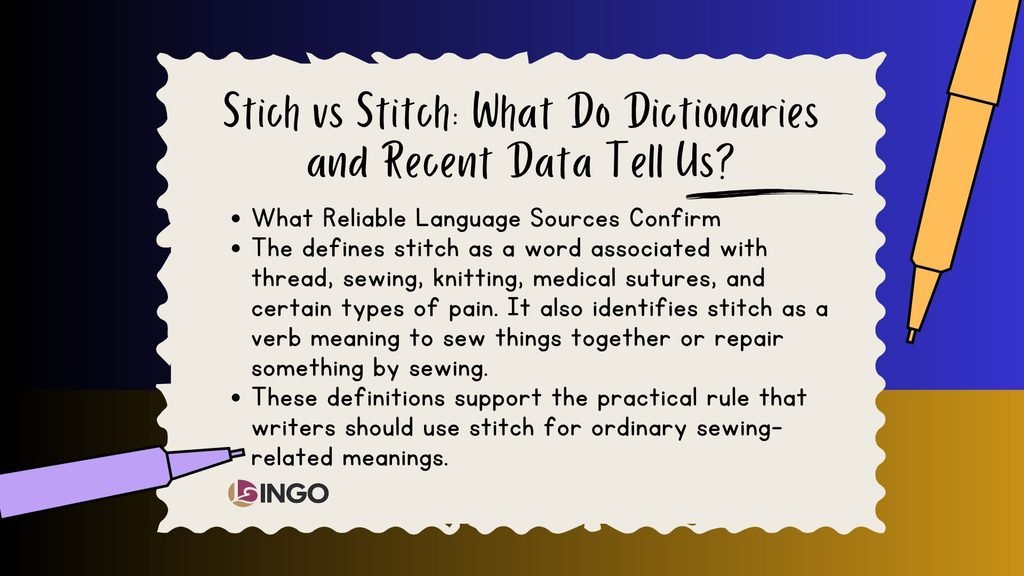
What Reliable Language Sources Confirm
The defines stitch as a word associated with thread, sewing, knitting, medical sutures, and certain types of pain. It also identifies stitch as a verb meaning to sew things together or repair something by sewing.
These definitions support the practical rule that writers should use stitch for ordinary sewing-related meanings.
Is There a Reliable 2025–2026 Statistic About This Spelling Mistake?
There is no verified, representative 2025–2026 statistic established here that measures how often English writers confuse stich with stitch. Therefore, assigning a percentage or claiming that a particular number of people make this mistake would be misleading.
Instead, the reliable evidence for this spelling guide comes from established dictionary definitions and standard English usage. These sources are sufficient to determine which spelling to use in everyday writing.
For content creators, Google’s guidance on helpful, reliable, people-first content also emphasizes accuracy, usefulness, and providing readers with a satisfying answer.
How to Use Data Responsibly in Grammar Articles
When writing about spelling differences, use trustworthy dictionaries for definitions and grammar references for usage rules. If you include statistics, identify the original source, publication date, and measurement method.
This approach strengthens credibility without adding unsupported claims simply to make an article appear more authoritative.
Mini Quiz:Stich vs Stitch
1. Which is the correct spelling for sewing?
Answer: Stitch
2. Fill in the blank: Grandma will ___ the torn pocket.
Answer: Stitch
3. What is the plural of stitch?
Answer: Stitches
4. Which sentence is correct?
Answer: I will stitch the loose button.
5. What does stitch mean in sewing?
Answer: To sew or join fabric with thread.
6. What is the past tense of stitch?
Answer: Stitched
7. Complete the sentence: The doctor removed the ___ after the wound healed.
Answer: Stitches
8. Which word describes a loop of yarn in knitting?
Answer: Stitch
9. Fill in the blank: The embroidery has a neat ___ pattern.
Answer: Stitch
10. What is the correct -ing form of stitch?
Answer: Stitching
11. Which sentence is correct?
Answer: He learned to stitch by hand.
12. What does “a stitch in my side” mean?
Answer: A sharp pain in the side, often during exercise.
13. Complete the sentence: The tailor added three ___ to the seam.
Answer: Stitches
14. Which spelling is standard for ordinary sewing-related usage?
Answer: Stitch
15. Fill in the blank: She is ___ a name onto the towel.
Answer: Stitching
16. What is the base form in “stitch, stitched, stitching”?
Answer: Stitch
17. Which sentence uses the present tense correctly?
Answer: She stitches the hem.
18. Which phrase is spelled correctly?
Answer: A row of stitches.
19. How can you remember the spelling of stitch?
Answer: Remember “T for Thread.”
20. Choose the correct sewing instruction.
Answer: First, stitch the two pieces of fabric together.
21. Which spelling is generally incorrect when referring to sewing?
Answer: Stich
22. Complete the sentence: She ___ the torn dress yesterday.
Answer: Stitched
23. Which word refers to decorative sewing with a needle and thread?
Answer: Stitching
24. Choose the correct sentence.
Answer: My grandmother taught me how to stitch.
25. What is the main difference between stich and stitch?
Answer: Stitch is the standard spelling for the everyday sewing-related word, while stich is generally a misspelling in that context.
Frequently Asked Questions About Stich vs Stitch
Q1: Is it stich or stitch?
Stitch is the correct spelling for the everyday English word related to sewing, knitting, repairing fabric, and closing wounds. Stich is generally a misspelling in these contexts.
Q2: What does stitch mean?
A stitch is a line or loop of thread, a particular sewing or knitting technique, or a thread used to close a wound. As a verb, it means to sew or join something using thread.
Q3: Why is stich incorrect?
Stich is incorrect when it is used as a substitute for the standard word stitch. It omits the letter t required in the usual spelling.
Q4: What is the plural of stitch?
The plural of stitch is stitches.
Example: “The tailor added several stitches to strengthen the seam.”
Q5:What is the past tense of stitch?
The past tense and past participle of stitch are stitched.
Example: “She stitched the torn pocket yesterday.”
Q6: Is stitching a correct word?
Yes. Stitching is the correct form used to describe the activity of sewing or the lines of thread visible on an item.
Example: “The stitching on this jacket is neat and strong.”
Q7: How can I remember the spelling of stitch?
Remember the phrase “Stitch has a T for Thread.” When you are writing about sewing or thread, the extra t can help you recall the correct spelling.
Q8: Can stich ever be a correct word?
Stich appears in rare specialist or historical contexts, but it is not the standard spelling of the everyday sewing-related word. For normal English writing, choose stitch.
Conclusion: Choose Stitch, Not Stich
When comparing stich vs stitch, the rule is straightforward: use stitch for ordinary English meanings related to sewing, knitting, embroidery, medical stitches, and side pain. The spelling stich is generally incorrect when used with these meanings.
Remember the extra t, review the example sentences, and proofread related forms such as stitches, stitched, and stitching before publishing your work.
Whether you are an English learner, a student, or a content creator, learning small spelling distinctions can make your writing clearer and more professional.
For more clear explanations of commonly confused English words and grammar rules, explore the other language guides on Lingorixa.
References
Merriam-Webster Dictionary — Stitch

Maimoona Asghar is a grammar enthusiast and language writer who creates clear, practical content to help learners improve English grammar, writing, punctuation, and communication skills through easy-to-understand explanations and examples.