If you’ve ever hesitated between unfazed vs unphased, you’re not alone. These two words sound virtually identical, and the familiar word phase makes unphased look like a logical spelling. But when you want to say that someone is calm, unbothered, or unaffected, there is a clear standard choice: unfazed.
Oxford Learner’s Dictionaries defines unfazed as meaning “not worried or surprised by something unexpected that happens.” The word comes from the verb faze, meaning to disturb or bother someone.
So, should you write unfazed or unphased? In ordinary English, especially when describing a person’s reaction, choose unfazed. However, unphased does have limited dictionary-recognized uses connected with phases or stages.
Let’s explore the difference, the meanings, examples, and an easy trick that will help you remember the correct spelling.
Unfazed vs Unphased: What Is the Difference?
The easiest way to distinguish unfazed vs unphased is to focus on meaning rather than pronunciation.
What Does “Unfazed” Mean?
Unfazed is an adjective that describes someone who remains calm or unaffected when faced with something unexpected, difficult, unpleasant, or surprising.
For example:
- She was unfazed by the criticism.
- He remained unfazed despite the unexpected question.
- The player looked completely unfazed by the pressure.
- Nothing seemed to leave her unfazed.
The word is formed from:
faze → fazed → unfazed
The verb faze means to disturb, bother, or disconcert someone.
Therefore:
Nothing could faze him.
and:
He was completely unfazed.
What Does “Unphased” Mean?
Unphased is much less common in ordinary English.
Dictionary sources recognize unphased in limited ways. It can be an uncommon variant of unfazed, but it can also describe something that is implemented all at once rather than gradually in stages.
For example, in a specialized discussion about policy implementation, you might encounter:
The new policy involved an unphased increase rather than a gradual, staged increase.
Here, unphased is connected to phase, meaning a stage or step in a process.
That meaning is quite different from describing a person who isn’t bothered.
The Simple Difference
| Word | Main meaning | Example |
|---|---|---|
| Unfazed | Not bothered, worried, or surprised | She was unfazed by the criticism. |
| Unphased | Related to something not being carried out in stages; also an uncommon variant of unfazed | The change involved an unphased implementation. |
For everyday writing, unfazed is almost certainly the word you need when describing someone’s reaction.
Why Do People Confuse Unfazed and Unphased?
The confusion mainly comes from pronunciation and the familiarity of the word phase.
Faze and Phase Sound Alike
Faze and phase are pronounced alike in standard English, but they have different meanings.
Faze means to disturb or bother:
The criticism didn’t faze her.
Phase means a stage, period, or step in a process:
The project has entered its second phase.
Because phase is much more familiar to many English speakers, it is easy to assume that the negative form must be unphased.
That assumption is usually incorrect when you’re talking about someone’s emotional reaction.
The Root Word Solves the Problem
Instead of memorizing unfazed as an isolated spelling, remember its root:
faze → unfazed
If something fazes you, it bothers or disturbs you.
If something does not faze you, you are unfazed.
This makes the spelling much easier to remember.
Compare These Sentences
The unexpected news didn’t faze Maria.
Maria was completely unfazed by the unexpected news.
But:
The company entered the second phase of the project.
These sentences demonstrate why faze and phase should not be treated as interchangeable words.
How to Use “Unfazed” Correctly
When you’re describing someone who stays calm despite pressure, criticism, bad news, or an unexpected situation, unfazed is the natural choice.
Common Sentence Patterns
A particularly common construction is:
remain + unfazed + by + something
Examples:
The teacher remained unfazed by the difficult question.
She remained unfazed by the negative comments.
The team remained unfazed by the unexpected delay.
You can also use unfazed after linking verbs:
He was unfazed by the result.
She seemed unfazed by the criticism.
They looked unfazed despite the pressure.
Unfazed in Everyday English
Here are some natural examples:
My sister was unfazed by the storm.
The child was completely unfazed by the loud noise.
He was unfazed when his first attempt failed.
She remained unfazed throughout the interview.
The experienced manager was unfazed by the sudden problem.
In each example, the word describes a person who is not noticeably disturbed by a situation.
Unfazed vs Similar Words
Depending on the context, you can replace unfazed with words such as:
- unperturbed
- unbothered
- calm
- unaffected
- composed
- undeterred
However, these words are not always exact substitutes.
For example, undeterred often suggests that someone continues despite an obstacle, while unfazed focuses more directly on a lack of disturbance or concern.
Unfazed vs Unphased: Real-Life Example
A Workplace Scenario
Imagine a manager preparing her team for an important presentation. Everything has been rehearsed several times, but just minutes before the presentation begins, the projector stops working. The presentation contains charts and graphs that the team expected to display on the screen.
Several employees become nervous. One person starts searching for a replacement cable, while another worries that the meeting will have to be postponed. The manager, however, stays calm. She quickly decides that the team can continue without the projector. She asks one employee to describe the main figures verbally and uses printed notes to guide the discussion.
Afterward, a colleague says, “I can’t believe you weren’t worried when the projector failed.”
A natural response would be:
“I was unfazed because we had enough information to continue.”
The manager is unfazed because the technical problem did not significantly disturb or discourage her.
Now imagine a different situation. A company is introducing a new employee benefit. Instead of introducing the benefit gradually over several years, the company introduces the entire change immediately. A specialized writer discussing the implementation might use unphased to describe a process that was not divided into stages.
The distinction is important. In the first example, the word describes a person’s reaction, so unfazed is the correct choice. In the second, the word relates to whether something happens in phases or stages, which is the specialized context in which unphased can appear.
The practical lesson is simple: identify the meaning before choosing the spelling. If you’re talking about confidence, calmness, criticism, pressure, surprise, or emotional reaction, use unfazed.
What Current 2025–2026 Sources Tell Us
Current Dictionary Evidence
As of 2026, Oxford Learner’s Dictionaries lists unfazed as an adjective meaning not worried or surprised by something unexpected. This remains the standard everyday usage for describing someone who stays calm.
Dictionary.com currently gives unphased two relevant entries: one for something implemented all at once rather than gradually in stages, and another identifying it as an uncommon variant of unfazed.
That distinction explains why simply calling unphased “always wrong” is too absolute. It can occur as a word, but it is not the spelling you should normally use when you mean “not bothered.”
What About Usage Data?
Exact search-volume figures for unfazed and unphased vary depending on the keyword-data provider, country, database, and date. Google Trends provides relative search-interest data rather than a universal count of all searches.
For that reason, a trustworthy grammar article should not invent an exact percentage or claim that one spelling is searched a specific number of times more than the other without a transparent data source.
For 2025–2026 content, the strongest evidence remains the current dictionary treatment: unfazed is the established everyday adjective for someone who is not disturbed, while unphased has a much narrower or uncommon role.
What Does Google Recommend for Content?
Google’s current Search Central guidance emphasizes helpful, reliable, people-first content rather than content created primarily to manipulate rankings. It also encourages accurate sourcing and content that provides genuine value to readers.
That principle matters here because a good spelling guide should do more than declare one word “right.” It should explain why the confusion happens, identify the meanings of both forms, and give readers practical examples they can apply.
A Quick Guide to Choosing Unfazed or Unphased
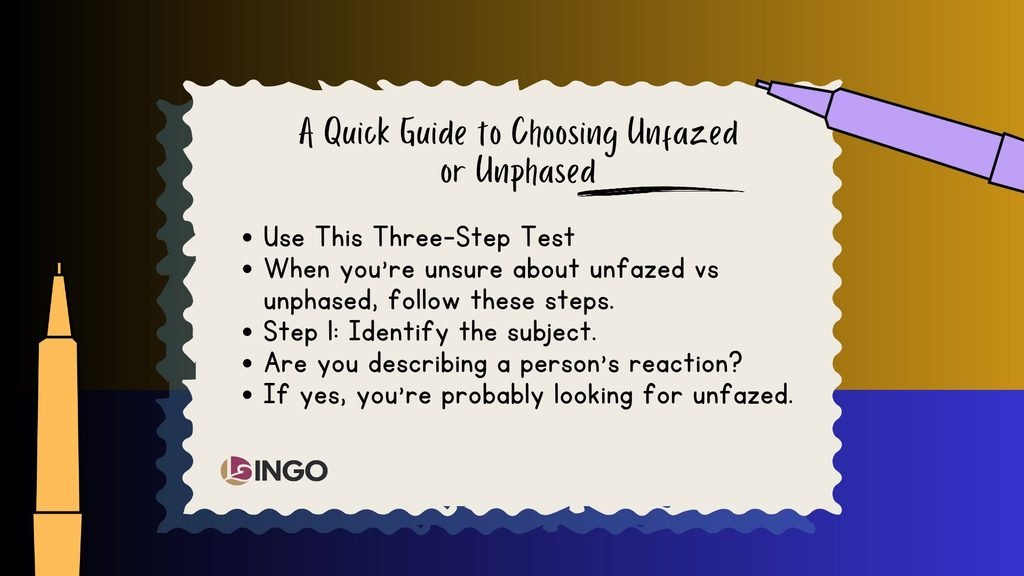
Use This Three-Step Test
When you’re unsure about unfazed vs unphased, follow these steps.
Step 1: Identify the subject.
Are you describing a person’s reaction?
If yes, you’re probably looking for unfazed.
Step 2: Ask what you mean.
Do you mean:
- not bothered?
- not worried?
- not surprised?
- calm under pressure?
- unaffected by criticism?
If yes, use unfazed.
Step 3: Look for a connection to stages.
Are you specifically discussing whether something was implemented in phases or stages?
If yes, unphased may be appropriate in its specialized sense.
Quick Checklist
| Question | Correct choice |
|---|---|
| She wasn’t bothered by the criticism. | Unfazed |
| He wasn’t surprised by the result. | Unfazed |
| The athlete stayed calm under pressure. | Unfazed |
| Nothing could disturb her. | Unfazed |
| The policy wasn’t introduced in stages. | Unphased may fit |
| I need the ordinary adjective for “not bothered.” | Unfazed |
The Best Memory Trick
Remember this sentence:
Nothing can faze me, so I am unfazed.
The connection is:
FAZE → UNFAZED
Not:
PHASE → UNPHASED
Once you remember the root verb faze, the spelling becomes much easier.
Mini Quiz:Unfazed vs Unphased
1. Which spelling is correct when you mean “not bothered or disturbed”?
A) Unfazed
B) Unphased
C) Unfaised
D) Unfayzed
Answer: A) Unfazed
2. Choose the correct word: “She was _____ by the criticism.”
A) Unphased
B) Unfazed
C) Unfaised
D) Unfaced
Answer: B) Unfazed
3. What does “unfazed” mean?
A) Not bothered or worried
B) Divided into stages
C) Extremely confused
D) Completely finished
Answer: A) Not bothered or worried
4. Which sentence uses “unfazed” correctly?
A) He remained unfazed by the difficult question.
B) He remained unfazed into three project stages.
C) The project entered its unfazed phase.
D) She unfazed the problem yesterday.
Answer: A) He remained unfazed by the difficult question.
5. What is the root verb of “unfazed”?
A) Faze
B) Phase
C) Face
D) Fade
Answer: A) Faze
6. Choose the correct sentence.
A) Nothing could faze him.
B) Nothing could phase him.
C) Nothing could faize him.
D) Nothing could fayze him.
Answer: A) Nothing could faze him.
7. Which word means “a stage or period in a process”?
A) Faze
B) Phase
C) Fazed
D) Unfazed
Answer: B) Phase
8. Which sentence correctly uses “phase”?
A) The project entered its second phase.
B) The project entered its second faze.
C) The project entered its second unfazed.
D) The project entered its second phaze.
Answer: A) The project entered its second phase.
9. Which phrase is standard when someone is not bothered by criticism?
A) Unfazed by criticism
B) Unphased by criticism
C) Unfazed with criticism
D) Unfazed from criticism
Answer: A) Unfazed by criticism
10. Which word best describes someone who stays calm under pressure?
A) Unphased
B) Unfazed
C) Phased
D) Fazed
Answer: B) Unfazed
11. Which sentence is correct?
A) She was unfazed by the sudden noise.
B) She was unphazed by the sudden noise.
C) She was unfaised by the sudden noise.
D) She was unfazed to the sudden noise.
Answer: A) She was unfazed by the sudden noise.
12. Which word is closest in meaning to “unfazed”?
A) Unperturbed
B) Disturbed
C) Confused
D) Alarmed
Answer: A) Unperturbed
13. Which spelling should you normally use in everyday English for “not bothered”?
A) Unphased
B) Unfazed
C) Unfaced
D) Unphazed
Answer: B) Unfazed
14. What does “faze” mean?
A) To disturb or bother
B) To divide into stages
C) To complete a project
D) To become silent
Answer: A) To disturb or bother
15. Which sentence best demonstrates the meaning of “unfazed”?
A) The athlete stayed unfazed after losing the first round.
B) The athlete divided the competition into an unfazed.
C) The athlete unfazed the competition.
D) The athlete entered the unfazed phase.
Answer: A) The athlete stayed unfazed after losing the first round.
16. Which pair correctly shows the meanings of “faze” and “phase”?
A) Faze = disturb; phase = stage
B) Faze = stage; phase = disturb
C) Faze = finish; phase = worry
D) Faze = explain; phase = surprise
Answer: A) Faze = disturb; phase = stage
17. Choose the correct completion: “Despite the pressure, the speaker remained _____.”
A) Unphased
B) Unfazed
C) Phased
D) Fazed
Answer: B) Unfazed
18. Which statement about “unphased” is most accurate?
A) It is always the standard spelling of unfazed.
B) It has limited or uncommon uses.
C) It means exactly the same thing as fazed.
D) It is the standard verb meaning to disturb.
Answer: B) It has limited or uncommon uses.
19. Which memory trick correctly helps you remember the spelling of “unfazed”?
A) Faze → unfazed
B) Phase → unfazed
C) Face → unfazed
D) Fade → unfazed
Answer: A) Faze → unfazed
20. Which sentence is best for professional writing?
A) The manager remained unfazed by the criticism.
B) The manager remained unphazed by the criticism.
C) The manager remained unfaised by the criticism.
D) The manager remained unphazed with the criticism.
Answer: A) The manager remained unfazed by the criticism.
21. Complete the sentence: “Nothing could _____ her during the interview.”
A) Phase
B) Faze
C) Unfazed
D) Phased
Answer: B) Faze
22. Complete the sentence: “She remained _____ despite the unexpected result.”
A) Phased
B) Fazed
C) Unphased
D) Unfazed
Answer: D) Unfazed
23. Which sentence correctly distinguishes “phase” from “faze”?
A) The new phase of the project did not faze him.
B) The new faze of the project did not phase him.
C) The new unfazed of the project did not phase him.
D) The new phase of the project did not unfaze him.
Answer: A) The new phase of the project did not faze him.
24. Which sentence contains the correct spelling for someone who remains calm during a crisis?
A) She was completely unphased during the crisis.
B) She was completely unfazed during the crisis.
C) She was completely unphazed during the crisis.
D) She was completely unfaised during the crisis.
Answer: B) She was completely unfazed during the crisis.
25. What is the easiest rule for remembering “unfazed”?
A) Faze means disturb, so unfazed means not disturbed.
B) Phase means disturb, so unphased means calm.
C) Face means disturb, so unfaced means calm.
D) Fade means disturb, so unfaded means calm.
Answer: A) Faze means disturb, so unfazed means not disturbed.
FAQs About Unfazed vs Unphased
Q1:Is “unfazed” the correct spelling?
Yes. Unfazed is the standard spelling when you mean not bothered, worried, surprised, or disturbed. Oxford lists it with the meaning “not worried or surprised by something unexpected that happens.”
Q2:Is “unphased” a real word?
Yes, but its use is limited. Dictionary.com recognizes unphased as an uncommon variant of unfazed and also gives it a separate meaning connected with something being implemented all at once rather than gradually in stages.
Q3:Should I write “unfazed by” or “unphased by”?
When you mean “not bothered by,” write unfazed by.
Correct:
She was unfazed by the criticism.
Q4:Why do people spell unfazed as unphased?
The main reason is that faze and phase sound alike. Since phase is a much more familiar word, writers may instinctively choose ph when spelling the word they hear.
Q5:What does unfazed mean?
Unfazed means calm or unaffected by something that might normally cause worry, surprise, or discomfort.
Example:
He remained unfazed by the difficult question.
Q6:Is unfazed formal English?
Yes. Although Oxford labels it informal, unfazed is widely understood and can be used naturally in everyday, professional, journalistic, and general written English.
In highly formal writing, alternatives such as unperturbed or unaffected may sometimes be preferable depending on the context.
Q7:What is the difference between faze and phase?
Faze means to disturb or bother someone.
The criticism didn’t faze her.
Phase means a stage, period, or step in a process.
The project entered a new phase.
They sound alike but have different meanings and spellings.
Q8:Is “unphased” always wrong?
No. It is too strong to say that unphased is always wrong. Dictionary sources recognize limited uses of the word. However, if you mean that a person was not bothered, worried, or surprised, unfazed is the appropriate standard choice.
Conclusion: Unfazed vs Unphased—Which One Should You Use?
The unfazed vs unphased confusion is easy to solve once you understand the roots of the words.
Use unfazed when you mean not bothered, worried, surprised, or affected:
She remained unfazed by the criticism.
Use unphased only when its specific, limited meaning connected with phases or stages is genuinely intended.
The easiest rule is:
Faze means to disturb, so unfazed means not disturbed.
So the next time you’re writing an email, article, essay, or social media post and want to describe someone who stays calm under pressure, choose unfazed.
Remember: If nothing can faze you, you’re unfazed.
For more clear explanations of commonly confused English words and grammar rules, explore the other language guides on Lingorixa.
References
Oxford Learner’s Dictionaries — “unfazed”

Maimoona Asghar is a grammar enthusiast and language writer who creates clear, practical content to help learners improve English grammar, writing, punctuation, and communication skills through easy-to-understand explanations and examples.