Wether vs weather vs whether can be confusing because all three words sound alike in many varieties of English. However, they have completely different meanings and grammatical uses.
Weather refers to conditions in the atmosphere, such as rain, sunshine, wind, or temperature. Whether is used when talking about uncertainty, alternatives, or possibilities. Wether is a much rarer word that refers to a castrated male sheep or, in some dictionaries, a castrated male goat.
The good news is that you do not need to memorize complicated grammar rules. Once you connect each spelling with its meaning, choosing the right word becomes much easier.
Wether vs Weather vs Whether: Quick Answer
Here is the easiest way to remember the difference:
| Word | Meaning | Example |
|---|---|---|
| Wether | A castrated male sheep or goat | The farmer moved the wether into another pen. |
| Weather | Conditions of the atmosphere | The weather is cold today. |
| Whether | Expresses a choice, uncertainty, or possibility | I don’t know whether she will come. |
Simple memory trick:
- Wether = sheep or goat
- Weather = sky and atmospheric conditions
- Whether = choice or uncertainty
The three words are homophones in many accents, meaning they are pronounced alike or very similarly despite having different spellings and meanings. Merriam-Webster lists weather and wether among the homophones of whether.
What Does “Wether” Mean?
Wether is a real English word, but it is uncommon in everyday conversation. It traditionally refers to a castrated male sheep, and it can also refer to a castrated male goat.
Wether Meaning and Usage
You are most likely to encounter wether in agricultural, farming, livestock, or veterinary contexts.
For example:
- The farmer selected a healthy wether for the flock.
- The wether was kept separate from the breeding animals.
- The shepherd examined the wether before moving the flock.
- Several wethers were grazing in the field.
Unlike weather and whether, wether has nothing to do with rain, temperature, choices, or uncertainty.
Is “Wether” a Common Word?
No. For most people, wether is relatively uncommon. That is why it is frequently mistaken for a spelling error.
If you are writing about everyday life and you typed wether, stop and check the sentence. You probably mean weather or whether.
For example:
❌ I don’t know wether it will rain.
✅ I don’t know whether it will rain.
But:
✅ The farmer owns a wether.
In that last sentence, wether is correct because the sentence is about an animal.
What Does “Weather” Mean?
Weather refers to the condition of the atmosphere at a particular time and place. It includes things such as temperature, rain, snow, wind, clouds, sunshine, and storms.
Weather as a Noun
This is the most common use of weather.
Examples:
- The weather is beautiful today.
- Bad weather delayed our flight.
- We checked the weather before leaving.
- The cold weather lasted for several days.
- What will the weather be like tomorrow?
A useful test is to ask:
“Am I talking about rain, temperature, wind, sunshine, or atmospheric conditions?”
If the answer is yes, you almost certainly need weather.
Weather as a Verb
Weather can also function as a verb. In this sense, it can mean to withstand, survive, or endure something difficult.
Examples:
- The company weathered the financial crisis.
- She weathered several difficult years.
- The old building has weathered many storms.
- They managed to weather the economic downturn.
So weather is not limited to discussions about the sky.
Common Weather Mistakes
A common mistake is using whether when you mean atmospheric conditions.
Incorrect:
❌ The whether is terrible today.
Correct:
✅ The weather is terrible today.
Another mistake is dropping the a from weather:
❌ The wether forecast says it will rain.
✅ The weather forecast says it will rain.
Remember:
Weather has “a” because it is connected with the atmosphere.
What Does “Whether” Mean?
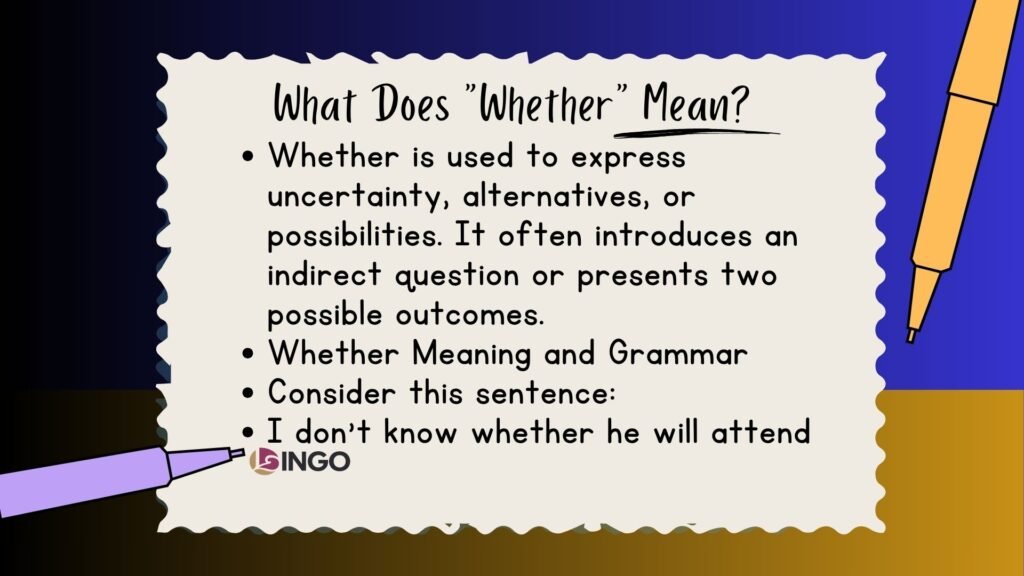
Whether is used to express uncertainty, alternatives, or possibilities. It often introduces an indirect question or presents two possible outcomes.
Whether Meaning and Grammar
Consider this sentence:
I don’t know whether he will attend.
The speaker does not know which possibility is true:
- He will attend.
- He will not attend.
Here, whether introduces uncertainty.
More examples include:
- I wonder whether she is available.
- We need to decide whether to stay.
- He asked whether I needed help.
- I am not sure whether they received the message.
- She hasn’t decided whether to accept the offer.
Whether for Choices and Alternatives
One of the clearest uses of whether is when there are alternatives.
For example:
I can’t decide whether to take the bus or the train.
The alternatives are:
- Take the bus.
- Take the train.
More examples:
- We must decide whether to leave now or later.
- She is considering whether to study abroad.
- I don’t know whether to call him or send an email.
- They discussed whether the project should continue.
This makes whether particularly useful in formal writing, academic writing, business communication, and professional correspondence.
Whether or Not
The expression whether or not means that either possibility produces the same result.
For example:
Whether or not it rains, the match will continue.
This means the match will continue in both situations:
- If it rains, the match continues.
- If it does not rain, the match continues.
Other examples:
- Whether or not she agrees, we will proceed.
- I’ll attend whether or not my friends come.
- Whether or not the weather improves, we will leave tomorrow.
Wether vs Weather vs Whether: How to Choose the Right Word
When you are unsure, use this three-question checklist.
Step 1: Are You Talking About an Animal?
If you mean a castrated male sheep or goat, use wether.
The farmer bought a young wether.
Step 2: Are You Talking About Atmospheric Conditions?
If you mean rain, snow, wind, temperature, sunshine, or storms, use weather.
The weather is expected to improve tomorrow.
Step 3: Are You Talking About a Choice or Possibility?
If you are expressing uncertainty or alternatives, use whether.
I don’t know whether he will come.
This gives you a simple formula:
Animal → Wether
Atmosphere → Weather
Choice/uncertainty → Whether
Real-Life Case Study: A Simple Email Mistake
Imagine that Sara works for a travel company and needs to email a customer about an upcoming trip.
She initially writes:
“We are not sure wether the weather will improve, so we will decide tomorrow.”
There are actually two different words needed in this sentence.
The first wether is incorrect because Sara is not talking about a sheep or goat. She is expressing uncertainty about the forecast. Therefore, she needs whether.
The second weather is correct because she is talking about atmospheric conditions.
The corrected sentence is:
“We are not sure whether the weather will improve, so we will decide tomorrow.”
This example is useful because whether and weather can appear next to each other in the same sentence.
They sound similar, but their grammatical jobs are completely different.
The first word, whether, introduces uncertainty: Will the weather improve or not? The second word, weather, identifies the subject being discussed: the atmospheric conditions.
This distinction becomes especially important in professional writing. A spelling mistake such as “wether the weather” can make an otherwise polished email look careless. The solution is not to memorize the spelling mechanically. Instead, identify the meaning first. Ask yourself: “Am I discussing atmospheric conditions?” If yes, use weather. Then ask: “Am I expressing uncertainty?” If yes, use whether.
This meaning-first approach is faster and more reliable than trying to remember which spelling simply “looks right.”
Wether vs Weather vs Whether: Comparison Table
| Feature | Wether | Weather | Whether |
|---|---|---|---|
| Main meaning | Castrated male sheep/goat | Atmospheric conditions | Choice or uncertainty |
| Part of speech | Noun | Noun/verb | Conjunction |
| Everyday usage | Rare | Very common | Very common |
| Connected to rain? | No | Yes | No |
| Connected to choices? | No | No | Yes |
| Example | The wether is in the pen. | The weather is warm. | I wonder whether she will come. |
A Fast Memory Trick
Try remembering these three associations:
Wether → Wool
A wether is a livestock term, so connect it with sheep.
Weather → Air
Weather describes what is happening in the atmosphere.
Whether → Choice
Whether often appears when you are considering one possibility versus another.
Another useful example combines all three:
Whether the weather changes, the farmer will keep the wether indoors.
Each word has a completely different job.
Common Mistakes With Wether, Weather, and Whether
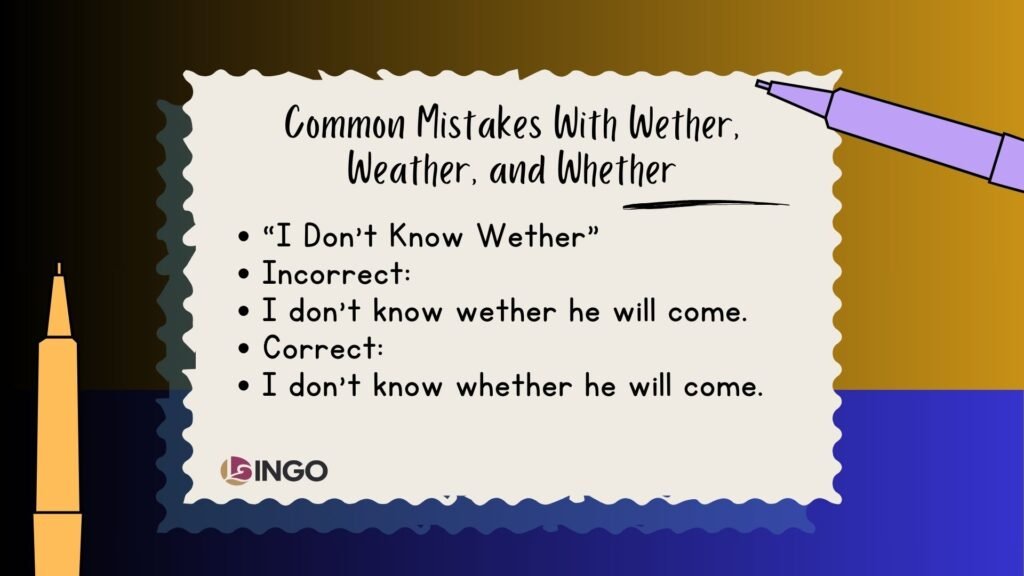
“I Don’t Know Wether”
Incorrect:
I don’t know wether he will come.
Correct:
I don’t know whether he will come.
Why? The sentence expresses uncertainty, not an animal.
“The Whether Is Cold”
Incorrect:
The whether is cold today.
Correct:
The weather is cold today.
Why? The sentence refers to atmospheric conditions.
“The Farmer Has a Weather”
Incorrect:
The farmer has a weather.
Correct:
The farmer has a wether.
Why? Here, the sentence is referring to a livestock animal.
“Whether” Before “To”
Whether is particularly useful before an infinitive when someone is deciding what action to take.
Correct:
I don’t know whether to go.
She is deciding whether to apply.
We need to determine whether to continue.
This is a useful pattern to remember because it clearly separates whether from weather and wether.
2025–2026 Data: Why Clear, Helpful Grammar Content Still Matters
There is no reliable 2025–2026 global statistic showing exactly how many people confuse wether, weather, and whether. Because this is a narrow spelling and grammar distinction, presenting an invented “confusion rate” would be misleading.
However, current content research reinforces the importance of creating genuinely useful explanatory content rather than writing solely for search engines.
HubSpot’s updated blogging research reports that 65% of marketers work at companies that maintain blogs, while 93% of those marketers consider blogging important or very important to their marketing strategy. It also reports that 51% of blog-producing businesses consider how-to guides a strong-performing format.
Google’s guidance similarly emphasizes helpful, reliable, people-first content and asks creators whether their pages provide substantial, complete, original, and useful information.
For a grammar article like this, that means the goal should not simply be repeating definitions. A genuinely useful page should answer the reader’s immediate question, show realistic examples, explain common mistakes, and give the reader a reliable method for choosing the correct word.
That is why the animal → atmosphere → choice framework is more useful than a definition alone.
Mini Quiz:Wether vs Weather vs Whether
1. The _____ is expected to be sunny tomorrow.
A) wether
B) weather
C) whether
D) wheather
2. I don’t know _____ she will attend the meeting.
A) wether
B) weather
C) whether
D) wheather
3. Which word refers to a castrated male sheep?
A) Wether
B) Weather
C) Whether
D) Whither
4. We should check the _____ before going hiking.
A) whether
B) wether
C) weather
D) whither
5. She hasn’t decided _____ to accept the job.
A) weather
B) whether
C) wether
D) whither
6. Which sentence uses weather correctly?
A) I don’t know weather he is coming.
B) The weather is unusually cold today.
C) The farmer bought a weather.
D) She wondered weather to stay.
7. Which sentence uses whether correctly?
A) The whether forecast says rain.
B) The whether is pleasant today.
C) I wonder whether they will arrive.
D) The farmer fed the whether.
8. Which sentence uses wether correctly?
A) The wether was moved into another pen.
B) The wether will be rainy tomorrow.
C) I don’t know wether she agrees.
D) The wether forecast predicts snow.
9. _____ or not we win, we will celebrate.
A) Wether
B) Weather
C) Whether
D) Whither
10. Bad _____ caused several flights to be delayed.
A) whether
B) wether
C) weather
D) whither
11. In “We need to decide whether to leave,” what does whether express?
A) A type of animal
B) Atmospheric conditions
C) A choice or uncertainty
D) A physical direction
12. The _____ forecast says temperatures will fall tonight.
A) weather
B) whether
C) wether
D) whither
13. I am unsure _____ the store is open.
A) wether
B) weather
C) whether
D) wheather
14. Which word would be appropriate in a sentence about sheep farming?
A) Wether
B) Weather
C) Whether
D) Whither
15. The stormy _____ kept us indoors.
A) whether
B) wether
C) weather
D) whither
16. Which sentence correctly uses whether or not?
A) Whether or not it rains, the event will continue.
B) Weather or not it rains, the event will continue.
C) Wether or not it rains, the event will continue.
D) Whither or not it rains, the event will continue.
17. What is the main meaning of weather as a noun?
A) A choice between alternatives
B) Atmospheric conditions
C) A castrated male sheep
D) A destination or direction
18. What is the main grammatical role of whether in “She asked whether I was ready”?
A) It introduces an indirect question.
B) It names an animal.
C) It describes temperature.
D) It identifies a storm.
19. Which pair is correctly matched with its meaning?
A) Wether — atmospheric conditions
B) Weather — uncertainty
C) Whether — choice or uncertainty
D) Wether — indirect question
20. Which sentence correctly uses weather as a verb?
A) The company weathered the difficult period.
B) The company whethered the difficult period.
C) The company wethered the difficult period.
D) The company whithered the difficult period.
21. I can’t decide _____ to take the bus or train.
A) weather
B) wether
C) whether
D) whither
22. Which sentence is correctly written?
A) The whether is getting colder.
B) I wonder wether he knows.
C) The weather is improving.
D) The farmer watched the whether.
23. Wether is a term used primarily for a castrated male sheep.
A) True
B) False
24. Whether can introduce alternatives or uncertainty.
A) True
B) False
25. Select all sentences that use the target words correctly.
A) The weather was cold, so we stayed inside.
B) I don’t know whether they will arrive.
C) The farmer moved the wether into the pen.
D) The wether forecast predicts heavy rain.
Answer Key
- B — weather
- C — whether
- A — wether
- C — weather
- B — whether
- B — The weather is unusually cold today.
- C — I wonder whether they will arrive.
- A — The wether was moved into another pen.
- C — Whether
- C — weather
- C — A choice or uncertainty
- A — weather
- C — whether
- A — Wether
- C — weather
- A — Whether or not it rains, the event will continue.
- B — Atmospheric conditions
- A — It introduces an indirect question.
- C — Whether — choice or uncertainty
- A — The company weathered the difficult period.
- C — whether
- C — The weather is improving.
- A — True
- A — True
- A, B, and C
Frequently Asked Questions
Q1:Is “wether” a correct English word?
Yes. Wether is a legitimate English noun referring primarily to a castrated male sheep. It is much less common than weather and whether, so it is often mistaken for a spelling error.
Q2:What is the difference between weather and whether?
Weather refers to atmospheric conditions such as rain, wind, temperature, and sunshine. Whether expresses uncertainty, alternatives, or possibilities.
For example:
The weather is rainy.
I don’t know whether it will rain.
Q3:Is it “whether or weather”?;
It depends on the meaning. Use whether for uncertainty or alternatives and weather for atmospheric conditions.
I don’t know whether we should go.
The weather is getting worse.
Q4:Can weather be a verb?
Yes. Weather can be a verb meaning to endure, survive, or withstand something difficult.
The company weathered the economic crisis.
Q5:Can I replace whether with if?
Sometimes. For example:
I don’t know whether she is coming.
and
I don’t know if she is coming.
Both can be acceptable in many contexts. However, whether is preferred or necessary in certain constructions, especially when presenting alternatives or before an infinitive:
I can’t decide whether to go.
Q6:Is “wether” a misspelling?
Not always. Wether is a real word. However, if you are not discussing sheep or goats, there is a good chance you intended to write weather or whether.
Q7:How can I remember weather vs whether?
Use this simple memory trick:
Weather = atmosphere.
Whether = choice.
If you can replace the word with “if” or the sentence involves alternatives, whether is often the right choice.
Q8:Can all three words appear in one sentence?
Yes, although this would be unusual in everyday writing.
For example:
Whether the weather improves will determine when the wether is moved outside.
Each word has a different meaning.
Final Takeaway: Wether vs Weather vs Whether
The difference between wether vs weather vs whether becomes easy once you focus on meaning rather than spelling.
- Wether = a castrated male sheep or goat.
- Weather = atmospheric conditions such as rain, wind, and temperature.
- Whether = uncertainty, alternatives, or possibilities.
The easiest rule to remember is:
Wether = animal. Weather = atmosphere. Whether = choice.
So if you are talking about tomorrow’s rain, choose weather. If you are deciding between two possibilities, choose whether. If you are writing about livestock, wether may be the word you need.
Before publishing an email, article, assignment, or professional message, take a second to check which meaning you intend. That small habit can eliminate one of the most easily overlooked homophone mistakes in English.
For more clear explanations of commonly confused English words and grammar rules, explore the other language guides on Lingorixa.
References
Cambridge Dictionary — Whether
Merriam-Webster Dictionary

Maimoona Asghar is a grammar enthusiast and language writer who creates clear, practical content to help learners improve English grammar, writing, punctuation, and communication skills through easy-to-understand explanations and examples.