If you have ever typed “to bad” and wondered whether it should be “too bad,” you are not alone. Too bad vs to bad is a common English grammar confusion because to and too sound alike when spoken.
The correct expression is “too bad” when you mean something is unfortunate, disappointing, regrettable, or excessively bad. “To bad” is not the correct spelling of this expression.
For example:
- ✅ Too bad you missed the movie.
- ❌ To bad you missed the movie.
The difference is only one letter, but that extra o completely changes the grammatical function of the word.
Let’s look at the rule, meanings, examples, exceptions, and an easy way to remember the difference.
Too Bad vs To Bad: Which One Is Correct?
“Too Bad” Is the Correct Expression
Too bad is the standard expression when you want to say that something is unfortunate, disappointing, or regrettable.
For example:
It’s too bad you couldn’t attend the meeting.
This means that it is unfortunate that the person could not attend.
The Cambridge Dictionary identifies too bad as an informal idiom that can express sympathy about a problem or, depending on context and tone, a lack of sympathy.
Other examples include:
- Too bad we missed the train.
- It’s too bad that the store closed.
- That’s too bad about your car.
- Too bad you couldn’t stay longer.
Why “To Bad” Is Usually Wrong
The word to does not normally function as an adverb modifying the adjective bad.
Compare:
- I went to school.
- She gave the book to John.
- I want to leave.
Here, to has a grammatical job.
But when you want to express disappointment, the correct form is:
That’s too bad.
Not:
❌ That’s to bad.
The Simple Rule
Remember this:
Too + adjective can describe something excessive or beyond an acceptable level.
Examples:
- too expensive
- too difficult
- too cold
- too loud
- too bad
Therefore:
The weather is too bad to travel.
Here, too modifies the adjective bad.
What Does “Too Bad” Mean?
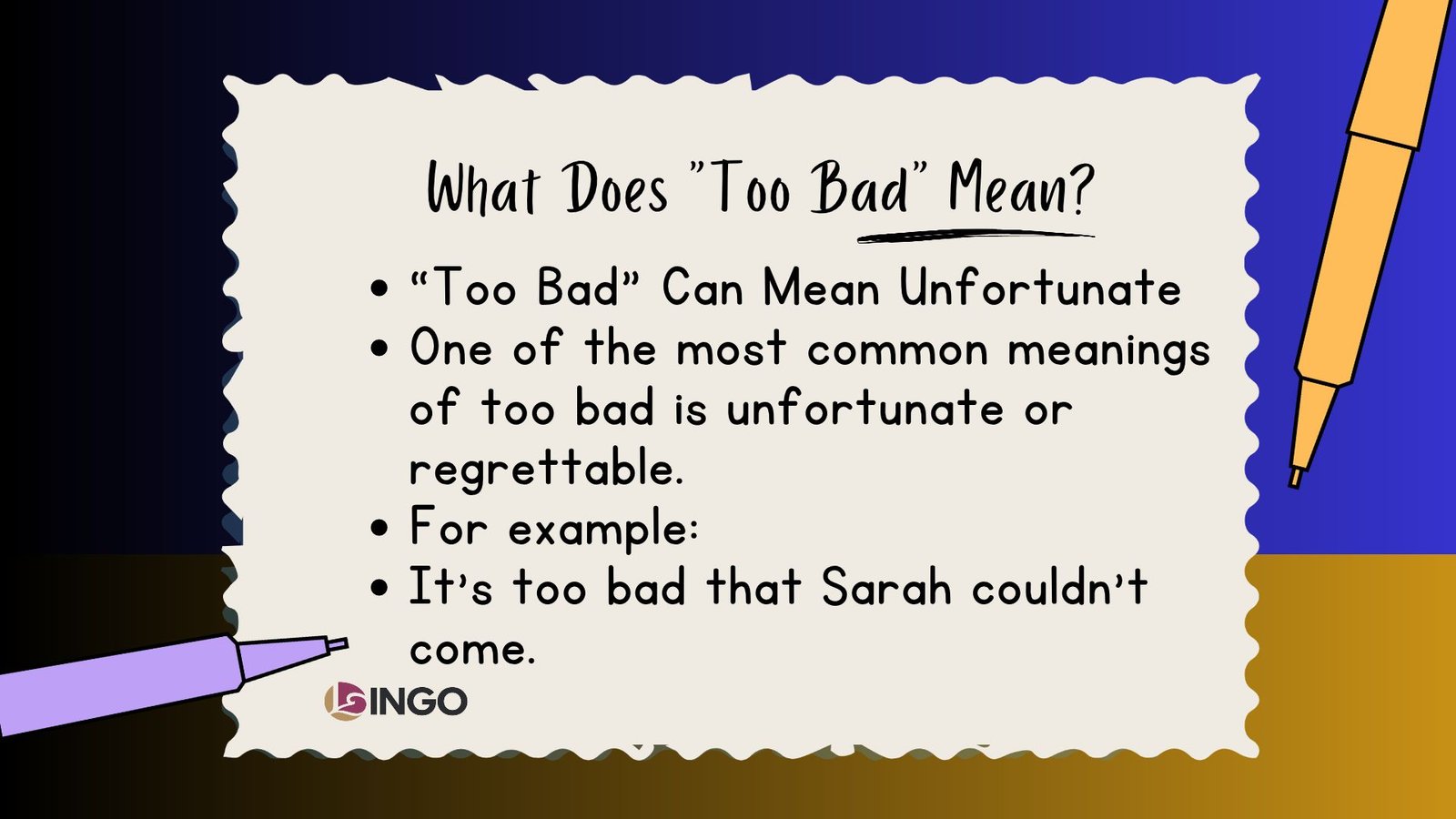
“Too Bad” Can Mean Unfortunate
One of the most common meanings of too bad is unfortunate or regrettable.
For example:
It’s too bad that Sarah couldn’t come.
This means:
It is unfortunate that Sarah couldn’t come.
You could also say:
It’s a shame that Sarah couldn’t come.
The Cambridge Dictionary gives too bad as an expression that can communicate sympathy about an unfortunate situation.
“Too Bad” Can Express Disappointment
The phrase can also describe something disappointing.
For example:
It’s too bad the concert was canceled.
The speaker is expressing disappointment about the cancellation.
Other examples:
- It’s too bad we didn’t get tickets.
- That’s too bad about your vacation.
- It’s too bad the weather changed.
“Too Bad” Can Mean Excessively Bad
There is another grammatical use that is slightly different.
In:
The traffic was too bad to drive safely.
Too means more than is acceptable or manageable.
The traffic was extremely bad to the point that it prevented safe driving.
Similarly:
The damage was too bad to repair.
Here, too bad means the condition was excessively bad.
“Too Bad” Can Sound Sarcastic
Context and tone matter.
Someone might say:
You forgot your wallet? Too bad.
This may not communicate genuine sympathy. It could sound dismissive or sarcastic.
Merriam-Webster notes that too bad can express sympathy but can also be used ironically when the speaker does not feel sorry.
Therefore, the phrase does not always have one emotional meaning.
How to Use “Too Bad” Correctly
Use “Too Bad” for Unfortunate Situations
Use too bad when reacting to disappointing or unfortunate news.
Examples:
Too bad you missed the bus.
It’s too bad that your flight was delayed.
That’s too bad. I hope everything works out.
Too bad we couldn’t meet yesterday.
These sentences all use too bad correctly.
Use “Too Bad” Before an Infinitive Construction
The phrase can also appear in structures such as:
The weather was too bad to go outside.
Here, too bad means excessively bad.
More examples:
- The roads were too bad to drive on.
- The situation became too bad to ignore.
- The food was too bad to finish.
- The injury was too bad to continue playing.
Use a More Formal Alternative When Appropriate
Although too bad is perfectly normal English, it is relatively conversational.
In formal writing, you might choose:
- unfortunate
- regrettable
- disappointing
- sadly
- unfortunately
For example:
Conversational:
It’s too bad that the event was canceled.
More formal:
Unfortunately, the event was canceled.
The best choice depends on your audience and writing situation.
Too Bad vs To Bad: Quick Comparison
| Expression | Correct? | Function | Example |
|---|---|---|---|
| too bad | ✅ Yes | Expresses regret or excessive degree | It’s too bad you missed it. |
| to bad | ❌ Usually no | Not the standard expression | ❌ It’s to bad you missed it. |
| from good to bad | ✅ Yes | Shows a change of condition | Things went from good to bad. |
| too bad to… | ✅ Yes | Shows excessive degree | It was too bad to ignore. |
The important point is that “to bad” can appear as two consecutive words in a larger grammatical structure, but it is not an alternative spelling of the expression “too bad.”
For example:
The situation went from good to bad.
Here, to is correctly showing a change from one state to another.
But:
❌ It’s to bad that you left.
is incorrect if you mean it’s unfortunate that you left.
Why Do People Confuse “To” and “Too”?
They Sound the Same
The biggest reason for this mistake is pronunciation.
In standard English pronunciation, to and too can sound identical in many everyday sentences.
When people hear:
“Too bad!”
they cannot see which spelling is being used.
That means writers must rely on grammar and meaning when choosing the correct spelling.
“Too” Has More Than One Meaning
The word too can mean also:
I want to come too.
It can also mean excessively:
This bag is too heavy.
In too bad, it functions in relation to the adjective bad.
“To” Has Different Grammatical Jobs
To is commonly used as a preposition:
We went to the store.
It can also introduce an infinitive:
I want to sleep.
It can show direction:
Give the letter to Maria.
Therefore, to and too are not interchangeable simply because they sound alike.
A Real-Life Example: Why the Extra “O” Matters
Imagine that a coworker tells you:
“I won’t be able to attend the office dinner tonight.”
You want to respond sympathetically.
You write:
❌ To bad! We were looking forward to seeing you.
The reader will probably understand what you meant, but the spelling is incorrect.
The natural version is:
✅ Too bad! We were looking forward to seeing you.
Now consider a different sentence:
The project went from good to bad after the main supplier left.
Here, to bad is not an error. The sentence is describing a change from one condition to another: good → bad.
This distinction is important because it prevents you from applying the rule mechanically. You should not assume that every occurrence of the two words to bad is automatically a spelling mistake.
The question is:
Are you trying to use the expression meaning “unfortunate” or “a shame”?
If yes, use too bad.
If to has its own grammatical function, such as showing movement or a change from one state to another, then to bad can occur naturally.
2025–2026 Usage Evidence: What Current Dictionaries Show
Current Dictionary Evidence
Current dictionary references continue to recognize too bad as an established English expression.
Merriam-Webster’s 2026 entry defines too bad as an idiom used to show that someone is sorry or feels bad about something. It also records an ironic use in which the speaker does not feel sorry.
The Cambridge Dictionary currently classifies too bad as an informal B1-level idiom and explains that its meaning can depend on context and tone.
Dictionary.com also lists too bad as an idiom meaning unfortunate and provides contemporary examples from publications dated in 2026.
What This Evidence Tells Us
The important takeaway from current 2026 dictionary evidence is straightforward:
- Too bad is an established English expression.
- It can communicate regret, disappointment, or sympathy.
- It can also describe something excessively bad.
- Tone can make it sympathetic or sarcastic.
- To bad is not a replacement spelling for this expression.
So, if your sentence means “what a shame” or “that is unfortunate,” choose too bad.
Easy Ways to Remember “Too Bad”
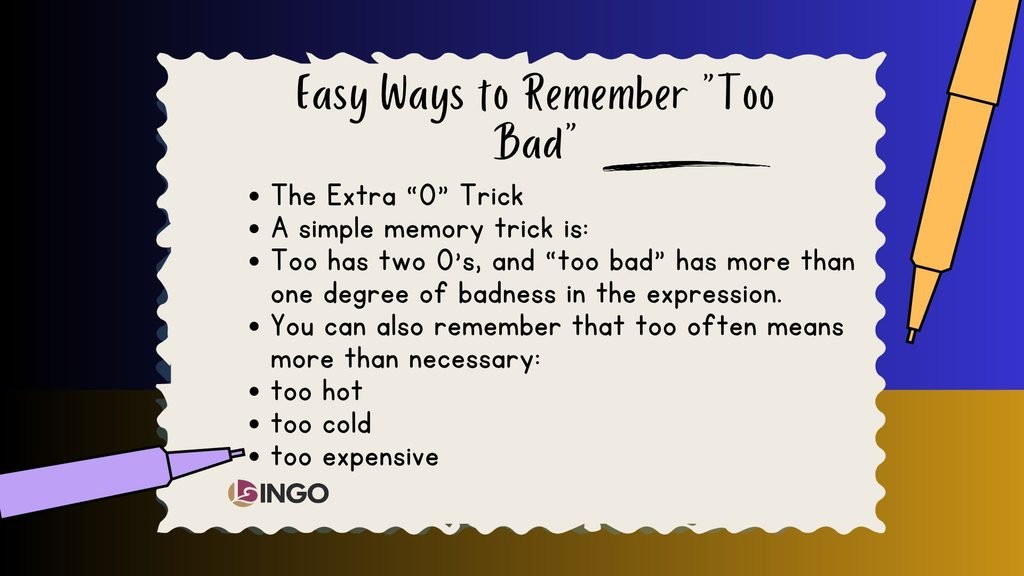
The Extra “O” Trick
A simple memory trick is:
Too has two O’s, and “too bad” has more than one degree of badness in the expression.
You can also remember that too often means more than necessary:
- too hot
- too cold
- too expensive
- too difficult
- too bad
Try the “Very” Test
When too means excessively, you can often think of it as indicating a high degree.
For example:
The weather is too bad to travel.
The bad weather has reached an unacceptable level.
If you’re using too bad as an expression of regret, you can often replace it with:
That’s unfortunate.
For example:
That’s too bad.
becomes:
That’s unfortunate.
If that meaning fits, too bad is the spelling you need.
Remember: “To” Needs a Job
When you see to, ask what it is doing.
Does it show direction?
Go to work.
Does it introduce a verb?
I want to learn.
Does it connect two states?
The situation changed from good to bad.
If none of these functions makes sense and you mean “what a shame,” you probably need too.
Common Mistakes With “Too Bad”
Mistake 1: “It’s to bad”
❌ It’s to bad that you missed the train.
✅ It’s too bad that you missed the train.
Mistake 2: “That’s to bad”
❌ That’s to bad about your injury.
✅ That’s too bad about your injury.
Mistake 3: “To bad we missed it”
❌ To bad we missed the concert.
✅ Too bad we missed the concert.
Mistake 4: Correcting Every “To Bad” Automatically
This is the opposite mistake.
Consider:
The situation changed from good to bad.
This is correct because to connects the two conditions.
So don’t simply search for the sequence to bad and replace it with too bad. Look at the sentence’s meaning and grammar first.
“Too Bad” vs Similar Expressions
Too Bad vs That’s a Shame
Both can express disappointment.
Too bad you couldn’t come.
That’s a shame you couldn’t come.
The second version can sound slightly more explicitly sympathetic.
Too Bad vs Unfortunately
Unfortunately is generally more neutral and formal.
Unfortunately, the meeting was canceled.
This may be preferable in professional or academic writing.
Too Bad vs What a Pity
What a pity can express stronger sympathy or disappointment.
What a pity you couldn’t stay.
However, too bad is extremely natural in everyday conversation.
Mini Quiz:Too Bad vs To Bad
1. Choose the correct sentence when expressing regret about missing an event.
A. Too bad I missed the event.
B. To bad I missed the event.
C. Two bad I missed the event.
D. Too bade I missed the event.
Answer: A
2. Which sentence correctly describes an unfortunate situation?
A. It’s too bad that she left early.
B. It’s to bad that she left early.
C. It’s two bad that she left early.
D. It’s too bade that she left early.
Answer: A
3. Complete the sentence: “_____ you couldn’t come with us.”
A. Too bad
B. To bad
C. Two bad
D. Too bade
Answer: A
4. In “The weather was too bad to travel,” what does “too bad” mean?
A. Excessively bad for traveling
B. A destination for traveling
C. Two separate bad conditions
D. A greeting for travelers
Answer: A
5. Which response is most natural after someone says, “I missed the concert”?
A. Too bad!
B. To bad!
C. Two bad!
D. Too bade!
Answer: A
6. Which sentence correctly uses “to” and “bad” as separate grammatical elements?
A. The situation changed from good to bad.
B. The situation changed from good too bad.
C. The situation changed from good two bad.
D. The situation changed from good bade bad.
Answer: A
7. Choose the correct sentence if you mean “It is unfortunate that the meeting was canceled.”
A. It’s too bad the meeting was canceled.
B. It’s to bad the meeting was canceled.
C. It’s two bad the meeting was canceled.
D. It’s too bade the meeting was canceled.
Answer: A
8. Which word functions as an adverb in “too bad”?
A. Too
B. Bad
C. Both
D. Neither
Answer: A
9. Which sentence correctly uses “too bad” to indicate an excessive degree?
A. The damage was too bad to repair.
B. The damage was to bad to repair.
C. The damage was two bad to repair.
D. The damage was too bade to repair.
Answer: A
10. Which sentence contains a spelling error?
A. That’s too bad.
B. It was too bad to continue.
C. It’s to bad that we missed it.
D. The situation went from good to bad.
Answer: C
11. What is the closest meaning of “That’s too bad” in a sympathetic context?
A. That’s unfortunate.
B. That’s nearby.
C. That’s the second one.
D. That’s extremely beautiful.
Answer: A
12. Which sentence correctly uses “too bad” in everyday conversation?
A. Too bad you can’t stay longer.
B. To bad you can’t stay longer.
C. Two bad you can’t stay longer.
D. Too bade you can’t stay longer.
Answer: A
13. Why is “to bad” incorrect in “It’s to bad we lost”?
A. “To” does not form the intended expression.
B. “Bad” must always be plural.
C. “Too” can only be used before verbs.
D. “To” is always a noun.
Answer: A
14. Which sentence correctly uses “to bad” as part of a larger grammatical structure?
A. The story changed from happy to bad.
B. It was to bad that she left.
C. Too bad she left.
D. I felt to bad about it.
Answer: A
15. Which replacement best matches “It’s too bad we missed the train”?
A. It’s unfortunate we missed the train.
B. It’s nearby we missed the train.
C. It’s two we missed the train.
D. It’s loudly we missed the train.
Answer: A
16. Which sentence is correct?
A. Too bad about your broken phone.
B. To bad about your broken phone.
C. Two bad about your broken phone.
D. Too bade about your broken phone.
Answer: A
17. In “The road was too bad to drive on,” what does “too” indicate?
A. An excessive degree
B. A destination
C. A number
D. A past-tense verb
Answer: A
18. Which sentence is more appropriate for a formal context?
A. Unfortunately, the event was canceled.
B. Two bad, the event was canceled.
C. To bad, the event was canceled.
D. Too bade, the event was canceled.
Answer: A
19. Which phrase could sound sarcastic depending on tone?
A. Too bad you lost the game.
B. The game starts at noon.
C. Please bring your notebook.
D. The team practiced yesterday.
Answer: A
20. Which rule best summarizes the difference?
A. Use “too bad” for the expression or excessive degree; use “to” when it has another grammatical function.
B. Always replace “too” with “to” before “bad.”
C. Always replace “to” with “too” before every adjective.
D. Both spellings have exactly the same grammatical use.
Answer: A
21. Choose the correct sentence.
A. It’s too bad that you missed the bus.
B. It’s to bad that you missed the bus.
C. It’s two bad that you missed the bus.
D. It’s too bade that you missed the bus.
Answer: A
22. Which sentence uses “too” to show an excessive degree?
A. The food was too bad to eat.
B. The food was to bad to eat.
C. The food was two bad to eat.
D. The food was too bade to eat.
Answer: A
23. Which sentence uses “to” correctly?
A. She went from happy to sad.
B. She went from happy too sad.
C. She went from happy two sad.
D. She went from happy bade sad.
Answer: A
24. If you want to say “What a shame,” which expression should you use?
A. Too bad
B. To bad
C. Two bad
D. Too bade
Answer: A
25. Which sentence is completely correct?
A. Too bad we couldn’t attend the party.
B. To bad we couldn’t attend the party.
C. Two bad we couldn’t attend the party.
D. Too bade we couldn’t attend the party.
Answer: A
Frequently Asked Questions
Q1:Is “too bad” grammatically correct?
Yes. Too bad is grammatically correct and is a well-established English expression. It can express regret, disappointment, sympathy, or an excessive degree of badness depending on the sentence.
Q2:Is “to bad” ever correct?
Yes, but not as an alternative spelling of too bad. For example, “from good to bad” is grammatical because to connects two conditions. If you mean “unfortunate” or “what a shame,” use too bad.
Q3:Should I say “too bad” or “to bad”?
Use too bad when expressing disappointment, regret, sympathy, or an undesirable degree.
Correct:
It’s too bad you couldn’t come.
Incorrect:
❌ It’s to bad you couldn’t come.
Q4:What does “too bad” mean?
Too bad can mean unfortunate, regrettable, disappointing, or a shame. It can also mean something is excessively bad, as in “The weather was too bad to travel.”
Q5:Can “too bad” sound rude?
Yes. Tone and context matter. A short response such as “Too bad.” can sometimes sound dismissive or sarcastic. A warmer sentence such as “That’s too bad. I’m sorry to hear that.” makes sympathy clearer. Cambridge and Merriam-Webster both note that the expression can be interpreted differently depending on context.
Q6:Is “too bad” formal English?
Too bad is standard English but is generally conversational and informal. In formal writing, alternatives such as unfortunate, regrettable, or unfortunately may be more appropriate.
Q7:Why do people write “to bad”?
The most common reason is that to and too sound alike in speech. Fast typing, spelling uncertainty, and unfamiliarity with their grammatical roles can also cause the mistake.
Q8:What is an easy way to remember “too bad”?
Remember that too has two O’s. When you mean “what a shame,” “unfortunate,” or excessively bad, write too bad with two O’s.
Conclusion: Too Bad Is the Correct Choice
When you’re choosing between too bad vs to bad, the answer is simple: use “too bad” when you mean unfortunate, disappointing, regrettable, or excessively bad.
For example:
✅ Too bad you missed the event.
✅ It’s too bad that the flight was canceled.
✅ The weather was too bad to travel.
The spelling “to bad” is not correct when you’re trying to use the common expression too bad. However, the two words to bad can appear together legitimately in a larger grammatical structure, such as:
The situation went from good to bad.
The easiest way to remember the difference is to understand the job each word performs. Too can modify an adjective, while to has other grammatical functions such as showing direction, relationships, infinitives, or changes between states.
Now that you know the rule, you can confidently write “too bad” whenever you mean “what a shame” or “unfortunate.”
For more clear explanations of commonly confused English words and grammar rules, explore the other language guides on Lingorixa.
References
Cambridge Dictionary: Too Bad
Cambridge Grammar: Too

Maimoona Asghar is a grammar enthusiast and language writer who creates clear, practical content to help learners improve English grammar, writing, punctuation, and communication skills through easy-to-understand explanations and examples.