Have you ever wondered whether sleeve vs. sleave is the correct spelling? These two words look almost identical and are pronounced alike or very similarly, so it is easy to confuse them. However, they are not simply two spellings of the same word.
The good news is that the rule is straightforward: use “sleeve” when you mean the part of clothing that covers the arm. “Sleave” is a real English word, but it is rare and has a completely different meaning connected with thread, silk, and tangled fibers.
This guide explains the difference between sleeve and sleave, shows you how each word is used, and gives you practical examples so you can choose the right spelling confidently.
Sleeve vs. Sleave: The Quick Answer
If you are writing about a shirt, jacket, coat, dress, or another garment, sleeve is the correct word.
Sleeve Meaning
Sleeve is a noun referring to the part of a garment that covers the arm. It can also describe various tubular or protective coverings.
Examples:
- The sleeve of my shirt is too long.
- She rolled up her sleeves before starting work.
- This jacket has removable sleeves.
- He bought a protective sleeve for his laptop.
Dictionaries also recognize other meanings of sleeve, including a protective covering and certain mechanical components.
Sleave Meaning
Sleave is also a legitimate English word, but it is uncommon in modern everyday writing. It can refer to tangled thread, a filament separated from a larger thread, or silk fibers. It can also function as a verb meaning to separate or disentangle fibers.
For example:
- The historical text refers to sleave silk.
- The craftsman worked carefully with the tangled sleave.
Therefore, if you mean the arm-covering part of clothing, sleeve—not sleave—is the word you want.
What Does “Sleeve” Mean?
The word sleeve is common in modern English and appears in everyday conversations, clothing descriptions, technical writing, and idiomatic expressions.
Sleeve in Clothing
The most familiar meaning is the part of a garment designed to cover some or all of the arm.
Common combinations include:
- long sleeve
- short sleeve
- shirt sleeve
- jacket sleeve
- coat sleeve
- dress sleeve
- rolled-up sleeve
- sleeveless
For example:
I bought a shirt with long sleeves.
The tailor shortened the sleeves of my coat.
Her dress has short sleeves.
Other Meanings of Sleeve
The word does not only apply to clothing. A sleeve can also mean a protective covering or tubular structure.
For example:
- a laptop sleeve
- a record sleeve
- a cable sleeve
- a protective sleeve
- a mechanical sleeve
Dictionary.com lists these broader meanings alongside the clothing sense.
This explains why you may see sleeve used outside fashion and clothing.
Common Expressions With “Sleeve”
English also has several expressions containing sleeve.
One familiar example is:
I have something up my sleeve.
It means that someone has a secret idea, plan, or surprise that they have not revealed yet.
Another expression is:
Roll up your sleeves.
Literally, it means moving your sleeves up your arms. Figuratively, it means preparing to work hard.
Why Are Sleeve and Sleave Confused?
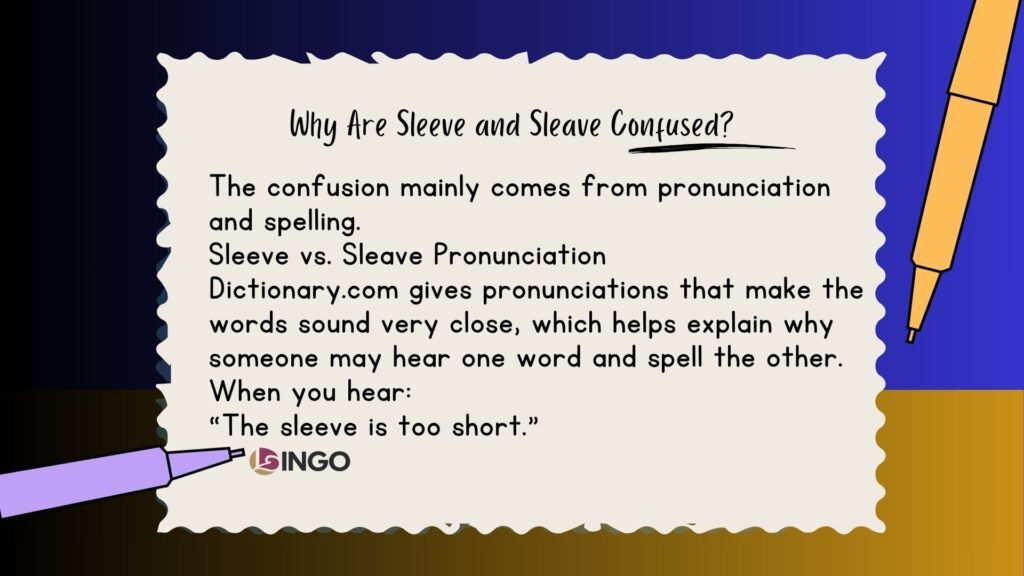
The confusion mainly comes from pronunciation and spelling.
Sleeve vs. Sleave Pronunciation
In ordinary English, sleeve is pronounced /sliːv/, with a long “ee” sound. Sleave has a similar pronunciation in its dictionary-listed senses. Dictionary.com gives pronunciations that make the words sound very close, which helps explain why someone may hear one word and spell the other.
When you hear:
“The sleeve is too short.”
you cannot depend entirely on sound to determine whether the spelling contains ee or ea.
That is where context becomes important.
The “EE” Memory Trick
A simple way to remember the spelling is:
Sleeve = clothing = EE
Think of the familiar word sleeve whenever you see or hear references to:
- shirts
- jackets
- coats
- dresses
- arms
- clothing
- fashion
So remember:
A shirt has a sleeve, not a sleave.
Is “Sleave” Just a Misspelling?
Not exactly.
This is an important distinction.
Sleave is a real word, so calling it simply a spelling error would be inaccurate. However, using sleave when you mean the part of a shirt or jacket covering the arm is incorrect.
Dictionary.com records sleave as a noun and verb associated with thread and silk rather than ordinary clothing.
Sleeve vs. Sleave Examples in Real Sentences
Seeing the words in context makes the difference much easier to understand.
Correct Examples With “Sleeve”
- The sleeve of my sweater is torn.
- She rolled up her sleeves.
- This shirt has short sleeves.
- The jacket sleeve is too tight.
- He pulled his hands into the sleeves of his coat.
- I need a protective sleeve for my tablet.
- The tailor adjusted the sleeves of the dress.
All of these examples use sleeve correctly.
Examples With “Sleave”
Because sleave is rare, you are much less likely to encounter it in ordinary conversation.
Examples include:
- The old textile description mentioned sleave silk.
- The historical passage used sleave to describe separated fibers.
The word is associated with specialized or historical textile terminology rather than everyday clothing.
A Simple Comparison
| Word | Meaning | Modern Usage | Example |
|---|---|---|---|
| Sleeve | Part of clothing covering the arm | Very common | The sleeve is too long. |
| Sleave | Tangled thread or separated silk fibers | Rare/historical | The text describes sleave silk. |
The key point is simple: the words have different meanings, even though they look and sound similar.
A Real-Life Writing Example: How One Letter Can Change the Meaning
Imagine that you are writing a product description for an online clothing store.
You want to describe a cotton shirt. Your original sentence reads:
“This shirt has comfortable long sleaves.”
At first glance, the sentence may look understandable. The reader can probably figure out what you mean. However, sleaves is not the standard plural of sleeve.
The corrected version is:
“This shirt has comfortable long sleeves.”
Now imagine the same mistake appearing throughout an online store. The product title might say “Long Sleave Shirt,” the description might mention “adjustable sleaves,” and the specifications might list “full sleave design.”
Although the meaning is still guessable, the spelling makes the business appear less polished.
This is especially important in professional writing because small spelling errors can affect how readers perceive the quality of a document. The same issue can appear in school assignments, resumes, blog posts, emails, social media captions, and product listings.
Now consider a different situation: you are reading an old textile document and encounter the word sleave. In that context, replacing it automatically with sleeve could actually change the historical meaning. Since sleave is a genuine word associated with thread and silk, context determines whether it is correct.
This example demonstrates an important lesson about English spelling: a word that looks like a mistake is not necessarily a mistake. Sometimes it is simply a rare word with a different meaning.
Sleeve vs. Sleave: What Current Language Data Tells Us
There is no reliable public 2025–2026 dataset that gives a precise worldwide count of people misspelling sleeve as sleave. Therefore, it would be misleading to invent a percentage or search-volume figure.
However, current dictionary and search resources provide useful evidence about the distinction.
Current 2026 Dictionary Evidence
As of 2026, major dictionary resources continue to distinguish the two forms:
- Sleeve is defined as the part of a garment covering the arm and also has several additional modern meanings.
- Sleave remains a dictionary-listed word associated with tangled thread, silk fibers, and separating fibers.
- Google Trends explains that its Explore tool can compare search terms and examine their popularity by location and related searches, but Trends data represents relative search interest rather than a simple worldwide count of users.
Google Books Ngram Viewer is another useful resource for studying historical word frequency. Its current documentation explains that its corpus displays how words and phrases occur in books and that its current data extends through 2022, so it should not be presented as 2025–2026 usage data.
What does this mean for everyday writers? The practical rule remains unchanged: when referring to clothing or a protective covering, choose sleeve.
Common Mistakes With Sleeve and Sleave
Knowing the common errors can help you avoid them.
Mistake 1: Using “Sleave” for Clothing
❌ The sleave of my shirt is dirty.
✅ The sleeve of my shirt is dirty.
Use sleeve for clothing.
Mistake 2: Writing “Sleaves” Instead of “Sleeves”
❌ This jacket has two sleaves.
✅ This jacket has two sleeves.
The plural of sleeve is sleeves.
Mistake 3: Assuming “Sleave” Is Always Wrong
❌ “Sleave isn’t a real English word.”
This statement is inaccurate.
✅ Sleave is a real but uncommon word connected with thread and silk.
Dictionary.com provides separate entries for both words.
Mistake 4: Trusting Pronunciation Alone
Because the words can sound alike, spelling them correctly requires attention to context.
If the subject is clothing, think:
sleeve → shirt → arm
If the subject is historical textiles or fibers, sleave may be relevant.
How to Remember the Correct Spelling
If you regularly confuse sleeve vs. sleave, use this three-step method.
Step 1: Identify the Context
Ask:
Am I talking about clothing or an arm covering?
If yes, use sleeve.
Step 2: Remember “EE”
Associate the spelling sleeve with common clothing words:
- sleeve
- sleeves
- sleeveless
- long-sleeved
This creates a useful spelling family.
Step 3: Check Before Publishing
If you are writing professionally and the word does not look right, check a reputable dictionary.
Cambridge Dictionary describes spelling as forming words with the correct letters in the correct order and recommends checking a dictionary when you are unsure about spelling.
Quick Checklist
Before you write the word, ask:
- Is it part of a shirt? → sleeve
- Is it part of a jacket? → sleeve
- Is it part of a coat? → sleeve
- Is it part of a dress? → sleeve
- Is it a protective covering? → sleeve
- Is it historical terminology for thread or silk? → sleave may be correct
Mini Quiz: Sleeve vs. Sleave
1. Which spelling is correct for the part of a shirt that covers the arm?
A) Sleeve
B) Sleave
C) Sleve
D) Sleev
Answer: A) Sleeve
2. She rolled up her ___ before washing the dishes.
A) Sleaves
B) Sleeves
C) Sleves
D) Sleevs
Answer: B) Sleeves
3. Which sentence is correctly spelled?
A) The sleave of my jacket is torn.
B) The sleve of my jacket is torn.
C) The sleeve of my jacket is torn.
D) The sleev of my jacket is torn.
Answer: C) The sleeve of my jacket is torn.
4. What does “sleave” mean in its rare traditional usage?
A) A shirt collar
B) Thread or silk fibers
C) A coat pocket
D) A jacket button
Answer: B) Thread or silk fibers
5. This dress has beautiful long ___.
A) Sleaves
B) Sleves
C) Sleeves
D) Sleevs
Answer: C) Sleeves
6. The tailor shortened the ___ of my coat.
A) Sleeve
B) Sleave
C) Sleve
D) Sleev
Answer: A) Sleeve
7. Which phrase is standard English?
A) Shirt sleave
B) Shirt sleve
C) Shirt sleeve
D) Shirt sleev
Answer: C) Shirt sleeve
8. Which sentence uses “sleave” in its rare textile sense?
A) The shirt has a blue sleave.
B) She rolled up her sleave.
C) The historical text mentions sleave silk.
D) The coat has two sleaves.
Answer: C) The historical text mentions sleave silk.
9. What is the correct plural of “sleeve”?
A) Sleaves
B) Sleeves
C) Sleves
D) Sleevs
Answer: B) Sleeves
10. Complete the expression: “I have something up my ___.”
A) Sleave
B) Sleeve
C) Sleve
D) Sleev
Answer: B) Sleeve
11. “Roll up your ___ and get to work.”
A) Sleaves
B) Sleeves
C) Sleves
D) Sleevs
Answer: B) Sleeves
12. Which spelling is correct for a protective covering for a laptop?
A) Sleave
B) Sleve
C) Sleeve
D) Sleev
Answer: C) Sleeve
13. Which sentence is correctly spelled?
A) His shirt has short sleaves.
B) His shirt has short sleves.
C) His shirt has short sleeves.
D) His shirt has short sleevs.
Answer: C) His shirt has short sleeves.
14. Which word is most appropriate in a modern clothing product description?
A) Sleave
B) Sleeve
C) Sleve
D) Sleev
Answer: B) Sleeve
15. Which sentence is correct?
A) The jacket sleave is too tight.
B) The jacket sleve is too tight.
C) The jacket sleeve is too tight.
D) The jacket sleev is too tight.
Answer: C) The jacket sleeve is too tight.
16. Which statement about “sleave” is accurate?
A) It is a rare English word.
B) It is the usual spelling of sleeve.
C) It is the plural of sleeve.
D) It means a shirt sleeve in modern English.
Answer: A) It is a rare English word.
17. Which spelling completes “long-___ shirt”?
A) Sleaved
B) Sleved
C) Sleeved
D) Sleeveed
Answer: C) Sleeved
18. She bought a short-___ top.
A) Sleaved
B) Sleved
C) Sleeved
D) Sleeveed
Answer: C) Sleeved
19. What is the easiest rule for choosing between “sleeve” and “sleave”?
A) Use sleeve for clothing.
B) Use sleave for all clothing.
C) Use sleave for jackets only.
D) Use both words interchangeably.
Answer: A) Use sleeve for clothing.
20. Which sentence contains the correct spelling?
A) I need a new sleave for my laptop.
B) I need a new sleve for my laptop.
C) I need a new sleeve for my laptop.
D) I need a new sleev for my laptop.
Answer: C) I need a new sleeve for my laptop.
21. Which option correctly distinguishes the two words?
A) Sleeve is common; sleave is rare.
B) Sleave is common; sleeve is rare.
C) They always have the same meaning.
D) Neither word is English.
Answer: A) Sleeve is common; sleave is rare.
22. The tailor repaired the torn ___.
A) Sleave
B) Sleve
C) Sleeve
D) Sleev
Answer: C) Sleeve
23. Which sentence correctly uses the plural form?
A) The coat has two sleaves.
B) The coat has two sleves.
C) The coat has two sleeves.
D) The coat has two sleevs.
Answer: C) The coat has two sleeves.
24. If you see “sleave” in an old textile document, what should you do?
A) Automatically change it to sleeve.
B) Assume it means jacket.
C) Assume it is always a typo.
D) Check its historical context.
Answer: D) Check its historical context.
25. Complete the memory tip: “Shirts have ___, not sleaves.”
A) Sleaves
B) Sleeves
C) Sleves
D) Sleevs
Answer: B) Sleeves
FAQs About Sleeve vs. Sleave
Q1:Is “sleeve” the correct spelling?
Yes. Sleeve is the standard modern spelling when you mean the part of a garment that covers the arm.
Q2:Is “sleave” a real word?
Yes. Sleave is a real but uncommon English word associated with tangled thread, silk fibers, and separating fibers.
Q3:Is it “shirt sleeve” or “shirt sleave”?
The correct phrase is shirt sleeve.
For example:
The shirt sleeve is too long.
Q4:What is the plural of sleeve?
The plural is sleeves.
Example:
My new jacket has long sleeves.
Q5:Are sleeve and sleave pronounced the same?
They can be pronounced the same or very similarly, depending on the word’s sense and pronunciation source. This similarity is one reason the spellings are easy to confuse.
Q6:Can I use “sleave” in modern English?
You can use it when you specifically mean its uncommon textile-related meaning. However, it should not replace sleeve when talking about clothing.
Q7:Why do people spell sleeve as sleave?
The main reason is that English spelling does not always make pronunciation predictable. Since sleeve and sleave can sound alike, writers may choose the wrong vowel combination when spelling the word from memory.
Q8:Which one should I use in everyday writing?
Use sleeve. It is the standard choice for clothing, protective coverings, and common expressions such as “up your sleeve.”
Conclusion: Sleeve vs. Sleave Made Simple
The difference between sleeve vs. sleave becomes easy once you focus on meaning.
Sleeve is the standard modern word for the part of a shirt, jacket, coat, dress, or other garment that covers the arm. It can also describe a protective or tubular covering.
Sleave is a genuine but rare word associated mainly with thread, silk, and tangled or separated fibers.
So, if you are talking about clothing, remember:
Shirts have sleeves, not sleaves.
When in doubt, look at the context before choosing the spelling. A quick dictionary check can also prevent an otherwise small spelling mistake from appearing in professional or published writing.
For more clear explanations of commonly confused English words and grammar rules, explore the other language guides on Lingorixa.
References

Maimoona Asghar is a grammar enthusiast and language writer who creates clear, practical content to help learners improve English grammar, writing, punctuation, and communication skills through easy-to-understand explanations and examples.