Have you ever typed cancellation vs cancelation and stopped because you were unsure which spelling was correct? You are not alone. The two forms look almost identical, and the difference is only one letter. However, that extra l matters when you want your writing to look polished and professional.
The good news is simple: cancellation is the standard and much more widely used spelling in both American and British English. Cancelation is also recognized as a variant, particularly in American English, but it is considerably less common.
In this guide, we will explain the difference between cancellation and cancelation, show how US and UK English handle the word, provide practical examples, and give you an easy way to remember the correct spelling.
Cancellation vs Cancelation: What Is the Difference?
The difference between cancellation and cancelation is primarily spelling, not meaning. Both nouns describe the act of stopping, calling off, withdrawing, or ending something that was planned or previously arranged.
For example, a flight can have a cancellation, a customer can request a cancellation, and a company can announce the cancellation of an event.
Cancellation Is the Standard Spelling
Cancellation is spelled with two l’s:
C-A-N-C-E-L-L-A-T-I-O-N
It is the usual spelling in both US and UK English. Merriam-Webster lists cancellation as the main noun entry and identifies cancelation as a less common variant.
Examples:
- The airline announced the cancellation of the flight.
- I received an email confirming my booking cancellation.
- The concert was postponed after the original cancellation.
- Please read the company’s cancellation policy before making a reservation.
Is Cancelation Correct?
Cancelation, with one l, is not simply a made-up spelling. It is recognized as a variant in some dictionaries, including Merriam-Webster. However, it is much less common than cancellation.
For most readers, especially in formal, academic, business, or published writing, cancellation is the safer choice.
For example:
Preferred: The cancellation of the meeting was announced yesterday.
Less common: The cancelation of the meeting was announced yesterday.
The meaning remains the same, but the first version is the form most readers expect.
Quick Comparison
| Feature | Cancellation | Cancelation |
|---|---|---|
| Spelling | Double l | Single l |
| Meaning | Act of canceling | Act of canceling |
| US English | Standard/common | Rare variant |
| UK English | Standard/common | Very uncommon |
| Formal writing | Recommended | Usually avoid |
| Academic writing | Recommended | Usually avoid |
| Business writing | Recommended | Recommended instead of cancelation |
| Best choice | Yes | Usually no |
American vs British English: Which Spelling Should You Use?
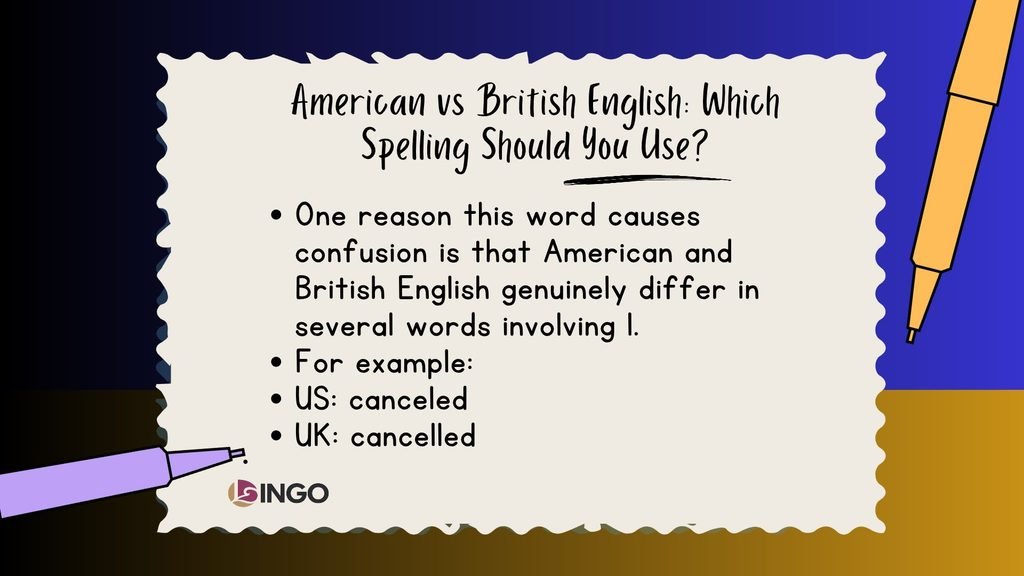
One reason this word causes confusion is that American and British English genuinely differ in several words involving l.
For example:
- US: canceled
- UK: cancelled
And:
- US: canceling
- UK: cancelling
However, cancellation is different. Both US and UK English commonly use the double-l spelling: cancellation. Merriam-Webster specifically notes that cancellation is the usual spelling everywhere, while cancelation is sometimes used.
Cancellation in American English
American English commonly uses:
- canceled
- canceling
- cancellation
For example:
The company canceled the event because of bad weather.
The cancellation was announced on Monday.
Notice that the verb has one l, but the noun has two.
This is perfectly normal.
Cancellation in British English
British English commonly uses:
- cancelled
- cancelling
- cancellation
For example:
The company cancelled the event because of bad weather.
The cancellation was announced on Monday.
Again, the noun remains cancellation.
Cambridge Dictionary defines cancellation as the act of deciding that an organized event will not happen or stopping an order, and gives the same noun form for UK and US pronunciation entries.
The Easy US vs UK Rule
Do not assume that every word connected to cancel follows the same spelling pattern.
| Word | US English | UK English |
|---|---|---|
| Verb | cancel | cancel |
| Past tense | canceled | cancelled |
| -ing form | canceling | cancelling |
| Noun | cancellation | cancellation |
So remember:
Canceled/cancelled can change. Cancellation normally does not.
Why Is Cancellation Spelled With Two Ls?
At first glance, cancel + ation might seem as though it should produce cancelation. That is why the one-l spelling looks logical to many writers.
However, English spelling is not always created by simply attaching a suffix to a word.
The Conventional Spelling Is Cancellation
The established noun form is:
cancel → cancellation
The spelling has been part of English usage for centuries. Merriam-Webster gives the first known use of cancellation as 1535, showing that the double-l noun is not a recent spelling preference.
English also contains many words whose derived forms cannot be predicted perfectly from a simple spelling formula. Historical development, pronunciation, morphology, and established usage all influence modern spelling.
Don’t Apply the Traveling Rule Here
Writers sometimes think:
American English removes an l, so American English must prefer cancelation.
That conclusion is misleading.
Compare:
- US traveling / UK travelling
- US modeled / UK modelled
- US canceled / UK cancelled
But:
- US cancellation / UK cancellation
Therefore, cancellation is one of the exceptions you simply need to remember.
A Simple Memory Trick
Use this:
Cancel + another L = cancellation
Or remember the common phrases:
- flight cancellation
- event cancellation
- order cancellation
- subscription cancellation
- appointment cancellation
- cancellation policy
Once you become familiar with these phrases, the spelling becomes much easier to remember.
When Should You Use Cancellation?
In almost every normal writing situation, cancellation is the best choice.
It works naturally in casual communication, professional documents, websites, academic writing, customer-service messages, policies, and formal notices.
Business and Professional Writing
Use cancellation in business communication:
We received your cancellation request this morning.
Please provide 24 hours’ notice for appointment cancellation.
The company issued a notice regarding the cancellation of the contract.
Using the standard spelling helps your writing appear polished and consistent.
Travel and Booking Situations
The word is particularly common when discussing travel:
We received a flight cancellation notice.
The hotel has a strict cancellation policy.
Passengers were informed about the cancellation before boarding.
The airline offered a refund following the cancellation.
Academic and Formal Writing
For school assignments, reports, essays, and research-related writing, cancellation is the sensible choice:
The cancellation of the experiment affected the research schedule.
Researchers discussed the cancellation of the planned study.
The cancellation resulted in a change to the project timeline.
Using the standard form avoids distracting readers with an uncommon spelling variant.
2025–2026 Data & Usage Snapshot
Current evidence from 2025–2026 continues to support cancellation as the dominant standard form, although cancelation remains recognized as a variant.
1. Merriam-Webster Still Lists Cancellation First
Merriam-Webster’s current dictionary entry gives cancellation as the main noun and lists cancelation as a less common variant. The entry was updated in February 2026, and its recent example sentences continue to use cancellation extensively.
2. The Word Has a Long Recorded History
Merriam-Webster records the first known use of cancellation in 1535. That makes the standard double-l spelling a long-established form rather than a modern editorial preference.
3. A 2026 Government Publishing Example
A particularly useful real-world example comes from the Maryland State Highway Administration’s 2026 Standard Specifications release materials. The release memo states that the spelling of “cancelation” in one section was corrected to “cancellation.”
This is useful evidence for professional writing: even in an official technical publication, the double-l form was selected as the corrected spelling.
What Does the Data Tell Us?
There is no single authoritative 2025–2026 global corpus percentage that establishes an exact US-versus-UK ratio for these two spellings. However, current dictionary evidence and recent official usage strongly support this practical conclusion:
Cancellation is the established default; cancelation is a recognized but uncommon variant.
For writers who want the safest spelling across international audiences, cancellation is the clear choice.
Real-Life Case Study: A 2026 Government Document
Consider the 2026 Standard Specifications materials published by the Maryland State Highway Administration. In its release memorandum, the agency identified a terminology correction in its specifications: the spelling “cancelation” was changed to “cancellation.” The document specifically describes this as a correction of spelling.
This example is valuable because it shows the issue outside a grammar blog or classroom exercise. Government specifications are designed to communicate technical requirements clearly and consistently. A spelling correction in such a document demonstrates why standard forms matter in professional communication.
Imagine a contractor, engineer, or project manager reading a specification containing the phrase “cancelation.” The meaning would still be understandable, but the less familiar spelling could look like an editorial error. Replacing it with cancellation removes that distraction.
The lesson applies to everyday writing as well. If you are preparing a company policy, website page, customer email, academic assignment, contract-related document, or technical report, choosing cancellation gives readers the form they are most likely to recognize immediately.
This does not mean cancelation has no dictionary status. Rather, it shows the practical difference between a recognized variant and the spelling that is normally preferred in polished writing.
Common Mistakes With Cancellation and Cancelation
Understanding a few common errors can help you avoid them permanently.
Mistake 1: Assuming US English Always Uses One L
American English does commonly use canceled and canceling, but that does not mean the noun must be cancelation.
Correct:
The airline canceled the flight because of the storm.
The flight cancellation caused major delays.
Mistake 2: Writing Cancelation in Formal Documents
Because cancelation is recognized as a variant, a spell-checker may not always flag it. However, cancellation is the more familiar and standard choice.
Instead of:
Please review our cancelation policy.
Use:
Please review our cancellation policy.
Mistake 3: Mixing Spellings
Consistency is important when writing for a professional audience.
Avoid switching between:
cancellation
cancelation
cancellation
cancelation
Choose cancellation and use it consistently.
Mistake 4: Confusing Cancellation With Canceled
These are different grammatical forms:
- cancel — verb
- canceled/cancelled — past-tense verb
- canceling/cancelling — present participle
- cancellation — noun
For example:
The company canceled the event.
The event’s cancellation surprised everyone.
A Simple Step-by-Step Guide to Choosing the Right Spelling
If you are unsure while writing, use this quick process.
Step 1: Identify the Word Form
Ask whether you need the noun.
If you are talking about the act or event of canceling something, you need the noun cancellation.
Step 2: Check the Number of Ls
Write:
cancellation
Not:
cancelation
Step 3: Consider Your Audience
Whether your audience uses American or British English, cancellation is the safest standard form.
Step 4: Check Related Forms Separately
Remember:
US English:
- canceled
- canceling
- cancellation
UK English:
- cancelled
- cancelling
- cancellation
Step 5: Keep Your Style Consistent
If your article, website, policy, or document uses US English, maintain US conventions elsewhere. If it uses UK English, maintain UK conventions elsewhere.
The important point is that cancellation itself normally stays with two l’s.
Cancellation vs Cancelation: Final Comparison
| Question | Answer |
|---|---|
| Which spelling is standard? | Cancellation |
| Is cancellation used in US English? | Yes |
| Is cancellation used in UK English? | Yes |
| Is cancelation recognized? | Yes, as a less common variant |
| Does cancelation have a different meaning? | No |
| Should I use cancelation in formal writing? | Usually no |
| Is canceled different from cancellation? | Yes |
| Is cancelled different from cancellation? | Yes |
| Best spelling for a global audience? | Cancellation |
| Best spelling for business writing? | Cancellation |
Mini Quiz:Cancellation vs Cancelation
1. Which spelling is the standard form in both American and British English?
A) Cancellation
B) Cancelation
C) Cancallation
D) Cancellasion
Answer: A) Cancellation
2. Which sentence uses the preferred spelling?
A) The airline announced the cancellation of the flight.
B) The airline announced the cancelation of the flight.
C) The airline announced the cancellasion of the flight.
D) The airline announced the cancelllation of the flight.
Answer: A) The airline announced the cancellation of the flight.
3. Which spelling is generally recommended for formal business writing?
A) Cancellation
B) Cancelation
C) Cancallation
D) Cancellasion
Answer: A) Cancellation
4. Complete the sentence: “Please review our ______ policy before booking.”
A) cancellation
B) cancelation
C) cancellasion
D) cancallation
Answer: A) cancellation
5. Which statement about “cancelation” is accurate?
A) It is a recognized but less common variant.
B) It is the only British spelling.
C) It has a completely different meaning.
D) It is never found in dictionaries.
Answer: A) It is a recognized but less common variant.
6. Which sentence correctly uses the common US past tense and standard noun?
A) The company canceled the event after the cancellation request.
B) The company cancelled the event after the cancelation request.
C) The company cancelld the event after the cancellation request.
D) The company cancled the event after the cancelation request.
Answer: A) The company canceled the event after the cancellation request.
7. Which sentence correctly uses the common UK past tense and standard noun?
A) The company cancelled the event after the cancellation request.
B) The company canceled the event after the cancelation request.
C) The company cancellled the event after the cancellation request.
D) The company cancelld the event after the cancellation request.
Answer: A) The company cancelled the event after the cancellation request.
8. Which spelling should you normally choose for a website’s cancellation policy?
A) cancellation
B) cancelation
C) cancellasion
D) cancallation
Answer: A) cancellation
9. Which phrase is spelled correctly?
A) flight cancellation
B) flight cancelation
C) flight cancellasion
D) flight cancelllation
Answer: A) flight cancellation
10. Which spelling is preferred in academic writing?
A) cancellation
B) cancelation
C) cancellasion
D) cancallation
Answer: A) cancellation
11. What is the plural of “cancellation”?
A) cancellations
B) cancelations
C) cancellationes
D) cancellationss
Answer: A) cancellations
12. Which form normally completes the phrase “appointment ______”?
A) cancellation
B) cancelation
C) cancellasion
D) cancallation
Answer: A) cancellation
13. Which sentence is most appropriate for a formal customer-service email?
A) We received your cancellation request.
B) We received your cancelation request.
C) We received your cancellasion request.
D) We received your cancelllation request.
Answer: A) We received your cancellation request.
14. Which statement about US English is correct?
A) Cancellation is commonly used in US English.
B) Cancelation is the only accepted US form.
C) Cancellation is only British English.
D) Neither spelling is used in US English.
Answer: A) Cancellation is commonly used in US English.
15. Which statement about British English is correct?
A) Cancellation is the standard noun form.
B) Cancelation is the standard noun form.
C) Cancellasion is the standard noun form.
D) Cancallation is the standard noun form.
Answer: A) Cancellation is the standard noun form.
16. Which pair correctly shows common US English usage?
A) canceled — cancellation
B) cancelled — cancelation
C) canceled — cancelation only
D) cancelled — cancellation only
Answer: A) canceled — cancellation
17. Which pair correctly shows common UK English usage?
A) cancelled — cancellation
B) canceled — cancelation
C) cancelled — cancelation only
D) cancled — cancellation
Answer: A) cancelled — cancellation
18. Which sentence contains the preferred spelling?
A) The concert’s cancellation disappointed many fans.
B) The concert’s cancelation disappointed many fans.
C) The concert’s cancellasion disappointed many fans.
D) The concert’s cancelllation disappointed many fans.
Answer: A) The concert’s cancellation disappointed many fans.
19. What is the safest spelling for an international English audience?
A) cancellation
B) cancelation
C) cancellasion
D) cancallation
Answer: A) cancellation
20. Which word is the noun meaning the act of canceling something?
A) cancellation
B) cancelled
C) canceling
D) cancel
Answer: A) cancellation
21. Which sentence correctly uses “cancellation” as a noun?
A) The flight cancellation caused major delays.
B) The flight cancel caused major delays.
C) The flight canceled caused major delays.
D) The flight canceling caused major delays.
Answer: A) The flight cancellation caused major delays.
22. Which spelling should normally appear in “subscription ______”?
A) cancellation
B) cancelation
C) cancellasion
D) cancallation
Answer: A) cancellation
23. Why can writers find “cancelation” confusing?
A) It is a recognized variant that looks plausible.
B) It has a completely different meaning.
C) It is the plural of cancellation.
D) It is the British past tense of cancel.
Answer: A) It is a recognized variant that looks plausible.
24. Which spelling is best for a formal cancellation notice?
A) cancellation
B) cancelation
C) cancellasion
D) cancallation
Answer: A) cancellation
25. Complete the rule: Cancel → ______
A) cancellation
B) cancelation only
C) cancellasion
D) cancallation
Answer: A) cancellation
Quick Score Guide
- 23–25: Excellent! 🌟 You have mastered the difference.
- 20–22: Very good! You understand the main rule.
- 16–19: Good progress! Review US vs UK usage once more.
- 10–15: Keep practicing the spelling and related verb forms.
- Below 10: Revisit the rule: cancellation is the preferred standard spelling.
FAQs About Cancellation vs Cancelation
Q1:Is cancellation or cancelation correct?
Cancellation is the standard and much more widely used spelling. Cancelation is recognized as a less common variant, particularly in American English. Merriam-Webster lists cancellation as the main form and cancelation as a less common variant.
Q2:s cancelation an American spelling?
Cancelation can occur in American English, but it is not the usual spelling. Cancellation remains the standard and more common choice in American English.
Q3:Does British English use cancellation?
Yes. Cancellation is the standard spelling in British English.
Q4:Does American English use cancellation?
Yes. American English commonly uses cancellation, even though American spelling generally uses canceled and canceling with one l. Merriam-Webster specifically describes cancellation as the usual spelling everywhere.
Q5:Why does cancellation have two Ls?
Cancellation is the established conventional noun form of cancel. Its spelling has a long history in English, with Merriam-Webster recording its first known use in 1535.
Q6:Is “cancelation” a spelling mistake?
Not necessarily. Cancelation is recognized as a variant spelling in some dictionaries. However, it is much less common than cancellation, so the double-l form is generally the better choice.
Q7:Which spelling should I use in formal writing?
Use cancellation. It is the safest choice for business emails, academic writing, websites, policies, professional documents, and international audiences.
Q8:What is the plural of cancellation?
The plural is cancellations.
For example:
The airline reported several cancellations after the storm.
Conclusion: Cancellation Is the Best Choice
When deciding between cancellation vs cancelation, the easiest answer is to choose cancellation with two l’s.
Although cancelation is recognized as a less common variant, cancellation is the standard form used in both American and British English. It is especially appropriate for professional, academic, formal, and customer-facing writing.
The key thing to remember is that the noun does not follow the same US/UK pattern as canceled/cancelled or canceling/cancelling. In most situations, write:
Cancel → cancellation
So whether you are writing about a flight cancellation, event cancellation, subscription cancellation, appointment cancellation, or cancellation policy, cancellation is the spelling to choose.
For more clear explanations of commonly confused English words and grammar rules, explore the other language guides on Lingorixa
References

Maimoona Asghar is a grammar enthusiast and language writer who creates clear, practical content to help learners improve English grammar, writing, punctuation, and communication skills through easy-to-understand explanations and examples.