If you are unsure whether cheer or chear is the correct spelling, you are not alone. These words look almost identical, but only one is the standard spelling used in modern English. Cheer is the correct word for expressing support, encouragement, happiness, or approval, while chear is generally considered an incorrect spelling in modern standard English.
In this guide, you will learn the difference between cheer vs. chear, what cheer means, how to use it correctly in sentences, and why chear should usually be avoided.
Cheer vs. Chear: Which Spelling Is Correct?
Cheer is the correct spelling
Cheer is the standard modern English spelling. It can function as both a verb and a noun.
As a verb, cheer can mean to shout in support of someone, encourage someone, or make someone happier. Oxford defines the verb as shouting to show support, praise, or encouragement.
Examples:
- The fans cheered for their team.
- We cheered when she won the competition.
- Her kind words cheered me up.
- Everyone cheered as the performers entered the stage.
Examples:
As a noun, cheer can refer to a shout or expression of support, happiness, or approval.
- A loud cheer came from the crowd.
- The team received a huge cheer from its supporters.
- Three cheers for the winning team!
Chear is not the standard spelling
Chear is not the spelling you should normally use in contemporary standard English. If you want to describe encouragement, applause, happiness, or enthusiastic support, use cheer.
For example:
❌ The crowd gave a loud chear.
✅ The crowd gave a loud cheer.
Therefore, when deciding between cheer vs. chear, choose cheer in ordinary modern English writing.
What Does Cheer Mean?
Cheer as a verb
The verb cheer has several closely related meanings.
First, it can mean to shout or make a loud expression of support or approval.
Example:
The students cheered when their teacher announced the holiday.
It can also mean to encourage someone.
Example:
Her friends cheered her on during the race.
Oxford specifically recognizes cheer somebody on as a phrase meaning to give someone shouts of encouragement during a competition or similar activity.
Finally, cheer can mean to make someone feel happier, more hopeful, or encouraged.
Example:
The good news cheered him after a difficult week.
Cheer as a noun
As a noun, cheer can mean a shout of approval, encouragement, or joy.
Examples:
- The crowd erupted into cheers.
- We heard a loud cheer from the stadium.
- Her speech received a warm cheer.
- The children gave three cheers for their coach.
Oxford also lists cheer as a noun for a special song or poem used by cheerleaders and, in formal or literary usage, an atmosphere of happiness.
Cheer vs. Chear in simple terms
| Word | Standard modern English? | Meaning |
|---|---|---|
| Cheer | Yes | Support, encouragement, a joyful shout, or making someone happier |
| Chear | Generally no | Usually a misspelling of cheer |
The easiest rule is simple: Use cheer, not chear.
Common Uses of Cheer in Everyday English
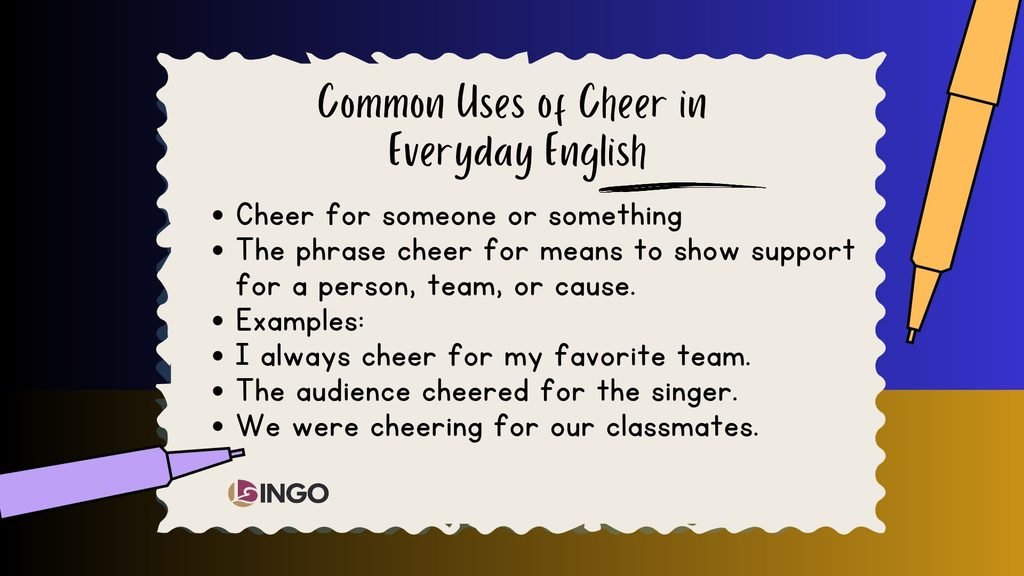
Cheer for someone or something
The phrase cheer for means to show support for a person, team, or cause.
Examples:
- I always cheer for my favorite team.
- The audience cheered for the singer.
- We were cheering for our classmates.
Cheer someone on
Cheer someone on means to encourage someone, especially during a competition or difficult activity.
Examples:
- Her parents cheered her on during the marathon.
- We stood beside him and cheered him on.
- The crowd cheered the runners on.
Cheer someone up
Cheer someone up means to make someone feel happier.
Oxford defines cheer up as becoming more cheerful or making another person or thing more cheerful.
Examples:
- I called my friend to cheer her up.
- This funny movie always cheers me up.
- His message cheered me up after a stressful day.
Cheerful
The adjective cheerful is also related to cheer. It describes someone or something that is happy, positive, or pleasant.
Examples:
- She has a very cheerful personality.
- The room looks bright and cheerful.
- He gave me a cheerful smile.
Oxford describes cheerful as happy and showing that happiness through one’s behavior.
Cheer vs. Chear: Real-Life Example
A student preparing for a school competition
Imagine a student named Sara preparing for an important school speaking competition. She has practiced her speech for several days, but she feels nervous before going on stage.
Her classmates gather in the audience to support her. When Sara walks onto the stage, they clap and cheer loudly. Their support helps her feel more confident.
During the speech, Sara briefly forgets one of her lines. Instead of becoming discouraged, she looks toward her friends. They smile and quietly cheer her on. She takes a breath, remembers her next point, and continues.
When Sara finishes, the audience gives her a huge cheer. Her teacher congratulates her, and Sara feels much happier about her performance.
Someone describing the event might write:
“Sara’s classmates cheered her on throughout the competition.”
It would be incorrect in standard modern English to write:
“Sara’s classmates cheared her on.”
This example demonstrates the different forms of cheer in natural English. The word can describe the action of supporting someone, the sound made by supporters, or the emotional effect of encouragement. The spelling remains cheer in each case.
This is also why recognizing common word patterns is useful. Once you know cheer, related forms such as cheered, cheering, cheers, cheerful, cheerfully, cheer on, and cheer up become easier to recognize and use.
Why Do People Write Chear Instead of Cheer?
Pronunciation can cause confusion
One reason people may write chear is that the pronunciation of cheer does not make the spelling immediately obvious to every English learner.
English has many words whose pronunciation cannot be predicted perfectly from their spelling. Learners may therefore spell a familiar sound according to what they think they hear.
For example:
❌ She tried to chear me up.
✅ She tried to cheer me up.
The correct spelling must be learned and remembered.
Similar-looking words can create spelling mistakes
English contains many words with similar vowel combinations, so it is easy to confuse spelling patterns.
However, cheer follows the standard spelling used in dictionaries and everyday English.
Cambridge also defines cheer as shouting to show approval or encourage someone and gives cheer as the noun for a shout of approval or encouragement.
Historical spelling does not change modern usage
Readers may occasionally encounter unusual or older spellings in historical texts. That does not mean those spellings are appropriate for contemporary everyday English.
For modern emails, essays, websites, school assignments, professional writing, and social media, cheer is the spelling to use.
Cheer vs. Chear: Quick Comparison Guide
| Feature | Cheer | Chear |
|---|---|---|
| Standard modern spelling | Yes | No |
| Can be a verb | Yes | No in standard modern usage |
| Can be a noun | Yes | No in standard modern usage |
| Means encouragement | Yes | No |
| Means a joyful shout | Yes | No |
| Used in “cheer up” | Yes | No |
| Used in “cheer on” | Yes | No |
| Recommended in formal writing | Yes | No |
Easy way to remember the spelling
Think of the familiar expression:
Cheer up!
If you remember cheer up, you can use the same spelling whenever you need the word.
Cheer = correct
Chear = usually incorrect
2025–2026 Search and Content Context
Why clear spelling answers still matter
Spelling questions may look simple, but they are useful examples of how people use online search to resolve everyday language problems.
A 2025 Pew Research Center study reported that the vast majority of surveyed respondents conducted searches using a search engine, and 58% had at least one search that produced an AI-generated summary alongside traditional results.
A separate 2025 survey discussed by Pew in 2026 found that 28% of U.S. adults said they typically turned first to search engines such as Google or Bing when seeking more information about a breaking-news event. This figure is about news rather than language searches, so it should not be interpreted as a measurement of how often people search spelling questions.
The broader takeaway for language content is that people continue to use online search to find quick answers to information needs. For a spelling query such as “cheer vs chear,” a useful page should therefore give the answer immediately, explain the distinction, and provide examples that readers can apply.
Google’s own guidance emphasizes helpful, reliable, people-first content that provides substantial value rather than content created primarily to manipulate search rankings.
Common Mistakes With Cheer
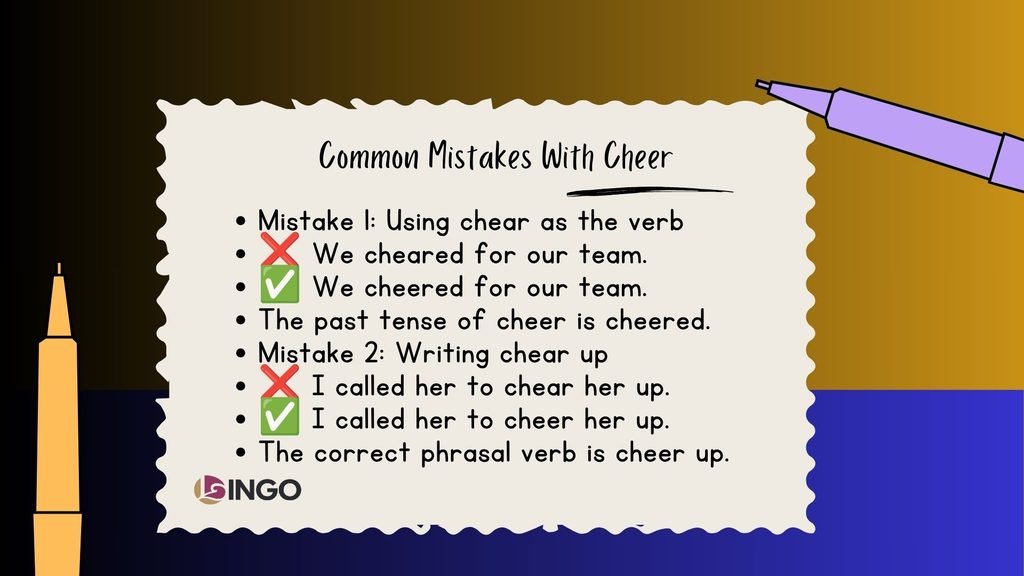
Mistake 1: Using chear as the verb
❌ We cheared for our team.
✅ We cheered for our team.
The past tense of cheer is cheered.
Mistake 2: Writing chear up
❌ I called her to chear her up.
✅ I called her to cheer her up.
The correct phrasal verb is cheer up.
Mistake 3: Confusing cheer with a simple shout
Not every loud shout is necessarily a cheer. A cheer usually communicates support, approval, encouragement, or joy.
Compare:
“Stop!” he shouted.
with:
“Go team!” the crowd cheered.
The first expresses a command, while the second expresses support or encouragement.
Mistake 4: Forgetting the double-e spelling
A useful visual reminder is:
ch + ee + r = cheer
The middle of the word contains ee, not ea.
How to Use Cheer Correctly
Step 1: Decide what you mean
If you mean support, encouragement, approval, or a joyful shout, cheer is probably the word you need.
Step 2: Check the spelling
Use:
cheer
Not:
chear
Step 3: Choose the correct form
| Meaning | Correct form | Example |
|---|---|---|
| Present verb | cheer | We cheer for our team. |
| Third-person verb | cheers | She cheers loudly. |
| Past tense | cheered | They cheered after the goal. |
| -ing form | cheering | Everyone was cheering. |
| Noun | cheer | We heard a loud cheer. |
| Encouragement | cheer on | They cheered him on. |
| Make happier | cheer up | The gift cheered her up. |
| Adjective | cheerful | He has a cheerful personality. |
Step 4: Read the sentence aloud
If you are unsure whether your sentence makes sense, read it aloud and consider its meaning.
For example:
“The fans cheered for the players.”
This clearly communicates that the fans were showing support.
Mini Quiz : Cheer vs. Chear
1. Which spelling is correct in modern English?
A. Chear
B. Cheer
C. Chere
D. Cheeer
Answer: B — Cheer
2. Which sentence is correct?
A. The fans cheared loudly.
B. The fans cheerd loudly.
C. The fans cheered loudly.
D. The fans cheerred loudly.
Answer: C — The fans cheered loudly.
3. Is “cheer” a standard English word?
A. Yes
B. No
Answer: A — Yes
4. What does “cheer” commonly mean as a verb?
A. To ignore someone
B. To criticize someone
C. To encourage or support someone
D. To confuse someone
Answer: C — To encourage or support someone
5. Which phrase is correct?
A. Chear someone on
B. Cheer someone on
C. Cheer someone in
D. Chear someone over
Answer: B — Cheer someone on
6. What does “cheer someone up” mean?
A. Make someone angry
B. Make someone leave
C. Make someone happier
D. Make someone tired
Answer: C — Make someone happier
7. What is the correct past tense of “cheer”?
A. Cheared
B. Cheerd
C. Cheerred
D. Cheered
Answer: D — Cheered
8. Which sentence is correct?
A. We chear for our team.
B. We cheerd for our team.
C. We cheer for our team.
D. We cheerred for our team.
Answer: C — We cheer for our team.
9. True or False: “Chear” is the standard modern spelling.
Answer: False
10. Which sentence uses “cheer” as a noun?
A. They cheer for us.
B. They cheered for us.
C. They are cheering for us.
D. We heard a loud cheer.
Answer: D — We heard a loud cheer.
11. Which sentence is correct?
A. Her friends cheared her on.
B. Her friends cheerd her on.
C. Her friends cheered her on.
D. Her friends cheerred her on.
Answer: C — Her friends cheered her on.
12. Which word is correctly related to “cheer”?
A. Chearful
B. Cheerful
C. Cheerfull
D. Chearfull
Answer: B — Cheerful
13. Complete the sentence: “The good news ______ me up.”
A. cheared
B. cheerd
C. cheerred
D. cheered
Answer: D — cheered
14. What can “cheer” refer to as a noun?
A. A vehicle
B. A building
C. A supportive or joyful shout
D. A type of food
Answer: C — A supportive or joyful shout
15. Which spelling contains the correct vowel combination?
A. chear
B. chere
C. cheer
D. chier
Answer: C — cheer
16. Which sentence is correctly spelled?
A. The crowd began chearing.
B. The crowd began cheerd.
C. The crowd began cheering.
D. The crowd began cheerred.
Answer: C — The crowd began cheering.
17. True or False: “Cheer” contains two consecutive e’s.
Answer: True
18. Which expression is correct?
A. Three chears for the winner!
B. Three chiers for the winner!
C. Three cheers for the winner!
D. Three chares for the winner!
Answer: C — Three cheers for the winner!
19. Which sentence uses “cheer” as a verb?
A. We heard a cheer.
B. We cheer for our school.
C. The cheer was loud.
D. Her cheerful smile was lovely.
Answer: B — We cheer for our school.
20. Which sentence is correct?
A. I tried to chear her up.
B. I tried to cheerd her up.
C. I tried to cheerred her up.
D. I tried to cheer her up.
Answer: D — I tried to cheer her up.
21. What is the correct -ing form of “cheer”?
A. Chearing
B. Cheerred
C. Cheering
D. Cheeringg
Answer: C — Cheering
22. Which sentence contains an incorrect spelling?
A. The crowd cheered loudly.
B. We cheer for our team.
C. She cheered me up.
D. They cheared for the players.
Answer: D — “Cheared” should be “cheered.”
23. Which sentence is correct?
A. His friends cheared him on.
B. His friends cheard him on.
C. His friends cheered him on.
D. His friends cheerd him on.
Answer: C — His friends cheered him on.
24. Complete the sentence: “Her kind words ______ me up.”
A. chear
B. cheard
C. cheerred
D. cheered
Answer: D — cheered
25. What is the easiest rule to remember?
A. Use “chear” for sports.
B. Both spellings are always interchangeable.
C. Use “chear” in formal writing.
D. Use “cheer” in standard modern English.
Answer: D — Use “cheer” in standard modern English.
Frequently Asked Questions About Cheer vs. Chear
Q1:Is cheer or chear correct?
Cheer is the correct standard modern English spelling. Chear should generally be treated as a spelling mistake in contemporary writing.
Q2:What does cheer mean?
Cheer can mean to shout in support or approval, encourage someone, or make someone happier. As a noun, it can mean a shout expressing support, happiness, or approval.
Q3:Is chear a word?
Chear is not the standard spelling used for the modern English meanings normally associated with cheer. In everyday contemporary writing, use cheer.
Q4:What is the past tense of cheer?
The past tense of cheer is cheered.
Example:
The crowd cheered when the player scored.
Q5:What is the difference between cheer and cheer up?
Cheer can mean to support or encourage someone, while cheer up means to become happier or make someone happier.
Examples:
The fans cheered for the team.
I told a joke to cheer her up.
Q6:What does cheer someone on mean?
Cheer someone on means to encourage someone with supportive words, sounds, or actions, especially during a race, competition, or difficult task.
Q7:Is “cheered” spelled with one or two e’s?
It is spelled cheered, with ee in the base word:
cheer → cheered
Q8:How can I remember cheer vs. chear?
Remember the common expression “cheer up.” The word cheer is spelled with ee, not ea.
Conclusion: Cheer vs. Chear
When choosing between cheer vs. chear, the answer is straightforward: cheer is the correct spelling for modern standard English.
Use cheer when you mean to show support, encouragement, approval, or happiness. It can also describe the joyful sound made by a group of people. Common expressions include cheer for, cheer on, and cheer up.
For example:
The crowd cheered for the winning team.
Her friends cheered her on during the race.
The good news cheered him up.
Avoid chear in normal contemporary writing. If you are writing an email, article, essay, school assignment, social media post, or professional document, cheer is the spelling you want.
For more clear explanations of commonly confused English words and grammar rules, explore the other language guides on Lingorixa.
References

Maimoona Asghar is a grammar enthusiast and language writer who creates clear, practical content to help learners improve English grammar, writing, punctuation, and communication skills through easy-to-understand explanations and examples.