Introduction
If someone sends you “TYSM” and you are wondering what those four letters mean, the answer is simple: TYSM means “Thank You So Much.” It is a common abbreviation used in texting, chats, social media, and other forms of informal online communication.
You might see TYSM after someone receives a favor, compliment, gift, helpful information, or emotional support. It saves time while still communicating appreciation.
But does TYSM always sound the same? Is it appropriate in professional messages? And what should you say when someone sends you “TYSM”?
This guide explains the TYSM meaning in text, shows real examples, compares it with similar expressions, and gives you natural replies you can use in different situations.
What Does TYSM Mean in Text?
TYSM Meaning in Text: The Simple Definition
TYSM means “Thank You So Much.”
It is an informal abbreviation used to express gratitude or appreciation in digital conversations. Collins English Dictionary lists TYSM as an abbreviation for “thank you so much” in messaging and social media.
The letters represent:
- T = Thank
- Y = You
- S = So
- M = Much
So:
TYSM = Thank You So Much
For example:
Alex: I sent you the notes from today’s class.
Sam: TYSM! I really needed them.
In this conversation, Sam is simply expressing strong appreciation.
Is TYSM an Acronym or Abbreviation?
TYSM is commonly called an acronym, abbreviation, or texting shorthand. More precisely, it functions as an initialism because it is formed from the initial letters of the words in “Thank You So Much.”
The technical label matters less in everyday conversation than knowing how the expression is used.
Is TYSM Positive?
Yes. TYSM normally communicates gratitude, appreciation, or thanks.
For example:
“TYSM for helping me!”
“Aww, tysm!”
“TYSM for remembering my birthday.”
However, as with many expressions, context can occasionally change the tone. In a sarcastic conversation, someone could use TYSM ironically. Therefore, always consider the surrounding message rather than interpreting the abbreviation in isolation.
How Is TYSM Used in Texting and Social Media?
TYSM in Chat
The TYSM meaning in chat is usually straightforward. People use it when they want to thank someone quickly.
Common situations include:
- Receiving help
- Getting useful information
- Receiving a compliment
- Getting a favor
- Receiving a gift
- Being given directions
- Receiving emotional support
- Getting an answer to a question
For example:
Friend: Here’s the link to the article you needed.
You: TYSM!
Or:
Friend: I saved you a seat.
You: Tysm! ❤️
TYSM on Social Media
TYSM is also useful in social-media conversations, especially in comments and direct messages.
For example:
Follower: Your tutorial helped me so much!
Creator: TYSM! I’m glad it helped.
Or:
Friend: Your new profile picture looks great!
You: Aww, tysm 😊
The meaning remains the same, although punctuation and emojis can make the message feel more enthusiastic or affectionate.
What Do TYSM, tysm, and TYSM!! Mean?
Capitalization usually does not change the basic definition.
| Version | Typical impression |
|---|---|
| TYSM | Clear and appreciative |
| tysm | Casual and relaxed |
| Tysm | Casual/standard mixed capitalization |
| TYSM! | Enthusiastic |
| TYSM!! | Very enthusiastic |
| tysm 😊 | Warm and friendly |
| tysm ❤️ | Warm or affectionate |
These are tendencies rather than strict rules. The relationship between the people and the rest of the conversation matter more than capitalization.
TYSM vs. Similar Texting Abbreviations
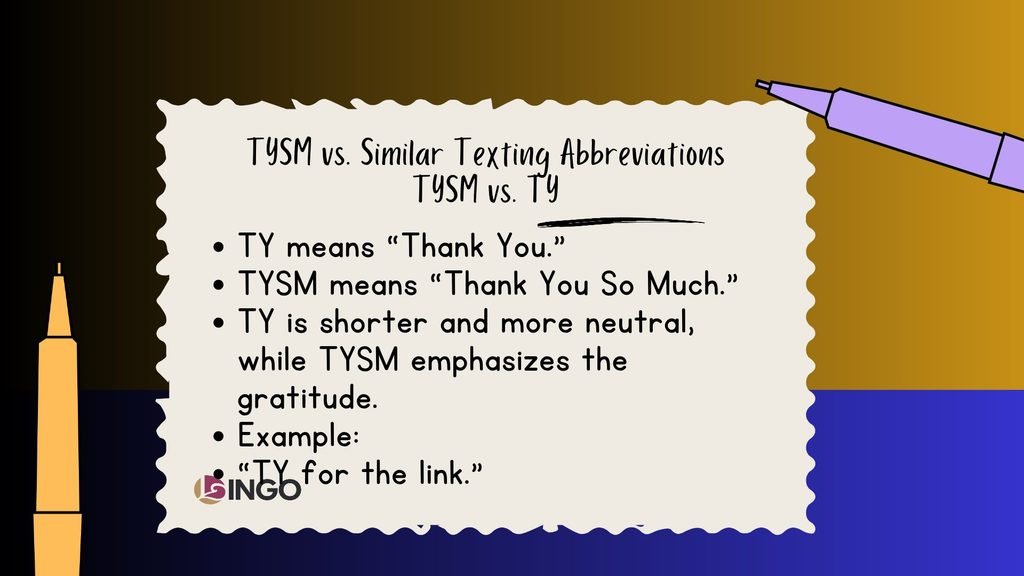
TYSM vs. TY
TY means “Thank You.”
TYSM means “Thank You So Much.”
TY is shorter and more neutral, while TYSM emphasizes the gratitude.
Example:
“TY for the link.”
“TYSM for taking the time to explain everything!”
Both are correct in casual messaging, but the second sounds more emphatic.
TYSM vs. TYVM
TYVM means “Thank You Very Much.”
It has essentially the same purpose as TYSM, although the wording is different.
| Expression | Full meaning | General tone |
|---|---|---|
| TY | Thank You | Brief, casual |
| TYSM | Thank You So Much | Warm, appreciative |
| TYVM | Thank You Very Much | Appreciative |
| Thanks | Thanks | Casual |
| Thank you | Thank you | Neutral and widely appropriate |
TYSM vs. “Thank You So Much”
The meaning is the same. The main difference is formality and length.
TYSM!
is suitable for a quick text.
Thank you so much for your help.
is more complete and can work in situations where a polished sentence is preferable.
When Should You Use TYSM?
Appropriate Situations for TYSM
TYSM is generally appropriate for informal digital communication.
You can comfortably use it with:
- Friends
- Family
- Classmates
- Online friends
- Social-media followers
- People you know casually
For example:
“TYSM for sending me the pictures!”
“TYSM for helping with my assignment!”
“Aww, tysm for the birthday wishes!”
When Should You Avoid TYSM?
Although TYSM is easy to understand, it is still informal.
In formal communication, consider writing the complete phrase instead.
Informal:
“TYSM for your help!”
Professional:
“Thank you very much for your assistance.”
For a business email, formal application, official letter, academic communication, or other professional document, spelling out your thanks is usually the safer choice.
Does TYSM Work in Professional Chats?
It depends on the workplace and communication culture.
In a relaxed team chat, someone might write:
“TYSM for sending the report!”
In a formal email, however, this would usually be better:
“Thank you very much for sending the report.”
The important distinction is not whether TYSM is grammatically wrong. It is about matching the level of formality to your audience.
How to Reply to TYSM
Simple Replies to TYSM
If someone sends you “TYSM,” you do not need to overthink your answer.
Natural replies include:
- You’re welcome!
- No problem!
- Anytime!
- Of course!
- No worries!
- Glad I could help!
- My pleasure!
- You got it!
For example:
Person A: TYSM for helping me!
Person B: You’re welcome!
Friendly Replies
For friends or casual conversations, you can make the response warmer:
“Of course! 😊”
“Anytime!”
“No worries at all!”
“Happy to help!”
“You know I’ve got you!”
If someone sounds especially grateful, you can respond with:
“Aww, you’re welcome! ❤️”
Professional Replies
If someone uses TYSM in a workplace chat, keep your response polite and appropriate to the relationship.
Good options include:
“You’re welcome!”
“Happy to help.”
“Glad I could help.”
“No problem at all.”
You generally do not need to match their abbreviation exactly. A complete phrase can still sound natural in a casual professional conversation.
Real-Life Example: Understanding the Meaning and Tone of TYSM
A Case Study of TYSM in a Digital Conversation
Imagine that Maria is preparing a presentation for an important university project. The night before the presentation, she realizes that several slides are missing from her computer. She remembers that her classmate Daniel helped create the original presentation, so she sends him a message.
Maria: “Hey, do you still have the original presentation file? I accidentally deleted some slides.”
Daniel checks his computer and discovers that he has a saved copy.
Daniel: “Yes! I found it. I’ll send it to you now.”
A few moments later, Maria receives the file and replies:
Maria: “TYSM!!! You seriously saved me 😭❤️”
Here, TYSM means exactly “Thank You So Much,” but the context makes the message feel stronger than a simple “thanks.” Maria is relieved, and the multiple exclamation marks and emojis emphasize her appreciation.
Now consider a less dramatic situation. The next morning, Maria asks:
Maria: “Which room is the presentation in?”
Daniel replies:
Daniel: “Room 204.”
Maria answers:
Maria: “tysm!”
The abbreviation has not changed meaning, but the situation is much less emotional. She is simply thanking him for a small piece of useful information.
This shows why context matters when interpreting texting slang. TYSM itself means “Thank You So Much,” but punctuation, emojis, wording, and the situation can influence how strongly the gratitude is expressed. A message such as “TYSM!!!” may sound highly enthusiastic, while “tysm” may feel like a quick, relaxed thank-you.
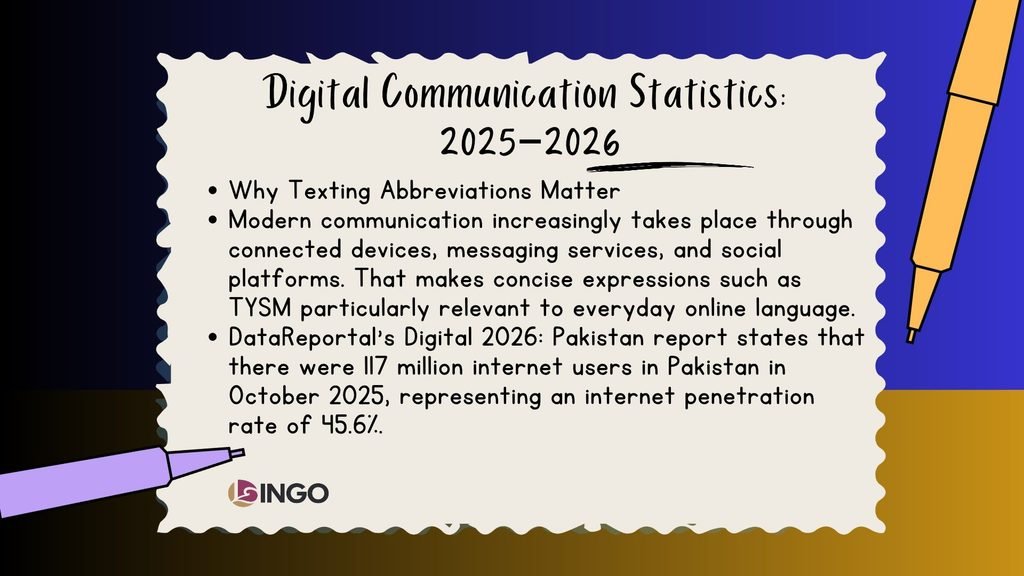
Digital Communication Statistics: 2025–2026
Why Texting Abbreviations Matter
Modern communication increasingly takes place through connected devices, messaging services, and social platforms. That makes concise expressions such as TYSM particularly relevant to everyday online language.
DataReportal’s Digital 2026: Pakistan report states that there were 117 million internet users in Pakistan in October 2025, representing an internet penetration rate of 45.6%. It also reported 79.9 million social-media user identities, equivalent to 31.2% of the population.
The same report states that 68.4% of Pakistan’s internet user base used at least one social-media platform in October 2025.
These statistics do not show how many people specifically use TYSM. There is no reliable representative statistic establishing a precise percentage of texters who use this abbreviation. Instead, the data provide useful context: a large digital audience communicates through online platforms where abbreviations and informal language are naturally encountered.
DataReportal also reported 194 million cellular mobile connections in Pakistan at the end of 2025. Because individuals can have multiple connections, this figure should not be interpreted as the number of unique mobile users.
Therefore, while statistics cannot prove the exact frequency of TYSM, they help explain the broader environment in which texting shorthand is used.
A Quick Guide to Understanding TYSM
Follow These Simple Steps
When you receive a message containing TYSM, use this checklist:
- Expand the abbreviation: TYSM = Thank You So Much.
- Read the previous message: Identify what the person is thanking you for.
- Check punctuation: Exclamation marks may add enthusiasm.
- Look at emojis: Emojis can add warmth or affection.
- Consider your relationship: A friend and a colleague may use the same abbreviation differently.
- Match the tone: Reply with “You’re welcome,” “Anytime,” or another suitable response.
- Don’t overinterpret it: TYSM normally means gratitude; the abbreviation alone does not establish romantic interest or another hidden meaning.
Quick Reference Table
| Situation | Example | Suitable reply |
|---|---|---|
| Friend asks for help | “TYSM for helping!” | “Anytime!” |
| Someone receives information | “TYSM for the link.” | “You’re welcome!” |
| Someone receives a compliment | “Aww, tysm!” | “Of course 😊” |
| Workplace chat | “TYSM for the report.” | “Glad I could help.” |
| Social-media comment | “TYSM for watching!” | “My pleasure!” |
| Emotional support | “TYSM for listening.” | “Always here for you.” |
Mini Quiz: TYSM Meaning in Text
1. What does TYSM mean in texting?
A. Tell You Something More
B. Thank You So Much
C. Take Your Time Slowly
D. Talk You Soon, Mate
Answer: B — Thank You So Much
2. Which situation is most suitable for using TYSM?
A. A casual chat with a friend
B. A formal legal contract
C. A government regulation
D. A formal academic paper
Answer: A — A casual chat with a friend
3. TYSM is commonly used to express:
A. Anger
B. Confusion
C. Gratitude
D. Disagreement
Answer: C — Gratitude
4. What does the “T” in TYSM represent?
A. Talk
B. Tell
C. Thank
D. Take
Answer: C — Thank
5. What does the “Y” in TYSM represent?
A. Yes
B. You
C. Your
D. Yours
Answer: B — You
6. Which abbreviation means “Thank You Very Much”?
A. TYSM
B. TYVM
C. TYS
D. TYM
Answer: B — TYVM
7. Does lowercase “tysm” generally have the same meaning as “TYSM”?
A. No, it means something negative
B. No, it is formal English
C. Yes, the basic meaning is the same
D. Yes, but only in emails
Answer: C — Yes, the basic meaning is the same
8. Which sentence uses TYSM naturally?
A. TYSM for helping me with my homework!
B. TYSM is hereby enacted as law.
C. The TYSM methodology was statistically significant.
D. Include TYSM in the legal agreement.
Answer: A — TYSM for helping me with my homework!
9. True or False: TYSM is generally more appropriate for casual messages than formal business letters.
Answer: True
10. What does the “M” in TYSM represent?
A. More
B. Many
C. Maybe
D. Much
Answer: D — Much
11. Which is a friendly reply to “TYSM!”?
A. According to Section 4
B. Anytime!
C. Dear Sir or Madam
D. Subject: Appreciation
Answer: B — Anytime!
12. Which expression has essentially the same meaning as TYSM?
A. Talk to you soon
B. Take your time
C. Thank you so much
D. Tell me something
Answer: C — Thank you so much
13. What can “TYSM!!!” communicate compared with “tysm”?
A. A completely different meaning
B. Formality
C. Extra enthusiasm
D. Anger in every situation
Answer: C — Extra enthusiasm
14. Which is an appropriate casual response to “TYSM for the notes”?
A. This contract is terminated.
B. Please submit your tax return.
C. No problem!
D. The experiment produced three variables.
Answer: C — No problem!
15. Is TYSM normally considered formal English?
A. Yes, it is a formal title
B. Yes, it is a legal abbreviation
C. No, it is informal shorthand
D. Yes, it is an academic citation style
Answer: C — No, it is informal shorthand
16. What does TYSM communicate most directly?
A. Confusion
B. Anger
C. A request
D. Gratitude
Answer: D — Gratitude
17. Which sentence is more appropriate in a formal email?
A. TYSM for your assistance!
B. tysm lol for your assistance
C. TYSM!!! Thanks!!!
D. Thank you very much for your assistance.
Answer: D — Thank you very much for your assistance.
18. Can TYSM be used in social-media comments?
A. Yes, especially in casual interactions
B. No, never
C. Only in legal documents
D. Only in academic journals
Answer: A — Yes, especially in casual interactions
19. Which statement about TYSM is most accurate?
A. It always means romantic love.
B. It always indicates sarcasm.
C. Its basic meaning is “Thank You So Much,” while context can affect the tone.
D. It is always used in formal writing.
Answer: C — Its basic meaning is “Thank You So Much,” while context can affect the tone.
20. What can “TYSM ❤️” communicate?
A. A legal requirement
B. A request for payment
C. A new dictionary definition
D. Warmth or affection
Answer: D — Warmth or affection
21. Which word does the “S” in TYSM represent?
A. Sorry
B. So
C. Some
D. Sure
Answer: B — So
22. Which reply would be natural after someone says, “TYSM for your help”?
A. You’re welcome!
B. What is your address?
C. Good night yesterday.
D. Please ignore this message.
Answer: A — You’re welcome!
23. What is the main purpose of texting abbreviations such as TYSM?
A. To make formal writing more complex
B. To communicate quickly and conveniently
C. To replace every English word
D. To create legal terminology
Answer: B — To communicate quickly and conveniently
24. Which situation would usually be better suited to “Thank you very much” than “TYSM”?
A. Texting your best friend
B. Replying to a casual Instagram comment
C. Writing a formal professional email
D. Chatting with a classmate
Answer: C — Writing a formal professional email
25. What is the best overall definition of TYSM?
A. A formal business expression
B. A romantic abbreviation
C. A greeting used before a conversation
D. An informal abbreviation meaning “Thank You So Much”
Answer: D — An informal abbreviation meaning “Thank You So Much”
FAQs About TYSM Meaning in Text
Q1:What does TYSM mean in a text?
TYSM means “Thank You So Much.” It is an informal abbreviation used to express gratitude in texts, chats, comments, and social media.
Q2:What does TYSM stand for?
TYSM stands for Thank You So Much. The letters come from the first letter of each word.
Q3:Is TYSM slang?
TYSM is commonly categorized as texting shorthand, internet slang, or an informal abbreviation. It is widely associated with messaging and social media. Collins specifically lists it as a messaging and social-media abbreviation.
Q4:How do you reply to TYSM?
You can reply with “You’re welcome,” “Anytime,” “No problem,” “Of course,” “Glad I could help,” or “My pleasure.” Choose a response that matches the conversation.
Q5:Is TYSM formal or informal?
TYSM is informal. It is suitable for casual texts, DMs, comments, and friendly chats. For formal emails and professional documents, use “Thank you” or “Thank you very much” instead.
Q6:Does TYSM mean something romantic?
Not by itself. TYSM normally means “Thank You So Much.” It can appear in romantic conversations, but the abbreviation itself does not establish romantic interest. The surrounding conversation provides the relevant context.
Q7:Is TYSM the same as “Thank You”?
They are related, but TYSM expands to “Thank You So Much,” which generally places more emphasis on appreciation than the shorter “TY” or “Thank you.”
Q8:Is TYSM the same as TYVM?
No. TYSM means “Thank You So Much,” while TYVM means “Thank You Very Much.” Both are abbreviations for expressing gratitude.
Conclusion
The TYSM meaning in text is simple: “Thank You So Much.” It is an informal texting abbreviation used to show gratitude and appreciation in messages, chats, comments, and social media.
You can use TYSM after receiving help, a compliment, a gift, useful information, or a thoughtful gesture. When someone sends you TYSM, natural responses include “You’re welcome,” “Anytime,” “No problem,” and “Glad I could help.”
Remember that TYSM is best suited to casual communication. In formal emails, academic writing, and professional documents, writing the complete phrase “Thank you” or “Thank you very much” is generally more appropriate.
So, if you see “TYSM” in your next conversation, you can confidently understand it as “Thank You So Much.” Keep exploring Hometimely for more straightforward explanations of texting abbreviations, English usage, spelling, and everyday communication.
For more clear explanations of commonly confused English words and grammar rules, explore the other language guides on Lingorixa.
References

Maimoona Asghar is a grammar enthusiast and language writer who creates clear, practical content to help learners improve English grammar, writing, punctuation, and communication skills through easy-to-understand explanations and examples.