Have you ever typed targeted vs targetted into a search box because you were unsure which spelling was right? You’re not alone. English has many spelling rules involving doubled consonants, so it’s easy to assume that target should become targetted.
The answer, however, is simple: targeted is the standard spelling.
The standard forms are target, targets, targeted, and targeting. Cambridge Dictionary identifies targeted as an adjective meaning directed at a particular person or thing, while targeting is the present participle of target.
In this guide, we’ll explain why targeted is correct, why targetted causes confusion, how to use the word in real sentences, and whether British and American English treat the spelling differently.
Targeted vs Targetted: Which Spelling Is Correct?
The correct spelling is:
Targeted ✅
The spelling you should normally avoid is:
Targetted ❌
Here is the difference at a glance:
| Spelling | Standard modern English | Example |
|---|---|---|
| targeted | Yes ✅ | The campaign targeted young adults. |
| targetted | No, generally nonstandard | The campaign targetted young adults. |
Current Cambridge Dictionary entries use targeted in examples such as targeted advertising, targeted content, and targeted approaches.
Why Is “Targeted” Correct?
The base verb is target.
To form the regular past tense:
target + ed = targeted
For example:
- The company targeted a new audience.
- The teacher targeted common grammar mistakes.
- The campaign targeted younger customers.
- The researchers targeted a specific group.
You do not need to add another t.
Is “Targetted” Ever the Preferred Spelling?
You may encounter targetted in online content, informal writing, or some older material. Its appearance in real-world writing does not make it the preferred standard form.
For modern professional, academic, business, and website content, targeted is the safest standard choice.
A useful rule to remember is:
target + ed = targeted
What Does “Targeted” Mean?
Targeted is the past tense and past participle of target, and it is also commonly used as an adjective.
The core meaning is directed toward a particular person, group, object, or purpose.
Cambridge defines targeted as directed at a particular person or thing and gives examples involving targeted advertising, content, and approaches.
Targeted as a Verb
When targeted is used as a verb, it describes an action directed toward something or someone.
Examples:
The company targeted college students with its new campaign.
The teacher targeted the students’ weakest areas.
The researchers targeted a specific group of participants.
The organization targeted rural communities.
In each sentence, targeted describes an action that happened in the past.
Targeted as an Adjective
Targeted can also describe something specifically designed or directed toward a particular audience or purpose.
Examples include:
- targeted advertising
- targeted marketing
- targeted content
- targeted support
- targeted treatment
- targeted campaign
- targeted approach
For example:
The company created a targeted marketing campaign.
Here, targeted describes the marketing campaign rather than functioning as the main past-tense verb.
Targeted vs Targeting
It’s useful to distinguish targeted from targeting.
| Word | Function | Example |
|---|---|---|
| target | Base verb | We need to target new customers. |
| targets | Present-tense verb | The campaign targets students. |
| targeted | Past tense/past participle | The campaign targeted students. |
| targeting | Present participle/gerund | The company is targeting students. |
Cambridge identifies targeting as the present participle of target.
Therefore:
target → targeted → targeting
Not:
target → targetted → targetting
Why Do People Write “Targetted”?
The confusion comes from legitimate English spelling patterns.
Many verbs double their final consonant when certain suffixes are added:
- stop → stopped
- plan → planned
- admit → admitted
- prefer → preferred
- run → running
Because of these examples, a writer may look at target and think:
target → targetted
That looks logical at first, but it is not the standard spelling.
The “Targeted” Spelling Rule
The easiest way to remember the correct form is not to invent an additional t.
Simply add -ed:
target + ed = targeted
Similarly:
target + ing = targeting
The pronunciation and spelling of the established forms are reflected in current dictionary entries. Cambridge lists targeting as the present participle and targeted as an established adjective/form.
Why the Double-T Pattern Causes Confusion
English consonant-doubling rules depend on factors such as syllable structure, stress, and the particular word. They cannot safely be applied mechanically to every verb.
For example:
stop → stopped
does not mean:
target → targetted
Likewise:
run → running
does not mean:
target → targetting
This is one reason English learners often benefit from learning the actual standard form of a word rather than applying a spelling rule without checking the word itself.
What About “Targetting”?
The standard spelling is:
targeting ✅
Not:
targetting ❌
Cambridge explicitly identifies targeting as the present participle of target.
Targeted in American and British English
One common question is whether targetted might be the British spelling while targeted is the American spelling.
In standard modern usage, that is not a useful distinction.
American English
Use:
targeted
Example:
The company launched a targeted advertising campaign.
British English
Use:
targeted
Example:
The organisation introduced a targeted support programme.
British and American English certainly differ in some spelling conventions, such as:
- colour / color
- centre / center
- travelled / traveled
However, targeted is the standard form to use across both varieties.
Cambridge’s UK and US entries both show targeted rather than requiring a doubled t.
Targeted Audience or Targetted Audience?
The correct phrase is:
targeted audience ✅
Not:
targetted audience ❌
A target audience is the particular group of people toward whom an advertisement, product, website, or program is directed. Cambridge defines the term in essentially these words.
For example:
Teenagers are the campaign’s target audience.
Or:
The company created a targeted campaign for teenage customers.
Real-Life Case Study: Correcting “Targetted” in Professional Writing
Imagine a marketing specialist preparing a monthly performance report. In the first draft, the report says:
“Our campaign targetted young professionals between the ages of 25 and 35.”
The sentence is understandable, but the spelling targetted is not the standard form. During proofreading, the writer checks the verb and changes it to:
“Our campaign targeted young professionals between the ages of 25 and 35.”
This may look like a tiny correction, but small spelling decisions matter in professional communication. A marketing report might be read by managers, clients, partners, or other departments. An unnecessary spelling error can distract readers and make the document appear less carefully edited.
The same issue can occur in academic writing. Suppose a student writes:
“The study targetted university students from different backgrounds.”
The corrected version is:
“The study targeted university students from different backgrounds.”
Nothing about the meaning has changed. The writer simply needs the standard past-tense form of target.
The lesson is useful beyond this one word. English contains many spelling patterns that look predictable but have exceptions or limitations. Instead of assuming that every verb behaves like stop or plan, writers should verify uncertain spellings with a reputable dictionary.
Current Cambridge entries provide direct evidence for targeted and targeting, while the dictionary also shows how target functions as a verb meaning to direct an action, product, or advertisement toward a particular person or group.
For students, editors, bloggers, marketers, and business writers, the practical takeaway is simple: when you mean the past form of target, write targeted.
2025–2026 Data and Evidence on the Spelling
Because this is a spelling question, the most useful “data” is authoritative current dictionary evidence rather than an invented percentage or unsupported search-volume figure.
Current Dictionary Snapshot
A review of current sources in 2025–2026 shows consistent standard usage:
| Evidence point | Current result |
|---|---|
| Cambridge entry for targeted | Standard entry |
| Cambridge entry for targeting | Standard present participle |
| Cambridge entry for target | Uses targeted examples |
| Wiktionary entry for targeted | Past tense/past participle of target |
| Wiktionary entry for targetted | Describes it as a nonstandard spelling |
Wiktionary’s current entry, last edited in May 2026, identifies targeted as the simple past and past participle of target and describes targetted as an uncommon British alternative form.
This is an important nuance: targetted can be encountered in real usage, so simply saying that nobody ever writes it would be inaccurate. However, if your goal is standard modern English for general professional or educational writing, targeted is the clear practical choice.
Google’s current Search Central guidance, last updated in December 2025, also emphasizes that quality content should be useful, reliable, original, comprehensive, and free from spelling or stylistic problems.
What This Evidence Means for Writers
For content published in 2025–2026:
- Use targeted as the default standard spelling.
- Use targeting for the present participle.
- Don’t automatically double the final consonant.
- Check a reputable dictionary when uncertain.
- Proofread important professional and academic content.
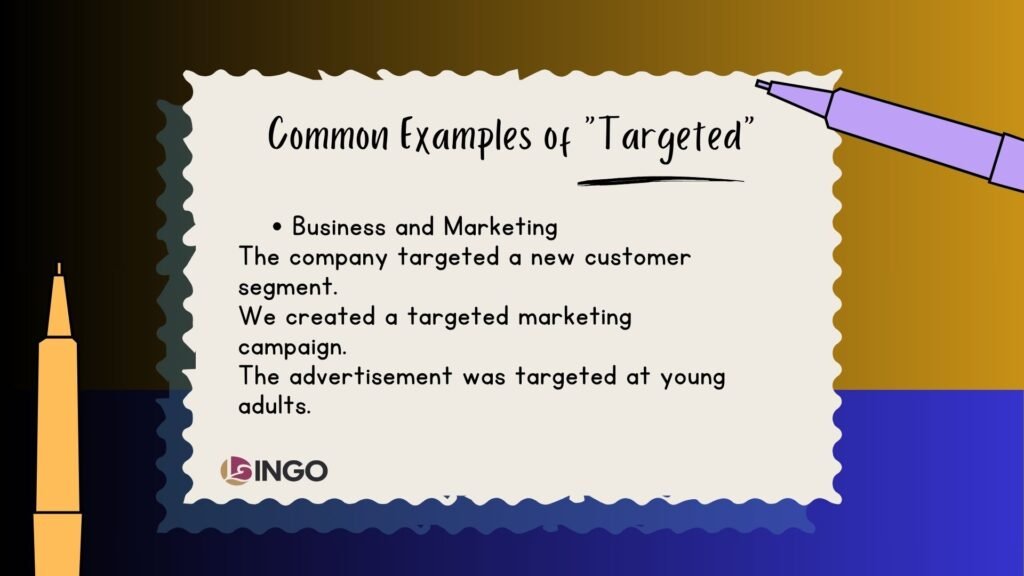
Common Examples of “Targeted”
Business and Marketing
The company targeted a new customer segment.
We created a targeted marketing campaign.
The advertisement was targeted at young adults.
The brand is targeting environmentally conscious consumers.
Cambridge’s Business English entry specifically gives examples such as targeted advertising, targeted marketing, and targeted initiatives.
Education
The teacher targeted common spelling errors.
Students received targeted feedback.
The school provides targeted support for struggling learners.
The lesson was targeted at beginner-level students.
Technology
The platform provides targeted recommendations.
The company targeted users based on their interests.
The team is targeting a specific user group.
Research
The study targeted university students.
Researchers developed a targeted approach to the problem.
The intervention provided targeted support.
Everyday English
The criticism was targeted at the wrong person.
The campaign targeted local residents.
The message was clearly targeted toward a younger audience.
Targeted vs Targetted: Quick Comparison Checklist
Use this checklist when proofreading:
| Question | Correct answer |
|---|---|
| Correct spelling? | targeted ✅ |
| Common nonstandard spelling? | targetted |
| Base verb? | target |
| Past tense? | targeted |
| Past participle? | targeted |
| Present participle? | targeting |
| Correct phrase? | targeted audience |
| Correct phrase? | targeted marketing |
| British English? | targeted |
| American English? | targeted |
A Simple Memory Trick
Remember:
TARGET + ED = TARGETED
And:
TARGET + ING = TARGETING
So when you’re unsure, think:
One T + -ed = targeted
One T + -ing = targeting
Mini Quiz:Targeted vs Targetted
1. Which spelling is correct?
A) Targeted
B) Targetted
C) Targetid
D) Targetedd
Answer: A) Targeted
2. Choose the correct sentence.
A) The campaign targetted students.
B) The campaign targeted students.
C) The campaign targetid students.
D) The campaign targetteded students.
Answer: B) The campaign targeted students.
3. What is the correct past tense of target?
A) Targetted
B) Targeting
C) Targeted
D) Targetteded
Answer: C) Targeted
4. Which is the correct present participle?
A) Targetted
B) Targetting
C) Targeting
D) Targeted
Answer: C) Targeting
5. True or False: Targeted is the standard spelling.
Answer: True
6. Which phrase is correctly spelled?
A) Targetted marketing
B) Targeted marketing
C) Targeting marketing
D) Targetid marketing
Answer: B) Targeted marketing
7. Complete the sentence:
“The company _____ young customers last year.”
A) target
B) targets
C) targeted
D) targeting
Answer: C) Targeted
8. Which sentence uses targeted as an adjective?
A) The company targeted customers.
B) We launched a targeted campaign.
C) The company targets customers.
D) They are targeting customers.
Answer: B) We launched a targeted campaign.
9. What does targeted mean?
A) Accidental
B) Directed toward a particular person or group
C) Repeated many times
D) Completely unrelated
Answer: B) Directed toward a particular person or group
10. Which spelling should you normally use in professional writing?
A) Targetted
B) Targeted
C) Targetting
D) Targetid
Answer: B) Targeted
11. Choose the correct sentence.
A) The teacher targetted common errors.
B) The teacher targeted common errors.
C) The teacher targetting common errors.
D) The teacher targetid common errors.
Answer: B) The teacher targeted common errors.
12. Which phrase is correct?
A) Targetted audience
B) Targeted audience
C) Targeting audience
D) Targetid audience
Answer: B) Targeted audience
13. True or False: Targetting is the standard spelling.
Answer: False
14. Complete the sentence:
“The company is _____ new customers.”
A) targeted
B) targetted
C) targeting
D) target
Answer: C) Targeting
15. Which is the base form?
A) Targeted
B) Targeting
C) Target
D) Targets
Answer: C) Target
16. Which sentence is correct?
A) The advertisement targetted young adults.
B) The advertisement targeted young adults.
C) The advertisement targetting young adults.
D) The advertisement targetid young adults.
Answer: B) The advertisement targeted young adults.
17. Which forms are standard? Select all that apply.
A) Target
B) Targets
C) Targeted
D) Targeting
E) Targetted
Answers: A, B, C, D
18. Is targetted the preferred spelling in modern standard English?
A) Yes
B) No
Answer: B) No
19. Which sentence is correct?
A) The school provided targetted support.
B) The school provided targeted support.
C) The school provided targetting support.
D) The school provided targetid support.
Answer: B) The school provided targeted support.
20. Complete the spelling rule:
Target + ____ = Targeted
A) -ted
B) -ed
C) -ing
D) -edd
Answer: B) -ed
21. Which sentence correctly uses targeting?
A) The company is targeting students.
B) The company is targetting students.
C) The company is targeted students.
D) The company is target students.
Answer: A) The company is targeting students.
22. Is targeted used in both British and American English?
A) Yes
B) No
Answer: A) Yes
23. Which sentence is correctly written?
A) The researchers targetted a specific group.
B) The researchers targeted a specific group.
C) The researchers targetting a specific group.
D) The researchers targetid a specific group.
Answer: B) The researchers targeted a specific group.
24. Which is the correct spelling?
A) Targetted advertising
B) Targeted advertising
C) Targetting advertising
D) Targetid advertising
Answer: B) Targeted advertising
25. Choose the best sentence.
A) Our campaign targetted a specific audience.
B) Our campaign targeted a specific audience.
C) Our campaign targetting a specific audience.
D) Our campaign targetid a specific audience.
Answer: B) Our campaign targeted a specific audience.
FAQs About Targeted vs Targetted
Q1:Is “targeted” or “targetted” correct?
Targeted is the standard spelling used in modern English. Current Cambridge dictionary entries use targeted and targeting as standard forms.
Q2:Is “targetted” a real word?
You can find targetted in some real-world usage, particularly in older or British material. However, it is generally treated as a nonstandard or uncommon variant. Wiktionary currently labels it a nonstandard spelling of targeted.
Q3:Why isn’t “target” spelled “targetted”?
Although some English verbs double their final consonant when adding -ed, that pattern does not mean every verb should double its final consonant. The established standard form of target is targeted.
Q4:Is “targeted” correct in British English?
Yes. Targeted is the standard spelling used in British English as well as American English. The spelling is not normally changed to targetted simply because British English is being used.
Q5:Is “targetting” correct?
The standard form is targeting, not targetting. Cambridge identifies targeting as the present participle of target.
Q6:What is the past tense of “target”?
The past tense is targeted.
Example:
The company targeted new customers last year.
Q7:What does “targeted” mean?
Targeted means directed toward a particular person, group, object, or purpose.
Example:
The company created a targeted advertising campaign.
Q8:Which is correct: “targeted audience” or “targetted audience”?
Targeted audience is the standard spelling.
Example:
The campaign was designed for a targeted audience.
However, when referring to the group itself, target audience is often the more natural phrase:
Teenagers are the campaign’s target audience.
Conclusion: Targeted Is the Correct Spelling
When it comes to targeted vs targetted, the practical answer is clear: targeted is the standard spelling you should use in modern English.
The standard forms are:
- target
- targets
- targeted
- targeting
Although targetted can be found in real usage, particularly as an uncommon British variant, it is not the form you should normally choose for professional, academic, website, or general-purpose writing. Current Cambridge evidence supports targeted and targeting, while current reference material identifies targetted as nonstandard or uncommon.
So remember:
Target + ed = targeted ✅
Not:
Target + ted = targetted ❌
For more clear explanations of commonly confused English words and grammar rules, explore the other language guides on Lingorixa.
References
- Cambridge Dictionary — Targeted
- Google Search Central — Creating Helpful, Reliable, People-First Content

Maimoona Asghar is a grammar enthusiast and language writer who creates clear, practical content to help learners improve English grammar, writing, punctuation, and communication skills through easy-to-understand explanations and examples.