Have you ever wondered whether the correct spelling is cryer or crier? The two words sound almost identical, which makes this spelling question surprisingly easy to get wrong.
In modern standard English, crier is the usual spelling when you mean someone who cries. It is also the established spelling in the expression town crier, referring to a person who traditionally announced news or official information in public. Cambridge Dictionary defines crier as someone who cries, while Oxford records crier as the traditional term for a public announcer.
However, cryer can appear in historical or variant contexts and is also used as a surname. So, the complete answer requires a little more explanation.
Let’s look at the meanings, spelling rules, examples, and practical differences between cryer vs crier.
Is “Crier” or “Cryer” Correct?
For most modern English writing, crier is the preferred spelling.
If you are describing someone who cries, write crier:
I’m not usually a crier, but that movie made me emotional.
If you are referring to the historical public announcer, use town crier:
The town crier announced the news to everyone in the square.
Oxford identifies crier as the word for the historical public announcer, while Cambridge also gives crier the meaning of someone who cries.
Crier vs Cryer at a Glance
| Word | Typical use | Meaning | Example |
|---|---|---|---|
| crier | Modern standard English | Someone who cries | I’m not much of a crier. |
| crier | Historical usage | Public announcer | The town crier made an announcement. |
| cryer | Variant/historical contexts | Variant spelling of crier | May occur in older sources |
| Cryer | Proper name | Surname | Mr. Cryer attended the event. |
Therefore, if you are writing an essay, article, email, school assignment, or ordinary sentence, crier is the safest choice.
Why “Crier” Is the Standard Choice
The spelling crier is well established in modern dictionaries.
Oxford gives crier as the noun associated with the historical public announcer and traces it to Middle English through Old French.
Cambridge also lists crier as a noun meaning someone who cries and gives its pronunciation as approximately “cry-er.”
This explains an important point: the word may sound like “cry-er,” but its standard spelling is “crier.”
What Does “Crier” Mean?
The noun crier has more than one meaning, depending on context.
Crier Meaning: Someone Who Cries
The most familiar modern meaning is a person who cries.
For example:
- I’m not normally a crier.
- She became a crier after watching the emotional film.
- He is a very sensitive crier.
- The child was a loud crier when he was tired.
Cambridge explicitly defines crier as “someone who cries.”
The word is especially common when someone is describing their emotional reaction:
I’m a crier, so I always bring tissues to sad movies.
Crier Meaning: A Public Announcer
Crier also has a historical meaning.
A town crier was traditionally a person who walked through a town announcing news, official orders, or public information.
For example:
The town crier rang a bell before announcing the royal proclamation.
Oxford describes a town crier as someone whose historical job was to walk through a town shouting news and official announcements.
Other examples include:
- The town crier announced the new law.
- A town crier once served as an important source of public information.
- The historical festival included a traditional town crier.
How Do You Pronounce “Crier”?
Crier is pronounced approximately “cry-er.”
Cambridge lists UK pronunciation as /ˈkraɪ.ə(r)/ and US pronunciation as /ˈkraɪ.ɚ/.
This pronunciation is one reason people sometimes assume the spelling should be cryer.
Why Do People Confuse “Cryer” and “Crier”?
The confusion mainly comes from pronunciation and the spelling of the base verb cry.
At first glance, it seems logical to take cry and add -er:
cry + er = cryer
However, English spelling does not always work by simply attaching a suffix to the unchanged spelling of a word.
Crier vs Cryer: The Spelling Pattern
Consider these examples:
| Base word | Related noun/adjective |
|---|---|
| cry | crier |
| try | trier |
| dry | drier |
| carry | carrier |
| vary | varier in some specialized contexts |
The important point is that the y does not automatically remain in every related form.
For crier, the standard spelling is established as c-r-i-e-r.
Pronunciation Can Be Misleading
English has many words whose pronunciation does not make their spelling obvious.
For example:
- write vs right
- there vs their
- break vs brake
- principal vs principle
- crier vs cryer
So, hearing the word pronounced “cry-er” does not mean that cryer is the standard spelling.
When you are writing for a modern English-speaking audience, crier is the form to choose.
Is “Cryer” Ever Correct?
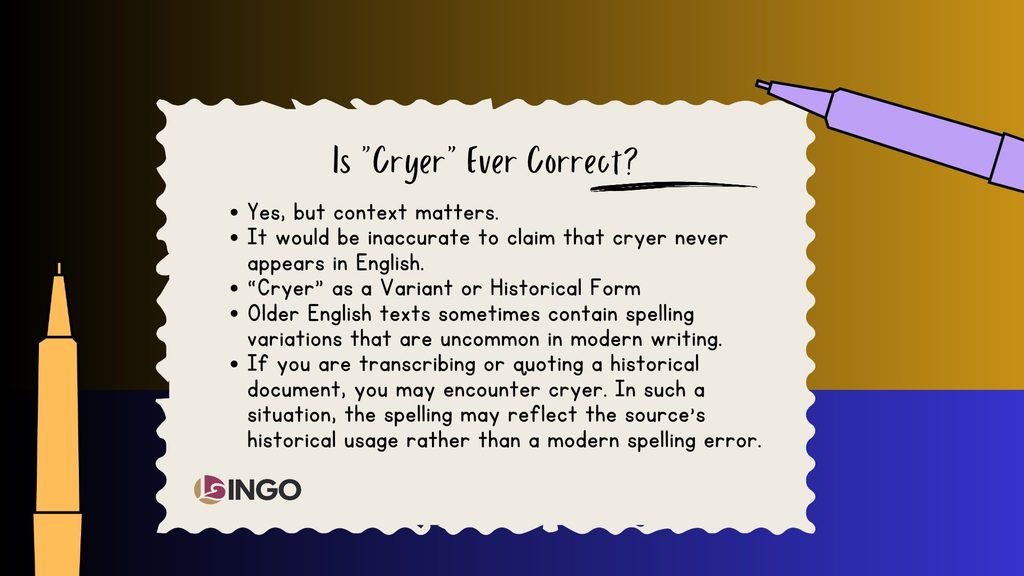
Yes, but context matters.
It would be inaccurate to claim that cryer never appears in English.
“Cryer” as a Variant or Historical Form
Older English texts sometimes contain spelling variations that are uncommon in modern writing.
If you are transcribing or quoting a historical document, you may encounter cryer. In such a situation, the spelling may reflect the source’s historical usage rather than a modern spelling error.
For example, if a historical document contains the phrase:
The cryer announced the proclamation.
an editor working with the original text may preserve that spelling to accurately represent the source.
However, if you are writing a new sentence today, crier is generally the better choice.
“Cryer” as a Surname
Cryer can also be a legitimate surname.
For example:
Cryer was listed among the guests.
In this case, you should not change Cryer to Crier. Proper names should retain their established spelling.
This distinction is especially important when editing biographies, historical records, family histories, or official documents.
The Practical Rule
Use this simple rule:
Modern common noun → crier
Person’s surname → preserve the established spelling
Historical quotation → check and preserve the original spelling when appropriate
Crier vs Cryer Examples
Seeing the words in context makes the distinction much easier.
Correct Examples With “Crier”
Here are several natural examples:
- I’m not normally a crier, but that ending made me emotional.
- My sister is a crier when she watches sad movies.
- The baby was a frequent crier during the night.
- He joked that his friends had turned him into a crier.
- The town crier announced the news to the crowd.
Examples of the Preferred Modern Spelling
Instead of:
❌ She is a frequent cryer.
write:
✅ She is a frequent crier.
Instead of:
❌ The town cryer announced the news.
write:
✅ The town crier announced the news.
Instead of:
❌ I’m becoming more of a cryer as I get older.
write:
✅ I’m becoming more of a crier as I get older.
When “Cryer” Should Stay
If Cryer is a surname, keep it:
✅ Mr. Cryer spoke at the meeting.
Likewise, if you are reproducing an historical source and the original contains cryer, changing it may alter the source’s wording.
A Real-Life Example: The Town Crier
The expression town crier is one of the clearest examples of why the spelling matters.
Imagine a town several centuries ago. There are no smartphones, websites, television broadcasts, or modern newspapers. Important information still needs to reach the public.
A town crier performs this role by traveling through the community and publicly announcing news or official information. According to Oxford, the traditional town crier’s job was to walk through a town shouting news and official announcements.
Suppose you are writing a museum description:
The town crier rang a bell before announcing the latest proclamation.
The established expression is town crier, not town cryer.
Now consider a completely different sentence:
I’m a crier whenever I watch emotional movies.
Here, crier refers to someone who cries.
Although the two meanings are different, they share the same spelling. This is why crier is an especially useful word to remember.
The pronunciation can make cryer seem logical, but standard modern usage favors crier. At the same time, historical documents and surnames may use Cryer, so writers should always consider the context before changing a spelling.
2025–2026 Data: English on the Modern Web
There is no dependable public statistic showing exactly how many people search for “cryer vs crier” each month. Therefore, assigning a specific search-volume number to this spelling question without a verifiable source would be misleading.
However, current web data shows why accurate English remains important for online communication.
As of September 2026, W3Techs reports that English is used by 49.5% of websites whose content language is known. Among websites in the top 1,000,000 by ranking, English accounts for 47.3%.
This does not measure spelling mistakes or grammar searches directly. Instead, it provides broader context: English remains a dominant language for web content.
Google’s current Search guidance emphasizes creating helpful, reliable, people-first content. Its September 2026 update also notes changes and clarifications around helpful content guidance.
For a spelling article, that means the goal should be simple: answer the reader’s question clearly, explain the exception, provide useful examples, and avoid unnecessary repetition.
Quick Comparison: Crier vs Cryer
| Feature | Crier | Cryer |
|---|---|---|
| Standard modern common noun | Yes | Usually no |
| Means someone who cries | Yes | Variant/historical contexts |
| Used in “town crier” | Yes | No |
| Can be a surname | Yes | Yes |
| Can appear in historical sources | Yes | Yes |
| Best choice for modern general writing | Yes | Usually no |
A Simple Decision Guide
Use crier when:
- You mean someone who cries.
- You are writing town crier.
- You are writing an essay or article.
- You are writing professional English.
- You are describing an emotional person.
Use Cryer when:
- It is someone’s established surname.
- You are preserving a historical source’s spelling.
- A specific title, name, or source uses that spelling.
Common Mistakes to Avoid
Mistake 1: Spelling It According to Its Sound
Because crier sounds like “cry-er,” writers sometimes automatically spell it cryer.
For modern standard English, use:
crier
Mistake 2: Writing “Town Cryer”
The established expression is:
town crier
Oxford specifically lists town crier as the traditional term.
Mistake 3: Changing a Person’s Surname
If someone’s name is Cryer, don’t change it to Crier simply because crier is the standard common noun.
Names follow their established spelling.
Mistake 4: Treating Every Historical Variant as a Typo
Historical English contains spelling variations that are not necessarily modern mistakes.
If you are quoting an old source, check the original before editing the spelling.
Mini Quiz: Cryer vs Crier
1. Which spelling is preferred in modern standard English?
A. Cryer
B. Crier
C. Cryar
D. Criar
Answer: B. Crier
2. Which phrase is correct?
A. Town cryer
B. Town cryar
C. Town crier
D. Town criyer
Answer: C. Town crier
3. What does crier commonly mean?
A. Someone who sings
B. Someone who cries
C. Someone who writes
D. Someone who laughs
Answer: B. Someone who cries
4. Complete the sentence: “I’m not usually a ___.”
A. cryer
B. crier
C. cryar
D. criyer
Answer: B. crier
5. Why do people sometimes spell crier as cryer?
A. They have different meanings
B. They are pronounced differently
C. “Crier” sounds like “cry-er”
D. Crier is an old spelling
Answer: C. “Crier” sounds like “cry-er”
6. Which sentence is correct?
A. She is a frequent cryer.
B. She is a frequent crier.
C. She is a frequent cryar.
D. She is a frequent criyer.
Answer: B. She is a frequent crier.
7. What is a town crier?
A. A person who sells newspapers
B. A person who traditionally announces news publicly
C. A person who writes books
D. A person who delivers letters
Answer: B. A person who traditionally announces news publicly
8. True or False: Crier is the usual modern spelling for someone who cries.
Answer: True
9. Which spelling is generally preferred in formal modern writing?
A. Cryer
B. Crier
C. Cryar
D. Cryeer
Answer: B. Crier
10. Which sentence uses town crier correctly?
A. The town cryer announced the news.
B. The town crier announced the news.
C. The town cryar announced the news.
D. The town criyer announced the news.
Answer: B. The town crier announced the news.
11. Can Cryer be a person’s surname?
A. No
B. Yes
C. Only in poetry
D. Only in British English
Answer: B. Yes
12. If someone’s surname is Cryer, what should you do?
A. Change it to Crier
B. Change it to Cryer-R
C. Keep the person’s established spelling
D. Always remove the final letters
Answer: C. Keep the person’s established spelling
13. Which sentence is correct?
A. I’m becoming more of a crier.
B. I’m becoming more of a cryar.
C. I’m becoming more of a criyer.
D. I’m becoming more of a cryeer.
Answer: A. I’m becoming more of a crier.
14. True or False: Cryer can appear as a historical or variant spelling.
Answer: True
15. Which spelling should normally be used in a modern article about someone who cries?
A. Cryer
B. Crier
C. Cryar
D. Cryerr
Answer: B. Crier
16. Complete the sentence: “The ___ announced the royal proclamation.”
A. town cryer
B. town crier
C. town cryar
D. town criyer
Answer: B. town crier
17. Which word is a noun?
A. Crier
B. Crying
C. Cried
D. Cry
Answer: A. Crier
18. Which sentence is written correctly?
A. He is not much of a cryer.
B. He is not much of a crier.
C. He is not much of a cryar.
D. He is not much of a criyer.
Answer: B. He is not much of a crier.
19. What is the main spelling difference between crier and cryer?
A. Crier contains “ie,” while cryer contains “y”
B. Crier contains “oo”
C. Cryer contains “ee”
D. They have completely different spellings
Answer: A. Crier contains “ie,” while cryer contains “y”
20. Which expression is historically associated with a public announcer?
A. Town crier
B. Town crierer
C. Town cryar
D. Town cryeer
Answer: A. Town crier
21. True or False: The pronunciation of crier can sound approximately like “cry-er.”
Answer: True
22. Which sentence is correct?
A. My sister is a crier when she watches sad films.
B. My sister is a cryer when she watches sad films.
C. My sister is a cryar when she watches sad films.
D. My sister is a cryeer when she watches sad films.
Answer: A. My sister is a crier when she watches sad films.
23. When might Cryer be retained rather than changed to Crier?
A. When it is someone’s surname
B. In every modern sentence
C. When writing the word incorrectly
D. When describing every emotional person
Answer: A. When it is someone’s surname
24. Which is the best general rule?
A. Always use cryer
B. Always use crier, including people’s surnames
C. Use crier for the modern common noun and check the context for Cryer
D. Both spellings are always interchangeable
Answer: C. Use crier for the modern common noun and check the context for Cryer
25. Which sentence contains the standard spelling?
A. “I am a cryer.”
B. “I am a cryar.”
C. “I am a crier.”
D. “I am a criyer.”
Answer: C. “I am a crier.”
Frequently Asked Questions
Q1: Is “crier” or “cryer” correct?
Crier is the standard spelling in modern English when referring to someone who cries or a traditional public announcer. Cryer can appear as a variant, historical form, or surname.
Q2: Is “cryer” a real word?
Yes. Cryer can occur as a historical or variant spelling and is also used as a surname. However, crier is generally preferred for the modern common noun.
Q3: What does “crier” mean?
Crier can mean someone who cries. It is also associated with the historical term town crier, a person who publicly announced news or official information.
Q4: Why is “crier” spelled with “ie”?
Crier is the established spelling of the noun. Although its pronunciation sounds like “cry-er,” standard English spelling uses crier.
Q5: Is “town crier” correct?
Yes. Town crier is the standard expression for the historical public announcer who called out news and official announcements.
Q6: Can “Cryer” be a surname?
Yes. Cryer can be a legitimate surname. If it is a person’s established family name, retain that spelling.
7. Are “crier” and “cryer” pronounced the same?
They can be pronounced the same or very similarly. Cambridge gives crier a pronunciation corresponding to approximately “cry-er.”
Q8: Should I use “crier” in formal writing?
Yes. For modern formal or professional writing, crier is the safer standard form when you mean someone who cries or a town crier.
Conclusion
When comparing cryer vs crier, the answer for modern standard English is straightforward: crier is the preferred spelling.
Use crier when you mean someone who cries and in the established expression town crier. Major dictionaries such as Cambridge and Oxford recognize crier in these uses.
However, Cryer can still be correct when it is a person’s surname, and cryer may appear in historical or variant contexts. Therefore, always consider the context before deciding that a spelling is wrong.
The easiest rule to remember is:
Modern common noun = crier.
Surname or historical source = check the context.
Now that you know the difference between cryer vs crier, you can use the standard spelling confidently in your essays, articles, emails, and everyday English.
For more clear explanations of commonly confused English words and grammar rules, explore the other language guides on Lingorixa.
References

Maimoona Asghar is a grammar enthusiast and language writer who creates clear, practical content to help learners improve English grammar, writing, punctuation, and communication skills through easy-to-understand explanations and examples.