Crain or Crane? If you are trying to spell the word for a lifting machine, a long-legged bird, or the verb meaning “to stretch your neck,” the correct spelling is crane. Crain is generally not the standard spelling of these common English meanings.
The confusion is understandable because crain and crane look and sound very similar. However, they do not have the same status in standard English. Crane is the established dictionary word, while Crain is most commonly encountered as a surname or other proper name.
In this guide, you will learn the difference between Crain vs. Crane, see practical examples, understand why the mistake happens, and discover a quick trick for remembering the correct spelling.
Quick Answer: Crain or Crane?
The correct spelling for the ordinary English word is crane.
| Spelling | Standard common English word? | Common use | Example |
|---|---|---|---|
| crane | Yes | Lifting machine | The crane lifted the steel beam. |
| crane | Yes | Long-legged bird | A crane flew over the wetland. |
| crane | Yes | Verb meaning to stretch the neck | She craned her neck to see. |
| Crain | Usually no | Surname or proper name | Mr. Crain called this morning. |
| crain | No for these meanings | Usually a spelling mistake | The crain lifted the load. |
Simple rule: Use crane for the machine, bird, or verb. Use Crain when it is someone’s actual name or part of an official proper name.
What Does “Crane” Mean?
The word crane has several established meanings in English. Cambridge Dictionary recognizes it as a noun referring to both lifting equipment and a bird, and as a verb meaning to stretch in order to see or hear something.
Crane as a Lifting Machine
A crane is a machine or structure designed to lift and move heavy objects.
For example:
- The crane lifted the steel beam.
- A tower crane was operating at the construction site.
- The workers used a mobile crane to move the equipment.
- The shipping company rented a large crane for the project.
This is the spelling you should use in construction, engineering, manufacturing, shipping, and other technical contexts.
Crane as a Bird
A crane is also a tall bird with long legs and a long neck.
Examples include:
- A crane landed near the lake.
- We watched several cranes flying across the marsh.
- The whooping crane is a well-known North American bird.
- A sandhill crane stood at the edge of the wetland.
The same spelling applies whether you are discussing the machine or the bird.
Crane as a Verb
Crane can also function as a verb. It means to stretch your neck or body to get a better view.
For example:
- I had to crane my neck to see the stage.
- She craned forward to read the sign.
- The children were craning their necks to see the parade.
Notice the past tense: craned, not crained.
What Does “Crain” Mean?
In ordinary English vocabulary, crain is generally not the standard spelling of the word crane. Therefore, if you mean a lifting machine, bird, or the action of stretching your neck, crane is the form to use.
However, Crain can be completely correct when it is a proper name, particularly a surname.
Is “Crain” Ever Correct?
Yes. Context matters.
For example:
Dr. Crain presented the research at the conference.
If Crain is the person’s actual surname, changing it to Crane would be an error.
FamilySearch identifies Crain as a surname and gives it as a variant associated with the surname Crane.
You may therefore encounter Crain in:
- People’s surnames
- Family names
- Business names
- Organization names
- Place names
- Titles or other official names
The key distinction is simple:
Common English word → crane
Official proper name → preserve the spelling used by that person or organization
Crain vs. Crane in a Sentence
Compare these examples:
Correct:
The crane lifted the container.
Incorrect for the machine:
The crain lifted the container.
But:
Correct as a surname:
Ms. Crain will lead the meeting.
Here, Crain is not replacing the common noun crane. It is someone’s name.
Crain or Crane: The Main Difference
The difference between Crain and Crane is primarily a spelling and usage issue.
A Simple Comparison
| Feature | Crain | Crane |
|---|---|---|
| Standard common English word | Generally no | Yes |
| Construction equipment | No | Yes |
| Long-legged bird | No | Yes |
| Verb meaning “stretch the neck” | No | Yes |
| Surname | Yes, can be | Yes, can be |
| Proper name | Can be | Can be |
| Past tense | Not applicable as the common verb | craned |
| Present participle | Not applicable | craning |
This table makes the distinction easy to remember: crane is the normal vocabulary word, while Crain may be correct when it represents a specific name.
Why Do People Write “Crain”?
There are several reasons people confuse these spellings.
First, English spelling cannot always be predicted perfectly from pronunciation. Crain can look plausible because English contains familiar words such as rain, train, and brain.
Second, Crain is a genuine surname. Family-name references document it as an established surname variant, so people may encounter the spelling in real life.
Third, when people hear the word rather than see it written, they may choose the spelling that seems most intuitive.
Therefore, the safest approach is to focus on meaning and context, not pronunciation alone.
2026 Reference Snapshot: What the Evidence Shows
Current dictionary and search-quality references provide a useful snapshot for understanding this spelling question.
Three Established Uses of “Crane”
Cambridge Dictionary currently gives three major grammatical uses of crane:
- Noun: a machine used for lifting and moving heavy objects.
- Noun: a tall bird with long legs and a long neck.
- Verb: to stretch in order to see or hear something.
That makes crane much more than simply the name of a construction machine.
Google’s current Search guidance also emphasizes helpful, reliable, people-first content and recommends providing clear, accurate, useful information rather than creating content primarily to manipulate search rankings.
In February 2026, Google also announced a Discover core update focused, among other things, on more in-depth, original, timely content and expertise on particular topics.
For a spelling article, the practical lesson is straightforward: give readers the answer quickly, explain the distinction accurately, and provide useful examples rather than repeating the keyword unnecessarily.
Real-Life Example: Choosing “Crane” in a Construction Report
Imagine that an employee is preparing a short construction report after a delivery of heavy steel beams. The employee writes, “The crain lifted the steel beam and moved it to the eastern side of the site.”
The meaning is understandable, but crain is not the standard spelling for the lifting machine. In a professional report, the sentence should read, “The crane lifted the steel beam and moved it to the eastern side of the site.”
Now imagine that the same employee writes, “Mr. Crain inspected the equipment before the operation.” In this sentence, Crain may be completely correct because it is a person’s surname.
This example demonstrates why simply memorizing that one spelling is “wrong” is not enough. Context determines whether the unusual-looking form is actually an error. A spelling checker might flag Crain in ordinary vocabulary, but an editor should not automatically change a person’s name.
The best proofreading question is therefore: Am I talking about the machine, bird, or action—or am I writing someone’s official name?
If the sentence describes equipment, wildlife, or stretching your neck, choose crane. If it identifies a person or organization whose official name is Crain, keep Crain exactly as written.
How to Remember “Crane” Easily
A simple memory trick can help you avoid the mistake.
Think of the Final “E”
Remember:
Crane = machine + bird + stretch
The final e belongs to the standard spelling.
You can create a quick mental association:
A crane needs an E.
Then remember the word family:
- crane
- cranes
- craned
- craning
For example:
The crane lifted the load.
The operator craned his neck to inspect the top.
Several cranes flew across the lake.
Check the Meaning Before Correcting a Name
If you see Crain, don’t automatically replace it with Crane.
Ask:
Is this a normal English vocabulary word or a proper name?
If it means the machine:
Use crane.
If it means the bird:
Use crane.
If it means stretching your neck:
Use crane.
If it is someone’s official surname:
Keep Crain.
This one question can prevent both spelling mistakes and incorrect editing of names.
Crain vs. Crane: Correct Examples
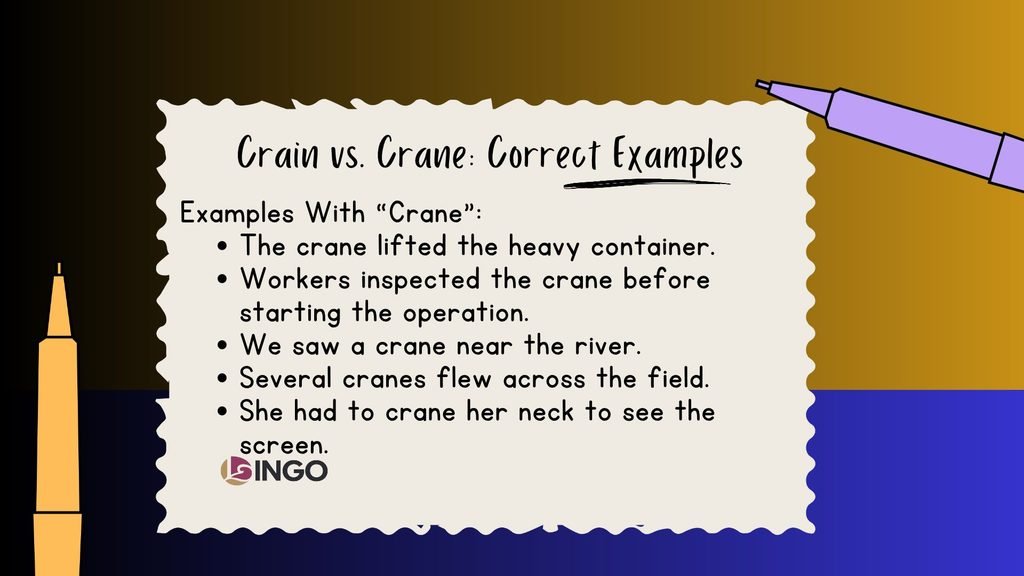
Here are some examples you can use as a quick reference.
Examples With “Crane”
- The crane lifted the heavy container.
- Workers inspected the crane before starting the operation.
- We saw a crane near the river.
- Several cranes flew across the field.
- She had to crane her neck to see the screen.
- He craned forward to hear the speaker.
- The children were craning their necks to watch the performance.
Examples With “Crain”
Use Crain when it is an established proper name:
- Mr. Crain called the office.
- Professor Crain published a new study.
- The Crain family moved to the area.
- We contacted the company using its official name.
Incorrect Common-Word Examples
These are incorrect when crane is intended:
- The crain lifted the beam. ❌
- A crain flew across the lake. ❌
- She crained her neck to see. ❌
Correct them to:
- The crane lifted the beam. ✅
- A crane flew across the lake. ✅
- She craned her neck to see. ✅
Crain or Crane:Mini Quiz
1. Which spelling is correct for the lifting machine used on construction sites?
A. Crain
B. Crane
C. Crayne
D. Crayn
Answer: B. Crane
2. Which spelling is correct for the long-legged bird?
A. Crain
B. Crane
C. Crayne
D. Crayn
Answer: B. Crane
3. Complete the sentence: “The workers used a _____ to lift the steel beam.”
A. Crain
B. Crane
C. Crayne
D. Crayn
Answer: B. Crane
4. Which word is correct in “She had to _____ her neck to see the stage”?
A. Crain
B. Crayne
C. Crane
D. Crayn
Answer: C. Crane
5. What is the correct past tense of “crane”?
A. Crained
B. Craned
C. Crainned
D. Crayne
Answer: B. Craned
6. Which spelling is correct for the present participle of “crane”?
A. Craining
B. Craning
C. Crayning
D. Crainning
Answer: B. Craning
7. Which sentence correctly uses “Crain” as a surname?
A. Mr. Crain called the office.
B. The Crain lifted the beam.
C. A Crain flew over the marsh.
D. She Crain her neck.
Answer: A. Mr. Crain called the office.
8. Which spelling should normally be used when referring to construction equipment?
A. Crain
B. Crane
C. Crayne
D. Crayn
Answer: B. Crane
9. Which spelling refers to the long-legged bird?
A. Crane
B. Crain
C. Crayne
D. Crayn
Answer: A. Crane
10. Which sentence is correctly spelled?
A. The crain lifted the container.
B. The crane lifted the container.
C. The crayne lifted the container.
D. The crayn lifted the container.
Answer: B. The crane lifted the container.
11. Which sentence correctly uses the verb “crane”?
A. He craned his neck to see.
B. He crained his neck to see.
C. He crain his neck to see.
D. He crayn his neck to see.
Answer: A. He craned his neck to see.
12. Which statement about “Crain” is accurate?
A. It is always the correct spelling of crane.
B. It can be a surname.
C. It is the standard spelling of the bird.
D. It is the standard spelling of the machine.
Answer: B. It can be a surname.
13. Complete the sentence: “Several _____ flew across the wetland.”
A. Crains
B. Cranes
C. Craynes
D. Crayns
Answer: B. Cranes
14. Which sentence uses “Crain” appropriately?
A. The Crain lifted the beam.
B. I spoke with Mr. Crain.
C. A Crain landed near the river.
D. She Crain her neck.
Answer: B. I spoke with Mr. Crain.
15. Which word belongs in “The operator inspected the _____ before lifting the load”?
A. Crain
B. Crane
C. Crayne
D. Crayn
Answer: B. Crane
16. Which word is correct in “The children watched the _____ near the lake”?
A. Crain
B. Crayne
C. Crane
D. Crayn
Answer: C. Crane
17. Complete the sentence: “She was _____ her neck to see over the crowd.”
A. Craning
B. Craining
C. Crayning
D. Crainning
Answer: A. Craning
18. Which sentence contains the correct spelling of the common noun?
A. A large crane stood at the construction site.
B. A large crain stood at the construction site.
C. A large crayne stood at the construction site.
D. A large crayn stood at the construction site.
Answer: A. A large crane stood at the construction site.
19. Which word is normally correct when referring to stretching your neck to see?
A. Crain
B. Crane
C. Crayne
D. Crayn
Answer: B. Crane
20. Which spelling should you choose for a person whose surname is officially written “Crain”?
A. Crane
B. Crain
C. Crayne
D. Crayn
Answer: B. Crain
21. Which pair contains the standard common-word spelling and its past tense?
A. Crane — Craned
B. Crain — Crained
C. Crayne — Crayned
D. Crayn — Crayned
Answer: A. Crane — Craned
22. Which sentence is correctly written?
A. The workers moved the crain carefully.
B. The workers moved the crane carefully.
C. The workers moved the crayne carefully.
D. The workers moved the crayn carefully.
Answer: B. The workers moved the crane carefully.
23. Which spelling is correct in “The bird is a sandhill _____”?
A. Crain
B. Crane
C. Crayne
D. Crayn
Answer: B. Crane
24. What is the best general rule for choosing between “Crain” and “crane”?
A. Always use Crain.
B. Always use Crane.
C. Use crane for the common word and Crain when it is an official name.
D. Use either spelling interchangeably.
Answer: C. Use crane for the common word and Crain when it is an official name.
25. Which sentence is fully correct?
A. The crain lifted the beam while she crained her neck.
B. The crane lifted the beam while she craned her neck.
C. The Crain lifted the beam while she craned her neck.
D. The crane lifted the beam while she crained her neck.
Answer: B. The crane lifted the beam while she craned her neck.
Frequently Asked Questions About Crain or Crane
Q1:Is “crain” or “crane” correct?
Crane is the correct standard spelling when you mean the lifting machine, the long-legged bird, or the verb meaning to stretch your neck.
Q2:Is “Crain” a misspelling?
Usually, crain is a misspelling when it is intended to mean crane. However, Crain can be correct when it is a person’s surname or another official proper name.
Q3:How do you spell the machine that lifts heavy objects?
It is spelled crane. For example: “The crane lifted the steel beam.”
Q4:Is “crain” an English word?
Crain is generally not the standard common-English spelling of crane. However, it exists as a surname and may occur in other proper names.
Q5:What is the past tense of “crane”?
The past tense is craned, not crained.
Example:
She craned her neck to see over the crowd.
Q6:Is “crane” both a noun and a verb?
Yes. As a noun, crane can refer to lifting equipment or a bird. As a verb, it means to stretch or extend the neck or body to see or hear better.
Q7:Is “Crain” a surname?
Yes. Crain is an established surname and is documented as a variant associated with Crane.
Q8:Is crane spelled differently in British and American English?
No. Crane is spelled the same in standard British and American English when referring to the machine, bird, or verb.
Conclusion: Crain or Crane?
So, Crain or Crane—which spelling is correct?
For ordinary English vocabulary, the answer is crane. Use crane for the lifting machine, the long-legged bird, and the verb meaning to stretch your neck.
Crain can still be correct when it is someone’s surname or another established proper name. Therefore, context matters.
The easiest rule to remember is:
Use “crane” for the common English word; use “Crain” when it is the official spelling of a name.
Now that you know the difference, you can confidently use crane in your writing and avoid the common crain spelling mistake.
For more clear explanations of commonly confused English words and grammar rules, explore the other language guides on Lingorixa.
References
Cambridge Dictionary: Crane.
Cambridge Learner’s Dictionary: Crane

Maimoona Asghar is a grammar enthusiast and language writer who creates clear, practical content to help learners improve English grammar, writing, punctuation, and communication skills through easy-to-understand explanations and examples.