
Have you ever wondered whether to write ridden or rode when talking about a past riding experience? Both words are correct, but they serve different grammatical purposes. Choosing the wrong one can make an otherwise clear sentence sound unnatural.
The confusion happens because ride is an irregular verb with different past forms. Rode is the simple past tense, while ridden is the past participle.
In this guide, you’ll learn the difference between ridden and rode, understand when to use each form, explore practical examples, and discover simple ways to avoid common grammar mistakes.
What Is the Difference Between Ridden and Rode?
The main difference between ridden and rode is their grammatical function. Both come from the verb ride, but they are used in different sentence structures.
- Rode: The simple past tense of ride.
- Ridden: The past participle of ride, generally used with helping verbs such as have, has, or had.
For example:
- Correct: I rode my bicycle yesterday.
- Correct: I have ridden my bicycle before.
In the first sentence, rode describes an action completed in the past. In the second, ridden works with the helping verb have to form the present perfect tense.
Ridden Meaning and Usage

Ridden is the past participle of the verb ride. It is used with auxiliary verbs to create perfect tenses and certain passive constructions.
Examples:
- She has ridden a horse several times.
- I have never ridden a motorcycle.
- They had ridden their bikes before sunset.
- He has ridden the train to work for years.
Rode Meaning and Usage
Rode is the simple past tense of ride. It describes an action that started and finished in the past.
Examples:
- I rode my bike to school yesterday.
- She rode a horse during her vacation.
- We rode the bus last Monday.
- He rode his motorcycle through the countryside.
Ridden or Rode: Quick Grammar Rule
Remember this simple rule:
- Use rode when describing a completed past action.
- Use ridden after have, has, or had when forming perfect tenses.
| Sentence | Correct Form | Reason |
|---|---|---|
| I ___ a horse yesterday. | Rode | Simple past |
| I have ___ a horse. | Ridden | Present perfect |
| She had ___ a bike before. | Ridden | Past perfect |
| We ___ the bus last night. | Rode | Simple past |
| He has never ___ a camel. | Ridden | Present perfect |
When Should You Use Ridden Instead of Rode?
Use ridden when your sentence requires a past participle rather than a simple past tense verb. It usually appears with helping verbs that establish a relationship between different points in time.
Use Ridden With Have and Has
The present perfect tense combines have or has with a past participle.
Examples:
- I have ridden a bicycle since childhood.
- She has ridden horses professionally.
- They have ridden this train many times.
- My brother has ridden a motorcycle before.
Use Ridden With Had
The past perfect tense uses had followed by a past participle.
Examples:
- I had ridden the horse before the competition began.
- She had ridden that bicycle before buying a new one.
- They had ridden the bus before it started raining.
Use Ridden in Passive Constructions
Ridden can also appear in passive sentences.
Examples:
- The horse was ridden by an experienced trainer.
- The motorcycle has been ridden on several long journeys.
- The bicycle had been ridden by several children.
How to Use Rode Correctly in a Sentence
Use rode when you want to describe a riding action that happened and finished in the past. It is especially common with specific past-time expressions.
Use Rode for Completed Past Actions
Examples:
- I rode my bicycle yesterday.
- She rode a horse last weekend.
- We rode the train during our holiday.
- He rode his scooter to the market.
Use Rode With Past-Time Expressions
Rode commonly appears with expressions such as:
- Yesterday
- Last week
- Last year
- Two days ago
- In 2024
- When I was younger
Examples:
- I rode a horse when I was younger.
- They rode their bikes last weekend.
- She rode the bus two hours ago.
Avoid Using Rode After Have, Has, or Had
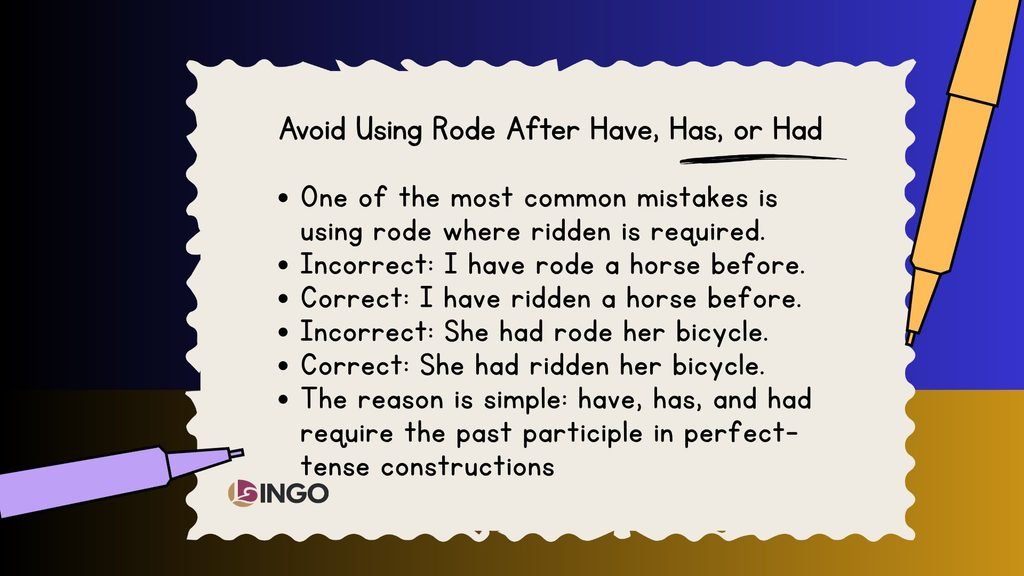
One of the most common mistakes is using rode where ridden is required.
Incorrect: I have rode a horse before.
Correct: I have ridden a horse before.
Incorrect: She had rode her bicycle.
Correct: She had ridden her bicycle.
The reason is simple: have, has, and had require the past participle in perfect-tense constructions.
Ridden or Rode: Comparison Table and Common Mistakes
Understanding the difference becomes easier when you compare both forms side by side.
Ridden vs. Rode: Key Differences
| Feature | Ridden | Rode |
|---|---|---|
| Verb form | Past participle | Simple past |
| Base verb | Ride | Ride |
| Common structure | Have/has/had + ridden | Subject + rode |
| Main purpose | Perfect tenses and passive constructions | Completed past actions |
| Example | I have ridden a horse. | I rode a horse. |
Common Grammar Mistakes to Avoid
Here are some frequent mistakes English learners make when using these words.
| Incorrect Sentence | Correct Sentence |
|---|---|
| I have rode a bike. | I have ridden a bike. |
| She has rode a horse. | She has ridden a horse. |
| They had rode the bus. | They had ridden the bus. |
| I ridden a motorcycle yesterday. | I rode a motorcycle yesterday. |
| He has never rode a camel. | He has never ridden a camel. |
A Simple Trick to Remember the Difference
Think of these three verb forms together:
- Ride = Present
- Rode = Simple past
- Ridden = Past participle
For example:
- Today, I ride my bicycle.
- Yesterday, I rode my bicycle.
- I have ridden my bicycle many times.
Memorizing this pattern makes it much easier to use the correct form without second-guessing yourself.
Real-Life Example: Understanding Ridden and Rode in Everyday English
Imagine a student named Daniel who is learning English and recently started taking weekend cycling lessons. During a conversation with his classmates, he wants to explain his experience.
At first, Daniel says, “I have rode a bicycle several times.” Although his classmates understand what he means, the sentence contains a grammatical mistake. The correct version is “I have ridden a bicycle several times.”
Later, Daniel describes what happened during his first cycling lesson. He says, “Last Saturday, I ridden a bicycle around the park.” Again, the verb form is incorrect because he is describing a completed action at a specific time in the past. He should say, “Last Saturday, I rode a bicycle around the park.”
After learning the difference, Daniel begins recognizing the grammatical patterns. When discussing general experience, he uses phrases such as “I have ridden a bicycle before.” When describing a particular event, he says, “I rode a bicycle last Saturday.”
This example demonstrates why understanding verb forms matters. The words ridden and rode may communicate similar actions, but their grammatical roles are different. Once Daniel learns that rode describes a completed past action and ridden follows helping verbs in perfect tenses, he becomes more confident in speaking and writing.
The same principle applies to other riding experiences, including horses, motorcycles, bicycles, and public transportation. Learning the correct forms helps you communicate clearly in conversations, school assignments, emails, and professional writing.
Ridden or Rode: Grammar Facts and 2025–2026 Reference Check
English grammar rules remain important for clear communication, especially when dealing with irregular verbs. The distinction between rode and ridden is supported by established English dictionaries and grammar references.
Here are some useful reference-based facts:
- Three principal verb forms: Ride, rode, and ridden are the three principal forms of this irregular verb.
- Two different past forms: Rode is the simple past form, while ridden is the past participle.
- No regular -ed ending: Unlike regular verbs such as walked or played, ride changes its spelling to form its past tense and past participle.
- Consistent grammar rule: The distinction between simple past and past participle remains the same in current English grammar references.
There is no reliable published 2025–2026 statistic establishing what percentage of English speakers confuse these two words. Therefore, it is better to rely on verified grammatical evidence than to present unsupported usage statistics.
Mini Quiz:Ridden or Rode
1. What is the simple past tense of ride?
Answer: Rode
2. What is the past participle of ride?
Answer: Ridden
3. Which is correct: “I have rode a horse” or “I have ridden a horse”?
Answer: I have ridden a horse.
4. Complete the sentence: We _____ the bus yesterday.
Answer: Rode
5. Is “I have ridden a motorcycle” grammatically correct?
Answer: Yes
6. What is the past participle of ride?
Answer: Ridden
7. Complete the sentence: He had _____ his bike before it started raining.
Answer: Ridden
8. Which is correct: “I have ridden a horse” or “I have rode a horse”?
Answer: I have ridden a horse.
9. Choose the correct sentence:
Answer: They rode to the park yesterday.
10. Is rode the past participle of ride?
Answer: False
11. Complete the sentence: She _____ a horse last weekend.
Answer: Rode
12. Which helping verb can come before ridden in the present perfect tense?
Answer: Has
13. Complete the sentence: I _____ my scooter two days ago.
Answer: Rode
14. Which sentence is correct: “They had rode before” or “They had ridden before”?
Answer: They had ridden before.
15. Which expressions are grammatically correct: Have ridden, Had ridden, Has rode, Rode yesterday?
Answer: Have ridden, Had ridden, and Rode yesterday.
16. What is the base form of rode?
Answer: Ride
17. Complete the sentence: The horse was _____ by an experienced trainer.
Answer: Ridden
18. Which sentence is grammatically incorrect: “I rode my bike yesterday,” “She has ridden a horse,” “They had ridden before sunset,” or “He has rode a motorcycle”?
Answer: He has rode a motorcycle.
19. Which sentence describes a past experience without specifying exactly when it happened?
Answer: I have ridden a horse before.
20. What are the three principal forms of ride?
Answer: Ride, Rode, Ridden
21. Complete the sentence: She has never _____ a camel.
Answer: Ridden
22. Choose the correct sentence:
Answer: I rode my bicycle last Sunday.
23. Which form should follow “had” in a past perfect sentence?
Answer: Ridden
24. Complete the sentence: We have _____ this train many times.
Answer: Ridden
25. Is “She rode a horse yesterday” grammatically correct?
Answer: Yes
Frequently Asked Questions About Ridden or Rode
1. Is it ridden or rode?
Both words are correct, but they have different grammatical functions. Rode is the simple past tense of ride, while ridden is its past participle.
Examples:
- I rode a bicycle yesterday.
- I have ridden a bicycle before.
2. What is the past tense of ride?
The simple past tense of ride is rode.
Example: She rode her bicycle to school yesterday.
Ridden is the past participle, not the simple past tense.
3. Is ridden a real word?
Yes, ridden is a correct English word. It is the past participle of the irregular verb ride.
Example: He has ridden a horse several times.
4. Should I say I have ridden or I have rode?
The correct expression is I have ridden.
Have must be followed by the past participle in this present perfect construction.
Correct: I have ridden a motorcycle before.
Incorrect: I have rode a motorcycle before.
5. Is it rode a horse or ridden a horse?
Both expressions are correct, depending on the sentence.
- She rode a horse yesterday.
- She has ridden a horse before.
Use rode for the simple past and ridden for the past participle.
6. Can I use ridden without have, has, or had?
Yes. Ridden can appear without these helping verbs in passive constructions.
Example: The horse was ridden by an experienced trainer.
However, when using ridden as part of a perfect tense, you need an appropriate auxiliary verb.
7. What are the three forms of ride?
The three principal forms are:
| Verb Form | Word |
|---|---|
| Present | Ride |
| Simple Past | Rode |
| Past Participle | Ridden |
Example: I ride every weekend, rode yesterday, and have ridden many times.
8. Is rode a regular or irregular verb form?
Rode is an irregular past-tense form of ride. It does not follow the standard rule of adding -ed to the base verb.
For example:
- Regular: Walk → Walked
- Irregular: Ride → Rode → Ridden
Conclusion: Ridden or Rode – Which One Should You Use?
Choosing between ridden or rode becomes easy once you understand their grammatical roles. Rode is the simple past tense of ride, while ridden is the past participle used in perfect tenses and passive constructions.
Remember these three forms:
- Ride: Present tense
- Rode: Simple past tense
- Ridden: Past participle
For example, say “I rode my bicycle yesterday” when describing a completed past action. Use “I have ridden my bicycle before” when talking about an experience.
Understanding this small grammar difference can improve your writing, speaking, and overall English communication.
For more clear explanations of commonly confused English words and grammar rules, explore the other language guides on Lingorixa.
References

Maimoona Asghar is a grammar enthusiast and language writer who creates clear, practical content to help learners improve English grammar, writing, punctuation, and communication skills through easy-to-understand explanations and examples.

