

Have you ever encountered the words nominator and nominee on an award application, election form, or professional recommendation? Although these terms look similar, they describe two completely different roles. Confusing them can lead to misunderstandings when completing official documents or discussing awards.
Understanding nominator vs nominee is simple once you know who takes action and who receives the nomination. A nominator is the person who recommends someone for a position, award, or opportunity, while a nominee is the person being recommended.
For example, if a teacher recommends a student for an academic award, the teacher is the nominator, and the student is the nominee.
In this complete guide, you will learn the definitions, differences, grammatical usage, and real-world examples of both terms. You will also discover common mistakes and practical ways to remember which word to use.
1. What Does Nominator Mean?
A nominator is a person who officially recommends, proposes, or puts forward another person for a position, award, honor, or opportunity.
In simple words, the nominator is the person who takes the initiative to suggest someone for recognition or consideration.
Definition of Nominator
- Word: Nominator
- Part of Speech: Noun
- Plural Form: Nominators
- Meaning: A person who nominates another individual for something.
- Related Verb: Nominate
A nominator usually provides the necessary information, completes nomination forms, and explains why the selected person deserves consideration.
Examples of Nominator in Sentences
- Sarah was the nominator who recommended John for the Employee of the Year award.
- The nominator must complete the application before the deadline.
- Each nominator should provide evidence supporting the candidate’s achievements.
- My manager became my nominator for the professional excellence award.
- The organization contacted the nominator to verify the submitted information.
Responsibilities of a Nominator
Depending on the nomination process, a nominator may have several responsibilities:
- Identifying a suitable candidate.
- Completing the official nomination form.
- Providing accurate information about the candidate.
- Explaining why the person deserves recognition.
- Submitting supporting documents or recommendation letters.
- Responding to questions from the selection committee.
Example: If a company manager recommends an employee for a leadership award, the manager acts as the nominator and provides information about the employee’s professional achievements.
2. What Does Nominee Mean?
A nominee is a person who has been officially recommended or proposed for a position, award, honor, or opportunity.
In simple words, a nominee is the person whose name is put forward by someone else for consideration.
Definition of Nominee
- Word: Nominee
- Part of Speech: Noun
- Plural Form: Nominees
- Meaning: A person who has been nominated for something.
- Related Verb: Nominate
A nominee does not automatically become a winner. Instead, the person is considered for an award, position, or opportunity through a selection process.
Examples of Nominee in Sentences
- John became a nominee for the Employee of the Year award.
- The nominees will be announced next Monday.
- She was excited to become a nominee for the national teaching award.
- Every nominee must meet the organization’s eligibility requirements.
- The committee selected five nominees for the final round.
Responsibilities and Role of a Nominee
A nominee may have different responsibilities depending on the organization or nomination process.
These can include:
- Providing personal or professional information.
- Submitting supporting documents.
- Confirming eligibility requirements.
- Sharing details about professional achievements.
- Attending interviews or selection events.
- Providing additional information when requested.
However, not every nomination process requires the nominee to participate directly. Some organizations allow nominators to complete the entire process on behalf of the candidate.
Example: If an employee is nominated for an outstanding performance award, the employee becomes the nominee. The employee may need to provide additional information about their achievements before the committee makes its final decision.
3. Nominator vs Nominee: Key Differences
The main difference between a nominator and a nominee is their role in the nomination process.
A nominator recommends someone, whereas a nominee is the person receiving that recommendation.
Nominator vs Nominee Comparison Table
| Feature | Nominator | Nominee |
|---|---|---|
| Meaning | Person who nominates someone | Person who is nominated |
| Role | Recommends a candidate | Receives the nomination |
| Main Action | Submits a nomination | Is considered for selection |
| Responsibility | Provides supporting information | May provide additional details |
| Position | Initiates the nomination | Is the subject of nomination |
| Verb Form | Nominate | Be nominated |
| Plural | Nominators | Nominees |
| Example | A teacher recommending a student | The student being recommended |
The Difference in Simple Words
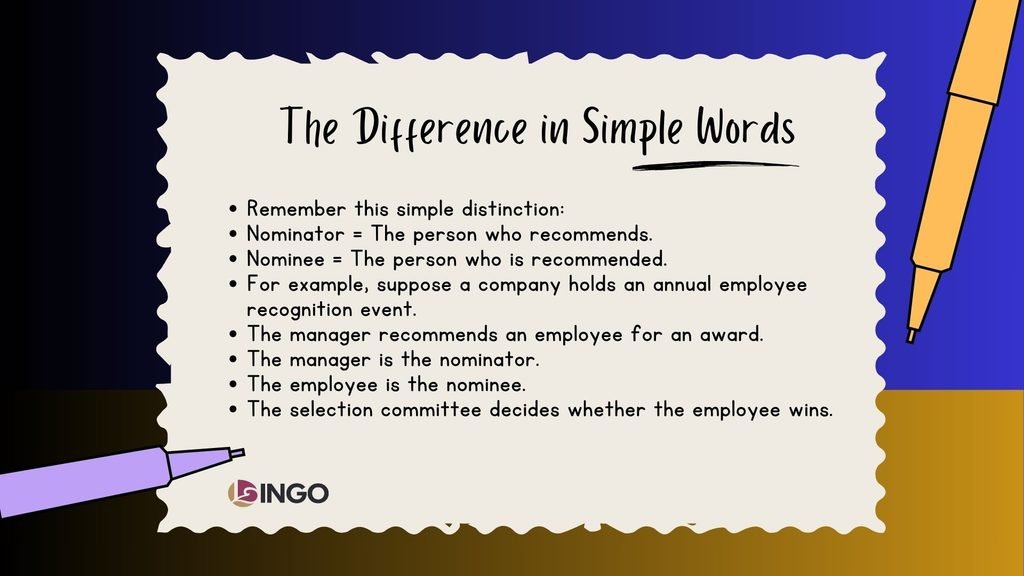
Remember this simple distinction:
- Nominator = The person who recommends.
- Nominee = The person who is recommended.
For example, suppose a company holds an annual employee recognition event.
- The manager recommends an employee for an award.
- The manager is the nominator.
- The employee is the nominee.
- The selection committee decides whether the employee wins.
This example clearly shows that the nominator and nominee have separate roles.
Nominator vs Nominee in a Sentence
Compare these two sentences:
- Correct: The nominator submitted the employee’s name for the award.
- Correct: The employee became a nominee for the award.
Both sentences use the words correctly because the first describes the person making the recommendation, while the second identifies the person receiving it.
4. How Are Nominator and Nominee Used in Real Life?
The words nominator and nominee appear in different situations, including professional awards, academic recognition, political elections, and organizational appointments.
Nominator vs Nominee in Awards
Award ceremonies are among the most common situations where these terms appear.
For example, a company organizes an annual employee recognition program. A department manager recommends an employee for outstanding performance.
- Manager = Nominator
- Employee = Nominee
- Selection committee = Decision-maker
The manager provides information about the employee’s achievements, while the employee is considered for the award.
Being nominated does not guarantee that someone will win.
Nominator vs Nominee in Elections
These terms are also used in political and organizational elections.
For example, a political party may nominate a person to run for a leadership position.
- The person or authorized group submitting the nomination acts as the nominator.
- The individual being proposed for the position is the nominee.
The nominee may later become a candidate in the election, depending on the applicable rules.
Nominator vs Nominee in Education
Schools, colleges, and universities frequently use nomination processes to recognize outstanding students.
For example, a professor recommends a student for a scholarship because of excellent academic performance.
- Professor = Nominator
- Student = Nominee
- Scholarship committee = Evaluator
The student may need to provide academic records, recommendation letters, and other documents.
Nominator vs Nominee in Professional Organizations
Professional associations also use nomination systems to recognize individuals who contribute to their industries.
For example, a professional organization may invite experienced members to nominate colleagues for leadership awards.
The person submitting the recommendation is the nominator, while the individual being recommended is the nominee.
The exact responsibilities of both parties depend on the organization’s rules.
5. Real-Life Case Study: Understanding Nominator vs Nominee
Consider a fictional example involving a company called Bright Future Technologies.
The company organizes an annual Excellence in Leadership Award to recognize employees who demonstrate outstanding leadership, teamwork, and professional performance.
One of the department managers, David, notices that an employee named Emma has consistently helped her colleagues, completed important projects, and improved team productivity.
David believes Emma deserves recognition. Therefore, he decides to recommend her for the company’s annual leadership award.
He completes the official nomination form, describes Emma’s achievements, and submits supporting information to the human resources department.
At this stage, David is the nominator because he initiated the recommendation and submitted Emma’s name for consideration.
Emma becomes the nominee because she is the person being recommended for the award.
After receiving the application, the selection committee reviews Emma’s professional achievements and compares her qualifications with those of other nominees.
The committee eventually selects Emma as the award winner.
This example demonstrates three important stages:
- Nomination: David recommends Emma for the award.
- Evaluation: The committee reviews Emma’s qualifications and achievements.
- Selection: Emma is chosen as the winner.
Notice that David remains the nominator throughout the process, while Emma is initially the nominee and later becomes the winner.
The two terms are not interchangeable, even though they are connected to the same award.
Key lesson: The nominator is the person who recommends someone, while the nominee is the person being recommended. Winning the award is a separate stage of the process.
6. Common Mistakes When Using Nominator and Nominee
Although these words have straightforward meanings, people sometimes confuse them because they share the same root word.
Mistake 1: Calling the Nominee a Nominator
Incorrect: Emma is the nominator for the Employee of the Year award because her manager recommended her.
Correct: Emma is the nominee for the Employee of the Year award because her manager recommended her.
The person making the recommendation is the nominator, not the person receiving it.
Mistake 2: Assuming Every Nominee Is a Winner
Incorrect: Every nominee automatically receives the award.
Correct: A nominee is considered for an award, but only the selected individual or individuals become winners.
Being nominated is not the same as winning.
Mistake 3: Confusing the Nominator With the Selection Committee
Incorrect: The selection committee is always the nominator.
Correct: The nominator submits the recommendation, while the selection committee evaluates the nominees and makes selection decisions.
These roles may be different depending on the organization’s procedures.
Mistake 4: Using Nominee for the Person Making the Recommendation
Incorrect: My colleague became a nominee when she submitted my name for the award.
Correct: My colleague became the nominator when she submitted my name for the award.
The person submitting the recommendation is the nominator.
Mistake 5: Assuming a Nominee Must Always Be an Individual
In many everyday award and election contexts, a nominee is an individual. However, some organizations also allow teams, groups, or organizations to be nominated.
Always check the rules of the relevant nomination program.
How to Remember the Difference
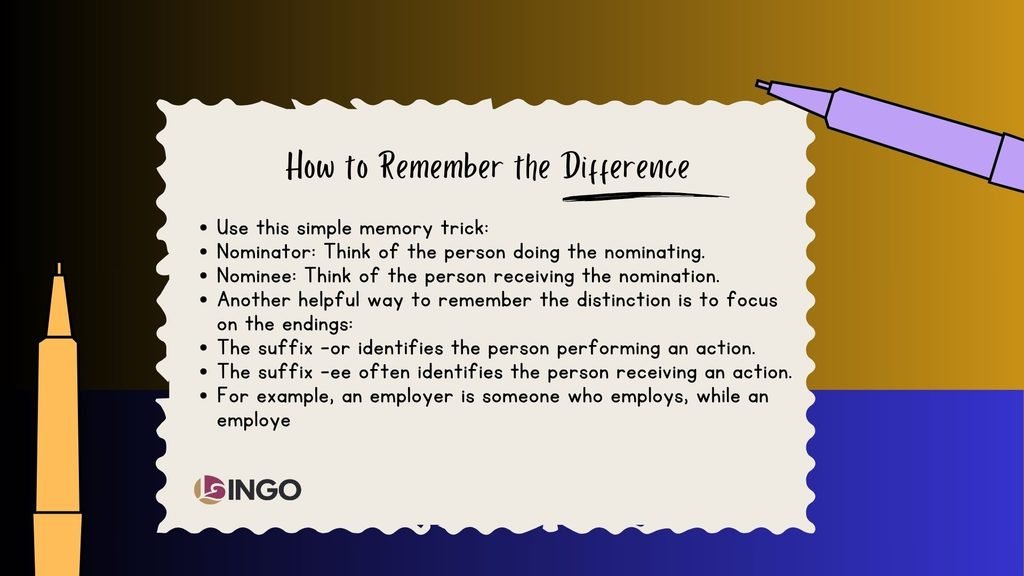
Use this simple memory trick:
- Nominator: Think of the person doing the nominating.
- Nominee: Think of the person receiving the nomination.
Another helpful way to remember the distinction is to focus on the endings:
- The suffix -or identifies the person performing an action.
- The suffix -ee often identifies the person receiving an action.
For example, an employer is someone who employs, while an employee is someone who is employed.
Similarly, a nominator nominates, while a nominee is nominated.
7. Nominator vs Nominee: Current Nomination Practices and 2025–2026 Examples
The distinction between a nominator and a nominee remains important in modern professional, academic, and government nomination systems.
Recent nomination guidelines show that organizations often assign specific responsibilities to the person submitting a nomination and the person being considered.
What Do Recent Nomination Guidelines Show?
Here are some examples from official nomination programs:
1. Project Management Institute (2025)
The Project Management Institute’s 2025 PMI Fellow nomination guidance identifies the nominator as the individual responsible for initiating and coordinating the nomination. The nominee is the PMI member being considered for recognition based on their contributions and impact.
2. Royal Society Awards (2025–2026)
The Royal Society’s nomination guidance explains that nominators submit applications and supporting statements about the people they recommend. The relevant committees then assess eligible nominations and select candidates for further consideration.
3. Philippine Presidential Awards (2026)
The official guidelines for the 2026 Presidential Awards for Filipino Individuals and Organizations Overseas specify that individuals and groups can submit nominations. The guidelines also explain that self-nominations may be considered.
These examples demonstrate that nomination requirements vary between organizations, but the fundamental distinction remains the same.
Data and Statistics: What the Available Evidence Tells Us
There is no single authoritative 2025–2026 global statistical dataset measuring nominators and nominees across all industries, award programs, and elections. Therefore, assigning a universal percentage or numerical ratio to these roles would be misleading.
However, recent official documents provide useful measurable information about nomination processes:
- 2025 PMI Fellow process: The published guidance defines the nominator’s coordination responsibilities and the nominee’s evaluation role.
- Royal Society award cycle: Its published timetable identifies November 30 as the opening date, February 19 as the closing date, March to May for shortlisting and scoring, July for decisions, and August for winner announcements.
- 2026 Philippine Presidential Awards: The official guidelines establish a nomination period from December 8, 2025, through May 29, 2026.
These documented processes demonstrate that nominations involve more than simply submitting someone’s name. They can include eligibility checks, supporting evidence, evaluation, shortlisting, and final selection.
Important takeaway: A nominator starts or coordinates the recommendation, while a nominee is the person or entity being considered. The exact process and requirements depend on the organization.
Mini Quiz:Nominator vs Nominee
1. Who is a nominator?
A. A person who receives a nomination
B. A person who nominates someone
C. A person who wins an award
D. A person who judges a competition
2. Who is a nominee?
A. A person who makes a nomination
B. A person who organizes an event
C. A person who is nominated
D. A person who selects the winner
3. Which word refers to the person making a recommendation?
A. Nominee
B. Nominator
C. Candidate
D. Winner
4. Which word describes someone being considered for an award?
A. Nominator
B. Nominee
C. Organizer
D. Selector
5. Complete the sentence: Sarah nominated John for the award. Sarah is the _____.
A. Nominee
B. Winner
C. Nominator
D. Candidate
6. Complete the sentence: John was nominated for the award. John is the _____.
A. Nominator
B. Nominee
C. Judge
D. Organizer
7. Which word is correct? The _____ submitted the nomination form.
A. Nominee
B. Nominator
C. Award
D. Candidate
8. A person nominated for a scholarship is called a _____.
A. Nominator
B. Nominee
C. Sponsor
D. Judge
9. What is the plural of nominator?
A. Nominators
B. Nominatories
C. Nominees
D. Nominationers
10. What is the plural of nominee?
A. Nomineers
B. Nominator
C. Nominees
D. Nomineies
11. Which sentence uses nominator correctly?
A. The nominator received the nomination.
B. The nominator nominated three students.
C. The nominator was selected as a nominee.
D. The nominator was nominated by the committee.
12. Which sentence uses nominee correctly?
A. The nominee submitted three nominations.
B. The nominee nominated the committee.
C. The nominee was shortlisted for the award.
D. The nominee selected the candidates.
13. What is the main difference between nominator and nominee?
A. They have exactly the same meaning.
B. A nominator gives a nomination, while a nominee receives one.
C. A nominee gives a nomination, while a nominator receives one.
D. Both words describe winners.
14. In an award ceremony, who is the nominee?
A. The person announcing the award
B. The person who nominated someone
C. The person nominated for the award
D. The event organizer
15. Complete the sentence: The committee selected Maria as a _____ for the position.
A. Nominator
B. Nominee
C. Nomination
D. Nominating
16. Can a person be both a nominator and a nominee?
A. Yes, in different situations
B. No, never
C. Only in sports
D. Only in academic competitions
17. Which word refers to the act of recommending someone?
A. Nominee
B. Nominator
C. Nomination
D. Nominal
18. Who usually submits someone’s name for consideration?
A. Nominee
B. Nominator
C. Winner
D. Audience
19. Complete the sentence: Each _____ must meet the award requirements.
A. Nominator
B. Nominee
C. Nomination
D. Organizer
20. Which option is grammatically correct?
A. She is the nominator for the award.
B. She is the nominate for the award.
C. She is the nomination for the award.
D. She is the nominating for the award.
21. A teacher recommends a student for a scholarship. Who is the nominator?
A. The student
B. The teacher
C. The scholarship
D. The selection committee
22. A student is recommended for a scholarship. Who is the nominee?
A. The teacher
B. The student
C. The school principal
D. The scholarship provider
23. Which word should complete this sentence? The _____ received an email confirming their nomination.
A. Nominator
B. Nominee
C. Organizer
D. Sponsor
24. Which statement is true?
A. A nominator is always the award winner.
B. A nominee always submits the nomination.
C. A nominator recommends someone for consideration.
D. A nominee organizes the award ceremony.
25. Choose the correct sentence.
A. The nominee nominated the nominator for the position.
B. The nominator nominated the nominee for the position.
C. The nomination nominated the nominee.
D. The nominator was the nomination.
Frequently Asked Questions (FAQs)
Q1: What is the main difference between a nominator and a nominee?
A nominator is the person who recommends someone for an award, position, or opportunity. A nominee is the person being recommended. The nominator takes the action, while the nominee receives the nomination.
Q2: Can a person be both a nominator and a nominee?
Yes, a person can be both a nominator and a nominee in different nomination processes. For example, someone may recommend a colleague for an award while being nominated for a separate award by another person.
However, whether someone can nominate themselves or participate in the same nomination process in multiple roles depends on the organization’s rules.
Q3: Is a nominee the winner of an award?
No. A nominee is someone being considered for an award, but nomination does not guarantee victory. A selection committee or voting process usually determines the winner.
Q4: Who is responsible for submitting a nomination form?
Generally, the nominator is responsible for submitting the nomination form. However, some organizations allow nominees to provide information, submit supporting documents, or participate directly in the application process.
Always check the specific nomination guidelines.
Q5: What is the plural of nominator and nominee?
The plural of nominator is nominators, while the plural of nominee is nominees.
Examples:
- Three nominators submitted applications.
- Five nominees were shortlisted for the award.
Q6: What is another word for nominator?
Depending on the context, similar terms include recommender, proposer, sponsor, or person making a nomination.
However, these words are not always exact synonyms because their meanings and responsibilities can differ.
Q7: What is another word for nominee?
Common alternatives include candidate, applicant, contender, or person being considered.
The best alternative depends on the context. For example, candidate is common in elections, while nominee is frequently used for awards and formal recognition.
Q8: Is a nominator the same as a seconder?
No. A nominator initially proposes someone for a position or opportunity, while a seconder formally supports that proposal in processes where a second supporter is required.
Both roles can appear in elections, organizational meetings, and formal nomination procedures.
Conclusion: Nominator vs Nominee – Which Word Should You Use?
Understanding nominator vs nominee becomes easy when you remember the main difference between these two words.
A nominator is the person who recommends someone for an award, position, election, or opportunity. A nominee is the person who receives that recommendation and is considered for selection.
For example, when a teacher recommends a student for an academic award, the teacher is the nominator, and the student is the nominee.
Both terms are important in professional communication, award applications, elections, and everyday English.
The easiest way to remember them is:
- Nominator = The person who nominates.
- Nominee = The person who is nominated.
Now that you understand their definitions, differences, and practical usage, you can confidently use both words in conversations, professional documents, and official nomination forms.
For more clear explanations of commonly confused English words and grammar rules, explore the other language guides on Lingorixa.
References

Maimoona Asghar is a grammar enthusiast and language writer who creates clear, practical content to help learners improve English grammar, writing, punctuation, and communication skills through easy-to-understand explanations and examples.

