Have you ever written “Thank you so much” and then wondered whether it is actually grammatically correct? You are not alone. English learners and even native speakers sometimes question whether “thank you so much” sounds too informal, overly emotional, or less correct than “thank you very much.”
The good news is simple: “Thank you so much” is grammatically correct English. It is a natural expression used to show strong gratitude, appreciation, or warmth.
The phrase works in everyday conversations, messages, emails, social situations, and many professional settings. However, the best choice depends on the situation and the tone you want to create.
In this guide, we will explain the grammar behind “thank you so much,” compare it with similar expressions, show you how to use it correctly, and give you practical examples.
Quick Answer: Is “Thank You So Much” Grammatically Correct?
Yes. “Thank you so much” is grammatically correct and widely accepted in modern English.
The phrase consists of:
- Thank you — an expression of gratitude.
- So much — an intensifying expression that emphasizes the degree of gratitude.
Cambridge Dictionary specifically gives “Thank you so/very much” as a standard example of much being used as an adverb.
For example:
- Thank you so much for your help.
- Thank you so much for coming.
- Thank you so much for the lovely gift.
- Thank you so much!
All of these sentences are natural and grammatically acceptable.
The main difference between “thank you so much” and “thank you very much” is usually not correctness. Instead, it is a matter of tone, emphasis, and context.
What Does “Thank You So Much” Mean?
The Meaning of “Thank You So Much”
“Thank you so much” is a stronger way of expressing gratitude than simply saying “thank you.”
It can communicate:
- Strong appreciation
- Warmth
- Sincerity
- Emotional gratitude
- Politeness
- Personal connection
For example:
Thank you for helping me.
This is polite and straightforward.
Thank you so much for helping me.
This adds stronger emphasis and can sound warmer or more heartfelt.
The phrase does not necessarily mean that the speaker is extremely emotional. In many everyday situations, “so much” is simply a conventional way to intensify gratitude.
Cambridge’s grammar guidance confirms that so much can express a large degree or amount, while Merriam-Webster defines thank-you as a polite expression of gratitude.
Is “So Much” an Intensifier?
Yes. In this expression, “so much” increases the strength of the gratitude being expressed.
Compare:
- Thank you.
- Thank you very much.
- Thank you so much.
All three are correct, but the last two add emphasis.
The same general idea appears in other expressions:
- I miss you so much.
- I appreciate it so much.
- I enjoyed it so much.
- Thank you so much.
Therefore, there is nothing grammatically unusual about placing “so much” after “thank you.”
Why Does “Thank You So Much” Sound Natural?
English has many established expressions that do not always follow the patterns learners expect from textbook grammar.
“Thank you” itself functions as a conventional expression of gratitude. Merriam-Webster traces the noun thank-you to the phrase thank you and lists its first known use as 1792.
Adding “so much” simply strengthens that expression.
So, rather than thinking of the phrase as an unusual construction, it is better to recognize it as a standard and established expression of gratitude.
How to Use “Thank You So Much” Correctly
“Thank You So Much” + For + Noun
When thanking someone for a thing, use:
Thank you so much for + noun
Examples:
- Thank you so much for the gift.
- Thank you so much for your advice.
- Thank you so much for your support.
- Thank you so much for the invitation.
- Thank you so much for your kindness.
This construction is particularly useful in emails, messages, cards, and conversations.
“Thank You So Much” + For + Verb-ing
When thanking someone for an action, use:
Thank you so much for + verb-ing
Examples:
- Thank you so much for helping me.
- Thank you so much for explaining this.
- Thank you so much for waiting.
- Thank you so much for checking my work.
- Thank you so much for taking the time to call.
Notice that the verb after for takes the -ing form.
Correct:
Thank you so much for helping me.
Incorrect:
Thank you so much for help me.
Correct:
Thank you so much for coming.
Incorrect:
Thank you so much for come.
This is an important pattern for English learners.
“Thank You So Much” as a Complete Expression
You do not always need to explain what you are grateful for.
You can simply say:
Thank you so much!
For example:
A: I brought you some coffee.
B: Thank you so much!
The context already explains the reason for the gratitude.
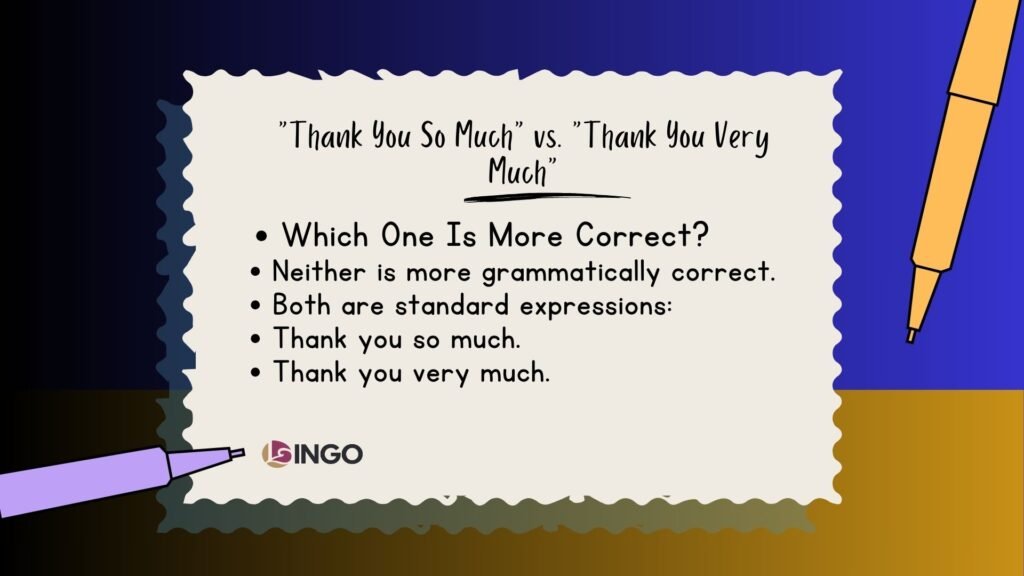
“Thank You So Much” vs. “Thank You Very Much”
Which One Is More Correct?
Neither is more grammatically correct.
Both are standard expressions:
- Thank you so much.
- Thank you very much.
The choice is mainly about style and tone.
“Thank you very much” can sometimes sound slightly more formal or traditional, while “thank you so much” often feels warmer and more conversational. However, the distinction is not absolute.
Historical language research also shows that both forms have been established in English for a long time. Grammarphobia notes examples of “thank you very much” dating back to the 1600s and “thank you so much” to the 1800s.
Comparison Table
| Expression | Tone | Common Use | Example |
|---|---|---|---|
| Thank you | Neutral | Everyday situations | Thank you for your help. |
| Thanks | Casual | Friends and informal situations | Thanks for helping me. |
| Thank you so much | Warm and appreciative | Personal, casual, and many professional situations | Thank you so much for your support. |
| Thank you very much | Polite and slightly formal | Professional and formal situations | Thank you very much for your assistance. |
| Many thanks | Polite and concise | Emails and written communication | Many thanks for your reply. |
| I really appreciate it | Warm and sincere | Personal or professional | I really appreciate your help. |
The key point is that correctness does not depend on choosing “very” instead of “so.”
When Should You Say “Thank You So Much”?
In Everyday Conversation
“Thank you so much” is completely natural in everyday speech.
For example:
Thank you so much for picking me up.
Thank you so much! That was really helpful.
Thank you so much for remembering my birthday.
It works particularly well when you want your gratitude to sound warm and genuine.
In Text Messages and Social Communication
The expression is extremely natural in informal digital communication.
For example:
Thank you so much!! 😊
Thank you so much for checking on me.
Thank you so much! I really appreciate it.
In a casual text, the phrase can sound more friendly than a highly formal alternative such as “I sincerely appreciate your assistance.”
In Professional Emails
You can also use “thank you so much” in professional communication, especially when the relationship is friendly or the message is not highly formal.
For example:
Thank you so much for sending the updated report.
Thank you so much for taking the time to meet with me.
However, in a highly formal business letter, academic correspondence, or official communication, you may prefer:
Thank you very much for your assistance.
or:
I sincerely appreciate your assistance.
The goal is not to avoid “thank you so much.” Instead, match your wording to the relationship and situation.
When “Thank You So Much” May Not Be the Best Choice
Extremely Formal Situations
Although grammatically correct, “thank you so much” may sound slightly conversational in some formal contexts.
For example, in a formal complaint response, legal letter, or highly official correspondence, you might choose:
Thank you for your attention to this matter.
instead of:
Thank you so much for your attention to this matter.
The first sounds more restrained and professional.
When You Need a Neutral Tone
Sometimes you simply need to acknowledge someone’s help without adding strong emotional emphasis.
For example:
Thank you for your email.
is neutral.
Thank you so much for your email.
sounds warmer and more appreciative.
Neither is wrong. The difference is tone rather than grammar.
When the Expression Is Repeated Too Often
Using “thank you so much” repeatedly can make writing sound repetitive.
For example:
Thank you so much for your email. Thank you so much for your help. Thank you so much for your time.
A better version might be:
Thank you for your email. I really appreciate your help and the time you took to explain everything.
Varying your expressions can make your writing sound more natural.
Case Study: Choosing the Right Thank-You Expression
A Realistic Workplace Example
Imagine that a manager helps an employee prepare an important presentation. The manager stays late, reviews the slides, suggests improvements, and sends the final version before the meeting.
The employee could write:
Thank you so much for taking the time to review my presentation. Your suggestions made the slides much clearer, and I really appreciate your help.
This version works because the relationship is professional but still allows for warmth. The employee is not merely acknowledging that the manager helped; they are expressing genuine appreciation.
Now imagine a different situation. The employee is writing to a government office regarding an official document. A more restrained sentence might be:
Thank you very much for your assistance with my application.
Both expressions communicate gratitude, but the second has a more formal feel.
This illustrates an important principle: “Thank you so much” is not grammatically less correct than “thank you very much.” The better choice depends on the audience, purpose, and desired tone.
In practical English writing, you should therefore think about appropriateness rather than correctness alone. If you are speaking to a friend, thanking someone for personal support, or writing a friendly professional email, “thank you so much” can be an excellent choice. If you are communicating in a highly formal setting, a more neutral expression may fit better.
“Thank You So Much” in 2025–2026: What Current Language Sources Show
Current Grammar Evidence
Current reference sources continue to recognize the construction as standard English.
Cambridge Dictionary’s current grammar material explicitly provides “Thank you so/very much” as an example of much functioning as an adverb.
Cambridge Grammar also gives the natural example:
“Thank you so much for helping us move house.”
This confirms that the construction is used naturally with for + verb-ing.
Current Dictionary Evidence
Merriam-Webster’s dictionary entry for thank-you was updated in March 2026 and continues to define it as a polite expression of gratitude. Its current examples also include modern uses of thank-you in writing and communication.
What the Historical Data Tells Us
While there is no authoritative public 2025–2026 statistic showing exactly how many English speakers say “thank you so much,” historical corpus evidence demonstrates that the phrase is not a recent invention.
Grammarphobia reports an example of “I thank you so much” from an 1869 novel, while “thank you very much” appears in an example from a 1650 letter.
So the evidence from current dictionaries, grammar references, and historical usage points in the same direction: “Thank you so much” is an established English expression, not a grammatical mistake.
Common Mistakes With “Thank You So Much”
Mistake 1: Writing “Thank You Soo Much”
In standard English, write:
Thank you so much.
Not:
Thank you soo much.
Extra letters such as “soo” may appear in informal texting to create emphasis, but they are not appropriate in standard formal writing.
Mistake 2: Using “Thank You Much”
Avoid:
Thank you much.
The standard expression is:
Thank you so much.
or:
Thank you very much.
Mistake 3: Forgetting “For”
When you identify the reason for your gratitude, use for correctly.
Correct:
Thank you so much for your help.
Correct:
Thank you so much for helping me.
Incorrect:
Thank you so much your help.
Mistake 4: Using the Wrong Verb Form
After for, use a noun or -ing form when referring to an action.
Correct:
Thank you so much for explaining the problem.
Incorrect:
Thank you so much for explain the problem.
Better Alternatives to “Thank You So Much”
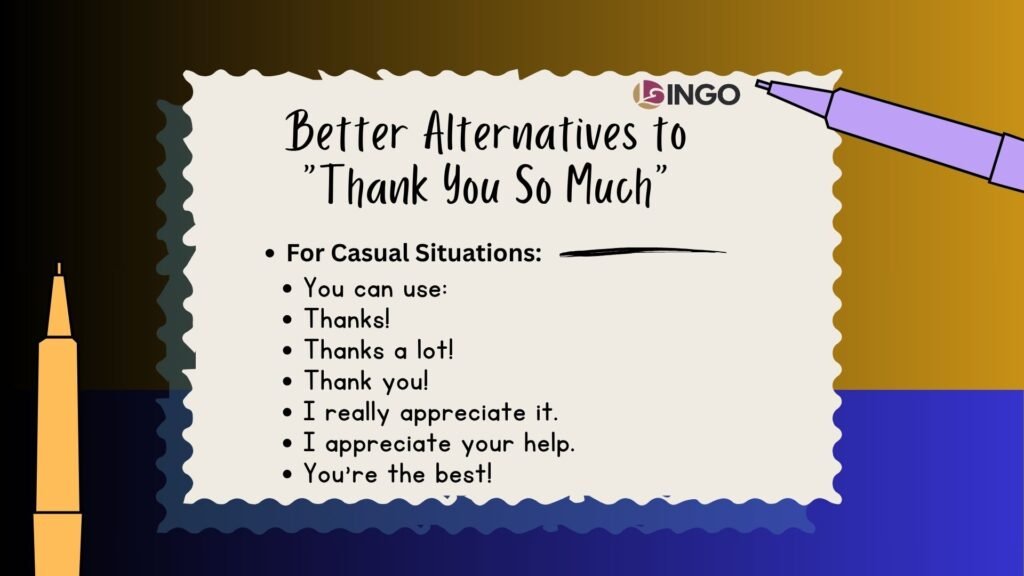
For Casual Situations
You can use:
- Thanks!
- Thanks a lot!
- Thank you!
- I really appreciate it.
- I appreciate your help.
- You’re the best!
Example:
Thanks a lot for helping me move.
For Professional Situations
Consider:
- Thank you for your assistance.
- Thank you very much for your help.
- I really appreciate your support.
- I sincerely appreciate your assistance.
- Many thanks for your time.
Example:
I really appreciate your assistance with this project.
For Heartfelt Gratitude
When you want your appreciation to sound particularly sincere:
- Thank you from the bottom of my heart.
- I can’t thank you enough.
- I truly appreciate everything you’ve done.
- I am incredibly grateful.
- Thank you so much for being there for me.
These expressions should be used thoughtfully because they carry stronger emotional weight.
A Simple Guide: Which Thank-You Phrase Should You Choose?
Use this quick guide when you’re unsure:
- Want a neutral expression?
→ Say “Thank you.” - Want a casual expression?
→ Say “Thanks.” - Want warm, strong appreciation?
→ Say “Thank you so much.” - Want a slightly more formal expression?
→ Say “Thank you very much.” - Want a concise professional email phrase?
→ Say “Many thanks.” - Want to emphasize genuine appreciation?
→ Say “I really appreciate it.”
The right phrase is the one that matches your relationship, situation, and intended tone.
Mini Quiz: Thank You So Much
1. Which sentence uses “thank you so much” correctly?
A. Thank you so much for your help.
B. Thank you so much your help.
C. Thank you so much to your help.
D. Thank you so much with your help.
Answer: A
2. What does “so much” mainly do in “Thank you so much”?
A. It intensifies the gratitude.
B. It changes the tense.
C. It introduces a question.
D. It identifies the person thanked.
Answer: A
3. Which sentence correctly uses “for” with an action?
A. Thank you so much for helping me.
B. Thank you so much for help me.
C. Thank you so much for helped me.
D. Thank you so much for to help me.
Answer: A
4. Which expression is generally the most neutral?
A. Thank you.
B. Thank you so much.
C. I can’t thank you enough.
D. Thank you from the bottom of my heart.
Answer: A
5. Which phrase is a common alternative to “Thank you so much”?
A. Thank you very much.
B. Thank you muchly.
C. Thank you many.
D. Thank you plenty.
Answer: A
6. Which sentence sounds warm and natural in everyday conversation?
A. Thank you so much for coming!
B. Thank you so much coming!
C. Thank you so much to coming!
D. Thank you so much with coming!
Answer: A
7. Which sentence is best for thanking someone for a gift?
A. Thank you so much for the gift.
B. Thank you so much the gift.
C. Thank you so much to the gift.
D. Thank you so much at the gift.
Answer: A
8. Is “Thank you so much!” a complete expression by itself?
A. Yes, it is complete.
B. No, it always needs a noun.
C. No, it always needs a verb.
D. No, it must be a question.
Answer: A
9. Which phrase is generally more casual than “Thank you so much”?
A. Thanks!
B. I sincerely appreciate your assistance.
C. Thank you very much.
D. I am deeply grateful.
Answer: A
10. Which sentence is grammatically correct?
A. Thank you so much for taking the time.
B. Thank you so much for take the time.
C. Thank you so much for took the time.
D. Thank you so much for to take the time.
Answer: A
11. Which statement about “Thank you so much” is true?
A. It is grammatically correct.
B. It is always grammatically incorrect.
C. It is only correct in questions.
D. It is only correct in academic writing.
Answer: A
12. Which sentence is suitable for a friendly professional email?
A. Thank you so much for your assistance.
B. Thanks a bunch, dude, for helping.
C. Yo, thanks for everything.
D. Much thanks, buddy.
Answer: A
13. What is the main difference between “Thank you so much” and “Thank you very much”?
A. Mostly tone and emphasis.
B. One is grammatical and one is not.
C. One expresses anger and one expresses gratitude.
D. One can only be written, not spoken.
Answer: A
14. Which punctuation is natural for an enthusiastic expression?
A. Thank you so much!
B. Thank you so much?
C. Thank you so much,
D. Thank you so much:
Answer: A
15. Which phrase best expresses strong personal gratitude?
A. Thank you so much for being there for me.
B. Thank you for existing there.
C. Thank you at being there for me.
D. Thank you with being there for me.
Answer: A
16. Which is correct when thanking someone for explaining something?
A. Thank you so much for explaining it.
B. Thank you so much for explain it.
C. Thank you so much for explained it.
D. Thank you so much for to explain it.
Answer: A
17. Which expression sounds most restrained in a highly formal message?
A. Thank you for your attention to this matter.
B. Thank you so much!!!
C. Thanks a million!
D. You’re amazing, thanks!
Answer: A
18. Which sentence correctly thanks someone for their support?
A. Thank you so much for your support.
B. Thank you so much your support.
C. Thank you so much to your support.
D. Thank you so much on your support.
Answer: A
19. Which expression naturally communicates strong appreciation?
A. Thank you so much.
B. I really regret it.
C. I really question it.
D. I really refuse it.
Answer: A
20. Which sentence correctly uses “thank you so much” with “everything”?
A. Thank you so much for everything.
B. Thank you so much everything.
C. Thank you so much to everything.
D. Thank you so much at everything.
Answer: A
21. Which best describes the tone of “Thank you so much”?
A. Warm and appreciative.
B. Hostile and confrontational.
C. Uncertain and doubtful.
D. Confused and incomplete.
Answer: A
22. Which sentence is correct in standard English?
A. Thank you so much for your kindness.
B. Thank you so much your kindness.
C. Thank you so much to your kindness.
D. Thank you so much with your kindness.
Answer: A
23. Which version is the most concise way to express gratitude?
A. Thank you.
B. I am extremely grateful to you for everything you have done.
C. I sincerely wish to express my appreciation.
D. I would like to take this opportunity to thank you.
Answer: A
24. Which sentence sounds natural when a friend helps you unexpectedly?
A. Thank you so much for helping me!
B. Thank you so much for help me!
C. Thank you so much for helped me!
D. Thank you so much for to help me!
Answer: A
25. What is the best rule to remember about “Thank you so much”?
A. It is correct; choose it based on tone and context.
B. It should never be used in English.
C. It is only correct before a noun.
D. It must always be followed by a question.
Answer: A
Frequently Asked Questions
Q1:Is “Thank You So Much” grammatically correct?
Yes. “Thank you so much” is grammatically correct and widely used in contemporary English. “So much” intensifies the expression of gratitude.
Q2:Is “Thank You So Much” formal or informal?
It can be used in both settings, but it generally sounds warmer and more conversational than “thank you very much.” In highly formal writing, a more restrained expression may be preferable.
Q3:Is “Thank You So Much” better than “Thank You Very Much”?
Neither is grammatically better. Both are correct. “Thank you so much” often sounds warmer, while “thank you very much” can sound slightly more formal or traditional.
Q4:Can I say “Thank You So Much” in a professional email?
Yes. It is appropriate in many professional emails, particularly when you want to sound friendly and appreciative. For very formal communication, “Thank you for your assistance” or “Thank you very much” may be a better fit.
Q5:Should I say “Thank You So Much for Helping Me”?
Yes. “Thank you so much for helping me” is completely correct. After “for,” use the -ing form when referring to an action.
Q6:Is “Thanks So Much” grammatically correct?
Yes. “Thanks so much” is also commonly used, especially in conversational English. It is generally more casual than “thank you so much.”
Q7:Can I say “Thank You So Much for Everything”?
Yes. This is a natural expression when someone has helped you in several ways. Cambridge Grammar specifically distinguishes the natural phrase “Thank you so much for everything” from the incomplete-looking “Thank you so much for all.”
Q8:What is the most polite way to say thank you?
There is no single phrase that is always the most polite. “Thank you,” “thank you very much,” “thank you so much,” and “I really appreciate it” can all be polite. Choose according to the situation and the relationship.
Conclusion: “Thank You So Much” Is Correct English
So, is “thank you so much” grammatically correct? Absolutely.
It is a natural, established expression used to communicate strong gratitude. The phrase combines “thank you” with “so much,” which intensifies the expression and adds warmth.
Use it when you want to sound appreciative and sincere:
Thank you so much for your help.
Use “thank you very much” when you want a slightly more formal tone, and use “thank you” when a simple, neutral expression is enough.
Most importantly, don’t worry that “thank you so much” is grammatically wrong. It is not. The real question is whether its tone fits your situation.
For more clear explanations of commonly confused English words and grammar rules, explore the other language guides on Lingorixa.
References
- Google Search Central — Creating Helpful, Reliable, People-First Content
- Cambridge Dictionary — English Grammar Today

Maimoona Asghar is a grammar enthusiast and language writer who creates clear, practical content to help learners improve English grammar, writing, punctuation, and communication skills through easy-to-understand explanations and examples.