Hoping is the correct spelling, while hopeing is a misspelling. The confusion happens because the verb hope ends in a silent e, and adding -ing requires a spelling change. Therefore, we write hoping, not hopeing.
For example:
- Correct: I am hoping to hear from you soon.
- Incorrect: I am hopeing to hear from you soon.
In this guide, you’ll learn why hoping is correct, what happens to the final e, how to use the word in sentences, and how to remember the rule easily.
Introduction: Hoping or Hopeing?
Have you ever typed hopeing and wondered whether the spelling looked right?
You are not alone. The word hope creates confusion when the –ing ending is added because English spelling rules sometimes require letters to disappear or change. In this case, the final e in hope is dropped before -ing is added.
So the correct form is:
hope + ing = hoping
Not:
hope + ing = hopeing
The reason is a common English spelling rule involving verbs that end in a silent e.
Hoping vs. Hopeing: Which Spelling Is Correct?
Hoping is the standard and correct spelling. Hopeing is not the standard spelling of the present participle of hope.
Why Is “Hoping” Correct?
The base verb is:
hope
When we add -ing, the final silent e is removed:
hope → hoping
This follows the spelling pattern used with many English verbs ending in a silent e.
For example:
| Base Verb | + -ing | Correct Form |
|---|---|---|
| hope | hope + ing | hoping |
| make | make + ing | making |
| write | write + ing | writing |
| take | take + ing | taking |
| use | use + ing | using |
Therefore, hopeing incorrectly keeps the final e.
Is “Hopeing” a Word?
Hopeing is generally considered a misspelling when you mean the present participle of hope.
The standard form is hoping.
For example:
- Correct: She is hoping to get the job.
- Incorrect: She is hopeing to get the job.
- Correct: We are hoping for good weather.
- Incorrect: We are hopeing for good weather.
What Does “Hoping” Mean?
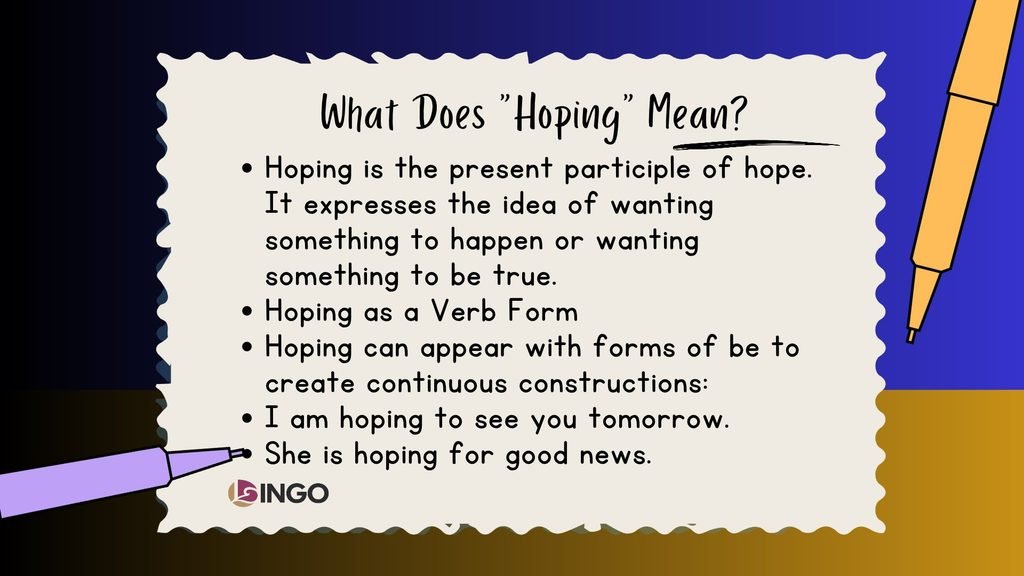
Hoping is the present participle of hope. It expresses the idea of wanting something to happen or wanting something to be true.
Hoping as a Verb Form
Hoping can appear with forms of be to create continuous constructions:
I am hoping to see you tomorrow.
She is hoping for good news.
They were hoping that the weather would improve.
It can also appear in participial phrases:
Hoping to arrive early, we left before sunrise.
Common Uses of “Hoping”
You will commonly see hoping followed by:
Hoping + to + verb
I am hoping to visit London next year.
Hoping + for + noun
We are hoping for better results.
Hoping + that + clause
She is hoping that her application is accepted.
The Spelling Rule Behind “Hoping”
The easiest way to understand hoping is to look at what happens to the final e.
Drop the Silent “e” Before “-ing”
Many English verbs ending in a silent e drop that e before taking -ing.
Examples include:
- hope → hoping
- smile → smiling
- dance → dancing
- close → closing
- move → moving
- arrive → arriving
So:
hope + ing → hoping
The spelling is not:
hope + ing → hopeing
Why Does English Drop the “e”?
The final e in words such as hope helps establish the pronunciation of the word. When the -ing ending is added, English spelling conventionally removes that silent e.
This produces a more established spelling pattern:
hope → hoping
rather than:
hope → hopeing
A Simple Memory Trick
Remember:
Drop the “e” before adding “-ing.”
Think of it this way:
HOPE − E + ING = HOPING
This simple formula can help you remember the correct spelling.
Hoping vs. Hopeing Examples
Seeing the two forms side by side makes the difference easier to recognize.
Correct Examples With “Hoping”
- I am hoping to hear from you soon.
- She is hoping for a positive response.
- We are hoping that everything goes well.
- They were hoping to arrive before dark.
- He is hoping to find a new job.
- I’m hoping you can help me.
- She left early, hoping to avoid traffic.
- We are hoping for better weather tomorrow.
Incorrect Examples With “Hopeing”
These should be written with hoping:
- ❌ I am hopeing to see you.
- ✅ I am hoping to see you.
- ❌ She is hopeing for good news.
- ✅ She is hoping for good news.
- ❌ They are hopeing to win.
- ✅ They are hoping to win.
The problem in each case is the unnecessary e before -ing.
A Quick Comparison: Hoping vs. Hopeing
| Feature | Hoping | Hopeing |
|---|---|---|
| Standard spelling | ✅ Yes | ❌ No |
| Base word | hope | hope |
| Correct formation | hope − e + ing | Incorrectly keeps e |
| Meaning | Wanting something to happen | — |
| Example | I am hoping to go. | I am hopeing to go. |
| Suitable for formal writing | Yes | No |
The key difference is simple: hoping drops the final e, while hopeing incorrectly retains it.
Real-Life Example: A Common Writing Mistake
Imagine a student writing an email to a university admissions office:
“I am hopeing to receive an update about my application soon.”
The meaning is perfectly understandable, but the spelling is incorrect. The student should write:
“I am hoping to receive an update about my application soon.”
Why?
The original verb is hope. When -ing is added, the final silent e is removed:
hope → hoping
This small spelling mistake is particularly easy to make because someone may naturally think that adding -ing simply means attaching the letters to the original word. That approach works for some verbs, but English has several spelling rules that change the form.
For instance:
- read → reading
- play → playing
- work → working
These words simply take -ing.
But:
- hope → hoping
- write → writing
- make → making
drop the final silent e.
This distinction becomes important in school assignments, emails, applications, professional communication, and online writing. A reader can usually understand hopeing, but standard written English requires hoping.
The practical lesson is to identify the base verb first. If the verb ends in a silent e, check whether that e should be removed before adding -ing.
2025–2026 Data: Why Spelling Accuracy Still Matters Online
There is no authoritative 2025–2026 dataset showing how many people specifically misspell hoping as hopeing, so a precise error rate would be misleading.
However, current digital-use data show why clear online English remains relevant. The International Telecommunication Union estimated that 6 billion people, or 74% of the world’s population, were online in 2025, up from 5.8 billion in 2024.
The ITU also reported that approximately 2.2 billion people remained offline in 2025.
These statistics do not establish how frequently hopeing is misspelled. Instead, they provide broader context about the enormous amount of communication taking place online.
For grammar and spelling websites, this reinforces the value of clear, accessible explanations that help people write accurately.
Google’s current Search guidance also emphasizes creating valuable content for people rather than producing generic material simply for search engines.
How to Remember “Hoping” Every Time
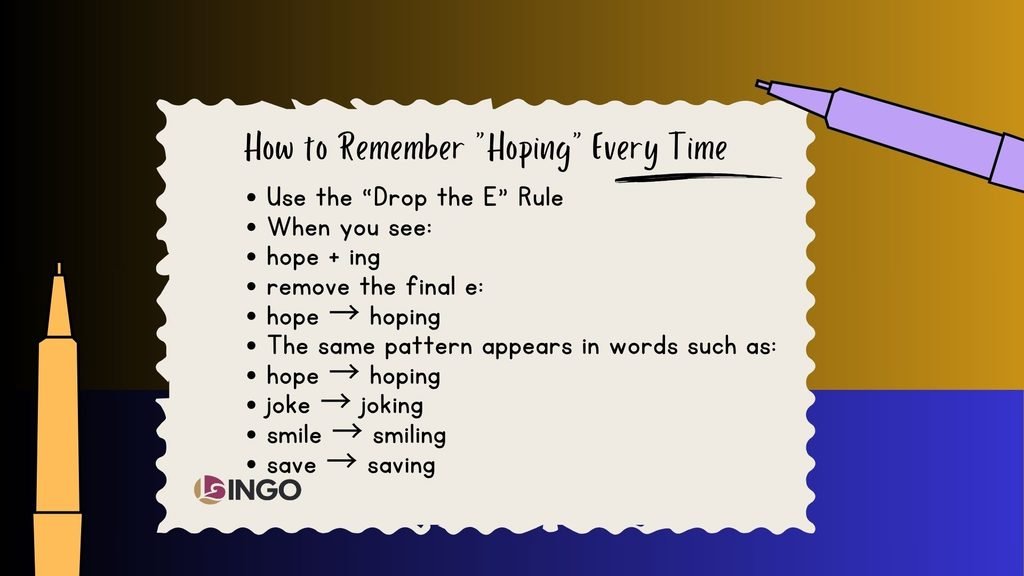
Use the “Drop the E” Rule
When you see:
hope + ing
remove the final e:
hope → hoping
The same pattern appears in words such as:
- hope → hoping
- joke → joking
- smile → smiling
- save → saving
- drive → driving
Use the “Say It, Then Check It” Method
If you are unsure, first identify the base word:
hoping → hope
Then ask:
Does the base verb end in a silent e?
If yes, check whether the e should be dropped before adding -ing.
For hope, the answer is yes.
Therefore:
hoping ✅
Keep This Formula in Mind
Silent-e verb + -ing → usually remove the final e
For example:
hope + ing → hoping
write + ing → writing
make + ing → making
This is a useful general spelling pattern, although English has exceptions and additional rules, so individual words should still be checked when uncertain.
Frequently Asked Questions About Hoping vs. Hopeing
Q1:Is “hoping” or “hopeing” correct?
Hoping is correct. Hopeing is a misspelling when you mean the present participle of hope.
Q2:Why is “hopeing” wrong?
The final silent e in hope is dropped before –ing is added. Therefore, hope + ing becomes hoping, not hopeing.
Q3:Is hoping a real word?
Yes. Hoping is the present participle of the verb hope.
Q4:What is the past tense of hope?
The past tense is hoped.
For example:
I hoped she would call.
Q5:What is the difference between hope and hoping?
Hope is the base verb, while hoping is its present participle.
- Hope: I hope you arrive safely.
- Hoping: I am hoping you arrive safely.
Q6:Can I use “hoping” in formal writing?
Yes. Hoping is a standard English word and is appropriate in formal and informal writing when used correctly.
Q7:Is “I am hoping” grammatically correct?
Yes. I am hoping is grammatically correct.
For example:
I am hoping to hear from you soon.
Q8:How can I quickly remember the spelling?
Use this formula:
HOPE − E + ING = HOPING
Whenever you add –ing to hope, remove the final e.
Conclusion: Hoping vs. Hopeing
The difference between hoping vs. hopeing is straightforward once you understand the spelling rule.
Hoping is the correct spelling. Hopeing is incorrect because the final silent e in hope is removed before -ing is added.
Remember:
hope → hoping
Not:
hope → hopeing
The same spelling pattern appears in words such as writing, making, smiling, saving, and driving.
If you are unsure, identify the base verb and check what happens to its final e before adding -ing. This simple habit can help you avoid common spelling mistakes in emails, assignments, articles, and everyday writing.
For more clear explanations of commonly confused English words and grammar rules, explore the other language guides on Lingorixa.
References

Maimoona Asghar is a grammar enthusiast and language writer who creates clear, practical content to help learners improve English grammar, writing, punctuation, and communication skills through easy-to-understand explanations and examples.