If you have ever searched for flatform vs platform, you may have wondered whether flatform is simply a misspelling of platform. The answer is more interesting: both words are correct, but they are not interchangeable in every context.
Platform is a broad English word used for raised surfaces, technology, transportation, public speaking, and footwear. Flatform, by contrast, is a specialized footwear term describing a shoe with a very thick sole that stays equally or almost equally thick from front to back.
Therefore, the right word depends on what you are describing. Once you understand the difference between a platform and a flatform, the spelling becomes much easier to remember.
What Does Platform Mean?
The word platform has several established meanings in English. Its central idea is a raised or supporting surface, but its meaning changes according to context.
Platform in Everyday English
A platform can be a raised area where people stand, work, perform, or wait.
For example:
- The train arrived at platform 4.
- The speaker walked onto the platform.
- Workers built a raised platform around the equipment.
The word can also refer to an opportunity or system.
For example:
- The website is an important platform for creators.
- The company launched a new digital platform.
- The organization provided a platform for young writers.
This makes platform a highly flexible word.
Platform in Technology
In technology, a platform can mean a computer system, software environment, online service, or digital system on which other activities take place.
Examples include:
- This application runs on a mobile platform.
- The company created an online learning platform.
- The social media platform introduced new features.
This usage is completely different from footwear, but the spelling remains platform.
Platform in Footwear
In footwear, a platform shoe has a thick sole that raises the foot above the ground.
For example:
She bought a pair of black platform sandals.
The term platform does not necessarily tell you that the sole is perfectly level. It is a broader description of an elevated sole design.
What Does Flatform Mean?
Flatform is a real English word, especially in footwear and fashion. It combines the ideas of flat and platform.
A flatform is a shoe with a very thick sole that is equally or almost equally thick at the front and back. As a result, the foot remains relatively level inside the shoe.
Flatform vs Platform: The Key Difference
The easiest way to remember the distinction is:
- Platform: a broad term for footwear with a thick, elevated sole.
- Flatform: a specific type of elevated shoe with a thick, mostly level sole.
For example:
- She wore platform heels to the party.
- She wore white flatform sneakers to the casual event.
- These platform boots have a noticeable heel.
- These flatform sandals have an almost even sole.
A flatform can therefore be considered a type of platform footwear, but not every platform shoe is a flatform.
Is Flatform a Misspelling?
No. Flatform is not simply a spelling mistake.
Cambridge Dictionary recognizes flatform as a noun for a style of shoe with a very thick sole that is equally or almost equally thick at the front and back. Collins Dictionary also defines it as a shoe with a thick, level sole.
So, if you see flatform sandals or flatform sneakers in a fashion article or product description, the spelling can be intentional and correct.
Flatform vs Platform: A Simple Comparison
The difference becomes clearer when the two words are placed side by side.
| Feature | Flatform | Platform |
|---|---|---|
| Basic meaning | A specific type of footwear | A broad word with several meanings |
| Common context | Fashion and footwear | Everyday English, technology, transportation, footwear, and more |
| Sole | Very thick and mostly level | Thick or raised; shape can vary |
| Toe-to-heel difference | Usually very small | May vary |
| Can describe a train area? | No | Yes |
| Can describe software? | No | Yes |
| Can describe shoes? | Yes | Yes |
| Is it a real word? | Yes | Yes |
| Example | flatform sandals | platform shoes |
The biggest distinction is specificity. Platform is the general word, while flatform is a more specialized footwear term.
How to Choose the Correct Word
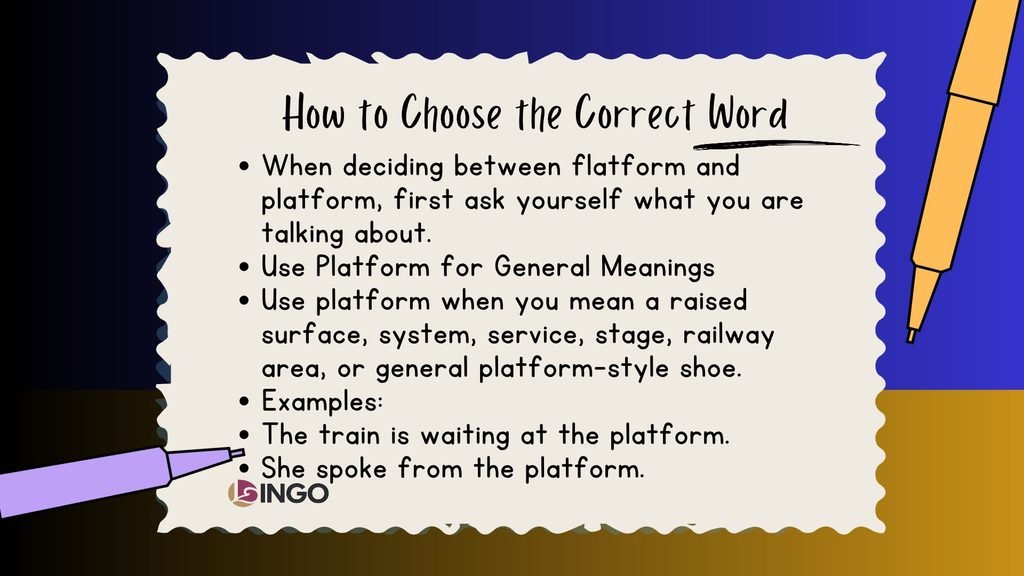
When deciding between flatform and platform, first ask yourself what you are talking about.
Use Platform for General Meanings
Use platform when you mean a raised surface, system, service, stage, railway area, or general platform-style shoe.
Examples:
- The train is waiting at the platform.
- She spoke from the platform.
- The company operates an online platform.
- He bought platform boots.
- The application works on several platforms.
In these sentences, replacing platform with flatform would be incorrect.
Use Flatform for a Specific Shoe Style
Use flatform when you are specifically describing footwear with a thick, nearly level sole.
Examples:
- She bought brown flatform sandals.
- These flatform sneakers add height without a steep heel.
- The designer released a collection of flatform shoes.
- Her flatform loafers have a thick rubber sole.
This is especially useful when the level sole is an important part of the shoe’s design.
A Quick Memory Trick
Think of the word as:
FLAT + FORM = FLATFORM
The word flat gives you the clue. A flatform provides the height of a platform while keeping the sole relatively flat from front to back.
For general uses, remember:
PLATFORM = the broad term
FLATFORM = the specific flat-soled footwear term
Real-Life Example: Choosing the Right Word
Imagine that Sara is shopping online for shoes. She wants footwear that gives her a little extra height but does not have the steep angle of a traditional high heel.
She sees three product descriptions.
The first says:
Black platform heels with a raised sole and high heel.
The second says:
White flatform sneakers with an extra-thick rubber sole.
The third says:
Leather platform sandals with a moderate heel.
Sara wants the second style because she prefers a thick sole that stays nearly level from the toe to the heel. In this situation, flatform is the more precise word.
Now imagine that Sara writes a review saying:
These flatform sneakers are comfortable and give me extra height.
That sentence uses flatform correctly because she is describing a particular type of footwear.
However, if she writes about the website where she purchased them, she should use platform:
The shopping platform had hundreds of shoe options.
Calling the website a “shopping flatform” would be incorrect.
This example demonstrates why the two words should not be treated as alternative spellings. They overlap in footwear, but they have different ranges of meaning. Platform can describe many types of raised structures and digital systems, while flatform is specifically associated with a particular shoe design.
2025–2026 Usage and Data Context
The distinction between these words is especially useful in today’s online environment because platform appears in many digital contexts beyond footwear.
DataReportal’s Digital 2025: Pakistan report recorded 116 million internet users in Pakistan in January 2025, representing an internet penetration rate of 45.7%. The same report recorded 66.9 million social media user identities in the country at that time.
These figures do not measure the frequency of the word platform. However, they provide useful context for why platform remains an important word in modern digital vocabulary: people routinely discuss social media platforms, online services, websites, applications, and digital systems.
The broader global picture is similar. DataReportal reported 5.56 billion internet users worldwide at the start of 2025, equal to 67.9% of the world’s population.
This matters for word choice because platform has a much broader modern meaning than footwear alone. You might use it when discussing technology or online services, while flatform remains a specialized footwear term.
Common Mistakes With Flatform and Platform
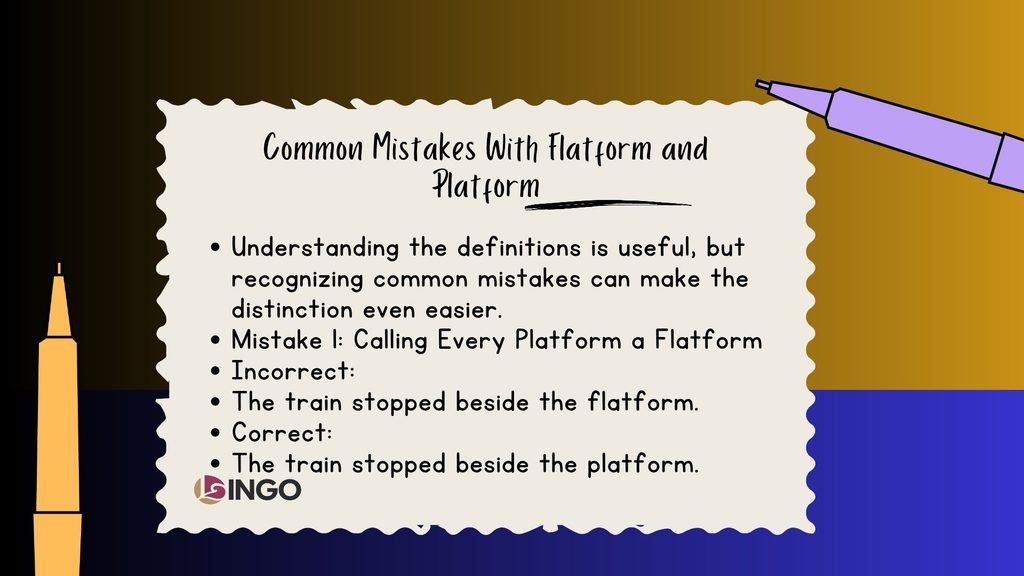
Understanding the definitions is useful, but recognizing common mistakes can make the distinction even easier.
Mistake 1: Calling Every Platform a Flatform
Incorrect:
The train stopped beside the flatform.
Correct:
The train stopped beside the platform.
Flatform is not the general spelling of platform. It is a specialized footwear word.
Mistake 2: Assuming Flatform Is Always Wrong
Incorrect assumption:
“Flatform” is just a typo.
Better understanding:
“Flatform” is a recognized footwear term for a thick, relatively level sole.
Therefore, seeing flatform sandals in a product listing does not automatically indicate a spelling error.
Mistake 3: Treating the Words as Perfect Synonyms
Although both can describe footwear, they are not exact synonyms.
A flatform gives you a more specific description of the sole’s shape. Platform is broader and can describe many kinds of elevated footwear as well as completely different things.
Mistake 4: Using Flatform in Technology
Incorrect:
This flatform supports mobile applications.
Correct:
This platform supports mobile applications.
Technology uses platform, not flatform.
Frequently Asked Questions About Flatform vs Platform
Q1:Is Flatform a Correct Word?
Yes. Flatform is a recognized footwear term. It describes a shoe with a very thick sole that is equally or almost equally thick at the front and back.
Q2:Is Platform the Correct Spelling?
Yes. Platform is the standard English word used for raised surfaces, railway areas, stages, technology systems, online services, and platform-style footwear.
Q3:What Is the Difference Between Flatform and Platform Shoes?
A platform shoe is a broad category of footwear with an elevated or thick sole. A flatform is a more specific style in which the thick sole remains mostly level from the front to the back.
Q4:Is a Flatform a Type of Platform Shoe?
Yes, in footwear terminology, a flatform can be understood as a specific type of platform-style shoe. However, not every platform shoe is a flatform because platform designs can have different sole shapes and heel profiles.
Q5:Is Flatform a Spelling Mistake for Platform?
Not necessarily. If the word appears in a footwear context, flatform may be the intended and correct term. It is recognized by major dictionaries as a shoe-related word.
Q6:Can I Use Platform Instead of Flatform?
Sometimes, especially when speaking generally about elevated footwear. However, flatform provides a more precise description when you specifically mean a thick, nearly level sole.
Q7:Which Word Should I Use for a Website or App?
Use platform.
For example:
The company created a new educational platform.
Flatform is not the appropriate word for a website, application, software system, or online service.
Q8:How Can I Remember the Difference?
Use this simple rule:
Platform = broad term. Flatform = flat-soled footwear.
If the word relates to technology, transportation, a raised surface, or a general system, choose platform. If you are describing a thick, nearly level shoe sole, flatform may be the more precise choice.
Conclusion: Flatform vs Platform
So, flatform vs platform is not simply a question of which spelling is correct. Both are legitimate words, but they serve different purposes.
Platform is the broader and more versatile word. It can describe a train area, raised surface, stage, technology system, online service, or elevated shoe design.
Flatform is a specialized footwear term describing a shoe with a thick sole that is equally or almost equally thick from front to back.
The easiest way to remember the difference is:
Platform = broad meaning
Flatform = flat, thick-soled footwear
Therefore, don’t automatically correct flatform to platform. First look at the context. If you’re talking about sandals, sneakers, or another type of footwear with a thick, level sole, flatform may be exactly the word you need.
For technology, transportation, general raised surfaces, and most other contexts, use platform.
For more clear explanations of commonly confused English words and grammar rules, explore the other language guides on Lingorixa.
Reference

Maimoona Asghar is a grammar enthusiast and language writer who creates clear, practical content to help learners improve English grammar, writing, punctuation, and communication skills through easy-to-understand explanations and examples.