Have you ever written “I am so exited for the trip” when you actually meant “I am so excited for the trip”? These two words look almost identical, but they have completely different meanings. Understanding excited vs exited will help you avoid common spelling mistakes and communicate more clearly in English.
The difference is simple: excited describes a feeling of happiness, enthusiasm, or eagerness, while exited means that someone left a place or moved out of something. Both spellings are correct, but you must choose the right one according to your sentence.
In this guide, you will learn their definitions, grammatical uses, real-life examples, common mistakes, and easy ways to remember the difference.
What Is the Difference Between Excited and Exited?
The main difference between excited and exited is their meaning and grammatical function. Excited usually describes an emotional state, whereas exited is the past tense or past participle of the verb exit.
What Does Excited Mean?
The word excited is an adjective that describes someone who feels happy, enthusiastic, eager, or thrilled about something.
Examples:
- I am excited about my upcoming vacation.
- The children were excited to see their favorite cartoon characters.
- She felt excited when she received the good news.
- We are excited about starting our new business.
In each sentence, excited describes an emotion or feeling.
What Does Exited Mean?
The word exited is the past tense and past participle of exit. It means that someone or something left a place, building, vehicle, program, or other setting.
Examples:
- She exited the classroom after the lesson.
- The passengers exited the bus safely.
- He exited the computer program without saving his work.
- The players exited the stadium after the match.
In these examples, exited describes an action rather than a feeling.
Excited vs Exited at a Glance
| Feature | Excited | Exited |
|---|---|---|
| Meaning | Feeling enthusiastic or happy | Left a place or situation |
| Part of speech | Usually an adjective | Verb form |
| Root word | Excite | Exit |
| Main purpose | Describes emotions | Describes leaving |
| Example | I am excited about the party. | I exited the party early. |
| Memory clue | Excitement and enthusiasm | Exit means leave |
The easiest way to remember the difference is to think about the situation. If someone is looking forward to something, use excited. If someone has already left somewhere, use exited.
How to Use Excited in a Sentence

Use excited when describing positive anticipation, enthusiasm, happiness, or strong interest in an upcoming event or opportunity.
Excited About Something
Use the phrase excited about when talking about an event, activity, idea, or experience that makes you feel enthusiastic.
Examples:
- I am excited about my birthday celebration.
- They are excited about their upcoming examination results.
- She feels excited about her new job.
- We were excited about the school trip.
Tip: The word about is useful when you want to identify the subject of someone’s excitement.
Excited to Do Something
Use excited to before a verb when describing an action you are eager to perform.
Examples:
- I am excited to meet my new classmates.
- He is excited to start his first job.
- We are excited to visit London.
- She was excited to open her birthday presents.
Notice that the word following to is the base form of the verb, such as meet, start, visit, or open.
Excited That Something Happened
Use excited that when explaining the situation or news that caused a feeling of enthusiasm.
Examples:
- I am excited that you can join us.
- She was excited that her application had been accepted.
- They were excited that their team had won the championship.
These patterns make your English sound more natural and help you express emotions accurately.
How to Use Exited in a Sentence
Use exited when describing an action that involves leaving a location, ending participation, or closing a computer program.
Exited a Place or Building
When someone leaves a physical location, exited is often an appropriate verb.
Examples:
- The students exited the classroom quietly.
- We exited the building through the main entrance.
- The passengers exited the train at the next station.
- She exited the restaurant after finishing dinner.
You can also use exited from in suitable contexts, although exited the building is generally more direct.
Exited a Job, Competition, or Organization
The word exited can also describe leaving a professional role, withdrawing from an organization, or departing from a competition.
Examples:
- The manager exited the company last month.
- The team exited the tournament in the semifinal round.
- The actor exited the television series after three seasons.
- The company exited the market because of declining sales.
These examples show that exit is not limited to physical doors or buildings. It can also describe leaving an activity, position, or business situation.
Exited a Computer Program
In technology, exited can describe closing or leaving a software application or program.
Examples:
- I exited the application after completing my work.
- She exited the game before the final level.
- The program exited unexpectedly because of an error.
The important point is that exited describes something that has already happened or a completed action, not someone’s excitement.
Common Mistakes When Using Excited vs Exited
Because the two words differ by only one letter, writers sometimes confuse them in emails, text messages, school assignments, and social media posts.
Incorrect vs Correct Examples
| Incorrect sentence | Correct sentence |
|---|---|
| I am exited about my holiday. | I am excited about my holiday. |
| She is exited to meet you. | She is excited to meet you. |
| We excited the building at noon. | We exited the building at noon. |
| He exited about the new job. | He is excited about the new job. |
| They were excited the stadium after the match. | They exited the stadium after the match. |
The first two incorrect sentences use exited when describing an emotion. The third and fifth confuse the verb exit with the adjective excited. The fourth incorrectly uses exited instead of the appropriate form of be excited.
Why Do People Confuse These Words?
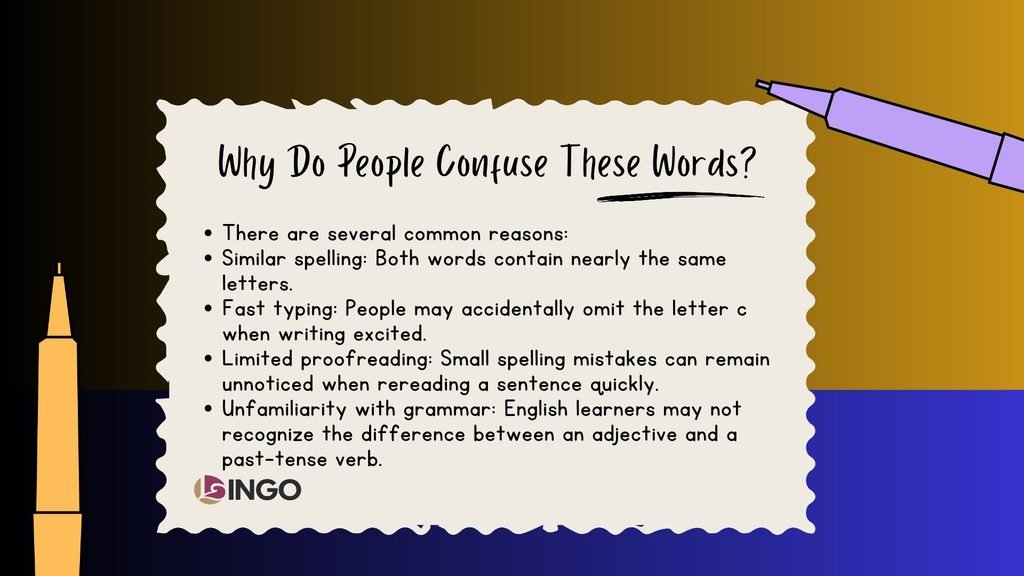
There are several common reasons:
- Similar spelling: Both words contain nearly the same letters.
- Fast typing: People may accidentally omit the letter c when writing excited.
- Limited proofreading: Small spelling mistakes can remain unnoticed when rereading a sentence quickly.
- Unfamiliarity with grammar: English learners may not recognize the difference between an adjective and a past-tense verb.
A Simple Memory Trick
Remember these two rules:
- Excited = enthusiasm. Think about a celebration, a trip, or good news.
- Exited = exit. Think about leaving a room, building, or application.
For example:
“I was excited about the concert, but I exited the venue before it ended.”
This sentence uses both words correctly because one describes a feeling and the other describes an action.
Real-Life Example: Excited vs Exited in Everyday Communication
Imagine that Sara is a university student who has been waiting for her graduation ceremony for several months. Her family plans to attend, and she has already selected her outfit. On the morning of the ceremony, she sends a message to her friend: “I am so exited about graduating today!”
Her friend understands what she means, but the sentence contains a spelling mistake. Sara is describing her happiness and anticipation, so the correct word is excited. She should write, “I am so excited about graduating today!”
Later, Sara arrives at the university auditorium. After the ceremony, she takes photographs with her classmates and thanks her professors. When the event ends, she leaves the building with her family.
If she describes this moment in a social media post, she might write, “We exited the auditorium after taking our graduation pictures.”
In this second sentence, exited is correct because Sara and her family physically left the auditorium.
The following day, Sara writes a short paragraph about her graduation experience. She explains that she was excited to receive her certificate, excited to celebrate with her family, and excited to begin her professional career. She also mentions that they exited the auditorium at approximately 2 p.m.
This example illustrates why context matters. Both words can appear in the same paragraph, but they perform different grammatical jobs. Excited communicates Sara’s emotions, while exited explains what she and her family did. By checking whether a sentence describes a feeling or an action, writers can choose the correct word without memorizing complicated rules.
Excited vs Exited: Usage Trends and Language Facts for 2025–2026
Understanding these words does not require complicated statistics, but reliable language resources can help clarify their definitions and usage.
What Reliable References Tell Us
Established dictionary references distinguish the words according to their grammatical roles:
What About 2025–2026 Search Statistics?
There is no verified statistic presented here that measures exactly how many people confuse excited with exited in 2025 or 2026. Providing a specific percentage without a reliable source would be misleading.
However, provides a tool for comparing search interest across terms, regions, and time periods. Search interest does not directly measure spelling errors, so researchers should avoid treating the two as equivalent.
Why This Matters for English Learners
Even without a verified confusion rate, the distinction is useful for students, professionals, and everyday writers. Choosing the right word makes sentences clearer and prevents readers from misunderstanding whether someone feels enthusiastic or has left a place.
Mini Quiz:Excited vs Exited
1. I am so _____ about my birthday party.
A. Exited B. Excited C. Exiting D. Excitement Answer: B. Excited
2. The passengers _____ the bus at the final stop.
A. Excited B. Exited C. Exciting D. Excitement Answer: B. Exited
3. Which sentence correctly uses excited?
A. She excited the building at noon. B. He exited about his new job. C. We are excited to meet our teacher. D. They exited to receive good news. Answer: C. We are excited to meet our teacher.
4. What is the past tense of the verb exit?
A. Excited B. Exciting C. Excitement D. Exited Answer: D. Exited
5. The children were _____ to see the zoo animals.
A. Exited B. Excited C. Exsited D. Excidted Answer: B. Excited
6. “The driver exited the highway.” What does exited mean?
A. Felt enthusiastic B. Became confused C. Left the highway D. Started driving Answer: C. Left the highway
7. She is _____ about her first day at university
. A. Excited B. Exited C. Exit D. Exiting Answer: A. Excited
8. Which sentence correctly uses exited?
A. I am exited for the weekend. B. She exited to meet her cousin. C. They are exited about the results. D. He exited the office after work. Answer: D. He exited the office after work.
9. What is the grammatical role of excited in “I feel excited”?
A. Preposition B. Adjective C. Conjunction D. Article Answer: B. Adjective
10. The team _____ the tournament after losing the semifinal.
A. Excited B. Exciting C. Exited D. Excitement Answer: C. Exited
11. Which phrase expresses enthusiasm about a future activity?
A. Excited to travel B. Exited to travel C. Exit to travel D. Excitement to traveled Answer: A. Excited to travel
12. The software _____ unexpectedly.
A. Excited B. Exciting C. Excitement D. Exited Answer: D. Exited
13. Which sentence contains a spelling mistake if the intended meaning is enthusiasm?
A. I am excited about the match. B. I am exited about the match. C. She feels excited today. D. We are excited to begin. Answer: B. I am exited about the match.
14. What is the base verb of exited?
A. Excite B. Exciting C. Exit D. Excitement Answer: C. Exit
15. We were _____ when our team won the final.
A. Excited B. Exited C. Exit D. Exiting Answer: A. Excited
16. Which sentence uses exited to describe a physical action?
A. She was excited for dinner. B. They felt excited about school. C. He is excited to swim. D. She exited through the side door. Answer: D. She exited through the side door.
17. Which sentence correctly expresses eagerness?
A. I exited to see the show. B. I am excited to see the show. C. I am exit to see the show. D. I exciting to see the show. Answer: B. I am excited to see the show.
18. In “The visitors exited the museum,” what does exited mean?
A. They were very happy. B. They were surprised. C. They left the museum. D. They entered the museum. Answer: C. They left the museum.
19. I am _____ that you can join us.
A. Excited B. Exited C. Exit D. Exiting Answer: A. Excited
20. Which sentence uses both words correctly?
A. I was exited about the trip and excited the bus. B. I excited about the trip and exited happy. C. I was exited about the trip and exited the bus. D. I was excited about the trip and exited the bus. Answer: D. I was excited about the trip and exited the bus.
21. Choose the correct word: “She was _____ to receive her graduation certificate.”
A. Exited B. Excited C. Exit D. Exiting Answer: B. Excited
22. “The students exited the classroom quietly.” Which word means left?
A. Students B. Classroom C. Exited D. Quietly Answer: C. Exited
23. Which sentence is correct?
A. We are excited about our vacation. B. We are exited about our vacation. C. We exited about our vacation. D. We exciting about our vacation. Answer: A. We are excited about our vacation.
24. Complete the sentence: “After the meeting, the manager _____ the room.”
A. Excited B. Exciting C. Exited D. Excitement Answer: C. Exited
25. What is the easiest way to remember the difference?
A. Both words describe happiness. B. Excited describes enthusiasm; exited means left. C. Exited describes enthusiasm; excited means left. D. Both words mean leaving a place. Answer: B. Excited describes enthusiasm; exited means left.
FAQs About Excited vs Exited
Q1: Is it excited or exited for a vacation?
Use excited. For example, “I am excited for my vacation.” The sentence expresses enthusiasm about a future experience.
Q2: Is exited a real word?
Yes. Exited is the past tense and past participle of exit. For example, “She exited the building.”
Q3: What is the difference between excited and exited?
Excited describes a feeling of happiness, enthusiasm, or eagerness. Exited describes leaving a place, situation, or program.
Q4: Can I say, “I am exited”?
You can use exited in a grammatically correct sentence when the context supports it, such as “I am exited from the system” in a suitable technical context. However, if you mean that you feel happy or enthusiastic, write “I am excited.”
Q5: Why do people write exited instead of excited?
People may confuse the words because they look similar, especially when typing quickly or proofreading carelessly. Remembering that excited relates to emotions and exited relates to leaving can help.
Q6: What is the past tense of excited?
The verb excite has the past-tense form excited. For example, “The announcement excited the students.” The word excited can also function as an adjective, as in “The students were excited.”
Q7: What is the opposite of excited?
Depending on the context, possible opposites include unexcited, unenthusiastic, indifferent, or uninterested. The best choice depends on the feeling you want to describe.
Q8: How can I remember excited vs exited?
Remember that excited contains the extra letter c and relates to enthusiasm. Exited comes from exit and refers to leaving. Ask yourself whether your sentence describes an emotion or an action.
Conclusion: Excited vs Exited Made Simple
Understanding excited vs exited is easy once you remember their meanings. Excited describes a feeling of enthusiasm, happiness, or eagerness, while exited is the past tense and past participle of exit, meaning to leave a place or situation.
Use excited when discussing celebrations, future plans, good news, or opportunities. Use exited when describing someone leaving a building, vehicle, competition, organization, or computer program.
For example, “I was excited about the concert, but I exited the venue early” demonstrates the difference perfectly.
For more clear explanations of commonly confused English words and grammar rules, explore the other language guides on Lingorixa.
References

Maimoona Asghar is a grammar enthusiast and language writer who creates clear, practical content to help learners improve English grammar, writing, punctuation, and communication skills through easy-to-understand explanations and examples.