Have you ever wondered whether the correct word is acception vs exception? These two words look and sound very similar, but they have different meanings and very different levels of use in modern English.
Exception is the standard word for something that is excluded from a rule, group, or general pattern. Acception, on the other hand, is a rare and largely obsolete English word historically associated with acceptance, reception, or a received meaning.
In this guide, you’ll learn the difference between acception and exception, see clear examples, discover an easy memory trick, and learn which word to use in everyday writing.
Acception vs Exception: The Basic Difference
The simplest way to understand acception vs exception is to compare their meanings and modern usage.
What Does “Exception” Mean?
Exception is a common English noun meaning a person, thing, or situation that is not included in a rule, group, list, or general pattern.
For example:
There are several exceptions to this rule.
You could also say:
Everyone attended the meeting, with the exception of Sarah.
Or:
The store normally does not accept returns, but the manager made an exception.
The word can also describe something that does not behave as expected:
The weather was unusually warm for December, but yesterday was an exception.
What Does “Acception” Mean?
Acception is a genuine historical English word, but it is not normally used as a modern substitute for exception.
Historically, acception was used in senses connected with acceptance, reception, or the received meaning of a word.
For example, an old linguistic text might discuss the acception of a term, referring to its particular or accepted sense.
Modern writers would generally use clearer words such as:
- meaning
- sense
- definition
- interpretation
- acceptance
Quick Comparison
| Word | Meaning | Modern Usage |
|---|---|---|
| Exception | Something excluded from a rule or general pattern | Common |
| Acception | A historical term connected with acceptance or received meaning | Rare/obsolete |
Quick rule: If you mean something that is outside a rule, use exception.
How to Use “Exception” Correctly
The word exception appears frequently in everyday English, academic writing, business communication, and formal documents.
“Exception to the Rule”
The expression exception to the rule refers to something that does not follow a general rule.
Examples:
- There are always exceptions to the rule.
- This situation is an exception to the rule.
- The new policy has several exceptions to the rule.
- She is an exception to the usual pattern.
For example:
Most employees must work in the office on Fridays, but remote employees are an exception to the rule.
“Make an Exception”
Make an exception means allowing someone or something to be treated differently from the usual rule.
Examples:
We normally require payment in advance, but we’ll make an exception this time.
The teacher does not accept late assignments, but she made an exception for the student.
I usually avoid desserts, but I’ll make an exception today.
This is one of the most common expressions involving exception.
“With the Exception Of”
With the exception of means excluding.
Examples:
I like every subject with the exception of chemistry.
Everyone came to the party with the exception of Ali.
The entire building was renovated with the exception of the basement.
This construction is particularly useful in formal, academic, and professional writing.
When Is “Acception” Used?
Although acception is uncommon today, understanding its historical meaning explains why you may occasionally encounter it.
Acception as a Received Meaning
One historical sense of acception was the received meaning or sense of a word.
For example, an older text might say:
The author used the term in this acception.
A modern writer would normally say:
The author used the term in this sense.
The second sentence is much clearer to contemporary readers.
Acception and Acceptance
Another historical connection of acception is with acceptance or reception.
Therefore, do not automatically assume that acception means exception.
If you mean:
- receiving something → acceptance
- the meaning of a word → meaning or sense
- something outside a rule → exception
Is “Acception” Wrong?
Calling acception simply “wrong” is not historically accurate because dictionaries document it as an English word.
A more precise description is that it is rare or obsolete in modern English.
Therefore, you may encounter it in historical literature, older dictionaries, or specialized discussions of language. However, it is generally not the word you want in ordinary modern writing.
Acception vs Exception: Examples Compared
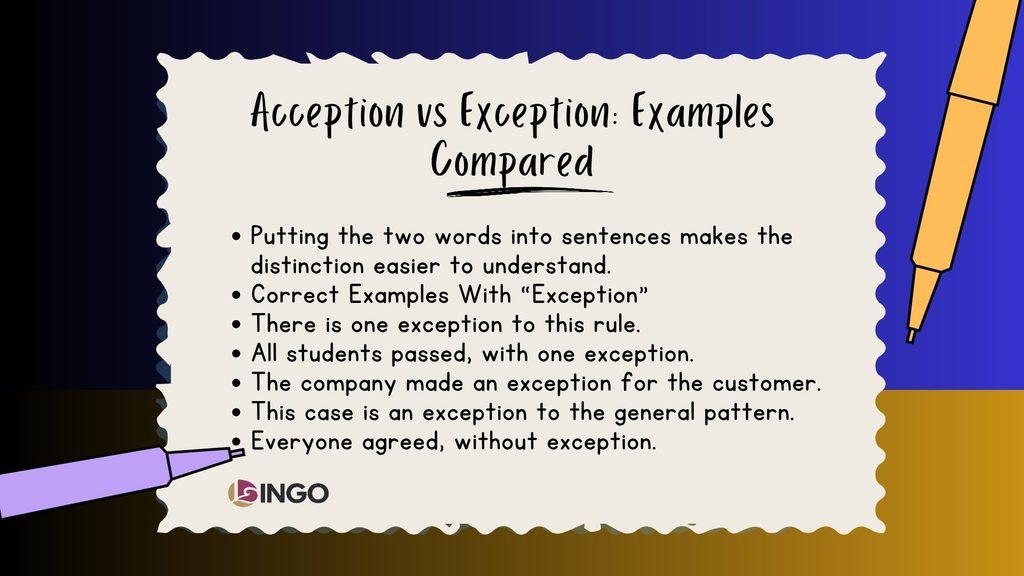
Putting the two words into sentences makes the distinction easier to understand.
Correct Examples With “Exception”
There is one exception to this rule.
All students passed, with one exception.
The company made an exception for the customer.
This case is an exception to the general pattern.
Everyone agreed, without exception.
These examples all involve exclusion, a special case, or something outside the normal pattern.
Historical Example With “Acception”
The author used the term in an older acception.
Here, acception refers to a historical or received sense of a word rather than an exception to a rule.
Common Mistakes
❌ There is one acception to the rule.
✅ There is one exception to the rule.
❌ The manager made an acception for the customer.
✅ The manager made an exception for the customer.
❌ Everyone attended with the acception of John.
✅ Everyone attended with the exception of John.
The modern expressions are exception to the rule, make an exception, and with the exception of.
A Real-Life Example of Acception vs Exception
Imagine a school has a clear policy: all assignments must be submitted by Friday at 5 p.m.
Most students follow the policy. However, one student becomes ill on Friday and contacts the teacher before the deadline. After considering the circumstances, the teacher allows the student to submit the assignment on Monday.
What happened?
The student received an exception to the normal deadline.
You could write:
The teacher made an exception to the submission policy.
You would not normally write:
The teacher made an acception to the submission policy.
Now consider a completely different situation. A researcher is studying an old English text from several centuries ago. The researcher finds that a particular word was used with a meaning that differs from its common modern meaning. In discussing that historical usage, the researcher may encounter the word acception, which was historically used for a received meaning or sense.
The two situations demonstrate the central distinction. Exception deals with something outside a rule or expected pattern. Acception belongs primarily to historical vocabulary and older senses involving acceptance or meaning.
Therefore, when writing an email, school assignment, business message, blog post, or everyday sentence, choose exception whenever your intended meaning is “a special case that does not follow the general rule.”
2025–2026 Usage and Reference Check
It is useful to separate modern everyday usage from historical dictionary evidence when comparing these words.
Modern Usage of “Exception”
Current English dictionaries continue to treat exception as a standard word for something that is excluded from a rule, group, or expected pattern.
Common expressions include:
- exception to the rule
- make an exception
- with the exception of
- take exception to something
- without exception
These expressions are common in everyday, academic, and professional English.
Modern Status of “Acception”
By contrast, English reference sources continue to identify acception as rare or obsolete in English.
That means there is an important practical distinction:
- Exception: standard modern English.
- Acception: rare or historical English.
- Acceptance: normal modern noun for the act of accepting.
- Meaning/Sense: clearer modern alternatives when discussing a word’s interpretation.
This distinction is particularly important for learners because the similar spelling can make the two words appear interchangeable when they are not.
Writing Clearly for Modern Readers
For online writing, clarity should come first. Google’s Search Central guidance recommends creating helpful, reliable, people-first content rather than content designed primarily to manipulate search rankings.
That principle also applies to vocabulary articles. A useful explanation should distinguish common modern usage from historical usage instead of presenting rare words as though they were equally common.
Easy Tricks to Remember the Difference
You don’t need to memorize a complicated dictionary definition.
Trick 1: Exception = Excluded
Think:
EXception → EXcluded
An exception is something excluded from a general rule.
For example:
The rule applies to everyone except one person.
That person is the exception.
Trick 2: Exception = Rule
Whenever you see words such as:
- rule
- policy
- regulation
- requirement
- standard
- general pattern
and you need a noun for something that does not follow it, think exception.
Trick 3: Acception = Accepted Sense
For the historical word acception, associate it with an accepted or received meaning.
This trick is mainly useful for recognizing the word in older texts. It does not mean you should replace exception with acception in modern sentences.
One-Line Memory Rule
Outside the rule = exception.
That single sentence will solve most everyday cases.
Acception vs Exception: Quick Comparison Table
| Feature | Acception | Exception |
|---|---|---|
| Part of speech | Noun | Noun |
| Modern frequency | Rare/obsolete | Common |
| Historical association | Acceptance or received meaning | Exclusion from a rule |
| Used for rules? | No | Yes |
| Used for special cases? | No | Yes |
| Common modern phrase | None in ordinary English | “Exception to the rule” |
| Everyday writing | Generally avoid | Normal |
| Example | An old acception of a term | An exception to the rule |
Three-Step Check
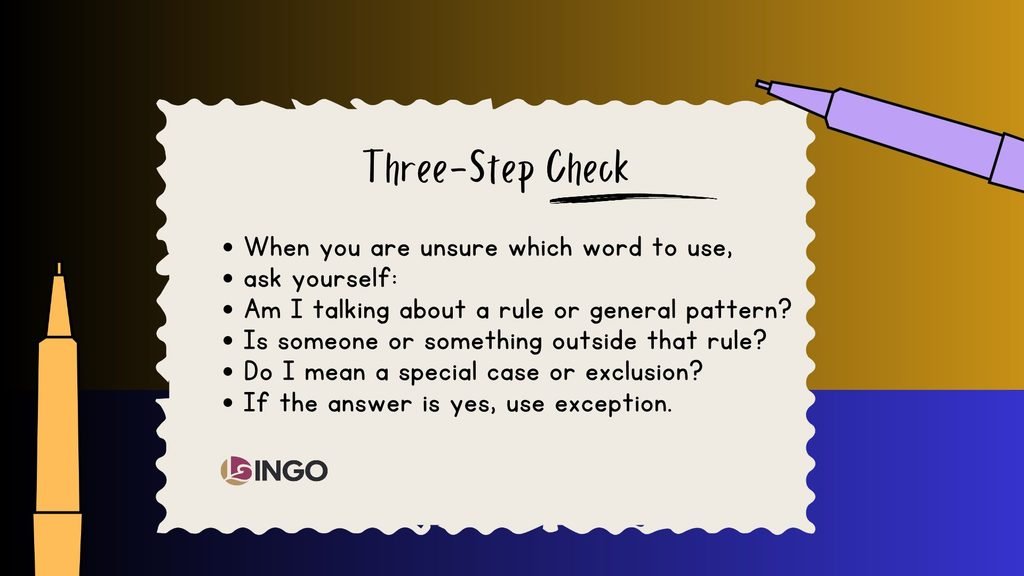
When you are unsure which word to use, ask yourself:
- Am I talking about a rule or general pattern?
- Is someone or something outside that rule?
- Do I mean a special case or exclusion?
If the answer is yes, use exception.
Mini Quiz:Acception vs. Exception
1. Choose the correct word:
There is one ______ to this rule.
A. Acception
B. Exception
C. Acceptance
D. Exclusion
Answer: B. Exception
2. What does exception mean?
A. An accepted meaning
B. Something excluded from a rule or pattern
C. A definition
D. An agreement
Answer: B. Something excluded from a rule or pattern
3. Which sentence is correct?
A. There is an acception to the rule.
B. There is an exception to the rule.
C. There is an acceptance to the rule.
D. There is a sense to the rule.
Answer: B. There is an exception to the rule.
4. What does “with the exception of” mean?
A. Including
B. Accepting
C. Excluding
D. Explaining
Answer: C. Excluding
5. Choose the correct word:
The manager made an ______ for the customer.
A. acception
B. exception
C. acceptance
D. interpretation
Answer: B. exception
6. Is acception a real English word?
A. No, it has never existed.
B. Yes, but it is rare or obsolete.
C. Yes, and it is more common than exception.
D. No, it is only a spelling error.
Answer: B. Yes, but it is rare or obsolete.
7. Which word is normally used for something outside a rule?
A. Acception
B. Exception
C. Acceptance
D. Definition
Answer: B. Exception
8. Choose the correct sentence:
A. Everyone attended with the acception of Sarah.
B. Everyone attended with the exception of Sarah.
C. Everyone attended with the acceptance of Sarah.
D. Everyone attended with the sense of Sarah.
Answer: B. Everyone attended with the exception of Sarah.
9. What is an exception to the rule?
A. A rule that applies to everyone
B. A case that does not follow the general rule
C. A new definition
D. An accepted decision
Answer: B. A case that does not follow the general rule
10. Which word historically referred to a received or accepted meaning?
A. Exception
B. Acception
C. Exclusion
D. Regulation
Answer: B. Acception
11. Choose the correct word:
There are several ______ to this policy.
A. acceptions
B. exceptions
C. acceptances
D. interpretations
Answer: B. exceptions
12. Which phrase is standard modern English?
A. Make an acception
B. Make an exception
C. Make an acceptation to the rule
D. Make an exceptionment
Answer: B. Make an exception
13. Which word is most appropriate in everyday writing?
A. Acception
B. Exception
C. Acceptionment
D. Acceptation
Answer: B. Exception
14. Choose the correct sentence:
A. This case is an exception to the general pattern.
B. This case is an acception to the general pattern.
C. This case is an acceptance to the general pattern.
D. This case is a meaning to the general pattern.
Answer: A. This case is an exception to the general pattern.
15. What does acception mainly represent in historical English?
A. A special case outside a rule
B. A received meaning or sense
C. A legal regulation
D. An exclusion
Answer: B. A received meaning or sense
16. Complete the sentence:
I like every subject with the ______ of chemistry.
A. acception
B. exception
C. acceptance
D. definition
Answer: B. exception
17. Which sentence uses exception correctly?
A. She was the only exception to the usual pattern.
B. She was the only acception to the usual pattern.
C. She was the only acceptance to the usual pattern.
D. She was the only definition to the usual pattern.
Answer: A. She was the only exception to the usual pattern.
18. What is a useful memory trick for exception?
A. Exception = accepted meaning
B. Exception = excluded case
C. Exception = explanation
D. Exception = agreement
Answer: B. Exception = excluded case
19. Which word should you use here?
The teacher made an ______ for the student who was ill.
A. acception
B. exception
C. definition
D. interpretation
Answer: B. exception
20. Which statement is correct?
A. Acception and exception have exactly the same meaning.
B. Exception is common modern English, while acception is rare or obsolete.
C. Acception is the normal modern word for a rule violation.
D. Exception is an obsolete word.
Answer: B. Exception is common modern English, while acception is rare or obsolete.
21. Choose the correct spelling:
Everyone passed, with one ______.
A. acception
B. exception
C. acceptation
D. excepption
Answer: B. exception
22. Which modern word is usually clearer than acception when discussing a word’s sense?
A. Meaning
B. Exception
C. Exclusion
D. Regulation
Answer: A. Meaning
23. Choose the correct sentence:
A. The company made an exception for the customer.
B. The company made an acception for the customer.
C. The company made an acceptance for the customer.
D. The company made an interpretation for the customer.
Answer: A. The company made an exception for the customer.
24. If something is excluded from a general rule, which word should you use?
A. Acception
B. Exception
C. Acceptance
D. Sense
Answer: B. Exception
25. What is the easiest rule to remember?
A. Acception = outside the rule
B. Exception = outside the rule
C. Both mean outside the rule
D. Acceptance = outside the rule
Answer: B. Exception = outside the rule
FAQs About Acception vs Exception
Q1:Is “acception” a real word?
Yes. Acception is a documented English word. However, its English senses are now rare or obsolete. Historical sources associate it with acceptance, reception, and received meaning.
Q2:Is “acception” the same as “exception”?
No. Exception refers to something excluded from a rule, group, or general pattern. Acception is a rare or obsolete term associated historically with acceptance or a received meaning.
Q3:Is it “acception to the rule” or “exception to the rule”?
The standard modern expression is “exception to the rule.”
There are always exceptions to the rule.
Q4:What does “exception” mean?
Exception means someone or something that is not included in a rule, group, list, or general pattern. It can also refer to something that behaves differently from what is normally expected.
Q5:What does “acception” mean?
Historically, acception could mean a received or accepted meaning or sense. It also had historical senses related to acceptance or reception.
Modern English generally uses alternatives such as meaning, sense, or acceptance instead.
Q6:Should I use “acception” in modern writing?
Usually, no. Unless you are discussing historical language or quoting an older source, meaning, sense, or acceptance will normally communicate the idea more clearly.
Q7:How do I remember “exception”?
Think EX = excluded.
If something is excluded from a rule, it is an exception.
Exception = excluded case.
Q8:What is the plural of “exception”?
The plural is exceptions.
Example:
There are several exceptions to this rule.
Conclusion: Acception vs Exception
The difference between acception vs exception is mainly a difference in meaning and modern usage.
Exception is the standard modern English word for something outside a rule, group, expectation, or general pattern. It appears in familiar expressions such as “exception to the rule,” “make an exception,” and “with the exception of.”
Acception is a documented historical English word, but it is rare or obsolete in English today. Historical sources connect it with meanings such as acceptance, reception, or a received sense of a word.
So remember:
Something outside a rule = exception.
Historical received meaning = acception.
For everyday English, exception is the word you will normally need.
For more clear explanations of commonly confused English words and grammar rules, explore the other language guides on Lingorixa.
References

Maimoona Asghar is a grammar enthusiast and language writer who creates clear, practical content to help learners improve English grammar, writing, punctuation, and communication skills through easy-to-understand explanations and examples.