Have you ever wondered whether you should write long term or long-term? You are not alone. Both forms are correct, but they are used in different grammatical situations.
The basic rule is simple: use “long-term” when the two words work together as an adjective before a noun; use “long term” when the phrase functions as a noun or follows certain prepositions.
For example:
- We need a long-term plan.
- We are thinking about the long term.
- This decision could benefit us in the long term.
Understanding this small distinction can make your writing more polished and professional. Let’s look at exactly when to use long term and long-term, with clear rules and examples.
What Is the Difference Between Long Term and Long-Term?
The difference between long term and long-term is mainly grammatical.
Long-term is normally a hyphenated compound adjective used before a noun.
She accepted a long-term position.
Here, long-term describes the noun position, so the hyphen helps show that the two words function together.
Long term, without a hyphen, is generally used when the expression functions as a noun phrase.
We are planning for the long term.
In this sentence, long term refers to an extended period of time rather than directly modifying another noun.
Long-Term as an Adjective
Use long-term when it describes a person, thing, plan, effect, strategy, relationship, or another noun.
Examples:
- We need a long-term solution.
- She has a long-term goal.
- They made a long-term investment.
- The company developed a long-term strategy.
- Exercise can provide long-term benefits.
The hyphen connects long and term because together they describe the noun that follows.
Long Term as a Noun Phrase
Use long term when you are referring to an extended period itself.
Examples:
- Think about the long term.
- The decision may help us in the long term.
- We need to consider the long term.
- What will happen in the long term?
- This approach is better for the long term.
A useful test is to ask: Is “long term” describing a noun immediately after it?
If yes, long-term is usually appropriate.
If no, long term is usually the better choice.
When to Use Long-Term With a Hyphen
The most important rule is that long-term is generally hyphenated when it comes directly before a noun and acts as a compound adjective.
Long-Term Before a Noun
Consider these examples:
| Correct Form | Example |
|---|---|
| long-term plan | We need a long-term plan. |
| long-term goal | Her long-term goal is to become a teacher. |
| long-term relationship | They have a long-term relationship. |
| long-term solution | We need a long-term solution. |
| long-term effect | The medicine may have long-term effects. |
| long-term investment | He made a long-term investment. |
| long-term strategy | The business needs a long-term strategy. |
In each example, long-term tells us what kind of noun follows.
Why the Hyphen Matters
Hyphens can make relationships between words easier to understand.
Compare:
We need a long-term solution.
The reader immediately understands that long and term combine to describe solution.
Compound adjectives are frequently hyphenated when they appear before a noun. This helps prevent ambiguity and makes sentence structure clearer.
Long-Term Goals and Plans
Some of the most common expressions containing long-term include:
- long-term goals
- long-term planning
- long-term growth
- long-term success
- long-term consequences
- long-term commitment
- long-term strategy
- long-term development
- long-term benefits
- long-term solution
For example:
Creating a long-term strategy is essential for sustainable growth.
Here, long-term modifies strategy, so the hyphen is appropriate.
When to Use Long Term Without a Hyphen
Use long term without a hyphen when it does not directly function as a compound adjective before a noun.
The Phrase “In the Long Term”
One of the most common expressions is:
in the long term
Examples:
- This investment should pay off in the long term.
- It may be difficult now, but it will help us in the long term.
- We need to consider the consequences in the long term.
Notice that there is no hyphen.
Why? Because long term is functioning as a noun phrase within the expression in the long term, rather than directly modifying a noun.
Other Common Examples
You can also write:
- for the long term
- over the long term
- in the long term
- thinking about the long term
- planning for the long term
Examples:
We are investing for the long term.
The policy could save money over the long term.
Businesses should think about the long term.
All of these use long term, not long-term.
Long Term vs Long-Term: A Quick Comparison
The easiest way to remember the distinction is to compare the grammatical roles.
| Form | Function | Example |
|---|---|---|
| long-term | Compound adjective | We need a long-term plan. |
| long term | Noun phrase | Think about the long term. |
| long term | Used after “in” | It will help in the long term. |
| long term | Used after “for” | We are planning for the long term. |
| long term | Used after “over” | Benefits appear over the long term. |
The Simple Rule
Remember this:
Before a noun → usually “long-term.”
As a noun phrase → usually “long term.”
For example:
long-term strategy → adjective + noun
in the long term → noun phrase
This rule will correctly handle most everyday uses.
A Real-Life Example: Choosing Between Long Term and Long-Term
Imagine that a small business owner is preparing a five-year growth strategy.
She writes:
“Our company needs a long term strategy for international expansion.”
The meaning is understandable, but the standard form is:
“Our company needs a long-term strategy for international expansion.”
Why? Because long-term directly modifies strategy. The two words form a compound adjective.
Later, she writes:
“We expect the investment to become profitable in the long term.”
This time, long term is correct because it appears in the expression in the long term. It is not directly modifying a noun.
She then writes:
“We are making this decision with the long term in mind.”
Again, long term is correct because it refers to the extended period itself.
Finally, she writes:
“The company has a long-term vision, but it must also make decisions that work in the short term.”
This sentence demonstrates both patterns naturally. Long-term vision uses the hyphen because the phrase modifies vision. The short term does not need a hyphen because it refers to a period of time.
This distinction is particularly useful in professional writing. Business documents frequently contain expressions such as long-term strategy, long-term investment, and long-term growth, while also using phrases such as in the long term and for the long term. Knowing the grammatical difference allows writers to move between these structures confidently without treating the hyphen as optional decoration.
Long Term vs Long-Term: Common Mistakes to Avoid
Mistake 1: Writing “long term plan”
Incorrect in standard edited writing:
We need a long term plan.
Better:
We need a long-term plan.
Because long-term directly describes plan, the compound adjective is normally hyphenated.
Mistake 2: Writing “in the long-term”
Less appropriate:
This will benefit us in the long-term.
Standard form:
This will benefit us in the long term.
Here, long term is functioning as a noun phrase after in.
Mistake 3: Assuming the Hyphen Is Always Required
Another common misunderstanding is believing that long-term must always be hyphenated.
It does not.
Compare:
We need a long-term solution.
with:
The solution will help in the long term.
Both are correct because their grammatical structures are different.
Mistake 4: Treating the Two Forms as Different Meanings
The meaning is closely related in both forms. The main difference is how the phrase functions in the sentence.
The hyphen is primarily signaling that long and term are working together as a modifier.
A Simple Step-by-Step Guide to Choosing the Correct Form
When you are unsure whether to write long term or long-term, follow these steps.
Step 1: Look at the Words After It
Ask whether a noun comes immediately after the phrase.
long-term plan
long-term goal
long-term effect
If it does, long-term is usually correct.
Step 2: Check Whether It Refers to a Period
If long term refers to an extended period rather than describing another noun, leave it open.
in the long term
for the long term
over the long term
Step 3: Check the Preposition
Expressions such as these normally use long term:
- in the long term
- for the long term
- over the long term
For example:
This decision may be expensive now but beneficial in the long term.
Step 4: Read the Sentence Aloud
If you are still uncertain, read the entire sentence.
Compare:
We developed a long-term strategy.
and:
We developed the strategy for the long term.
The first describes a strategy. The second refers to a period of time.
Long Term vs Long-Term in Professional Writing
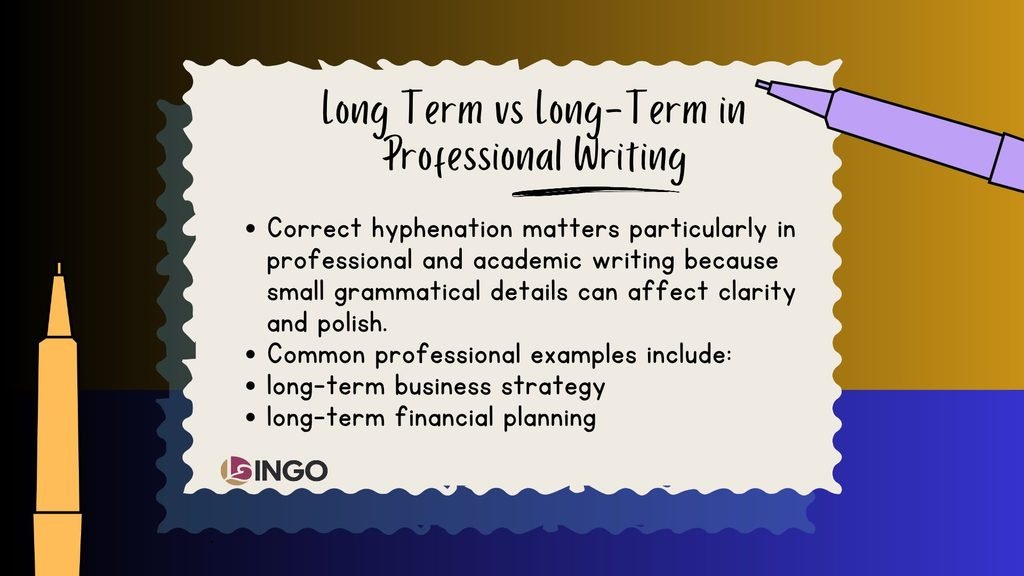
Correct hyphenation matters particularly in professional and academic writing because small grammatical details can affect clarity and polish.
Common professional examples include:
- long-term business strategy
- long-term financial planning
- long-term customer relationships
- long-term career development
- long-term environmental impact
- long-term organizational goals
- long-term economic growth
However, writers should not add a hyphen simply because the expression contains long and term.
For example:
The company is thinking about the long term.
Not:
The company is thinking about the long-term.
The second version incorrectly treats the phrase as though it were modifying a following noun.
Google’s current guidance emphasizes helpful, reliable, people-first content rather than writing designed primarily to manipulate rankings. Clear grammar, useful explanations, accurate sourcing, and a satisfying reader experience all support that broader principle.
2025–2026 Data: Why Clear Online Writing Still Matters
Grammar questions may look small, but clear language remains important in digital publishing.
HubSpot’s recent marketing data shows that blog content continues to play a significant role in modern content strategies. Its 2026 marketing statistics report says blog posts were among the top five highest-ROI content formats in 2025, with 22.26% of marketers identifying them among the highest-return formats. It also reports that 38% of marketers used blog posts in 2025 and that website/blog/SEO remained the leading ROI-generating channel in its survey.
HubSpot’s 2025 State of Blogging research similarly found that 65% of marketers worked at companies that maintained blogs, while 93% of those marketers considered blogging important or very important to their marketing strategy.
These numbers do not mean that using a hyphen automatically improves search rankings. Rather, they reinforce why accurate, readable writing remains valuable for publishers. A grammar article should answer the reader’s question directly, use examples that make the rule obvious, and avoid unnecessary complexity.
That is especially important for phrases such as long term vs long-term, where a single hyphen can signal a different grammatical function.
Mini Quiz:Long Term vs Long-Term
1. Which sentence uses the correct form?
A. We need a long term plan.
B. We need a long-term plan.
C. We need a longterm plan.
D. We need a long—term plan.
Answer: B
2. Which sentence is correct?
A. It will benefit us in the long-term.
B. It will benefit us in the long term.
C. It will benefit us in long-term.
D. It will benefit us in the longterm.
Answer: B
3. Choose the correct phrase.
A. long term goal
B. long-term goal
C. longterm goal
D. long—term goal
Answer: B
4. Which sentence is correctly written?
A. Think about the long-term.
B. Think about the long term.
C. Think about long-term.
D. Think about the longterm.
Answer: B
5. Choose the correct form: “She has a _____ career goal.”
A. long term
B. long-term
C. longterm
D. long—term
Answer: B
6. Which sentence is correct?
A. We are planning for the long term.
B. We are planning for the long-term.
C. We are planning for long-term.
D. We are planning for the longterm.
Answer: A
7. Which form should be used before the noun “solution”?
A. long term solution
B. long-term solution
C. longterm solution
D. long—term solution
Answer: B
8. Which sentence correctly uses “long term”?
A. They created a long term strategy.
B. They created a long-term strategy.
C. They created a longterm strategy.
D. They created a long—term strategy.
Answer: B
9. Which phrase is correctly written?
A. in the long term
B. in the long-term
C. in long-term
D. in the longterm
Answer: A
10. Choose the correct sentence.
A. The company needs long-term growth.
B. The company needs long term growth.
C. The company needs longterm growth.
D. The company needs long—term growth.
Answer: A
11. Which form is normally used as a compound adjective before a noun?
A. long term
B. long-term
C. longterm
D. long / term
Answer: B
12. Which sentence is correct?
A. This is better for the long-term.
B. This is better for the long term.
C. This is better for long-term.
D. This is better for the longterm.
Answer: B
13. Complete the sentence: “They developed a _____ business strategy.”
A. long term
B. long-term
C. longterm
D. long—term
Answer: B
14. Which sentence correctly uses the phrase as a noun?
A. We should consider the long term.
B. We should consider the long-term.
C. We should consider long-term.
D. We should consider the longterm.
Answer: A
15. Choose the correct form: “The decision could have _____ effects.”
A. long term
B. long-term
C. longterm
D. long—term
Answer: B
16. Which sentence is correctly written?
A. Over the long-term, the investment may grow.
B. Over the long term, the investment may grow.
C. Over long-term, the investment may grow.
D. Over the longterm, the investment may grow.
Answer: B
17. Which sentence uses “long-term” correctly?
A. We are thinking about the long-term.
B. We have a long-term strategy.
C. We are planning for the long-term.
D. We considered the long-term.
Answer: B
18. Which sentence uses “long term” correctly?
A. She has a long term goal.
B. She created a long term plan.
C. She wants to succeed in the long term.
D. She developed a long term strategy.
Answer: C
19. Choose the correct phrase.
A. long-term investment
B. long term investment
C. longterm investment
D. long—term investment
Answer: A
20. Which sentence is correct?
A. They are thinking in the long-term.
B. They are thinking in the long term.
C. They are thinking in long-term.
D. They are thinking in the longterm.
Answer: B
21. Why is “long-term” hyphenated in “long-term plan”?
A. It is a compound adjective modifying “plan.”
B. It always has to be hyphenated.
C. It is a verb phrase.
D. It is a proper noun.
Answer: A
22. Which sentence is correct?
A. We want a long-term relationship with customers.
B. We want a long term relationship with customers.
C. We want a longterm relationship with customers.
D. We want a long—term relationship with customers.
Answer: A
23. Which sentence correctly uses “long term” as a noun phrase?
A. They created a long-term goal.
B. She has a long-term plan.
C. We are preparing for the long term.
D. He developed a long-term strategy.
Answer: C
24. Complete the sentence: “Good habits can provide _____ benefits.”
A. long term
B. long-term
C. longterm
D. long—term
Answer: B
25. What is the easiest rule for remembering the difference?
A. Always use long-term.
B. Always use long term.
C. Use long-term before a noun; use long term when referring to a period.
D. Use either form in every situation.
Answer: C
FAQs About Long Term vs Long-Term
Q1:Is “long-term” always hyphenated?
No. Long-term is normally hyphenated when it functions as a compound adjective before a noun, such as long-term plan. But long term is normally open when it functions as a noun phrase, such as in the long term.
Q2:Is it “long term” or “long-term goal”?
The correct form is long-term goal.
She has a long-term goal of becoming a published author.
Because long-term modifies the noun goal, the words are hyphenated.
Q3:Is “in the long term” hyphenated?
No. The standard form is in the long term.
The decision will benefit us in the long term.
Q4:Is “long term plan” correct?
In standard edited English, long-term plan is preferred because long-term is a compound adjective modifying plan.
Q5:Should I write “for the long term” or “for the long-term”?
Write for the long term.
We are making this investment for the long term.
Here, long term refers to the period itself.
Q6:What is the difference between long-term and long term?
Long-term is generally an adjective used before a noun:
a long-term solution
Long term is generally a noun phrase referring to an extended period:
in the long term
Q7:Is “long-term” an adjective?
Yes. In phrases such as long-term planning, long-term success, and long-term effects, long-term functions as a compound adjective.
Q8:What is the easiest way to remember the rule?
Use this shortcut:
Before a noun = long-term.
Referring to a period = long term.
So:
long-term strategy
but:
in the long term
Conclusion: Long Term or Long-Term?
The difference between long term and long-term is straightforward once you understand their grammatical roles.
Use long-term when the words work together as a compound adjective before a noun:
a long-term plan
a long-term relationship
long-term benefits
Use long term when the phrase functions as a noun phrase, especially in expressions such as:
in the long term
for the long term
over the long term
The key is not simply memorizing where the hyphen goes. Instead, look at what the phrase is doing in the sentence.
Before a noun? Use “long-term.” Referring to an extended period? Use “long term.”
If you are writing for a website, school, workplace, or professional audience, applying this simple rule will make your writing clearer and more polished.
For more clear explanations of commonly confused English words and grammar rules, explore the other language guides on Lingorixa
References
Cambridge Dictionary: Long-term
Cambridge Grammar: Compounds

Maimoona Asghar is a grammar enthusiast and language writer who creates clear, practical content to help learners improve English grammar, writing, punctuation, and communication skills through easy-to-understand explanations and examples.