Have you ever written “nieve” and wondered whether it should actually be “naive”? If so, you are not alone. The pronunciation of this word can make its spelling surprisingly easy to confuse.
So, naive or nieve which is correct? The correct standard English spelling is naive. Naïve is also an accepted spelling, while nieve is not the standard spelling for this meaning. Cambridge Dictionary lists naive as an adjective and also identifies naïve as an alternative form.
In this guide, you’ll learn the correct spelling, meaning, pronunciation, differences between naive and naïve, common examples, and an easy way to remember the word.
Naive or Nieve: Which Spelling Is Correct?
The short answer is:
Naive = Correct ✅
Naïve = Correct ✅
Nieve = Incorrect for this meaning ❌
Why Is “Naive” Correct?
Naive is the standard English spelling of an adjective describing someone who lacks experience or is too ready to trust people or believe something.
For example:
- She was naive to believe every promise he made.
- It was naive to assume the project would be easy.
- He was too naive to recognize the warning signs.
Cambridge Dictionary defines naive in relation to being too willing to believe others or to assume that people’s intentions are good, particularly because of limited life experience.
Is “Naïve” Also Correct?
Yes.
Naïve is an alternative spelling of naive. The two words have the same meaning and pronunciation.
The two dots over the i are called a diaeresis. In modern English, however, many writers simply use naive without the marks.
For example:
She was naive about the risks.
and:
She was naïve about the risks.
Both are acceptable.
Is “Nieve” Correct?
No—not when you mean someone who is inexperienced, innocent, or overly trusting.
For example:
He was naive about the situation. ✅
Not:
He was nieve about the situation. ❌
Therefore, when you’re choosing between naive or nieve, remember that naive is the spelling you need.
What Does Naive Mean?
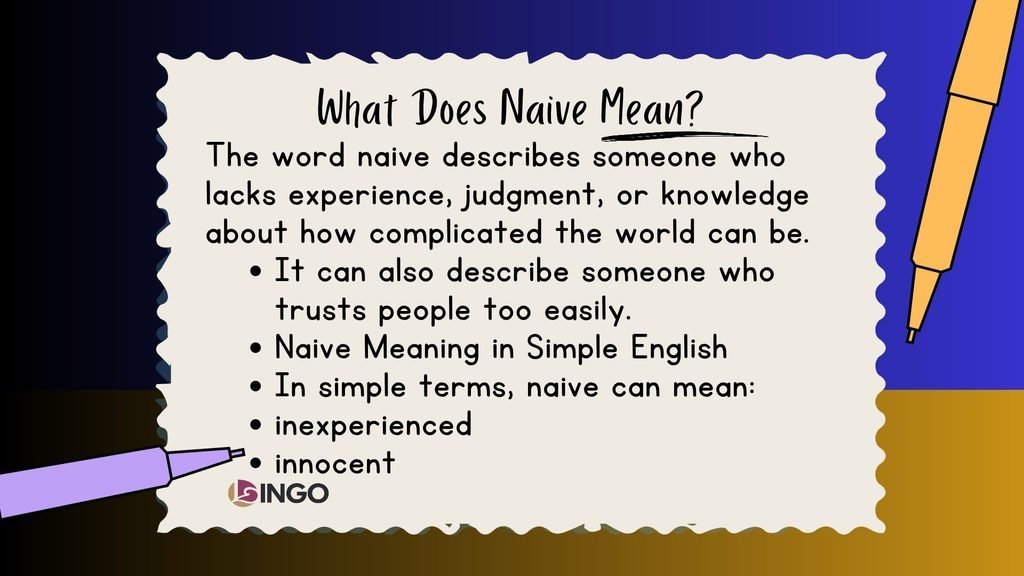
The word naive describes someone who lacks experience, judgment, or knowledge about how complicated the world can be.
It can also describe someone who trusts people too easily.
Naive Meaning in Simple English
In simple terms, naive can mean:
- inexperienced
- innocent
- overly trusting
- unsophisticated
- lacking worldly experience
For example:
I was naive enough to believe that everyone was honest.
This means the speaker lacked experience and trusted people too easily.
Cambridge’s learner dictionary similarly explains naive as believing things too easily because of insufficient experience of the world.
Does Naive Mean Stupid?
Not necessarily.
This is an important distinction.
A person can be very intelligent and still be naive about a particular subject.
For example:
She is an excellent engineer, but she was naive about running a business.
The sentence does not say that she is unintelligent. It means she lacked experience in business.
Examples of Naive in Sentences
Here are some natural examples:
- I was naive to think everything would go according to plan.
- She was too naive to recognize the scam.
- His naive optimism made everyone smile.
- Don’t be naive enough to believe every online advertisement.
- The young traveler was naive about the dangers.
- It was a naive assumption.
- He made a naive decision because he lacked experience.
Naive vs. Nieve: What’s the Difference?
The biggest difference is simple: naive is the correct spelling, while nieve is a common misspelling when referring to this meaning.
Naive vs. Nieve Comparison
| Spelling | Correct? | Meaning |
|---|---|---|
| Naive | ✅ Yes | Inexperienced or overly trusting |
| Naïve | ✅ Yes | Alternative spelling of naive |
| Nieve | ❌ No | Not the standard spelling for this meaning |
Why Do People Spell It “Nieve”?
The mistake probably feels natural because of the word’s pronunciation.
Cambridge gives the UK pronunciation as /naɪˈiːv/ and the US pronunciation as /nɑˈiv/.
When people hear the word rather than see it written, they may try to spell the sound as nieve.
English spelling, however, is not always predictable from pronunciation.
The Easy Spelling Pattern
Break the word down visually:
NA + I + VE = NAIVE
The important part to remember is:
NAI
not:
NIE
So if you’re asking “Is it naive or nieve?”, look for the AI combination.
How to Use Naive Correctly
Understanding the spelling is only half the job. You also need to know how the word works in a sentence.
Naive as an Adjective
Naive is an adjective, so it normally describes a noun or person.
Examples:
- a naive student
- a naive assumption
- a naive belief
- a naive approach
- a naive question
Example:
His naive assumption caused problems later.
Naively as an Adverb
The adverb is naively.
It describes an action carried out in an inexperienced or overly trusting way.
Examples:
- She naively believed him.
- I naively assumed the work would be finished today.
- He naively trusted the stranger.
Cambridge lists naively as the adverbial form of naive.
Naivety as a Noun
Naivety is a noun referring to the quality of being naive.
For example:
His naivety made him easy to deceive.
Cambridge also lists naivety as the noun form.
You may also encounter naiveté, particularly in formal writing.
Naive vs. Naïve: Are Both Correct?
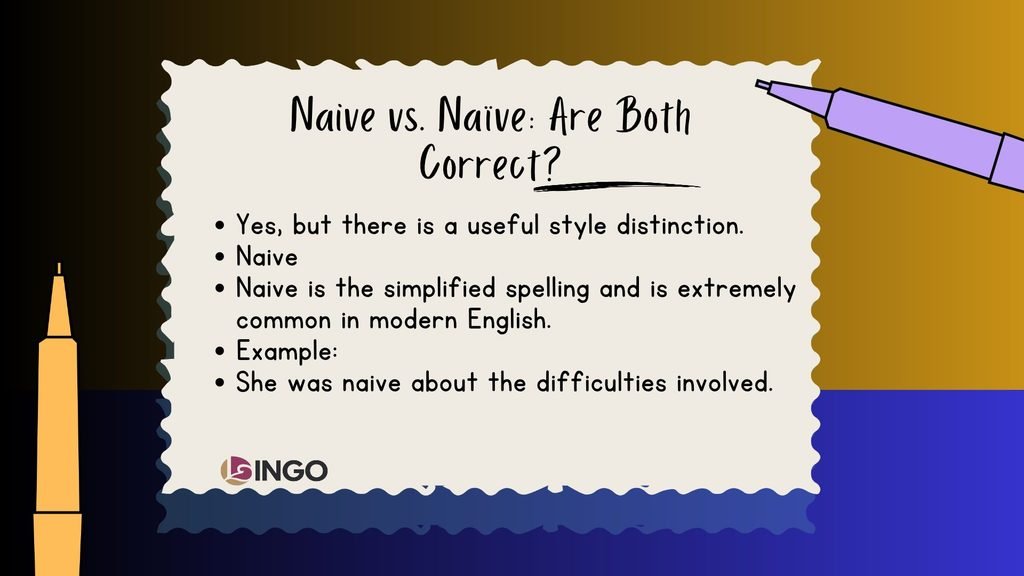
Yes, but there is a useful style distinction.
Naive
Naive is the simplified spelling and is extremely common in modern English.
Example:
She was naive about the difficulties involved.
Naïve
Naïve retains the diaeresis.
Example:
She was naïve about the difficulties involved.
Both forms communicate the same meaning.
Interestingly, the 2025 NICE Style Guide specifically recommends “naive” rather than “naïve” in its own house style. That is a style preference, not proof that naïve is universally incorrect.
For general-purpose writing, naive is therefore a simple and safe choice.
Real-Life Example: A Common Spelling Mistake
Imagine a college student preparing an essay about a fictional character. The character believes that everyone he meets is honest and assumes that problems will always work themselves out.
The student writes:
“The main character is nieve because he trusts everyone around him.”
The meaning is understandable, but the spelling is incorrect. The student checks a reliable dictionary and discovers that the correct form is naive.
The sentence becomes:
“The main character is naive because he trusts everyone around him.”
This version is correct and communicates the idea clearly.
The example also highlights an important point about the word itself. Calling the character naive does not necessarily mean that he is unintelligent. He may be clever in many areas, but his limited experience makes him overly trusting. Cambridge’s definition similarly connects naive with a lack of experience and a tendency to believe people too readily.
This is why naive can be useful when discussing people, decisions, assumptions, beliefs, plans, and approaches. A person can have a naive belief, a naive assumption, or a naive approach without being generally unintelligent.
2025–2026 Spelling and Usage Notes
There is no meaningful new spelling change in 2025–2026 that turns nieve into an accepted English spelling. Current authoritative dictionary resources continue to recognize naive and naïve.
What Current References Show
| Resource | Current guidance |
|---|---|
| Cambridge Dictionary | Lists naive and notes naïve as an alternative |
| NICE Style Guide, 2025 | Uses naive rather than naïve in its house style |
| Cambridge Learner’s Dictionary | Lists naive, naively, and naivety |
The NICE guide is particularly useful for current style information because its 2025 edition explicitly includes Naive among its preferred spellings.
The practical takeaway is straightforward: use naive in ordinary modern English unless you have a specific reason to retain the diaeresis.
How to Remember “Naive” Easily
If you frequently confuse naive and nieve, use this four-step method.
Step 1: Remember “AI”
The correct spelling contains:
NAI
Not:
NIE
Step 2: Break It Into Parts
Think:
NA + IVE = NAIVE
This makes the unusual spelling easier to visualize.
Step 3: Connect Related Words
Remember the word family:
- naive
- naively
- naivety
They all reinforce the NAI spelling.
Step 4: Practice With a Sentence
Use it naturally:
It was naive of me to believe everything I heard.
The more often you see and use the word, the easier the spelling becomes.
Mini Quiz:Naive or Nieve
1. Which spelling is correct?
A) Nieve
B) Naive
C) Neive
D) Nayve
Answer: B) Naive
2. Which alternative spelling is also correct?
A) Nieve
B) Naiv
C) Naïve
D) Nayve
Answer: C) Naïve
3. What does “naive” generally mean?
A) Highly experienced
B) Overly trusting or inexperienced
C) Extremely angry
D) Very wealthy
Answer: B) Overly trusting or inexperienced
4. Choose the correctly spelled sentence.
A) She was nieve about the risks.
B) She was naiv about the risks.
C) She was naive about the risks.
D) She was nayve about the risks.
Answer: C) She was naive about the risks.
5. What is the adverb form of “naive”?
A) Naively
B) Naivly
C) Nievily
D) Naivefully
Answer: A) Naively
6. What is a noun form of “naive”?
A) Nievety
B) Naivety
C) Naivness
D) Naively
Answer: B) Naivety
7. Which letter combination helps you remember “naive”?
A) IE
B) EA
C) AI
D) EI
Answer: C) AI
8. Which sentence is correct?
A) He was nieve and trusted everyone.
B) He was naiv and trusted everyone.
C) He was naive and trusted everyone.
D) He was neive and trusted everyone.
Answer: C) He was naive and trusted everyone.
9. Does “naive” necessarily mean unintelligent?
A) Yes, always
B) No, someone can be intelligent but inexperienced
C) Yes, but only in formal writing
D) Only when capitalized
Answer: B) No, someone can be intelligent but inexperienced
10. Which sentence is correct?
A) It was a naive assumption.
B) It was a nieve assumption.
C) It was a naiv assumption.
D) It was a nayve assumption.
Answer: A) It was a naive assumption.
11. Which spelling is widely used in modern English?
A) Nieve
B) Naive
C) Neive
D) Naiv
Answer: B) Naive
12. What are the two dots in “naïve” called?
A) Accent
B) Apostrophe
C) Diaeresis
D) Hyphen
Answer: C) Diaeresis
13. Choose the correct sentence.
A) She naively trusted the stranger.
B) She nieve trusted the stranger.
C) She naive trusted the stranger.
D) She naiv trusted the stranger.
Answer: A) She naively trusted the stranger.
14. Choose the correct noun form.
A) His naivety made him easy to deceive.
B) His nieve made him easy to deceive.
C) His naive made him easy to deceive.
D) His naivly made him easy to deceive.
Answer: A) His naivety made him easy to deceive.
15. Which spelling should you use for someone who is inexperienced?
A) Nieve
B) Naive
C) Nayve
D) Neive
Answer: B) Naive
16. Which word is closest in meaning to “naive”?
A) Experienced
B) Inexperienced
C) Expert
D) Skilled
Answer: B) Inexperienced
17. Which word can be an opposite of “naive” when referring to experience?
A) Gullible
B) Innocent
C) Experienced
D) Trusting
Answer: C) Experienced
18. Which sentence is correct?
A) He took a nieve approach.
B) He took a naiv approach.
C) He took a naive approach.
D) He took a neive approach.
Answer: C) He took a naive approach.
19. Which sequence appears in “naive,” “naively,” and “naivety”?
A) NIE
B) NAI
C) NEI
D) NAY
Answer: B) NAI
20. Choose the correctly spelled sentence.
A) It was nieve to trust the claim.
B) It was naiv to trust the claim.
C) It was neive to trust the claim.
D) It was naive to trust the claim.
Answer: D) It was naive to trust the claim.
21. What is the relationship between “naive” and “naïve”?
A) They have completely different meanings.
B) They are alternative spellings.
C) Only “naïve” is correct.
D) Only “naive” is correct.
Answer: B) They are alternative spellings.
22. Which sentence correctly uses “naive”?
A) She had a naive belief about the situation.
B) She had a nieve belief about the situation.
C) She had a naiv belief about the situation.
D) She had a neive belief about the situation.
Answer: A) She had a naive belief about the situation.
23. Which spelling should you avoid when you mean “inexperienced”?
A) Naive
B) Naïve
C) Nieve
D) Naive in plain text
Answer: C) Nieve
24. Which situation best demonstrates being naive?
A) Carefully checking every fact
B) Believing every promise without checking
C) Having years of experience
D) Being an expert
Answer: B) Believing every promise without checking
25. What is the easiest spelling reminder for “naive”?
A) NIE + VE
B) NAI + VE
C) NEI + VE
D) NAY + VE
Answer: B) NAI + VE
Frequently Asked Questions
1. Is it naive or nieve?
Naive is correct. Naïve is also an accepted spelling, while nieve is not the standard English spelling for this meaning.
2. Is “naïve” spelled correctly?
Yes. Naïve is a correct alternative spelling of naive. The two forms have the same meaning.
3. What does naive mean?
Naive generally describes someone who lacks experience or is too willing to trust others or believe something without enough evidence.
4. Is “nieve” an English word?
If you mean naive, then nieve is not the standard English spelling. Use naive or naïve instead.
5. How do you pronounce naive?
Cambridge lists the UK pronunciation as /naɪˈiːv/ and the US pronunciation as /nɑˈiv/.
6. Is naive a negative word?
It can be negative when it suggests poor judgment or excessive trust. However, the tone depends on context. It can sometimes suggest innocence or a lack of experience rather than stupidity.
7. What is the noun form of naive?
The common noun form is naivety. Naiveté is another form you may encounter.
8. What is the easiest way to remember the spelling?
Remember:
NAI + VE = NAIVE
The key is to use AI, not IE.
Conclusion
So, naive or nieve? The correct spelling is naive. Naïve is also correct, while nieve is not the standard spelling when you mean inexperienced, innocent, or overly trusting.
The easiest way to remember naive is to focus on the AI sequence:
NA-I-VE → NAIVE
You can use naive to describe an inexperienced person, an overly trusting belief, an unrealistic assumption, or an unsophisticated approach. Just remember that naive does not necessarily mean stupid—someone can be highly intelligent and still be naive about something they have little experience with.
For clear, accurate English writing, choose naive when you’re tempted to write nieve.
For more clear explanations of commonly confused English words and grammar rules, explore the other language guides on Lingorixa.
References

Maimoona Asghar is a grammar enthusiast and language writer who creates clear, practical content to help learners improve English grammar, writing, punctuation, and communication skills through easy-to-understand explanations and examples.