Introduction
Is it stopping or stoping? If you have ever typed the word quickly and wondered whether the final p should be doubled, you are not alone.
The correct spelling is stopping, with two p’s. Stoping is generally an incorrect spelling when you mean the present participle or gerund of the verb stop.
The reason is a common English spelling rule: when certain short verbs ending in a consonant follow a short-vowel pattern, the final consonant is doubled before adding a suffix such as -ing or -ed.
For example:
- stop → stopping
- stop → stopped
- plan → planning
- plan → planned
- run → running
- run → running
In this guide, you will learn exactly why stopping has two p’s, when the doubling rule applies, how to use the word correctly, and how to avoid similar spelling mistakes.
Is It Stopping or Stoping?
The correct spelling is stopping.
Stopping is the present participle and gerund form of stop. Cambridge Dictionary lists stopping as the present participle of stop, while stop can mean to finish an activity, pause, cease moving, or prevent something from happening.
Why Is Stopping Spelled With Two P’s?
The spelling changes because the final consonant of stop is doubled before -ing is added.
The process is:
stop + ing → stopping
The word does not become stoping because English spelling conventions require the final p to be doubled in this situation.
Compare:
| Base verb | + -ing | Correct form |
|---|---|---|
| stop | stop + ing | stopping |
| plan | plan + ing | planning |
| run | run + ing | running |
| sit | sit + ing | sitting |
| shop | shop + ing | shopping |
Is Stoping Ever Correct?
For ordinary English writing, stoping is not the correct form of the verb stop + -ing.
If you want to describe the action of stopping, use stopping.
Incorrect: I am stoping the car.
Correct: I am stopping the car.
Incorrect: The rain is stoping.
Correct: The rain is stopping.
Therefore, if your intended meaning is the action of stop, remember the double p.
The Spelling Rule Behind Stopping
The key to understanding stopping is the consonant-doubling rule.
The Short-Vowel + Consonant Pattern
Many short, one-syllable verbs end in a pattern consisting of:
consonant + vowel + consonant
For example:
- stop
- plan
- run
- sit
- shop
When these verbs take -ing or certain other vowel-starting suffixes, the final consonant is commonly doubled.
So:
- stop → stopping
- plan → planning
- run → running
- sit → sitting
- shop → shopping
The rule helps preserve the pronunciation of the short vowel.
When Do You Double the Final Consonant?
A useful practical pattern is:
For many one-syllable verbs ending in consonant-vowel-consonant, double the final consonant before adding -ing.
Examples:
- hop → hopping
- rob → robbing
- cut → cutting
- swim → swimming
- drop → dropping
However, English spelling has exceptions and additional conditions, so this should be treated as a useful rule rather than a rule that applies mechanically to every verb.
Stopping vs. Stoping: A Quick Rule
When you see stop + ing, do not simply attach -ing to the base word.
Instead:
stop + ing → stopping
A simple memory trick is:
Stop before you stop: keep the second p.
That is, the word stop already ends in p, and the spelling becomes stopping when -ing is added.
How to Use Stopping Correctly
Stopping can function as a present participle, part of a continuous verb construction, or a gerund acting as a noun.
Stopping as a Present Participle
When an action is happening or developing, stopping can appear in a continuous construction.
Examples:
- The car is stopping at the traffic light.
- She is stopping the machine.
- The bus is stopping near the station.
- The rain is finally stopping.
In these sentences, stopping describes an ongoing action or process.
Stopping as a Gerund
A gerund is an -ing form that functions as a noun.
Examples:
- Stopping suddenly can be dangerous.
- Stopping the machine requires caution.
- I dislike stopping during a long journey.
- Stopping the argument was difficult.
Here, stopping refers to an activity or action.
Stopping in Common Expressions
The word also appears in several everyday expressions:
- stopping by — visiting briefly
- stopping over — staying somewhere temporarily during a journey
- stopping traffic — causing people or vehicles to stop
- stopping someone from doing something — preventing an action
For example:
I am stopping by your office after lunch.
The police were stopping cars for inspection.
Nothing could stop her from finishing the project.
Cambridge also documents constructions such as stop + -ing and stop + to-infinitive, which have different meanings.
Stopping vs. Stoping: Examples You Can Remember
Seeing the words in context makes the spelling easier to remember.
Correct Examples
- The bus is stopping at the next station.
- She is stopping to check her phone.
- Please stop stopping the recording.
- The machine keeps stopping unexpectedly.
- He is stopping by the store later.
- The rain is stopping now.
- We are stopping for lunch.
- They are stopping the project temporarily.
Incorrect Examples
These examples contain the common spelling mistake:
- The bus is stoping at the station.
- She is stoping the machine.
- The rain is stoping.
- We are stoping for lunch.
Replace stoping with stopping in each case.
A Simple Comparison
| Incorrect | Correct |
|---|---|
| stoping | stopping |
| stoped | stopped |
| stoping suddenly | stopping suddenly |
| stoping the car | stopping the car |
| stoping work | stopping work |
The same doubling principle explains why the past tense is stopped, not stoped.
Stop + -ing vs. Stop + to: An Important Difference
Spelling is not the only issue involving stop. The construction that follows the verb can also change the meaning.
Stop Doing Something
Stop + -ing means to cease an activity.
For example:
She stopped talking.
This means she was talking and then ceased talking.
Other examples:
- He stopped smoking.
- They stopped arguing.
- We stopped working.
- The children stopped playing.
Stop to Do Something
Stop + to + verb means to pause one activity in order to do another.
For example:
She stopped to talk to her friend.
This means she paused what she was doing so she could talk.
Compare:
She stopped talking.
Meaning: She ceased talking.
She stopped to talk.
Meaning: She paused another activity in order to talk.
This distinction is especially useful for English learners because changing -ing to to + verb can change the meaning of the sentence. Cambridge specifically identifies both constructions and distinguishes their uses.
Case Study: A Common Workplace Spelling Mistake
Imagine a junior employee preparing an email to a client after a software problem has been fixed.
The employee writes:
“The system has stoped working, but our technical team is working on the issue.”
There are actually two possible concerns here: the meaning of stop and its spelling. If the employee means that the system ceased functioning, the appropriate sentence might be:
“The system has stopped working, but our technical team is working on the issue.”
Later, the employee writes:
“We are stoping the service temporarily while we complete maintenance.”
Again, the intended form is:
“We are stopping the service temporarily while we complete maintenance.”
These errors are small, but they illustrate why spelling rules matter in professional communication. A reader can usually understand what the writer means, but repeated spelling mistakes can make otherwise clear writing look less polished.
A 2025 study of recruiters and HR professionals from 19 companies in Karachi found that the ability to write professional, grammatically correct emails received a mean importance rating of 4.47 on a 5-point scale. The study was limited in size and used a convenience sample, so it should not be generalized to every employer. Nevertheless, it provides a useful real-world example of why careful written English can matter in professional settings.
The practical lesson is simple: when writing an email, report, assignment, or website article, take a moment to check words whose spelling changes when a suffix is added. Stopping, planned, running, and written are all examples where understanding the spelling pattern is more reliable than guessing from pronunciation.
2025–2026 Data: Why Accurate English Still Matters
Recent research continues to examine the relationship between grammar, writing, and professional communication.
A 2026 study published in Frontiers in Education surveyed university students about grammar in workplace communication. In that study, 79.1% agreed or strongly agreed that proper grammar in professional workplace communication was important, while 74.3% believed proper grammar supported acceptance of a job application. The study involved a specific university-student population, so these percentages should not be treated as universal workplace statistics.
A separate 2025 study of 107 university students examined business-English writing through project-based learning. The researchers assessed areas including clarity, structure, vocabulary, tone, grammar, confidence, and workplace communication preparation. The study reported improvements in students’ writing-related outcomes after the intervention.
These findings do not mean that every spelling mistake will damage a person’s career. Instead, they reinforce a more practical point: clear and accurate English remains a meaningful part of academic and professional communication.
For a small word such as stopping, learning the spelling rule once can prevent repeated errors across emails, assignments, reports, and online content.
A Quick Checklist for Remembering Stopping
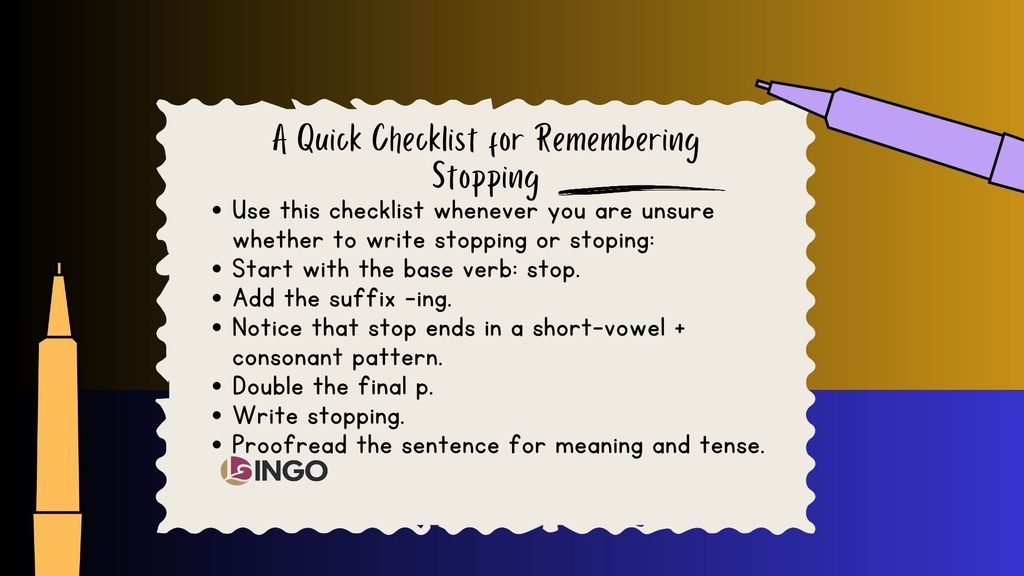
Use this checklist whenever you are unsure whether to write stopping or stoping:
- Start with the base verb: stop.
- Add the suffix -ing.
- Notice that stop ends in a short-vowel + consonant pattern.
- Double the final p.
- Write stopping.
- Proofread the sentence for meaning and tense.
The Fastest Memory Trick
Remember:
STOP + P + ING = STOPPING
Or simply:
One stop has one p at the end; stopping has two p’s.
This is not the complete explanation of every English consonant-doubling situation, but it is an effective way to remember this particular spelling.
Stopping or Stoping : Mini Quiz
1. Which spelling is correct?
A) Stoping
B) Stopping — Answer
C) Stoppping
D) Stoppin
2. Complete the sentence: “The bus is ___ here.”
A) Stoping
B) Stopping — Answer
C) Stoppping
D) Stoppin
3. What is the correct form of “stop + ing”?
A) Stoping
B) Stopping — Answer
C) Stoppping
D) Stoppeding
4. Why does “stopping” have two p’s?
A) The final p is doubled before adding -ing — Answer
B) Every verb doubles its final letter
C) The pronunciation requires two p sounds
D) The original word was “stopp”
5. Which sentence is correct?
A) She is stoping the machine.
B) She is stopping the machine. — Answer
C) She is stoppping the machine.
D) She is stoppin the machine.
6. Which word follows a similar doubling pattern?
A) Opening
B) Planning — Answer
C) Cleaning
D) Raining
7. Choose the correct spelling: “The rain is finally ___.”
A) Stoping
B) Stopping — Answer
C) Stoppped
D) Stoppin
8. What is the correct past tense of “stop”?
A) Stoped
B) Stopped — Answer
C) Stoppped
D) Stopt
9. Which sentence is correctly spelled?
A) They are stoping for lunch.
B) They are stopping for lunch. — Answer
C) They are stoppping for lunch.
D) They are stoppin for lunch.
10. What is the base verb in “stopping”?
A) Stopp
B) Stop — Answer
C) Stopped
D) Stopping
11. Which phrase is correct?
A) Stoping the car
B) Stopping the car — Answer
C) Stoppping the car
D) Stoppin the car
12. What does “stop doing something” generally mean?
A) Begin the activity
B) Repeat the activity
C) Cease the activity — Answer
D) Plan the activity
13. Which sentence means that someone paused another activity in order to talk?
A) She stopped talking.
B) She stopped to talk. — Answer
C) She stopping to talk.
D) She stop talking.
14. Which sentence means that she ceased talking?
A) She stopped talking. — Answer
B) She stopped to talk.
C) She stopping talking.
D) She stop to talking.
15. Complete the sentence: “We are ___ by the store later.”
A) Stoping
B) Stopping — Answer
C) Stopped
D) Stop
16. Which spelling is correct?
A) Runing
B) Running — Answer
C) Runnning
D) Runnin
17. Which spelling is correct?
A) Shoping
B) Shopping — Answer
C) Shoppping
D) Shoppin
18. Which sentence is correct?
A) The machine keeps stoping.
B) The machine keeps stopping. — Answer
C) The machine keeps stop.
D) The machine keeps stopped.
19. Which spelling should you use in formal writing?
A) Stoping
B) Stopping — Answer
C) Stoppin
D) Stoppping
20. How many p’s are in “stopping”?
A) One
B) Two — Answer
C) Three
D) None
21. Which transformation is correct?
A) Stop → Stoping
B) Stop → Stopping — Answer
C) Stop → Stoppping
D) Stop → Stoppeding
22. Which sentence is correctly written?
A) He is stoping the car.
B) He is stopping the car. — Answer
C) He is stopped the car.
D) He is stop the car.
23. What is the correct -ing form of “plan”?
A) Planing
B) Planning — Answer
C) Plannning
D) Plannin
24. Which sentence uses “stopping” as a gerund?
A) Stopping suddenly can be dangerous. — Answer
B) Stoping suddenly can be dangerous.
C) Stopped suddenly can be dangerous.
D) Stop suddenly can be dangerous.
25. What is the best rule for remembering “stopping”?
A) Never double consonants before -ing.
B) Always double every final letter before -ing.
C) Double the final consonant in this short verb before adding -ing. — Answer
D) Remove the final consonant before adding -ing.
Frequently Asked Questions
Q1:Is stopping or stoping correct?
Stopping is correct when you mean the -ing form of the verb stop. The spelling stoping is not the standard form for this meaning.
Q2:Why does stopping have two p’s?
The final p is doubled before adding -ing because stop fits the spelling pattern that triggers consonant doubling in this type of short verb.
Q3:Is stoping a word?
Stoping is not the standard spelling of the present participle or gerund of stop. In ordinary English, write stopping.
Q4:How do you spell stop with ing?
Write:
stop + ing = stopping
Do not write stoping.
Q5:Is stopped also spelled with two p’s?
Yes. The past tense and past participle are stopped, with two p’s.
Examples:
- The car stopped suddenly.
- The machine has stopped working.
- She stopped talking.
Q6:What is the difference between stopping and stopped?
Stopping is the -ing form:
The train is stopping.
Stopped is the past tense or past participle:
The train stopped.
Q7:What is the difference between stop doing and stop to do?
Stop doing something means to cease that activity:
He stopped working.
Stop to do something means to pause another activity in order to perform the next action:
He stopped to work on the problem.
The intended meaning determines which structure you need.
Q8:How can I remember the spelling of stopping?
Remember the simple form:
stop + p + ing = stopping
Think of the extra p as the letter that prevents the common mistake stoping.
Conclusion
So, is it stopping or stoping?
The correct spelling is stopping, with two p’s.
The spelling follows the consonant-doubling pattern used with many short verbs before -ing. Once you understand the pattern, forms such as stopping, stopped, planning, running, and sitting become much easier to spell correctly.
Remember the essential rule:
stop + ing = stopping
Whether you are writing an email, school assignment, blog post, report, or everyday message, using stopping instead of stoping keeps your English accurate and polished.
For more clear explanations of commonly confused English words and grammar rules, explore the other language guides on Lingorixa.
Rrferances

Maimoona Asghar is a grammar enthusiast and language writer who creates clear, practical content to help learners improve English grammar, writing, punctuation, and communication skills through easy-to-understand explanations and examples.