Have you ever wondered whether the correct phrase is “I would love to” or “I would love too”? You are not alone. Because to and too sound alike, they are easy to confuse in writing.
The correct standalone expression is “I would love to.” Here, to introduces an action that is understood from the context. Too, however, generally means “also” or “more than necessary.”
For example:
“Would you like to join us for dinner?”
“I would love to.”
But you can also correctly say:
“I would love to join you too.”
In that sentence, both words are correct because they have different grammatical functions.
This guide explains the difference between to and too, shows you when to use each one, and gives you a simple rule you can remember whenever you are unsure.
What Is the Correct Form: “I Would Love To” or “I Would Love Too”?
The correct standalone expression is:
I would love to.
We use this phrase when the action has already been mentioned or is obvious from the conversation.
For example:
“Would you like to come to the party?”
“I would love to.”
The complete meaning is:
“I would love to come to the party.”
The verb does not have to be repeated because the listener already understands it.
Why “I Would Love Too” Is Incorrect
The word too cannot normally replace the infinitive to.
Therefore:
- ❌ I would love too.
- ✅ I would love to.
However, too can correctly appear later in the sentence:
I would love to come too.
Here, too means “also.”
That is the key difference.
What Does “To” Do?
In “I would love to,” to is the infinitive marker. It introduces a base-form verb when that verb is stated.
Examples:
- I would love to help.
- I would love to visit.
- I would love to join.
- I would love to learn.
- I would love to attend.
The basic structure is:
would + love + to + base verb
When the verb is understood from the previous sentence, the phrase can end with to:
“Would you like to help us?”
“I would love to.”
What Does “Too” Do?
Too is an adverb. It commonly has two meanings:
1. Also
I would love to come too.
2. Excessively
The coffee is too hot.
The bag is too heavy.
Therefore, to and too are not interchangeable simply because they sound alike.
I Would Love To or Too: The Simple Grammar Rule
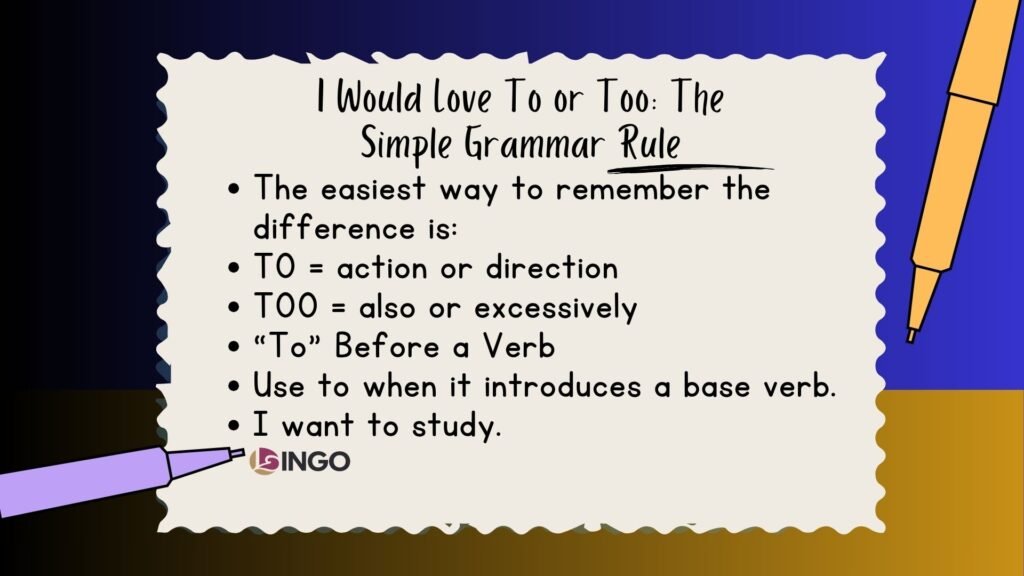
The easiest way to remember the difference is:
TO = action or direction
TOO = also or excessively
“To” Before a Verb
Use to when it introduces a base verb.
I want to study.
She hopes to travel.
We decided to stay.
I would love to participate.
In “I would love to,” the action is understood from the context.
“Too” Meaning “Also”
Use too when you want to add the meaning “also.”
I would love to go too.
This means:
I would also love to go.
Other examples:
Sarah wants to attend too.
I would like to meet him too.
We would love to participate too.
“Too” Meaning “Excessively”
Use too when something exceeds a desirable or acceptable level.
The coffee is too hot.
The box is too heavy.
The instructions are too complicated.
The deadline is too soon.
So, the meaning of the sentence tells you which spelling you need.
When Should You Use “I Would Love To”?
The phrase “I would love to” is useful when accepting invitations, showing enthusiasm, expressing willingness, or responding positively to an offer.
Accepting an Invitation
“Would you like to join us for dinner?”
“I would love to!”
The response sounds warm and enthusiastic.
Responding to an Offer
“Would you like me to help you?”
“I would love to.”
The omitted action is help you.
Showing Interest
“Would you like to attend the conference?”
“I would love to.”
This communicates genuine interest.
Using “Would Love To” With a Full Verb
When the action is stated, use:
would love + to + base verb
Examples:
I would love to visit London.
I would love to learn Spanish.
I would love to discuss the project.
I would love to attend the event.
I would love to help with the project.
Avoid changing the verb after to into a past-tense or -ing form.
- ❌ I would love to visited.
- ❌ I would love to visiting.
- ✅ I would love to visit.
When Is “Too” Correct?
The word too is completely correct when it means “also” or “excessively.”
“Too” Meaning “Also”
Consider:
I would love to come too.
The first to introduces the verb come. The second too means also.
You could rewrite the sentence as:
I would also love to come.
Both versions communicate essentially the same idea.
“Too” Meaning “Excessively”
Consider:
I would love to go, but the trip is too expensive.
Here, too means that the price is higher than desirable or acceptable.
Other examples include:
The room is too small.
The journey is too long.
The deadline is too soon.
The instructions are too difficult.
Can “To” and “Too” Appear Together?
Yes.
For example:
I would love to come too.
This is grammatically correct because each word has a different function.
| Word | Function | Example |
|---|---|---|
| to | Introduces an infinitive | I want to go. |
| to | Shows direction | She went to school. |
| too | Means also | I want to go too. |
| too | Means excessively | It is too difficult. |
A Quick “To vs. Too” Checklist
When you’re unsure which word to use, follow these three steps.
Step 1: Is It Followed by an Action?
If the word introduces a base-form verb, use to.
I would love to help.
I want to learn.
She decided to stay.
Step 2: Does It Mean “Also”?
If you can replace the word with also, use too.
I would love to help too.
Equivalent:
I would also love to help.
Step 3: Does It Mean “Excessively”?
If something is beyond a desirable level, use too.
The task is too difficult.
The Three-Second Memory Test
Remember:
To → action
Too → also
Too → excessive
This simple test can help you make the correct choice in everyday writing.
Real-Life Case Study: A Small Mistake in a Professional Email
Imagine that Daniel receives an email from his manager:
“Would you like to attend the client meeting on Friday?”
Daniel wants to accept the invitation. He quickly types:
“I would love too!”
Although the intended meaning is clear, too is not correct in this position. Daniel is not saying that he would also love something, nor is he describing the meeting as excessive. He is referring to the action attend the client meeting, which is already understood from his manager’s question.
The better response is:
“I would love to!”
The implied meaning is:
“I would love to attend the client meeting.”
Later, Daniel adds:
“I would love to attend the meeting with you too.”
Now both words are correctly used. The first to belongs to the infinitive to attend, while the second too means also.
This example demonstrates why pronunciation alone cannot determine spelling. In spoken English, to and too may sound alike, but written English requires you to understand their grammatical roles.
The same mistake can happen in text messages, school assignments, job applications, business emails, and social-media posts. The solution is simple: identify what you mean before choosing the spelling. If you are introducing an action, use to. If you mean also, use too. If you mean that something is excessive, use too.
Common Mistakes With “To” and “Too”
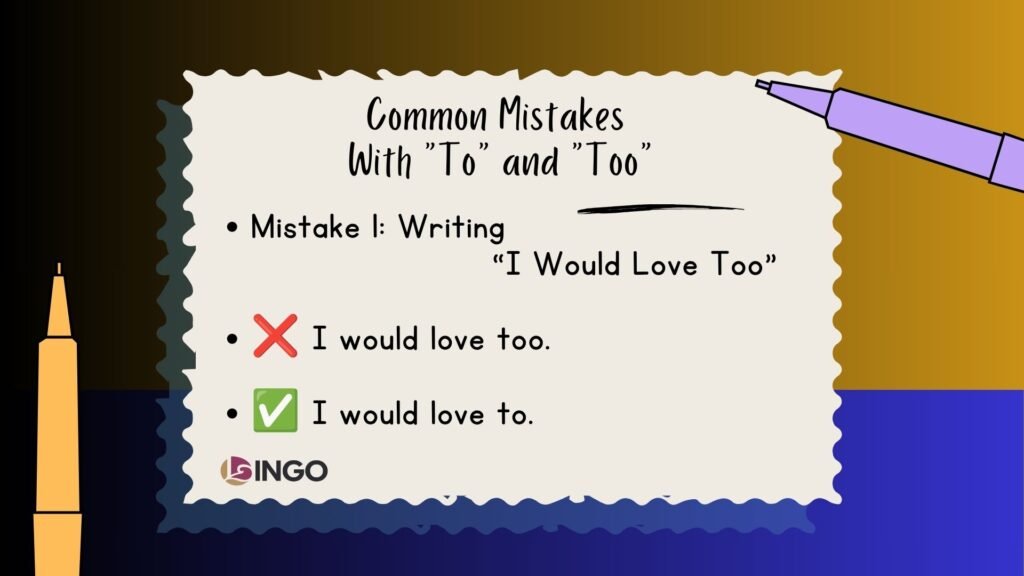
Mistake 1: Writing “I Would Love Too”
❌ I would love too.
✅ I would love to.
The correct word is to because an understood action follows it.
Mistake 2: Writing “Too” Before a Verb
❌ I would love too meet you.
✅ I would love to meet you.
Remember:
to + base verb
Mistake 3: Forgetting the Meaning of “Too”
If too means also, it can appear at the end of a sentence:
I would love to come too.
This means:
I would also love to come.
Mistake 4: Confusing “Too” With “Very”
Compare:
The movie is very long.
This simply emphasizes the adjective.
The movie is too long.
This suggests that the movie is longer than desirable or acceptable in context.
Therefore, very and too can change the meaning of a sentence.
2025–2026 Data: Why Clear Writing Still Matters
Grammar questions exist within a much larger digital communication environment. DataReportal reported that 6.04 billion people were using the internet worldwide at the start of October 2025, representing 73.2% of the world’s population. The report also noted that internet users had increased by 294 million over the previous 12 months.
Blogging and online publishing also remain significant. HubSpot’s 2025 State of Blogging research found that 65% of marketers worked at companies that maintain blogs, while 93% of those marketers rated blogging as important or very important to their marketing strategy. HubSpot also reported that 56% expected blogging’s role in their content strategy to expand.
These figures do not specifically measure searches for “I would love to or too,” but they provide useful context: people continue to communicate and publish extensively online, making clarity and correctness valuable skills.
Google’s current guidance emphasizes creating helpful, reliable, people-first content and recommends demonstrating expertise, providing original value, and avoiding content created primarily to manipulate search rankings.
For a grammar resource, that means giving readers a direct answer, explaining the rule accurately, providing useful examples, and helping them apply the rule independently.
Mini Quiz:I Would Love To or Too
1. Choose the correct sentence:
A. I would love too.
B. I would love to.
C. I would love two.
D. I would love tow.
Answer: B. I would love to.
2. Complete the sentence:
“I would love ___ join you.”
A. to
B. too
C. two
D. tow
Answer: A. to
3. Which sentence is correct?
A. I would love too meet you.
B. I would love to meet you.
C. I would love two meet you.
D. I would love tow meet you.
Answer: B. I would love to meet you.
4. What does “too” mean in “I would love to come too”?
A. Very
B. Also
C. Toward
D. Two
Answer: B. Also
5. Choose the correct response:
“Would you like to attend the event?”
A. I would love too!
B. I would love to!
C. I would love two!
D. I would love tow!
Answer: B. I would love to!
6. Complete the sentence:
“She wants ___ learn English.”
A. too
B. two
C. to
D. tow
Answer: C. to
7. Which sentence correctly uses “too” to mean “also”?
A. I want too go.
B. I want to go too.
C. I too go to.
D. I want two go.
Answer: B. I want to go too.
8. Complete the sentence:
“I would love ___ help you.”
A. too
B. to
C. two
D. tow
Answer: B. to
9. Which sentence is correct?
A. The coffee is to hot.
B. The coffee is too hot.
C. The coffee is two hot.
D. The coffee is tow hot.
Answer: B. The coffee is too hot.
10. In “The bag is too heavy,” what does “too” mean?
A. Also
B. Excessively
C. Toward
D. Number two
Answer: B. Excessively
11. Choose the correct sentence:
A. I would love to visit Paris.
B. I would love too visit Paris.
C. I would love two visit Paris.
D. I would love tow visit Paris.
Answer: A. I would love to visit Paris.
12. Which sentence is grammatically correct?
A. I would love to come too.
B. I would love too come to.
C. I would love two come too.
D. I would love tow come too.
Answer: A. I would love to come too.
13. Complete the sentence:
“We would love ___ attend the meeting.”
A. too
B. two
C. to
D. tow
Answer: C. to
14. Choose the correct sentence:
A. The movie is to long.
B. The movie is too long.
C. The movie is two long.
D. The movie is tow long.
Answer: B. The movie is too long.
15. What is the meaning of “I would love to”?
A. I strongly dislike it.
B. I would be happy or pleased to do it.
C. I cannot do it.
D. I have already done it.
Answer: B. I would be happy or pleased to do it.
16. Complete the sentence:
“Would you like to help us?”
“I would love ___.”
A. too
B. two
C. to
D. tow
Answer: C. to
17. Which sentence uses “too” correctly?
A. I would love too attend.
B. I would love to attend too.
C. I would love two attend.
D. I would love tow attend.
Answer: B. I would love to attend too.
18. Complete the sentence:
“The instructions are ___ difficult.”
A. to
B. too
C. two
D. tow
Answer: B. too
19. Which word means “also”?
A. To
B. Too
C. Two
D. Tow
Answer: B. Too
20. Which word is normally used before a base verb?
A. Too
B. Two
C. To
D. Tow
Answer: C. To
21. True or False:
“I would love too” is the standard correct response to “Would you like to come?”
Answer: False
22. True or False:
“I would love to come too” is grammatically correct.
Answer: True
23. Choose the correct sentence:
A. I would love too learn more.
B. I would love to learn more.
C. I would love two learn more.
D. I would love tow learn more.
Answer: B. I would love to learn more.
24. Which sentence uses “too” to mean “also”?
A. This box is too heavy.
B. I would love to join too.
C. The room is too small.
D. The test is too difficult.
Answer: B. I would love to join too.
25. Complete the sentence:
“Would you like to travel with us?”
“I would love ___!”
A. too
B. two
C. to
D. tow
Answer: C. to
FAQs About “I Would Love To or Too”
Is “I would love to” grammatically correct?
Yes. “I would love to” is grammatically correct and commonly used to express enthusiasm or willingness to perform an action.
Is it “I would love to” or “I would love too”?
The correct standalone expression is “I would love to.” Use too when it means also or excessively.
Can I say “I would love to come too”?
Yes. “I would love to come too” is completely correct.
The first to introduces come, while too means also.
What does “I would love to” mean?
It generally means “I would really like to” or “I would be happy to.”
For example:
“Would you like to join us?”
“I would love to.”
Is “I would love too” ever correct?
Not as the normal standalone response to an invitation. If you are referring to an understood action, use to.
How can I remember the difference between “to” and “too”?
Use this simple rule:
To = action or direction
Too = also or excessively
For example:
I want to go too.
Is “I would love to” suitable for professional English?
Yes. It is polite, natural, and appropriate in many professional emails, workplace conversations, invitations, and everyday interactions.
Why are “to” and “too” easy to confuse?
They are commonly pronounced alike, which makes them homophones. However, their meanings and grammatical functions are different.
Conclusion: “I Would Love To” Is Correct
If you’re wondering “I would love to or too,” the correct standalone phrase is “I would love to.”
Use to when it introduces an action:
I would love to help.
Use too when it means also:
I would love to help too.
Use too when something is excessive:
The task is too difficult.
The easiest rule to remember is:
TO = action or direction
TOO = also or excessively
Once you understand that distinction, choosing between to and too becomes much easier.
For more clear explanations of commonly confused English words and grammar rules, explore the other language guides on Lingorixa.
References

Maimoona Asghar is a grammar enthusiast and language writer who creates clear, practical content to help learners improve English grammar, writing, punctuation, and communication skills through easy-to-understand explanations and examples.