
Introduction
Have you ever paused while writing and wondered whether the correct spelling is suing or sueing? You are not alone. Many English writers find it confusing when adding the suffix –ing to verbs that end in the letter e.
The correct spelling is suing, not sueing. The word comes from the verb sue, which means to take legal action against someone or an organization. When adding -ing, the silent final e is dropped.
In this guide, you will learn the difference between suing and sueing, understand the spelling rule, explore practical sentence examples, and discover how to avoid this common spelling mistake.
Suing or Sueing: Which Spelling Is Correct?
Suing is the correct spelling, while sueing is incorrect. When the suffix -ing is added to the verb sue, the final silent e is removed.
| Word | Correct or Incorrect | Explanation |
|---|---|---|
| Suing | Correct | Standard spelling of the present participle of sue |
| Sueing | Incorrect | Retains an unnecessary final e |
Examples:
- Correct: The customer is suing the company for damages.
- Incorrect: The customer is sueing the company for damages.
Therefore, whenever you need this word in your writing, choose suing.
Why Is Suing the Correct Spelling?
The spelling follows a common English grammar rule. When a verb ends in a silent e, the final e is generally removed before adding -ing.
For example:
- Make → Making
- Bake → Baking
- Write → Writing
- Hope → Hoping
- Sue → Suing
The same principle explains why suing is correct.
Is Sueing Ever Acceptable?
No. In standard modern English, sueing is considered a misspelling of suing.
Whether you are writing an academic assignment, professional email, legal article, or everyday message, use suing.
What Does Suing Mean?
The word suing is the present participle and gerund form of the verb sue. It describes taking legal action against a person, business, or organization.
For example:
- She is suing her employer for unfair dismissal.
- The company is suing its former business partner.
- They are suing the manufacturer over the defective product.
Suing as a Present Participle
A present participle is a verb form ending in -ing. It can be used with helping verbs to describe an ongoing action.
Examples:
- The family is suing the hospital.
- Several customers are suing the company.
- He has been suing the organization for compensation.
In these sentences, suing describes an action that is happening or continuing.
Suing as a Gerund
A gerund is a verb ending in -ing that functions as a noun.
Examples:
- Suing can be expensive.
- Suing is sometimes the last option.
- She considered suing after the incident.
In these examples, suing acts as the subject or object of the sentence.
Understanding the Spelling Rule: Sue vs. Suing
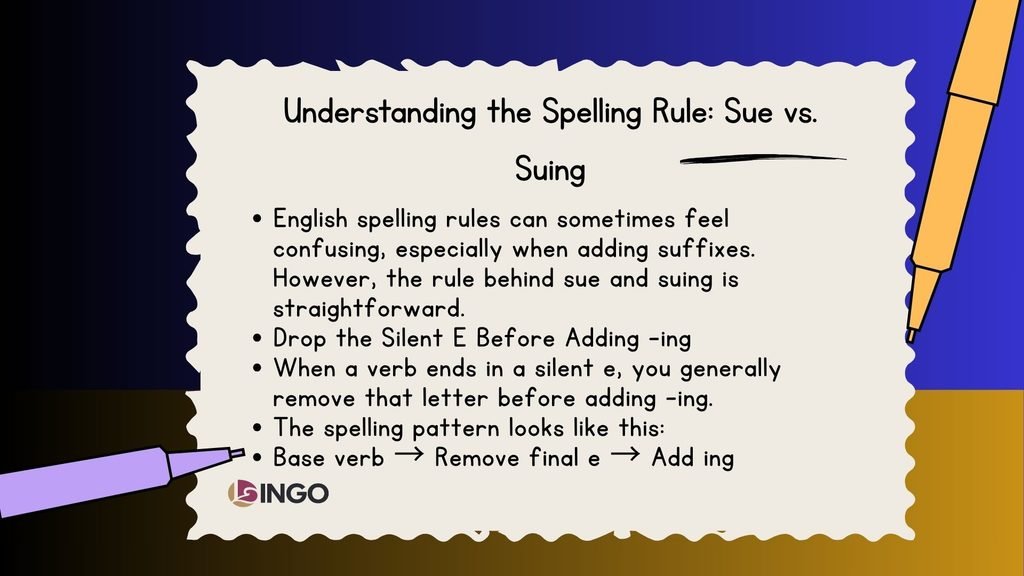
English spelling rules can sometimes feel confusing, especially when adding suffixes. However, the rule behind sue and suing is straightforward.
Drop the Silent E Before Adding -ing
When a verb ends in a silent e, you generally remove that letter before adding -ing.
The spelling pattern looks like this:
Base verb → Remove final e → Add ing
Examples:
| Base Verb | Correct -ing Form |
|---|---|
| Sue | Suing |
| Dance | Dancing |
| Write | Writing |
| Smile | Smiling |
| Drive | Driving |
| Hope | Hoping |
| Close | Closing |
| Bake | Baking |
This spelling rule helps maintain correct English grammar and prevents unnecessary letters.
Are There Exceptions to This Rule?
Yes. Some English verbs retain their final e when adding -ing, particularly verbs ending in -ee, -ye, or -oe.
Examples include:
- See → Seeing
- Agree → Agreeing
- Dye → Dyeing
- Hoe → Hoeing
These exceptions explain why you should not assume that every verb ending in e follows exactly the same pattern.
However, sue follows the standard rule:
Sue → Suing, not Sueing.
Suing in Everyday English: Examples and Common Mistakes
Understanding a spelling rule is easier when you see how a word works in real sentences. The word suing commonly appears in conversations, news reports, business writing, and legal discussions.
10 Correct Examples of Suing in Sentences
Here are ten examples showing how to use the word correctly:
- The customer is suing the company for selling a defective product.
- She considered suing her employer after being unfairly dismissed.
- The family is suing the hospital for medical negligence.
- Several investors are suing the financial institution.
- He threatened to sue the newspaper for publishing false information.
- The organization is suing the contractor over the broken agreement.
- Suing someone can involve significant legal expenses.
- They are suing the manufacturer for damages.
- The business owner discussed suing the supplier.
- The passengers are suing the airline after the incident.
Common Mistakes to Avoid
Writers sometimes make spelling mistakes because they apply familiar patterns incorrectly.
| Incorrect Sentence | Correct Sentence |
|---|---|
| She is sueing the company. | She is suing the company. |
| They are sueing their employer. | They are suing their employer. |
| He considered sueing the newspaper. | He considered suing the newspaper. |
| The family is sueing the hospital. | The family is suing the hospital. |
Remember that the correct form is always suing in standard English.
Real-Life Writing Example: Choosing the Correct Spelling
Imagine a student named Daniel who is preparing an English assignment about consumer rights. He wants to explain what happens when a customer takes legal action against a company.
While writing his introduction, he types:
“The customer is sueing the manufacturer because the product caused serious damage.”
At first glance, the sentence looks understandable. However, Daniel notices that the spelling does not look quite right.
He checks an English dictionary and discovers that the correct present participle of sue is suing. He then corrects his sentence:
“The customer is suing the manufacturer because the product caused serious damage.”
Later, Daniel uses the word several more times in his assignment:
- The customer is suing the manufacturer for compensation.
- Suing a company may require legal evidence.
- The family considered suing after receiving professional legal advice.
This example demonstrates why understanding spelling rules matters. Even when readers understand an incorrectly spelled word, spelling mistakes can affect the clarity and professionalism of written communication.
By learning the silent-e rule, Daniel can also avoid similar mistakes with words such as writing, making, and dancing.
The important lesson is simple: do not add -ing without checking whether the original verb requires a spelling change.
Suing vs. Sueing: Quick Comparison and Spelling Statistics
The difference between these two spellings is easy to remember once you understand the rule.
Suing vs. Sueing Comparison Table
| Feature | Suing | Sueing |
|---|---|---|
| Spelling status | Correct | Incorrect |
| Base word | Sue | Sue |
| Word formation | Sue + ing, with e removed | Sue + ing, incorrectly retaining e |
| Grammatical use | Gerund and present participle | Nonstandard misspelling |
| Dictionary recognition | Recognized | Not the standard form |
| Recommended usage | Yes | No |
What Do 2025–2026 References Tell Us?

There is no reliable, widely published 2025–2026 statistic specifically measuring how often people misspell suing as sueing. Therefore, assigning a percentage or claiming a particular number of writers make this mistake would be misleading.
However, established dictionary references provide clear evidence of the accepted spelling:
- Merriam-Webster lists the verb forms as sued and suing.
- Cambridge Dictionary identifies suing as the present participle of sue.
- Cambridge also provides examples of the word in legal and everyday contexts.
These references confirm that suing is the accepted spelling in modern English.
For spelling questions, checking an established dictionary is more reliable than relying on how a word looks or sounds.
Mini Quiz:Suing or Sueing
1. Which spelling is correct?
A. Sueing
B. Suing
C. Suying
D. Sewing
Answer: B. Suing
2. What is the base verb of suing?
A. Sued
B. Suit
C. Sue
D. Suing
Answer: C. Sue
3. What does the verb sue mean?
A. To take legal action
B. To make an agreement
C. To offer assistance
D. To cancel a contract
Answer: A. To take legal action
4. Which sentence uses suing correctly?
A. She is sueing the company.
B. She is suying the company.
C. She is suing the company.
D. She is sued the company.
Answer: C. She is suing the company.
5. True or False: The final e in sue is removed before adding -ing.
Answer: True
6. What is the past-tense form of sue?
A. Suing
B. Sued
C. Sueing
D. Sues
Answer: B. Sued
7. Complete the sentence: They are _____ their former employer.
A. Sueing
B. Sued
C. Sues
D. Suing
Answer: D. Suing
8. Which spelling rule applies to sue when adding -ing?
A. Double the final consonant
B. Change u to y
C. Drop the final silent e
D. Add -ed instead
Answer: C. Drop the final silent e
9. Which are correctly spelled -ing forms? (Select all correct answers.)
A. Making
B. Writing
C. Hopeing
D. Dancing
Answers: A, B, D
10. In the sentence “Suing can be expensive,” how does suing function?
A. Adjective
B. Gerund
C. Adverb
D. Conjunction
Answer: B. Gerund
11. True or False: Sueing is the accepted present participle spelling of sue.
Answer: False
12. Which sentence uses suing as a gerund?
A. She is suing the manufacturer.
B. They are suing the airline.
C. Suing requires careful consideration.
D. He was suing the business.
Answer: C. Suing requires careful consideration.
13. Complete the sentence: The family considered _____ the hospital.
A. Sueing
B. Suing
C. Sued
D. Sues
Answer: B. Suing
14. What is the third-person singular present form of sue?
A. Sue
B. Sued
C. Suing
D. Sues
Answer: D. Sues
15. Which sentence is grammatically correct?
A. He has been suing the company.
B. He has been sueing the company.
C. He have been suing the company.
D. He has been sued the company.
Answer: A. He has been suing the company.
16. Which word is an exception to the usual rule of dropping final e before -ing?
A. Baking
B. Writing
C. Seeing
D. Hoping
Answer: C. Seeing
17. Which spelling is correct in both British and American English?
A. Sueing
B. Suing
C. Suying
D. Sewing
Answer: B. Suing
18. Which sentence correctly describes an ongoing legal action?
A. The company is sueing its supplier.
B. The company suing its supplier.
C. The company are suing its supplier.
D. The company is suing its supplier.
Answer: D. The company is suing its supplier.
19. Complete the sentence: She threatened to _____ the newspaper.
A. Suing
B. Sued
C. Sue
D. Sueing
Answer: C. Sue
20. Which sentences use suing correctly? (Select all correct answers.)
A. They are suing the manufacturer.
B. Suing can take time and money.
C. She is sueing her employer.
D. He considered suing the business.
Answers: A, B, D
21. What is the correct -ing form of the verb “bake”?
A. Bakeing
B. Baking
C. Bakk ing
D. Bakesing
Answer: B. Baking
22. Which sentence uses the past tense of sue correctly?
A. She suing the company yesterday.
B. She sue the company yesterday.
C. She sued the company yesterday.
D. She sueing the company yesterday.
Answer: C. She sued the company yesterday.
23. What grammatical form is “suing” in the sentence “The family is suing the hospital”?
A. Present participle
B. Past participle
C. Simple past
D. Infinitive
Answer: A. Present participle
24. Which word correctly completes the sentence: “He is thinking about _____ the company”?
A. Sue
B. Sued
C. Sueing
D. Suing
Answer: D. Suing
25. What is the easiest way to remember the correct spelling of suing?
A. Keep the final e and add ing.
B. Remove the final silent e before adding ing.
C. Double the letter u.
D. Replace e with y.
Answer: B. Remove the final silent e before adding ing.
Quiz complete!
Remember: Sue → Suing → Sued. The correct spelling is always suing, not sueing.
Frequently Asked Questions About Suing or Sueing
1. Is it suing or sueing?
Suing is correct. Sueing is an incorrect spelling because the final silent e is removed before adding -ing.
2. What does suing mean?
Suing means taking legal action against a person, business, or organization. It often involves seeking compensation or another legal remedy.
3. Why is sueing incorrect?
Sueing is incorrect because it does not follow the standard spelling rule for verbs ending in a silent e. The final e must be removed before adding -ing.
4. What is the past tense of sue?
The past tense of sue is sued.
Example: The customer sued the company last year.
5. What is the present participle of sue?
The present participle of sue is suing.
Example: The family is suing the hospital.
6. Is suing a verb or a noun?
Suing is a verb form that can function as a present participle or a gerund. When used as a gerund, it functions as a noun.
Example: Suing can be expensive.
7. Is suing used in British and American English?
Yes. Suing is the standard spelling in both British and American English. There is no regional spelling difference between the two varieties.
8. How can I remember the correct spelling of suing?
Remember this simple rule: drop the silent e before adding -ing.
Sue → Suing.
This pattern also works with words such as bake → baking and write → writing.
Conclusion: Suing or Sueing – Remember the Correct Spelling
When choosing between suing or sueing, the correct answer is suing.
The word comes from the verb sue, meaning to take legal action against someone. When adding the suffix –ing, you remove the final silent e to create the correct form.
Remember these simple points:
- Suing: Correct spelling.
- Sueing: Incorrect spelling.
- Sue: Base verb.
- Sued: Past tense.
- Suing: Present participle and gerund.
Understanding this spelling rule will help you write more accurately and confidently.
For more clear explanations of commonly confused English words and grammar rules, explore the other language guides on Lingorixa.
References

Maimoona Asghar is a grammar enthusiast and language writer who creates clear, practical content to help learners improve English grammar, writing, punctuation, and communication skills through easy-to-understand explanations and examples.

