Have you ever written oversite when you meant oversight? These two words look almost identical, so it is easy to confuse them. However, understanding oversight vs oversite becomes much simpler when you know what each term means and where it belongs.
Oversight is a common English word that refers to supervision or an unintentional mistake. Oversite, on the other hand, is a specialized construction term used in certain building contexts, particularly in British construction terminology.
In everyday writing, business communication, and academic work, oversight is usually the word you need. In this guide, you will learn their definitions, examine practical examples, and discover how to choose the correct word confidently.
What Is the Difference Between Oversight and Oversite?
The main difference between oversight and oversite is their meaning and context. Although they differ by only one letter, they are not interchangeable.
What Does Oversight Mean?
Oversight is a noun with two main meanings:
- Supervision or monitoring: The responsibility for watching, managing, or ensuring that an activity is performed correctly.
- An unintentional mistake: Something that has been forgotten, missed, or overlooked.
For example:
- The manager provided oversight during the entire project.
- Leaving her name off the invitation was an unfortunate oversight.
- The government introduced stricter oversight of the new regulations.
In the first and third examples, oversight means supervision or monitoring. In the second, it describes an accidental omission.
According to the Cambridge Dictionary, both meanings are established uses of the word.
What Does Oversite Mean?
Oversite is a less common technical term associated with construction. In certain British building contexts, it refers to a layer of concrete or similar material placed over prepared ground, commonly beneath a ground-floor structure.
For example:
- The builders completed the oversite concrete before continuing with the floor construction.
- The construction specification described the required oversite layer.
This usage belongs to specialized building terminology rather than ordinary conversation.
Therefore, if you are talking about a forgotten task, a management responsibility, or an accidental error, oversight is the appropriate choice.
Oversight vs Oversite: Meaning, Examples, and Usage
Understanding each word in context is the easiest way to avoid confusion. Consider how the intended meaning changes the spelling.
Examples of Oversight in Everyday English
Here are several examples showing the correct use of oversight:
- Workplace: The supervisor provides oversight to ensure employees follow company procedures.
- Education: The school introduced additional oversight of its examination process.
- Writing: Forgetting to include the final paragraph was an oversight.
- Finance: The accounting team corrected an oversight in the monthly report.
- Project management: Effective oversight helped the team complete the project on schedule.
Notice that oversight refers either to supervision or to something unintentionally missed.
Examples of Oversite in Construction
The word oversite has a much narrower application.
- Building work: The contractor prepared the oversite before installing the floor.
- Construction planning: The engineer specified the materials required for the oversite layer.
- Technical documentation: The building report described the condition of the oversite concrete.
These examples illustrate a specialized construction use. The exact terminology and specifications may vary by region and building practice, so technical documents should follow the relevant professional standards.
Quick Comparison Table
| Feature | Oversight | Oversite |
|---|---|---|
| Word type | Noun | Noun |
| Main meaning | Supervision or an accidental mistake | A specialized construction-related term |
| Common context | Work, education, government, everyday English | Certain building and construction contexts |
| General writing | Standard and widely used | Usually inappropriate unless the technical meaning is intended |
| Example | The error was an oversight. | The contractor prepared the oversite. |
Quick rule: Use oversight for supervision or a mistake. Use oversite only when you specifically mean the construction-related term.
How to Use Oversight and Oversite Correctly
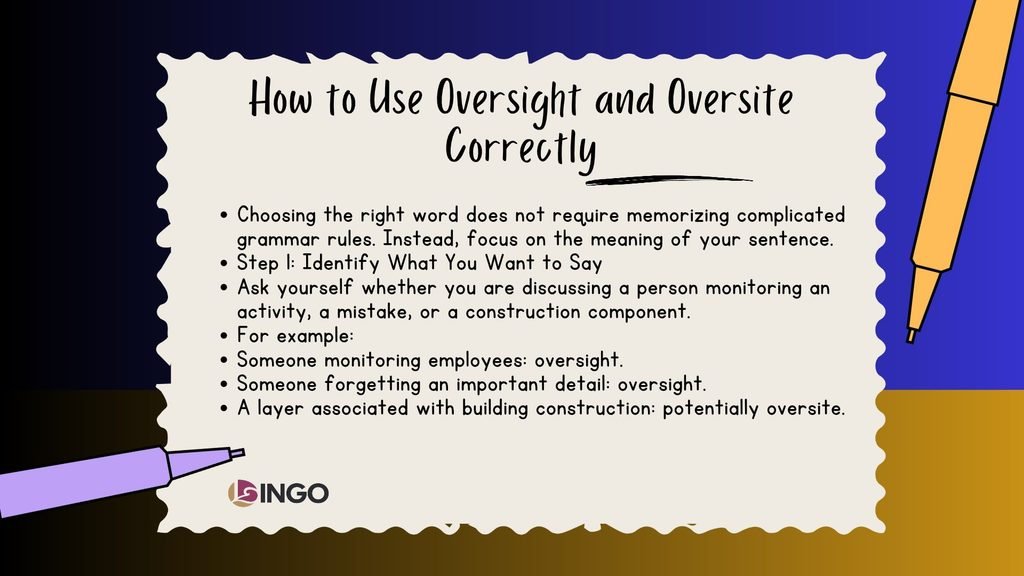
Choosing the right word does not require memorizing complicated grammar rules. Instead, focus on the meaning of your sentence.
Step 1: Identify What You Want to Say
Ask yourself whether you are discussing a person monitoring an activity, a mistake, or a construction component.
For example:
- Someone monitoring employees: oversight.
- Someone forgetting an important detail: oversight.
- A layer associated with building construction: potentially oversite.
Step 2: Check the Sentence Context
Consider these sentences:
Incorrect for the intended meaning: The missing signature was an oversite.
Correct: The missing signature was an oversight.
The sentence describes a detail that someone failed to notice. Therefore, oversight is the correct spelling.
Now consider another example:
Construction context: The contractor installed the oversite concrete according to the building specifications.
Here, oversite may be appropriate because the sentence concerns a specialized construction term.
Step 3: Proofread Before Publishing
When editing an article, email, assignment, or professional report, check whether the spelling matches the intended meaning.
A useful proofreading checklist is:
- Am I describing supervision or monitoring?
- Am I describing an accidental omission?
- Am I discussing a construction-specific term?
- Does the word fit the sentence naturally?
- Have I checked the spelling before submitting or publishing?
If the sentence concerns ordinary English rather than building terminology, oversight is generally the safe choice.
A Real-Life Example: Choosing the Correct Word at Work
Imagine that Sarah is a project coordinator at a marketing company. She is responsible for monitoring deadlines, reviewing reports, and making sure the team completes its assignments correctly.
One afternoon, Sarah sends a report to her manager. While reviewing it, the manager notices that the final section is missing. Sarah checks her files and discovers that she accidentally forgot to attach the updated page.
In her follow-up email, Sarah writes, “I apologize for the oversight. I have attached the complete report.”
Her use of oversight is correct because she is describing an unintentional mistake. She did not deliberately leave out the page; she simply failed to notice that it was missing.
Later that week, Sarah visits a construction site where her company is helping plan a new office. A contractor discusses the preparation of the ground-floor area and refers to the oversite concrete in the building specifications.
In this second situation, the construction-related term may be appropriate because the discussion concerns a physical component of the building rather than a forgotten task.
Sarah now understands why the two words cannot be substituted for each other. Although their spellings are similar, their meanings depend on context.
This example also demonstrates a practical lesson: the correct spelling is determined by what you mean, not merely by how a word sounds. Paying attention to context helps prevent misunderstandings in workplace emails, technical documents, and everyday communication.
What Do Current Language and SEO Resources Tell Us?
Reliable references are useful when distinguishing a common English word from a specialized technical term. However, it is important to separate verified language information from unsupported statistics.
What Dictionary Evidence Shows
The Cambridge Dictionary documents oversight as both an accidental mistake and a form of supervision or responsibility. These definitions establish that the word is appropriate in a wide range of everyday and professional contexts.
What Google Recommends for Helpful Content
Google’s Search Central guidance, available in 2026, emphasizes helpful, reliable, people-first content, accurate information, and clear explanations that satisfy readers’ needs.
For an article about confusing words, that means providing accurate definitions, practical examples, and trustworthy references rather than repeating the same keyword unnecessarily.
What the 2025–2026 Data Can and Cannot Establish
As of October 2026, the authoritative references cited here establish the meaning and usage of oversight, but they do not provide a verified 2025–2026 numerical comparison of how frequently people search for oversight versus oversite.
Consequently, it would be misleading to invent search-volume percentages, error rates, or popularity figures.
The practical conclusion is based on documented usage: oversight is an established word for supervision and accidental mistakes, while oversite has a specialized construction-related application. Writers should select the term that accurately communicates their intended meaning.
For SEO content, Google also recommends creating useful, reliable material for readers rather than producing content primarily to manipulate rankings. Accurate definitions and clear examples serve that purpose better than unsupported statistics.
Mini Quiz:Oversight vs Oversite
1. Which word means an unintentional mistake or omission?
A. Oversight B. Oversite C. Overseeing D. Oversighted
Answer: A. Oversight
2. Choose the correct word: “Leaving the attachment out of the email was an ____.”
A. Oversite B. Oversight C. Overseeing D. Overlook
Answer: B. Oversight
3. What does “management oversight” usually mean?
A. An accidental typo B. A concrete floor layer C. Supervision and monitoring D. A building measurement
Answer: C. Supervision and monitoring
4. Which spelling is correct when referring to a forgotten detail?
A. Oversite B. Oversighte C. Oversigt D. Oversight
Answer: D. Oversight
5. Which sentence uses “oversight” correctly?
A. The missed deadline was an oversight. B. The builder poured the oversight concrete. C. She oversight the team yesterday. D. We bought two oversight for the foundation.
Answer: A. The missed deadline was an oversight.
6. In certain British construction contexts, what can “oversite” refer to?
A. A forgotten appointment B. A prepared ground layer beneath a floor C. A supervisor’s report D. A spelling correction
Answer: B. A prepared ground layer beneath a floor
7. True or False: “Oversight” can refer to both supervision and an accidental omission.
Answer: True
8. Choose the correct word: “The director provides ____ of the department’s activities.”
A. Oversite B. Overlook C. Oversight D. Oversighted
Answer: C. Oversight
9. Choose the best word: “The contractor prepared the ____ before proceeding with the floor.”
A. Oversight B. Oversite C. Overseeing D. Overlook
Answer: B. Oversite
10. True or False: “Oversite” is the standard spelling for an accidental mistake in everyday English.
Answer: False
11. Which sentence describes supervision rather than a mistake?
A. Forgetting the date was an oversight. B. The missing signature was an oversight. C. The team corrected an oversight in the report. D. The committee provides oversight of the project.
Answer: D. The committee provides oversight of the project.
12. Complete the sentence: “I forgot to include the final page. It was an ____.”
A. Oversight B. Oversite C. Overseeing D. Overlooked
Answer: A. Oversight
13. Which situations can correctly use “oversight”?
A. A manager monitoring employee performance B. A forgotten name on an invitation C. A committee supervising a public program D. The technical name of every concrete floor
Answer: A, B, and C
14. Why are “oversight” and “oversite” not interchangeable?
A. They always have identical meanings. B. They have different meanings and contexts. C. One is always a verb. D. One is only used in American English.
Answer: B. They have different meanings and contexts.
15. Choose the correct spelling: “The accounting team corrected an ____ in the monthly report.”
A. Oversite B. Oversight C. Overseeing D. Oversighted
Answer: B. Oversight
16. Which action best illustrates oversight in the sense of supervision?
A. Forgetting a meeting B. Leaving a name off a list C. Reviewing a team’s work for compliance D. Misspelling a word
Answer: C. Reviewing a team’s work for compliance
17. Which sentence is best for a professional apology about a missed detail?
A. I apologize for the oversite in my report. B. I apologize for the oversight in my report. C. I apologize for the oversee in my report. D. I apologize for the overseeing in my report.
Answer: B. I apologize for the oversight in my report.
18. Which field is most likely to use the specialized term “oversite”?
A. Construction B. Poetry criticism C. Email etiquette D. School attendance records
Answer: A. Construction
19. Which sentence uses the wrong word for its intended meaning?
A. The board provides oversight of the program. B. Forgetting the receipt was an oversight. C. The missed appointment was an oversite. D. The manager reviewed the process under independent oversight.
Answer: C. The missed appointment was an oversite.
20. Which sentences use “oversight” correctly?
A. The error was an oversight. B. The agency strengthened its oversight of the program. C. She will oversight the team tomorrow. D. The contractor ordered three oversight for the floor.
Answer: A and B
21. Which verb means “supervise” and is related in meaning to “oversight”?
A. Oversite B. Overlook C. Oversee D. Oversight
Answer: C. Oversee
22. A proofreader notices that a paragraph was accidentally omitted. What is the best description of the error?
A. An oversite B. An oversight C. An oversee D. An overseeing
Answer: B. An oversight
23. Which is the safest word choice in an ordinary business email about a forgotten task?
A. Oversite B. Oversighting C. Oversight D. Oversighted
Answer: C. Oversight
24. What should you check before choosing between “oversight” and “oversite”?
A. The intended meaning and context B. The number of syllables only C. Whether the sentence is long D. Whether the word appears at the start
Answer: A. The intended meaning and context
25. Complete the sentence: “The committee’s independent ____ helped ensure that the project followed the rules.”
A. Oversite B. Oversight C. Overlook D. Overseeing
Answer: B. Oversight
Quick Revision
- Oversight: Supervision or an accidental mistake.
- Oversite: A specialized construction-related term used in certain building contexts.
- Oversee: A verb meaning to supervise or manage.
Remember: For everyday writing, use oversight when referring to a mistake or supervision.
Frequently Asked Questions About Oversight vs Oversite
1. Is Oversite a Real Word?
Yes. Oversite is used as a specialized construction term in certain building contexts. However, it is not the standard word for an accidental mistake or supervision. In ordinary writing, oversight is usually correct.
2. Is Oversight the Correct Spelling?
Yes. Oversight is the correct spelling when referring to supervision, monitoring, or an unintentional mistake.
Example: “Leaving the attachment out of the email was an oversight.”
3. What Is the Difference Between Oversight and Oversite?
Oversight refers to supervision or an accidental omission. Oversite is a less common, specialized term associated with certain construction practices.
The correct choice depends on the meaning of your sentence.
4. Can Oversight Mean a Mistake?
Yes. An oversight can be an unintentional error caused by failing to notice, remember, or include something.
Example: “It was an oversight that I forgot to include your name on the list.”
5. How Do You Use Oversight in a Sentence?
Use oversight when describing supervision or an accidental mistake.
Examples:
- The director provides oversight of the department.
- Forgetting to send the document was an oversight.
- The investigation required independent oversight.
6. Is Oversite an Alternative Spelling of Oversight?
No. They are not interchangeable spelling variants. Although the words look similar, oversight is the standard term for supervision or an accidental mistake, while oversite has a specialized construction-related meaning.
7. How Can I Remember the Difference Between Oversight and Oversite?
Remember that oversight relates to overseeing something or overlooking a detail. Think of oversite in the context of a building site and its construction terminology.
This simple association can help you choose the correct word when writing.
Conclusion: Oversight vs Oversite
The difference between oversight vs oversite comes down to meaning and context.
Oversight is the standard English word for supervision, monitoring, or an unintentional mistake. Oversite is a specialized construction term used in certain building contexts.
When writing emails, articles, academic assignments, or business reports, choose oversight whenever you mean that someone overlooked a detail or supervised an activity. Reserve oversite for situations where the construction-related meaning is intended.
For more clear explanations of commonly confused English words and grammar rules, explore the other language guides on Lingorixa.
References
https://dictionary.cambridge.org/dictionary/english/oversight
https://www.merriam-webster.com/dictionary/oversight

Maimoona Asghar is a grammar enthusiast and language writer who creates clear, practical content to help learners improve English grammar, writing, punctuation, and communication skills through easy-to-understand explanations and examples.