Have you ever written “openned” and wondered whether it is correct? If so, you’re not alone. The question of opened or openned usually comes from confusion about English spelling rules, especially rules involving doubled consonants.
The correct spelling is opened. Openned is incorrect in standard English.
The word opened is the past tense and past participle of the regular verb open. Cambridge Dictionary lists the forms as open → opened → opened.
In this guide, you’ll learn why opened is correct, why openned is wrong, how to use the word naturally, and an easy way to remember the spelling.
Opened or Openned: Which Spelling Is Correct?
Opened is the correct spelling
Opened is the standard English spelling.
The word comes from the base verb open. Because open is a regular verb, its past form is created by adding -ed:
open + ed = opened
Examples:
- She opened the door.
- He opened the window.
- I opened the email.
- They opened the store yesterday.
- Maria opened the box carefully.
Cambridge Dictionary identifies opened as both the past simple and past participle of open.
Openned is incorrect
Openned is a common spelling mistake, but it is not the standard past form of open.
For example:
She openned the door. ❌
The correct sentence is:
She opened the door. ✅
The extra n is unnecessary.
Quick answer
| Word | Correct? | Example |
|---|---|---|
| Opened | ✅ Correct | She opened the door. |
| Openned | ❌ Incorrect | She openned the door. |
So if you’re ever unsure, choose opened.
Why Is Opened Correct and Openned Wrong?
The past tense of open is opened
English regular verbs commonly form the past tense by adding -ed. Cambridge Grammar gives open as a regular verb with these three forms:
open → opened → opened
Compare:
- open → opened
- clean → cleaned
- play → played
- walk → walked
- call → called
Therefore, there is no reason to add a second n to open.
Why doesn’t the final n get doubled?
This is where many learners become confused.
English does have a consonant-doubling rule. For example:
- stop → stopped
- plan → planned
- prefer → preferred
- commit → committed
However, consonant doubling does not happen automatically whenever a word ends in a consonant.
Cambridge Grammar explains that doubling depends on the structure and stress of the word. It specifically notes that words such as open do not double the final consonant because the final syllable is not stressed.
Therefore:
- open → opened ✅
- openned ❌
An easy spelling formula
You don’t need to memorize a complicated rule every time.
Simply remember:
OPEN + ED = OPENED
The base word remains intact, and -ed is added.
What Does Opened Mean?
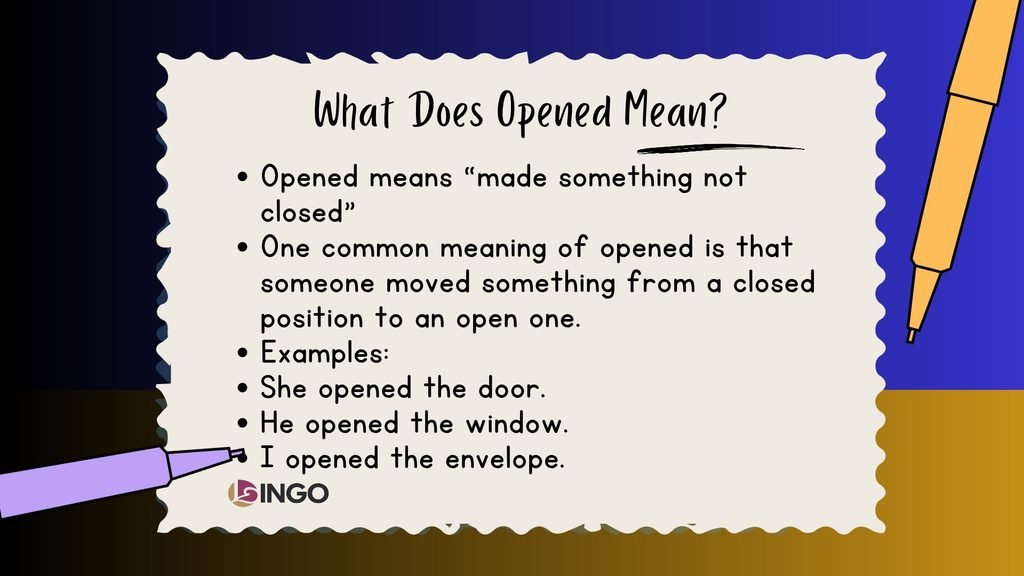
Opened means “made something not closed”
One common meaning of opened is that someone moved something from a closed position to an open one.
Examples:
- She opened the door.
- He opened the window.
- I opened the envelope.
- The child opened the cupboard.
- She opened her eyes.
Cambridge defines open in this sense as moving something to a position that is not closed.
Opened can mean “started”
The word can also describe the beginning of something.
For example:
- The restaurant opened last Monday.
- The new store opened at 9 a.m.
- The speaker opened the meeting with a short introduction.
- The company opened a new branch.
So, opened does not always describe physically opening an object.
Opened can describe computer actions
We also use opened when talking about digital files, programs, emails, and documents.
For example:
- I opened the document.
- She opened the email.
- He opened the application.
- I accidentally opened the wrong file.
Cambridge includes opening a computer document or program among the meanings of open.
Opened or Openned: Examples in Everyday English
Correct sentences with opened
Here are some natural examples:
- I opened the front door.
- She opened her book.
- He opened the package.
- We opened the windows.
- They opened a new restaurant.
- She opened her email.
- I opened the file yesterday.
- The teacher opened the discussion.
- The museum opened at ten.
- He opened the envelope carefully.
Incorrect sentences with openned
These examples contain the spelling mistake:
- I openned the door. ❌
- She openned her book. ❌
- He openned the package. ❌
- They openned the store. ❌
Correct them by removing the extra n:
- I opened the door. ✅
- She opened her book. ✅
- He opened the package. ✅
- They opened the store. ✅
Opened in different grammatical structures
Past simple:
She opened the door.
Present perfect:
She has opened the door.
Past perfect:
She had opened the door before I arrived.
Passive voice:
The new store was opened last week.
In each case, the spelling remains opened.
A Real-Life Example: Why Writers Spell It “Openned”
Imagine a student writing an English assignment about arriving at school one morning.
She writes:
“When I arrived at school, the teacher had already openned the classroom.”
The sentence may look almost correct. The student has actually chosen the appropriate tense: had opened is a past perfect construction because one past action happened before another past action.
However, the spelling is incorrect.
The corrected sentence is:
“When I arrived at school, the teacher had already opened the classroom.”
Why might the student have written openned? One possibility is that she remembers that English sometimes doubles a final consonant before adding -ed. She may know examples such as planned, stopped, and preferred, then incorrectly apply the same pattern to open.
This is an important distinction. English spelling rules often depend on the structure and pronunciation of a word rather than a simple “double the final letter” formula. Cambridge Grammar specifically distinguishes words such as stop and commit from open, where the final consonant is not doubled.
The easiest solution is to remember the complete verb form:
open → opened → opened
This is especially useful when proofreading school assignments, emails, reports, blog posts, or professional documents. If you see openned, pause and check the base word. Once you recognize open as a regular verb, the correct spelling becomes much easier to remember.
A Simple Comparison: Opened vs. Openned
| Feature | Opened | Openned |
|---|---|---|
| Standard English | ✅ Yes | ❌ No |
| Past tense of open | ✅ Yes | ❌ No |
| Past participle | ✅ Yes | ❌ No |
| Correct spelling | ✅ Yes | ❌ No |
| Extra “n” | No | Yes |
| Appropriate for formal writing | ✅ Yes | ❌ No |
Step-by-step spelling check
When you’re unsure, follow these three steps:
Step 1: Identify the base verb.
open
Step 2: Add the regular past-tense ending.
open + ed
Step 3: Read the result.
opened
That’s it.
English Usage Data: Why Correct Spelling Still Matters
English is used on a global scale, so small spelling questions can matter to a very large audience.
The British Council’s current Future of English research reports that nearly one-third of the world’s population—about 2.3 billion people—speaks English. It also reports that English is an official language in 67 nations and that around 60% of internet content is in English.
These figures do not measure how often people misspell opened, so they should not be interpreted as data about the specific opened/openned error. Instead, they demonstrate the broader scale of English communication.
For learners and writers, mastering small spelling distinctions can improve clarity across many types of writing, including:
- Academic assignments
- Business emails
- Website content
- Social media posts
- Reports
- Everyday messages
Google’s current Search Essentials guidance, updated in December 2025, also emphasizes creating helpful, reliable, people-first content and using language that people naturally use to find information.
For a grammar website, that means answering a simple spelling question clearly and accurately is more useful than filling an article with unnecessary repetition.
How to Remember the Spelling of Opened
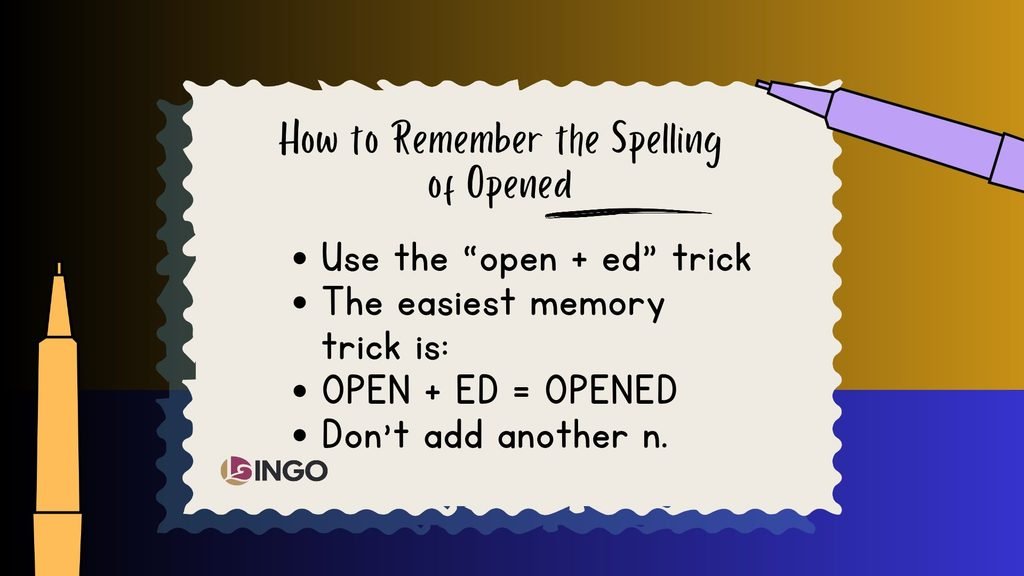
Use the “open + ed” trick
The easiest memory trick is:
OPEN + ED = OPENED
Don’t add another n.
Compare open with true doubling examples
Remember these pairs:
| Base verb | Correct past form |
|---|---|
| open | opened |
| stop | stopped |
| plan | planned |
| shop | shopped |
| commit | committed |
| prefer | preferred |
The important lesson is that not every verb follows the consonant-doubling pattern.
Use a sentence
If you repeatedly confuse the spelling, memorize a short sentence:
I opened the door.
Then associate the spelling with the sentence.
When you need the word later, the correct form should come naturally.
Mini Quiz:Opened or Openned
1. Which spelling is correct?
A. Openned
B. Opened
C. Oppened
D. Openning
Answer: B. Opened
2. What is the past tense of “open”?
A. Openning
B. Openned
C. Opened
D. Opens
Answer: C. Opened
3. Choose the correct sentence.
A. She openned the door.
B. She oppened the door.
C. She opened the door.
D. She openning the door.
Answer: C. She opened the door.
4. Which spelling contains an unnecessary extra “n”?
A. Opened
B. Opens
C. Openned
D. Opening
Answer: C. Openned
5. Complete the sentence: “I _____ the window yesterday.”
A. open
B. opens
C. opened
D. openned
Answer: C. opened
6. What is the correct formula?
A. Open + ing = opened
B. Open + ed = opened
C. Open + n + ed = openned
D. Oppen + ed = oppened
Answer: B. Open + ed = opened
7. Which sentence is correct?
A. He openned his book.
B. He opened his book.
C. He openning his book.
D. He oppened his book.
Answer: B. He opened his book.
8. Is “openned” a standard English spelling?
A. Yes
B. No
C. Only in formal writing
D. Only in American English
Answer: B. No
9. Which word is the past participle of “open”?
A. Opens
B. Opening
C. Opened
D. Openned
Answer: C. Opened
10. Choose the correct sentence.
A. They have opened the store.
B. They have openned the store.
C. They have opens the store.
D. They have openning the store.
Answer: A. They have opened the store.
11. Which is the correct three-form sequence?
A. Open – Opening – Opened
B. Open – Opened – Opened
C. Open – Openned – Openned
D. Open – Opens – Openned
Answer: B. Open – Opened – Opened
12. Complete the sentence: “She had _____ the box.”
A. opens
B. opening
C. openned
D. opened
Answer: D. opened
13. Why is “openned” incorrect?
A. It has an extra n.
B. It has an extra vowel.
C. It needs an extra e.
D. It needs to end in -ing.
Answer: A. It has an extra n.
14. Which sentence is correctly written?
A. I openned my email.
B. I opened my email.
C. I oppened my email.
D. I openning my email.
Answer: B. I opened my email.
15. What kind of verb is “open”?
A. Irregular verb
B. Regular verb
C. Modal verb
D. Auxiliary verb
Answer: B. Regular verb
16. Complete the sentence: “The museum _____ last week.”
A. opens
B. opening
C. openned
D. opened
Answer: D. opened
17. Which spelling should you use in formal writing?
A. Openned
B. Oppened
C. Opened
D. Openning
Answer: C. Opened
18. Which sentence uses “opened” correctly?
A. She has opened the package.
B. She has openned the package.
C. She has opens the package.
D. She has openning the package.
Answer: A. She has opened the package.
19. Which word completes this sentence? “He _____ the envelope carefully.”
A. openned
B. opened
C. opens
D. openning
Answer: B. opened
20. What happens when you add “-ed” to “open”?
A. The n is doubled.
B. The word becomes “oppened.”
C. The word becomes “opened.”
D. The word becomes “openning.”
Answer: C. The word becomes “opened.”
21. Choose the correctly spelled sentence.
A. We openned the windows.
B. We opened the windows.
C. We oppened the windows.
D. We openning the windows.
Answer: B. We opened the windows.
22. Which spelling is incorrect?
A. Opened
B. Opening
C. Opens
D. Openned
Answer: D. Openned
23. Complete the sentence: “The company _____ a new branch.”
A. openned
B. opening
C. opened
D. opens yesterday
Answer: C. opened
24. Which statement is true?
A. “Openned” is the correct past tense.
B. “Opened” is the correct past tense.
C. Both spellings are equally standard.
D. Neither spelling is correct.
Answer: B. “Opened” is the correct past tense.
25. What is the easiest way to remember the correct spelling?
A. Open + n + ed
B. Oppen + ed
C. Open + ed
D. Open + ning
Answer: C. Open + ed
Frequently Asked Questions About Opened or Openned
Q1:Is “openned” a correct spelling?
No. Openned is not the standard spelling. The correct form is opened.
Q2:Is it opened or openned?
It is opened.
For example:
She opened the window.
Q3:What is the past tense of open?
The past tense of open is opened.
Present: She opens the door.
Past: She opened the door.
Cambridge Dictionary lists opened as the past simple and past participle of open.
Q4:Why isn’t open spelled openned?
Because open does not require consonant doubling when -ed is added. The correct form is:
open + ed = opened
Q5:Is opened a past participle?
Yes. Opened is both the past simple and past participle form of open.
Examples:
- She opened the door.
- She has opened the door.
- They had opened the store.
Q6:Can I use opened in formal writing?
Yes. Opened is standard English and is completely appropriate in academic, professional, business, and everyday writing.
Q7:Is “open” an irregular verb?
No. Open is a regular verb. Its main forms are:
open → opened → opened
Cambridge Grammar includes open among regular verbs whose past and -ed forms are made by adding the regular ending.
Q8:How can I avoid spelling opened incorrectly?
Remember the simple formula:
OPEN + ED = OPENED
If you see openned, remove the extra n.
Conclusion: Opened or Openned?
So, opened or openned—which is correct?
The correct spelling is opened.
Opened is the past tense and past participle of the regular verb open. Openned is an incorrect spelling caused by incorrectly doubling the final n.
Remember:
Open → Opened → Opened
Whether you’re writing an email, completing an assignment, publishing an article, or improving your English vocabulary, choosing opened will keep your writing accurate and professional.
For more clear explanations of commonly confused English words and grammar rules, explore the other language guides on Lingorixa.
References
Cambridge Grammar: Open or Opened?

Maimoona Asghar is a grammar enthusiast and language writer who creates clear, practical content to help learners improve English grammar, writing, punctuation, and communication skills through easy-to-understand explanations and examples.