

Introduction
Have you ever written a sentence such as “I got stucked in traffic” and wondered whether it was grammatically correct? You are not alone. Many English learners and even native speakers occasionally confuse irregular verbs, especially when forming their past tense.
So, is “stucked” a correct word? No. In standard English, stucked is incorrect. The word stuck is both the simple past tense and past participle of the verb stick.
For example, you should write, “I got stuck in traffic,” rather than “I got stucked in traffic.”
In this guide, you will learn why stuck is correct, how to use it in different sentences, common mistakes to avoid, and practical examples that will help you use the word confidently.
Is Stucked a Correct Word in English?
No, stucked is not the standard past tense of stick. The correct form is stuck. The verb stick is irregular, meaning it does not form its past tense by simply adding -ed.
For example:
- Incorrect: I stucked my poster on the wall.
- Correct: I stuck my poster on the wall.
- Incorrect: She got stucked in the elevator.
- Correct: She got stuck in the elevator.
Although people sometimes use stucked because they apply the regular past-tense rule, standard English grammar does not recognize it as the correct form.
Why Is Stucked Incorrect?
Most regular English verbs form their past tense by adding -ed.
For example:
- Walk → Walked
- Talk → Talked
- Clean → Cleaned
- Jump → Jumped
However, some English verbs are irregular. Their past-tense forms change in different ways rather than following the standard -ed pattern.
Stick is one of these irregular verbs:
- Present: Stick
- Past: Stuck
- Past participle: Stuck
Therefore, adding -ed to stuck creates an incorrect form in standard English.
What Is the Correct Past Tense of Stick?
The correct past tense of stick is stuck.
Here is the basic verb structure:
| Verb Form | Correct Word |
|---|---|
| Base form | Stick |
| Third-person singular | Sticks |
| Present participle | Sticking |
| Simple past tense | Stuck |
| Past participle | Stuck |
Examples:
- I stick labels on my notebooks.
- She sticks pictures on the wall.
- He is sticking a stamp on the envelope.
- I stuck the note on the refrigerator.
- She has stuck the photograph inside her diary.
Remember that stuck works as both the simple past tense and past participle.
What Does Stuck Mean?
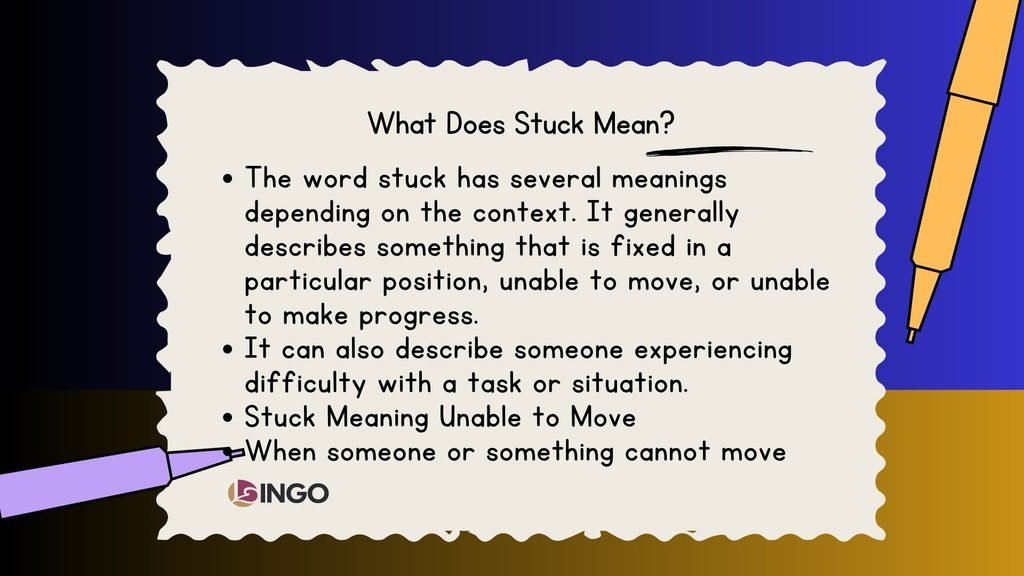
The word stuck has several meanings depending on the context. It generally describes something that is fixed in a particular position, unable to move, or unable to make progress.
It can also describe someone experiencing difficulty with a task or situation.
Stuck Meaning Unable to Move
When someone or something cannot move from a particular position, stuck describes that situation.
Examples:
- My car got stuck in the mud.
- The door is stuck and will not open.
- We were stuck in traffic for two hours.
In these sentences, stuck describes something that cannot move freely.
Stuck Meaning Unable to Make Progress
The word can also describe a person who cannot find a solution or continue working on something.
Examples:
- I am stuck on this mathematics problem.
- She got stuck while writing her assignment.
- We are stuck on the final stage of the project.
Here, stuck does not describe physical movement. Instead, it expresses difficulty or a lack of progress.
Stuck Meaning Attached or Fixed
Another meaning of stuck is firmly attached to a surface or object.
Examples:
- The chewing gum is stuck to my shoe.
- A small piece of paper was stuck to the window.
- The label got stuck on the wrong package.
These examples show how the same word can communicate different ideas depending on the sentence.
Stuck vs. Stucked: Understanding the Difference
Understanding the difference between stuck and stucked is simple once you learn how irregular verbs work.
The important rule is that stuck is the accepted past-tense form, while stucked is a nonstandard form that should be avoided in formal and standard English writing.
Stuck vs. Stucked Comparison Table
| Feature | Stuck | Stucked |
|---|---|---|
| Grammatical status | Correct | Incorrect in standard English |
| Base verb | Stick | Stick |
| Past tense | Correct | Incorrect |
| Past participle | Correct | Incorrect |
| Formal writing | Acceptable | Avoid |
| Everyday communication | Acceptable | Avoid |
Examples of Correct and Incorrect Usage
Here are some common sentences to help you understand the difference:
| Incorrect Sentence | Correct Sentence |
|---|---|
| I got stucked in traffic. | I got stuck in traffic. |
| He stucked the paper to the wall. | He stuck the paper to the wall. |
| My phone got stucked. | My phone got stuck. |
| She has stucked the picture. | She has stuck the picture. |
| We were stucked inside the room. | We were stuck inside the room. |
| The door was stucked. | The door was stuck. |
Notice that the correct form remains stuck regardless of whether you are describing a past action or using a helping verb.
When Should You Use Stuck?
Use stuck in the following grammatical situations:
- Simple past: I stuck the photograph on the wall.
- Present perfect: I have stuck the label on the box.
- Past perfect: She had stuck the note on the refrigerator.
- Passive construction: The poster was stuck to the door.
- Adjective: The window is stuck.
The form changes according to the sentence structure, but you never need to add -ed to stuck.
How to Use Stuck Correctly in Different Sentences
Learning grammar rules becomes easier when you see how words function in everyday communication. The word stuck appears in conversations, emails, academic writing, and professional communication.
Stuck in Everyday Conversations
People frequently use stuck when describing situations in which they cannot move or make progress.
Examples:
- I got stuck in traffic on my way to work.
- My brother was stuck in the elevator.
- We got stuck in the rain without an umbrella.
- The car got stuck in the snow.
- I am stuck trying to solve this problem.
Stuck in Professional and Academic Writing
The word stuck is also appropriate in professional and academic contexts.
Examples:
- The project got stuck because of unexpected technical problems.
- The document was stuck in the approval process.
- The research team was stuck on an important question.
- The software update got stuck during installation.
These sentences demonstrate that stuck is suitable for both casual and formal communication.
Stuck With Helping Verbs
A common source of confusion is the use of stuck with helping verbs such as has, have, had, was, and were.
Remember that the past participle of stick is also stuck.
Examples:
- She has stuck the photograph on the wall.
- They have stuck the labels on every package.
- He had stuck the instructions to the door.
- The paper was stuck to the desk.
- Several passengers were stuck in the airport.
You do not need to add another past-tense ending when using these structures.
Common Mistakes to Avoid When Using Stuck
Even though the rule is straightforward, English learners sometimes make mistakes because they apply regular verb patterns to irregular verbs.
Adding -ed to Stuck
The most common mistake is writing stucked instead of stuck.
Incorrect: The car got stucked in the mud.
Correct: The car got stuck in the mud.
The reason is simple: stick has an irregular past-tense form.
Confusing Stuck With Sticking
Another common mistake is using stuck when the sentence requires the present participle sticking.
Compare these examples:
- Correct: I am sticking the poster on the wall.
- Correct: I stuck the poster on the wall.
- Correct: I have stuck the poster on the wall.
Use sticking for continuous actions and stuck for the past tense and past participle.
Using Stuck Without the Correct Helping Verb
Sometimes the problem is not the word itself but the sentence structure.
Examples:
- Incorrect: I have stick the paper.
- Correct: I have stuck the paper.
- Incorrect: She had stick the photograph.
- Correct: She had stuck the photograph.
After have, has, or had, use the past participle stuck.
A Real-Life Example: How a Small Grammar Mistake Can Affect Communication
Imagine a student named Sarah who is preparing an English assignment for her university. She wants to explain that her computer stopped responding while she was working on an important presentation.
She writes:
“My laptop got stucked while I was preparing my presentation, so I lost some important information.”
Her teacher understands what she means, but notices the incorrect verb form. The teacher explains that stick is an irregular verb and that its past tense and past participle are both stuck.
Sarah corrects her sentence:
“My laptop got stuck while I was preparing my presentation, so I lost some important information.”
Later, Sarah writes another sentence:
“I have stucked the reminder on my notebook.”
She realizes that the same mistake has appeared again. This time, she remembers that the past participle is also stuck and changes the sentence to:
“I have stuck the reminder on my notebook.”
After reviewing several examples, Sarah understands that the correct form does not change when she uses different helping verbs.
This example demonstrates why learning irregular verb forms is important. A small spelling or grammar mistake may not prevent readers from understanding a sentence, but using the correct form makes writing clearer, more professional, and grammatically accurate. The best way to avoid similar mistakes is to learn irregular verb patterns and practice them in everyday sentences.
Data and Grammar Facts About Irregular Verbs (2025–2026)

Although there is no reliable official 2025–2026 statistic specifically measuring how often English speakers write stucked, research on irregular verbs helps explain why this mistake occurs.
Here are some useful linguistic facts:
- Irregular verbs are a small group: A research study published in Nature reported that fewer than 3% of modern English verbs are irregular.
- Common irregular verbs remain important: The same research explains that frequently used irregular verbs tend to retain their unusual forms over time.
- Irregular forms have a long history: Researchers tracked 177 Old English irregular verbs and found that 98 remained irregular in modern English.
- Regularization is a natural language process: English speakers sometimes apply the regular -ed pattern to irregular verbs, which helps explain forms such as stucked appearing in nonstandard communication.
These figures come from published linguistic research, not a newly conducted 2025–2026 survey. No verified annual dataset establishes a specific percentage of people who use stucked. Therefore, it would be misleading to present an invented usage statistic as current research.
The practical lesson is that irregular verbs require individual attention. Learning stick, stuck, stuck is more reliable than trying to apply the -ed rule to every English verb.
Mini Quiz:Is “Stucked” a Correct Word?
Topic: Is “Stucked” a Correct Word? (Past Tense of “Stuck”)
1. What is the correct past tense of the verb stick?
- A. Sticked
- B. Stuck
- C. Sticking
- D. Stucked
2. Which sentence is grammatically correct?
- A. I got stucked in traffic.
- B. I get stucked in traffic.
- C. I got stuck in traffic.
- D. I getting stuck in traffic.
3. True or False: The word stuck is both the simple past tense and past participle of stick.
4. What is the base form of stuck?
- A. Stick
- B. Sticking
- C. Stucked
- D. Sticks
5. Complete the sentence: She has _____ the photograph on the wall.
- A. Sticked
- B. Sticking
- C. Stick
- D. Stuck
6. Which form is used for the present continuous tense of stick?
- A. Stuck
- B. Sticking
- C. Stucked
- D. Sticks
7. True or False: “He stucked the paper to the door” is grammatically correct.
8. Which sentence correctly uses stuck?
- A. She has stuck the note on the desk.
- B. She has stick the note on the desk.
- C. She has stucked the note on the desk.
- D. She has sticking the note on the desk.
9. What is the present participle of stick?
- A. Stucks
- B. Stucked
- C. Sticking
- D. Stuck
10. Complete the sentence: My car got _____ in the mud.
- A. Sticked
- B. Stuck
- C. Stucked
- D. Sticking
11. Which verb is irregular?
- A. Walk
- B. Clean
- C. Jump
- D. Stick
12. Which of the following are correct forms of stick? (Select all that apply.)
- A. Stick
- B. Stuck
- C. Sticking
- D. Stucked
13. Choose the correct past perfect sentence.
- A. She had stick the paper.
- B. She had sticking the paper.
- C. She had stuck the paper.
- D. She had stucked the paper.
14. What does “I am stuck on this question” mean?
- A. I have already answered it.
- B. I cannot find a solution.
- C. I am writing the answer quickly.
- D. I have forgotten the question.
15. Which sentence uses stuck as an adjective?
- A. I stick labels on boxes.
- B. She is sticking a label.
- C. He stuck the poster yesterday.
- D. The door is stuck.
16. Which sentence correctly uses the past participle in the passive voice?
- A. The poster was stuck to the door.
- B. The poster was stick to the door.
- C. The poster was stucked to the door.
- D. The poster was sticking to the door by him.
17. Which is the correct spelling in standard English?
- A. Stuckked
- B. Stuck
- C. Stucked
- D. Stik
18. Complete the sentence: They were _____ in the elevator for an hour.
- A. Stick
- B. Sticking
- C. Stuck
- D. Stucked
19. Which sentence is incorrect in standard English?
- A. I stuck a stamp on the envelope.
- B. She has stuck the photo in her diary.
- C. The paper is stuck to the table.
- D. He has stucked the label on the box.
20. What is the third-person singular present form of stick?
- A. Sticks
- B. Stuck
- C. Sticking
- D. Stucked
21. Complete the sentence: Yesterday, I _____ a note on the refrigerator.
- A. Stick
- B. Stuck
- C. Sticking
- D. Stucked
22. Which sentence correctly uses sticking?
- A. She is sticking a picture on the wall.
- B. She is stuck a picture on the wall.
- C. She is stucked a picture on the wall.
- D. She is stick a picture on the wall.
23. What is the past participle of stick?
- A. Sticked
- B. Sticks
- C. Stuck
- D. Sticking
24. Complete the sentence: The chewing gum was _____ to my shoe.
- A. Stick
- B. Sticked
- C. Stucked
- D. Stuck
25. Why is stucked incorrect in standard English?
- A. Because stick is an irregular verb.
- B. Because stick is a noun only.
- C. Because stuck is a present-tense verb.
- D. Because English verbs cannot have past forms.
Frequently Asked Questions (FAQs)
Q1: Is “stucked” grammatically correct?
No. Stucked is not the correct past-tense form of stick in standard English. The correct form is stuck.
Q2: What is the past tense of stick?
The simple past tense of stick is stuck. For example: “I stuck the photograph on the wall.”
Q3: Is stuck the past tense or past participle?
It is both. Stuck serves as the simple past tense and past participle of stick.
Q4: Should I say “I got stuck” or “I got stucked”?
You should say “I got stuck.” The word stuck is the correct form when describing something that happened in the past.
Q5: Is “I have stuck” grammatically correct?
Yes. “I have stuck the note on the wall” is grammatically correct because stuck is the past participle of stick.
Q6: Why do people say stucked instead of stuck?
People sometimes add -ed because they assume all English verbs follow the regular past-tense pattern. However, stick is an irregular verb, so its past tense is stuck.
7. What is the difference between stick, stuck, and sticking?
These words represent different forms of the same verb:
- Stick: Base form – I stick labels on boxes.
- Stuck: Past tense and past participle – I stuck a label on the box.
- Sticking: Present participle – I am sticking a label on the box.
Q8: Can I use stuck in formal writing?
Yes. Stuck is grammatically correct and appropriate for formal and informal writing. You can use it in professional emails, academic assignments, reports, and everyday conversations.
Conclusion: Is Stucked a Correct Word?
So, is stucked a correct word? No. The correct past tense and past participle of stick are both stuck.
Remember this simple verb pattern:
- Present tense: Stick
- Past tense: Stuck
- Past participle: Stuck
- Present participle: Sticking
For example, write “I got stuck in traffic” instead of “I got stucked in traffic.”
Understanding irregular verbs will help you avoid common grammatical mistakes and improve your English writing and communication skills.
For more clear explanations of commonly confused English words and grammar rules, explore the other language guides on Lingorixa.
References

Maimoona Asghar is a grammar enthusiast and language writer who creates clear, practical content to help learners improve English grammar, writing, punctuation, and communication skills through easy-to-understand explanations and examples.

