
Introduction
Have you ever wondered whether saying “of which” is grammatically correct? You may have encountered this expression in books, professional emails, academic writing, or everyday conversations and questioned whether it sounds natural.
The good news is that “of which” is grammatically correct in English. It is commonly used to show a relationship between something and a larger group, subject, or previously mentioned idea. However, using it in the wrong sentence structure can make your writing confusing or unnecessarily formal.
In this guide, you will learn what “of which” means, when to use it, how it differs from “which,” and how to construct grammatically correct sentences with practical examples.
Is It Correct to Say “Of Which”?
Yes, “of which” is grammatically correct and is commonly used in formal and written English. It combines the preposition “of” with the relative pronoun “which” to connect information about something previously mentioned.
For example:
- She bought five books, two of which were novels.
- We visited several cities, the names of which I cannot remember.
- He owns three houses, one of which is near the beach.
In each example, “of which” connects a previously mentioned noun with additional information.
Why Is “Of Which” Grammatically Correct?
The expression follows an established English grammatical structure. The word “which” refers to an object, animal, idea, or previously mentioned thing, while “of” expresses a relationship, connection, or part of a whole.
Consider this sentence:
“She has four children, two of which are studying abroad.”
Here:
- Four children are the previously mentioned group.
- Two identifies a portion of that group.
- “Of which” connects the portion to the entire group.
Therefore, the expression is both meaningful and grammatically acceptable.
Is “Of Which” Formal or Informal?
“Of which” generally sounds more formal than everyday alternatives. It is particularly useful in academic writing, business communication, reports, and professional documents.
For example:
Formal: The company introduced ten products, three of which received international recognition.
More conversational: The company introduced ten products, and three of them received international recognition.
Both sentences are correct, but the second sounds more natural in casual conversation.
What Does “Of Which” Mean?
“Of which” generally means “among which,” “from which,” or “a part of which,” depending on the context.
It helps explain a relationship between something and a previously mentioned noun.
Examples of “Of Which” in Different Contexts
Here are some practical examples:
- Showing a portion of a group: I purchased six shirts, two of which were blue.
- Identifying something within a collection: She recommended several books, one of which was particularly interesting.
- Providing additional information: The building has twelve rooms, most of which are spacious.
- Explaining a relationship: They discussed several problems, the causes of which remain unclear.
- Describing a selection: We interviewed five candidates, three of which were experienced professionals.
The fifth example should use “whom” or “of whom” because candidates are people:
“We interviewed five candidates, three of whom were experienced professionals.”
This distinction is important for correct English grammar.
How “Of Which” Works in Sentence Structure
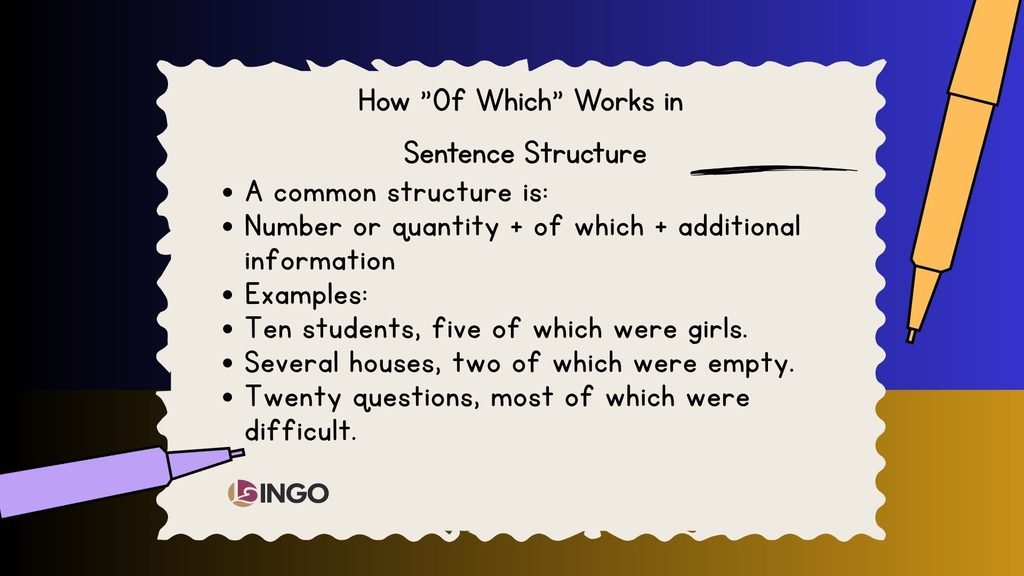
A common structure is:
Number or quantity + of which + additional information
Examples:
- Ten students, five of which were girls.
- Several houses, two of which were empty.
- Twenty questions, most of which were difficult.
These are sentence fragments without a main clause. Complete versions would be:
- Ten students attended the event, five of whom were girls.
- Several houses were available, two of which were empty.
- We answered twenty questions, most of which were difficult.
Notice that the choice of “which” or “whom” depends on whether the reference is a thing or a person.
When Should You Use “Of Which”?
You can use “of which” in several situations, especially when describing parts of a group, explaining relationships, or adding information about something.
1. When Referring to a Part of a Group
Use “of which” when you want to identify a specific number or portion of previously mentioned things.
Examples:
- I bought eight dresses, three of which were expensive.
- She owns four cars, one of which is electric.
- We visited several restaurants, two of which were closed.
This structure makes sentences shorter and avoids unnecessary repetition.
2. When Explaining Relationships
You can use “of which” to explain how something relates to another thing.
Examples:
- The house, the roof of which was damaged, needed repairs.
- They discovered a problem, the cause of which remains unknown.
- I read a report, the details of which were surprising.
This construction is particularly useful in academic and professional writing.
3. When Asking Questions
“Of which” can also appear in questions when asking someone to identify something from a group or selection.
Examples:
- Of which option are you most confident?
- Of which subjects do you have the strongest knowledge?
- Of which examples are you referring?
These questions are grammatically possible, although they may sound formal. In everyday conversation, you might say:
- Which option are you most confident about?
- Which subjects do you know best?
- Which examples are you referring to?
“Of Which” vs. “Which”: What Is the Difference?
Although both expressions are grammatically correct, they serve different purposes in English sentences.
“Which” is a relative pronoun or question word used to identify or provide information about things. “Of which” combines a preposition and relative pronoun to express a specific relationship.
Comparison Table
| Expression | Meaning | Example |
|---|---|---|
| Which | Identifies or refers to something | Which book do you prefer? |
| Of which | Shows a relationship or portion | I bought five books, two of which were expensive. |
| In which | Shows a location or situation | This is the room in which we met. |
| From which | Shows a source or origin | This is the country from which she came. |
| For which | Shows purpose or reason | The reason for which he left is unclear. |
How to Choose the Correct Expression
Follow these simple steps:
- Identify the noun or thing you are discussing.
- Decide whether you need to identify something or explain its relationship to something else.
- Use “which” for general identification or description.
- Use “of which” when expressing a relationship, such as a portion or connection.
- Check whether the sentence sounds natural and communicates your intended meaning.
For example:
Incorrect: I have six books, two which are interesting.
Correct: I have six books, two of which are interesting.
The preposition “of” is necessary to establish the relationship between the two books and the complete collection.
Common Mistakes When Using “Of Which”
Even though “of which” is correct, English learners sometimes use it incorrectly. Understanding these common mistakes can improve your writing.
Mistake 1: Using “Which” Instead of “Of Which”
Incorrect: She bought ten dresses, three which were expensive.
Correct: She bought ten dresses, three of which were expensive.
The phrase “of which” is needed to show that three dresses belong to the group of ten.
Mistake 2: Using “Of Which” for People
Incorrect: I invited five friends, two of which attended.
Correct: I invited five friends, two of whom attended.
Use “whom” rather than “which” when referring to people in this construction.
Mistake 3: Using Unnecessary Words
Incorrect: I have several books, and two of which are interesting.
Correct: I have several books, two of which are interesting.
Alternatively:
I have several books, and two of them are interesting.
Avoid combining structures that do not work together grammatically.
Mistake 4: Creating Incomplete Sentences
Incorrect: Several products, three of which were defective.
Correct: Several products were recalled, three of which were defective.
The original example is a fragment because it lacks a main clause.
Mistake 5: Using the Wrong Preposition
Incorrect: This is the situation of which I was talking about.
Better: This is the situation I was talking about.
Also correct: This is the situation about which I was talking.
Choose the preposition that matches the intended meaning and avoid repeating it unnecessarily.
Real-Life Example: Using “Of Which” in Professional Writing

Imagine that a marketing manager is preparing a report about a company’s recent advertising campaign. The company launched twelve promotional campaigns across different platforms, including social media, email marketing, television, and online advertising.
The manager wants to explain that five campaigns generated excellent results, while three campaigns performed below expectations.
Instead of writing several short sentences, the manager can use “of which” to present the information more clearly.
For example:
“The company launched twelve advertising campaigns during the final quarter of the year, five of which generated significant customer engagement. Three of which performed below expectations, while the remaining campaigns produced average results.”
However, the second sentence contains a grammatical problem because it begins with an incomplete construction.
A better version would be:
“The company launched twelve advertising campaigns during the final quarter of the year, five of which generated significant customer engagement, while three performed below expectations. The remaining campaigns produced average results.”
This example demonstrates how “of which” can connect related information without repeating the same nouns unnecessarily.
It also highlights an important writing lesson: using sophisticated expressions does not automatically make writing better. Every sentence still needs correct grammatical structure, appropriate punctuation, and a clear meaning.
In professional reports, academic assignments, and business documents, this construction can help writers communicate detailed information efficiently.
What Do Grammar Resources Say? (2025–2026)
Understanding the grammatical background of “of which” is more useful than relying on assumptions about whether a phrase sounds correct.
There is no reliable, widely recognized 2025–2026 statistic establishing how frequently English speakers use the exact expression “of which.” Therefore, assigning a percentage or claiming a specific usage increase would be misleading.
However, established grammar references explain the grammatical principles behind this construction:
- Cambridge Dictionary: Its grammar guidance explains that “which” can follow a preposition in relative clauses. It also distinguishes more formal preposition placement from conversational alternatives.
- British Council: Its English grammar guidance explains how relative pronouns work with prepositions and gives examples of expressions such as “one of which,” “most of which,” and “all of which.”
- Purdue OWL: Its writing guidance identifies “which” and “whose” as relative pronouns and explains their grammatical functions in relative clauses.
These resources provide established grammatical evidence supporting the correct use of the expression.
What These Grammar Principles Mean for Writers
The practical lessons are straightforward:
- “Of which” is an established English construction.
- It is particularly useful in formal writing.
- It can describe portions of groups or relationships between things.
- “Of whom” is generally the appropriate alternative when referring to people.
- A sentence must still contain a complete grammatical structure.
Mini Quiz:Is It Correct to Say “Of Which”?
1. Which sentence uses “of which” correctly?
- A. I bought five books, two of which were expensive.
- B. I bought five books, two which were expensive.
- C. I bought five books, two of them which expensive.
- D. I bought five books, two of that were expensive.
2. What does “of which” generally express?
- A. A time relationship
- B. A relationship or part of something
- C. A person’s identity
- D. A future action
3. Which expression is appropriate when referring to people?
- A. Two of which
- B. Two of that
- C. Two of whom
- D. Two of where
4. True or False: “She owns four cars, one of which is electric” is grammatically correct.
5. Complete the sentence: “The building has twelve rooms, most ____ are spacious.”
- A. Of which
- B. Which of
- C. Of whom
- D. Of that
6. Which sentence is correct when referring to five teachers?
- A. Five teachers, two of which were new.
- B. Five teachers, two of whom were new.
- C. Five teachers, two of where were new.
- D. Five teachers, two of whose were new.
7. Which phrase usually sounds more formal?
- A. Two of them
- B. A couple of them
- C. Two of which
- D. Some of them
8. Which sentences use “of which” correctly? Select all that apply.
- A. I read three books, one of which was fascinating.
- B. They bought six chairs, two of which were wooden.
- C. She met four doctors, two of which were specialists.
- D. We visited ten museums, several of which were crowded.
9. Choose the correct sentence.
- A. I have six pens, two which are blue.
- B. I have six pens, two of which are blue.
- C. I have six pens, two of whom are blue.
- D. I have six pens, two of where are blue.
10. True or False: “Of which” is generally the preferred relative construction for referring to people.
11. Complete the sentence: “The report, the details ____ were surprising, was published yesterday.”
- A. Of which
- B. Of whom
- C. Of where
- D. Of who
12. Which is a natural conversational alternative to “three of which”?
- A. Three of whom
- B. Three of them
- C. Three of that
- D. Three of where
13. Which sentence contains a sentence fragment?
- A. I bought four bags, two of which were black.
- B. Several products were recalled, three of which were defective.
- C. Several products, three of which were defective.
- D. She selected five items, one of which was damaged.
14. Which sentence uses a preposition correctly in a formal relative clause?
- A. This is the room in which we met.
- B. This is the room which in we met.
- C. This is the room whom we met.
- D. This is the room of where we met.
15. Which expressions can correctly introduce information about a portion of a group of things? Select all that apply.
- A. One of which
- B. Most of which
- C. Several of which
- D. One of whom
16. Choose the best correction: “I have several books, and two of which are interesting.”
- A. I have several books, two of which are interesting.
- B. I have several books, and two of whom are interesting.
- C. I have several books, and two which are interesting.
- D. I have several books, and two of where are interesting.
17. Which sentence correctly uses “of which” to describe a problem?
- A. They found a problem, the cause of which was unclear.
- B. They found a problem, the cause of whom was unclear.
- C. They found a problem, the cause which of was unclear.
- D. They found a problem, the cause of where was unclear.
18. Which question sounds more natural in everyday English?
- A. Of which book are you speaking?
- B. Which book are you talking about?
- C. Of whom book are you speaking?
- D. Which of book are you speaking?
19. What is the grammatical role of “of” in “two of which”?
- A. A conjunction
- B. A preposition
- C. An adjective
- D. An adverb
20. Complete the sentence: “We discussed several issues, the effects ____ remain uncertain.”
- A. Of which
- B. Of whom
- C. Of where
- D. Of who
21. Which sentence is correct?
- A. The company launched ten products, three of which were successful.
- B. The company launched ten products, three of whom were successful.
- C. The company launched ten products, three which of were successful.
- D. The company launched ten products, three of that were successful.
22. Which phrase correctly expresses the source of something?
- A. Of which
- B. From which
- C. For which
- D. In which
23. Which is the correct formal sentence about five candidates?
- A. We interviewed five candidates, three of whom had experience.
- B. We interviewed five candidates, three of which had experience.
- C. We interviewed five candidates, three of where had experience.
- D. We interviewed five candidates, three of that had experience.
24. Which statements about “of which” are accurate? Select all that apply.
- A. It can be used in formal writing.
- B. It can identify a portion of a group of things.
- C. It must always be used when referring to people.
- D. It can connect additional information to a previously mentioned noun.
25. Choose the best sentence for formal academic writing.
- A. The study examined eight factors, two of which were significant.
- B. The study examined eight factors, two which were significant.
- C. The study examined eight factors, two of whom were significant.
- D. The study examined eight factors, two of where were significant.
Frequently Asked Questions (FAQs)
Q1: Is it grammatically correct to say “of which”?
Yes, “of which” is grammatically correct. It combines the preposition “of” with the relative pronoun “which” to express a relationship between things or ideas.
Example: She purchased four paintings, two of which were expensive.
Q2: What does “of which” mean in English?
“Of which” can mean “among which,” “from which,” or indicate a relationship or part of something, depending on the sentence.
Example: I have several assignments, most of which are complete.
Q3: Can you start a sentence with “of which”?
Yes, you can begin a sentence with “of which” when the sentence structure supports it.
Example: Of which three options are you most confident?
However, this construction often sounds formal. In everyday English, “Which of the three options would you choose?” is more natural.
Q4: Is “of which” formal or informal?
“Of which” is generally considered more formal. It is frequently useful in academic writing, professional reports, and formal communication.
In casual conversations, expressions such as “two of them” may sound more natural.
Q5: What is the difference between “which” and “of which”?
“Which” identifies or introduces information about something, while “of which” expresses a relationship or portion.
Example:
- Which book do you want?
- I bought three books, one of which was expensive.
Q6: Can “of which” refer to people?
Generally, use “of whom” when referring to people.
Example:
Incorrect: I met four teachers, two of which were new.
Correct: I met four teachers, two of whom were new.
Q7: Can I use “of which” in academic writing?
Absolutely. “Of which” is appropriate for academic writing when used correctly. It helps connect related information and makes complex sentences more concise.
Example: The study examined several factors, the effects of which were significant.
Q8: Is “of which” interchangeable with “among which”?
Not always. Both expressions can sometimes describe something within a group, but their grammatical structures and meanings differ depending on context.
Example:
- Three of which were damaged.
- Among which were three damaged items.
Choose the expression that best fits your intended sentence.
Conclusion: Is It Correct to Say “Of Which”?
Yes, “of which” is grammatically correct and is a useful expression in English. It helps connect information, describe portions of a group, and explain relationships between previously mentioned things.
Remember these important points:
- Use “of which” when referring to things or ideas.
- Use “of whom” when referring to people.
- Use “which” when identifying or describing something.
- Prefer natural alternatives in casual conversations.
- Make sure your sentence has a complete grammatical structure.
Learning how to use “of which” correctly can make your writing clearer, more precise, and more professional.
For more clear explanations of commonly confused English words and grammar rules, explore the other language guides on Lingorixa.
References

Maimoona Asghar is a grammar enthusiast and language writer who creates clear, practical content to help learners improve English grammar, writing, punctuation, and communication skills through easy-to-understand explanations and examples.

