
Introduction
Have you ever written a professional email or joined a workplace conversation and wondered whether to say “from my end” or “from my side”? Both expressions are widely used in everyday and professional English, but choosing the right one can sometimes feel confusing.
The good news is that both phrases are understandable and grammatically acceptable in appropriate contexts. However, they can emphasize slightly different things depending on the situation.
“From my end” generally highlights your part of a task, responsibility, or process, while “from my side” often emphasizes your position, involvement, or contribution.
In this guide, you’ll learn the meaning of both expressions, understand their differences, explore practical examples, and discover which phrase works best in professional emails, meetings, and everyday conversations.
What Does “From My End” Mean?
“From my end” refers to your part of a situation, responsibility, task, or process. It is commonly used when explaining what you have completed, what you can observe, or whether something is working correctly on your side.
In simple words, it communicates information about your involvement or circumstances.
Examples of From My End
Here are some natural examples:
- Everything is ready from my end.
- There are no pending tasks from my end.
- The payment has been processed from my end.
- I’ve completed the necessary updates from my end.
- Everything seems to be working fine from my end.
Each sentence focuses on the speaker’s own situation or contribution.
For example, when someone says, “Everything is ready from my end,” they mean they have completed their responsibilities and are ready for the next step.
When Should You Use From My End?
Use this expression when discussing:
- Task completion: When you’ve finished your assigned work.
- Technical situations: When reporting whether something works on your system.
- Project updates: When explaining the progress of your responsibilities.
- Personal circumstances: When describing what is happening in your situation.
Example:
“I’ve checked the documents, and everything looks correct from my end.”
This means the speaker has reviewed the documents and has not noticed any problems.
What Does “From My Side” Mean?
“From my side” refers to your position, involvement, contribution, or perspective in a particular situation.
It is frequently used in conversations involving teamwork, decisions, agreements, and shared responsibilities.
In simple terms, it tells someone how you view a situation or what your position is regarding a particular matter.
Examples of From My Side
Consider these examples:
- There are no objections from my side.
- Everything is fine from my side.
- I have no concerns from my side.
- There is nothing more to add from my side.
- You can proceed with the plan from my side.
These sentences communicate the speaker’s position or willingness to move forward.
For example, “There are no objections from my side” means the speaker does not have any disagreement with the suggested decision.
When Should You Use From My Side?
Use this expression when discussing:
- Agreement: When you accept a suggestion or decision.
- Personal opinions: When sharing your position in a discussion.
- Teamwork: When explaining your contribution to a shared activity.
- Participation: When communicating your involvement in a situation.
Example:
“From my side, I am comfortable with the proposed schedule.”
This sentence communicates that the speaker agrees with the suggested schedule.
From My End vs From My Side: What Is the Actual Difference?
The main difference between these expressions is their emphasis.
Although they sometimes overlap, “from my end” usually focuses on your part of a process or situation, whereas “from my side” often highlights your position, involvement, or contribution.
Key Differences Between Both Expressions
| Feature | From My End | From My Side |
|---|---|---|
| Main meaning | Your part or circumstances | Your position or involvement |
| Common context | Work updates and responsibilities | Discussions and agreements |
| Focus | Tasks and progress | Perspective and contribution |
| Workplace usage | Reporting completion | Expressing agreement |
| Example | Everything is ready from my end. | No objections from my side. |
| General tone | Conversational and professional | Conversational and professional |
Remember that this distinction is a useful guideline, not an absolute grammar rule. Both expressions can sometimes communicate the same idea.
From My End vs From My Side in Professional Communication
Both phrases can appear in workplace conversations, business emails, and project discussions.
However, the best choice depends on what you want to communicate.
Situation 1: Reporting completed work
“Everything has been completed from my end.”
This communicates that your assigned responsibilities are finished.
Situation 2: Expressing agreement
“There are no concerns from my side.”
This communicates that you do not have any objections.
Situation 3: Discussing a shared project
“All the necessary arrangements have been made from my end.”
This tells your colleagues that you have handled your responsibilities.
Situation 4: Accepting a proposal
“From my side, the proposed changes look good.”
This communicates your approval of the suggested changes.
Which Expression Sounds More Natural?
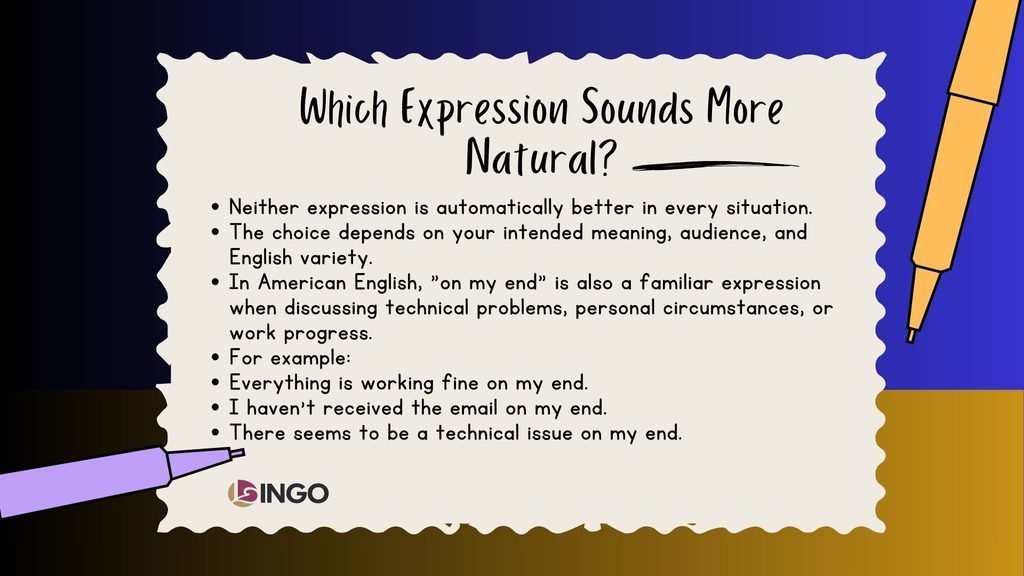
Neither expression is automatically better in every situation.
The choice depends on your intended meaning, audience, and English variety.
In American English, “on my end” is also a familiar expression when discussing technical problems, personal circumstances, or work progress.
For example:
- Everything is working fine on my end.
- I haven’t received the email on my end.
- There seems to be a technical issue on my end.
When expressing an opinion, “from my perspective” or “in my opinion” may sound clearer.
Therefore, choosing a direct expression can sometimes make your communication more natural.
Real-Life Example: Choosing the Right Phrase in a Workplace Conversation
Imagine that Sarah and Daniel are working together on a business presentation. Sarah is responsible for preparing the slides, while Daniel handles the research and supporting documents.
On Monday morning, Daniel sends Sarah a message asking whether everything is ready for their upcoming meeting.
Sarah replies:
“All the presentation slides have been completed from my end. I’ve also reviewed the formatting and corrected the minor mistakes.”
Here, Sarah uses “from my end” because she is reporting the completion of her assigned responsibilities.
A few minutes later, Daniel responds:
“Great! There are no concerns from my side either. I’m happy with the presentation, and we can move forward with the meeting.”
Daniel uses “from my side” to communicate his agreement and position regarding the presentation.
Later, their manager asks whether both employees are comfortable with the proposed presentation schedule.
Sarah says:
“From my perspective, the schedule looks reasonable.”
Daniel adds:
“I have no objections.”
Notice how each expression communicates a slightly different idea.
Sarah uses “from my end” to report completed work. Daniel uses “from my side” to express agreement. They also use “from my perspective” and “I have no objections” to communicate their opinions more directly.
This example demonstrates an important lesson: choosing the right expression is not simply about following a grammar rule. It is about communicating your intended message clearly.
In professional situations, readers and listeners should understand whether you are reporting progress, accepting responsibility, or expressing an opinion.
Common Mistakes and Better Alternatives
Although both phrases are understandable, some sentences can sound repetitive, unclear, or unnecessarily complicated.
Here are some common mistakes and more natural alternatives.
Mistake 1: Using Both Expressions Repeatedly
Unnecessarily repetitive:
“Everything is completed from my end, and there are no issues from my side.”
Better:
“Everything is completed, and I haven’t identified any issues.”
The revised sentence is shorter and communicates the same basic information.
Mistake 2: Using From My Side to Express a Clear Opinion
Less direct:
“From my side, I think this is a good idea.”
Better:
“In my opinion, this is a good idea.”
The alternative communicates the speaker’s opinion more naturally.
Mistake 3: Using From My End Instead of Explaining Responsibility
Less clear:
“The project is complete from my end.”
Better:
“I’ve completed my part of the project.”
The second sentence clearly identifies what the speaker has accomplished.
Mistake 4: Confusing From My Side With On My Side
These expressions are not always interchangeable.
- From my side: Refers to your position or contribution.
- On my side: Can mean that someone supports you or that something is located on your side.
For example:
“There’s no problem from my side.”
This communicates that you have no issue with the situation.
“Fortunately, you have me on your side.”
This means that you have someone’s support.
Understanding the difference helps prevent confusion.
Data and Statistics: What Does Recent English Usage Tell Us?
When comparing commonly used English expressions, it is important to distinguish between actual usage evidence and unsupported popularity claims.
There is no established, authoritative 2025–2026 statistic directly measuring how frequently English speakers use “from my end” compared with “from my side” across everyday conversations and professional emails.
However, several useful resources help explain the importance of choosing appropriate expressions.
What Available Language Resources Show
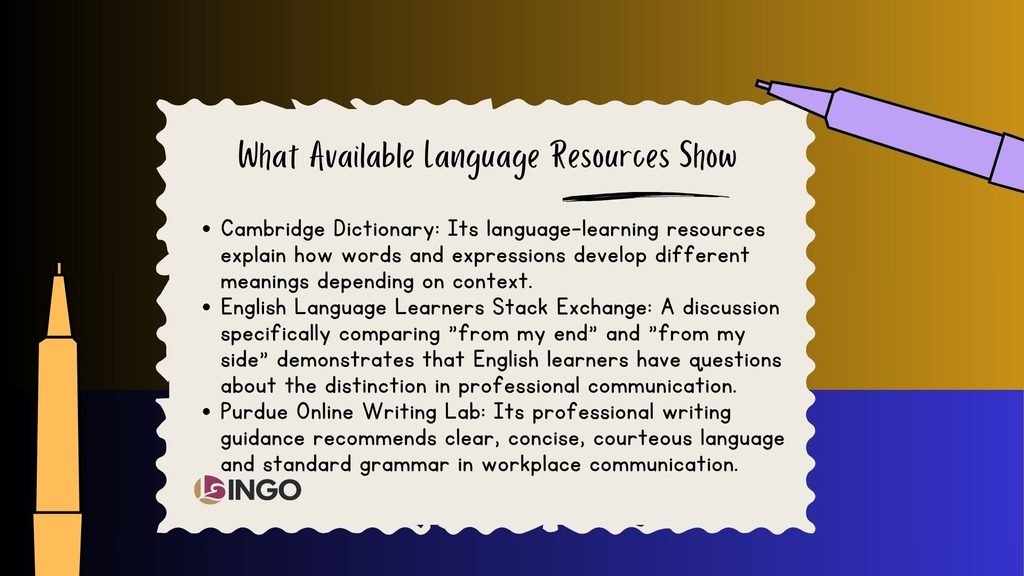
- Cambridge Dictionary: Its language-learning resources explain how words and expressions develop different meanings depending on context.
- English Language Learners Stack Exchange: A discussion specifically comparing “from my end” and “from my side” demonstrates that English learners have questions about the distinction in professional communication.
- Purdue Online Writing Lab: Its professional writing guidance recommends clear, concise, courteous language and standard grammar in workplace communication.
These resources support a practical conclusion: rather than choosing an expression simply because it sounds familiar, consider whether it accurately communicates your intended meaning.
For reliable language learning, consult established dictionaries, professional writing guides, and contextual examples instead of relying on unsupported usage percentages.
Quick Guide: How to Choose Between From My End and From My Side
If you still find these expressions confusing, use the following guide before writing your next email or message.
Step 1: Identify Your Intended Meaning
Ask yourself what you want to communicate.
- Are you reporting completed work?
- Are you describing a technical situation?
- Are you expressing agreement?
- Are you sharing your personal opinion?
Step 2: Choose the Appropriate Expression
| Your Intended Meaning | Recommended Expression |
|---|---|
| Reporting completed work | From my end |
| Describing your technical situation | On my end |
| Expressing your position | From my side |
| Sharing an opinion | From my perspective |
| Accepting a suggestion | I have no objections |
| Confirming your responsibility | I’ve completed my part |
Step 3: Check Whether Your Sentence Sounds Natural
Read your sentence again and consider whether a simpler alternative would communicate the same idea.
For example:
Instead of:
“Everything is completed from my end.”
You can write:
“I’ve completed everything assigned to me.”
Both communicate completion, but the second sentence is more specific.
Quick tip: Use “from my end” when discussing your part of a process and “from my side” when emphasizing your position or involvement. When clarity matters most, choose a direct alternative.
Mini Quiz:From My End vs From My Side
1. Which phrase is commonly used to describe someone’s personal perspective or position?
A. From my end
B. From my side
C. Both are always incorrect
D. Neither phrase
2. What does “from my end” usually mean?
A. From my location only
B. From my perspective or responsibility
C. From another person’s opinion
D. From the beginning
3. Which phrase is more suitable when discussing someone’s viewpoint?
A. From my end
B. From my side
C. Both can work
D. Neither
4. Choose the correct sentence.
A. From my end, everything is ready.
B. From my ends, everything is ready.
C. From my ending, everything is ready.
D. From mine end, everything is ready.
5. What does “from my side” often communicate?
A. Someone else’s responsibility
B. Your position, contribution, or perspective
C. A physical direction only
D. A future event
6. Which phrase is commonly used in professional communication to indicate that your part is complete?
A. From my end
B. From my sides
C. From mine side
D. From my ending
7. Fill in the blank: “There are no pending tasks ______.”
A. from my sides
B. from my end
C. from mine end
D. from my ending
8. Are “from my end” and “from my side” always interchangeable?
A. Yes, in every situation
B. No, their meanings can differ slightly
C. Only in formal writing
D. Only in British English
9. Which phrase can emphasize your personal involvement in a discussion?
A. From my side
B. From my ends
C. From mine sides
D. From my ending
10. Choose the grammatically correct expression.
A. From my side, I have no objections.
B. From my sides, I have no objections.
C. From mine side, I have no objections.
D. From my sided, I have no objections.
11. What is the closest meaning of “from my end”?
A. Regarding my part
B. Behind my back
C. Across the street
D. In the future
12. Which phrase is appropriate when explaining your position in a disagreement?
A. From my side
B. From my endings
C. From mine end
D. From my ends
13. Fill in the blank: “The report has been submitted ______.”
A. from my end
B. from my endings
C. from mine ends
D. from my ending
14. Which statement is true?
A. Both phrases can be used in everyday communication.
B. Only “from my side” is correct.
C. Only “from my end” is correct.
D. Both phrases are spelling mistakes.
15. Which phrase may sound more natural when referring to your part of a task?
A. From my end
B. From my sides
C. From mine side
D. From my endings
16. What does “from my side, everything looks fine” communicate?
A. The speaker’s perspective is that everything is fine.
B. Everything is physically on one side.
C. Someone else has checked everything.
D. The speaker disagrees with everyone.
17. Choose the correct sentence.
A. From my end, the payment has been processed.
B. From my ends, the payment has been processed.
C. From mine end, the payment has been processed.
D. From my ending, the payment has been processed.
18. Which phrase is generally suitable for describing your contribution to a project?
A. From my side
B. From my endings
C. From mine sides
D. From my ending
19. What should you consider when choosing between these phrases?
A. The context and intended meaning
B. The number of words
C. The sentence length only
D. The capitalization
20. Fill in the blank: “______ , I think we should proceed with the plan.”
A. From my side
B. From my sides
C. From mine sides
D. From my ending
21. Which phrase can indicate that your responsibilities have been completed?
A. From my end
B. From my endings
C. From mine end
D. From my ending
22. Which sentence uses “from my side” correctly?
A. From my side, I support this decision.
B. From my sides, I support this decision.
C. From mine side, I support this decision.
D. From my sided, I support this decision.
23. What is a good alternative to “from my end” in professional writing?
A. On my part
B. On my endings
C. At mine end
D. From my ending
24. Which phrase is more closely associated with someone’s position or viewpoint?
A. From my side
B. From my ending
C. From mine sides
D. From my ends
25. What is the best way to use “from my end” and “from my side”?
A. Use them randomly in every sentence.
B. Choose the phrase that best fits the context.
C. Avoid both phrases completely.
D. Always use “from my side” in formal writing.
Frequently Asked Questions (FAQs)
Q1: Is It Correct to Say From My End or From My Side?
Yes, both expressions are used in English and can be correct depending on the context. “From my end” generally emphasizes your part of a task or situation, while “from my side” often highlights your position or involvement.
Q2: What Is the Difference Between From My End and From My Side?
“From my end” usually refers to your responsibilities, progress, or circumstances. “From my side” often communicates your perspective, agreement, or contribution. However, their meanings can overlap in everyday communication.
Q3: Is From My End Professional?
Yes, “from my end” is commonly understood in workplace communication, especially when discussing project updates, completed tasks, and technical situations.
For example:
“Everything has been checked from my end.”
However, a more direct sentence such as “I’ve checked everything” may sound clearer.
Q4: Is From My Side Formal or Informal?
“From my side” is generally acceptable in conversational and professional settings. However, in formal business writing, expressions such as “from my perspective,” “in my opinion,” or “I have no objections” may communicate your meaning more precisely.
Q5: Can I Use From My End in a Business Email?
Yes. You can use it when reporting your progress, responsibilities, or work status.
For example:
“All the requested documents have been reviewed from my end.”
A more direct alternative is:
“I’ve reviewed all the requested documents.”
Both sentences are understandable.
Q6: Which Is Better: From My End or On My End?
Both expressions are used, but their naturalness depends on the sentence.
“On my end” is particularly common when describing technical situations or what you can observe.
Example:
“Everything is working correctly on my end.”
“From my end” can emphasize your contribution or part of a process.
Example:
“The requested updates have been completed from my end.”
Q7: What Are Some Better Alternatives to From My End and From My Side?
Here are several alternatives you can use:
- From my perspective
- In my opinion
- On my part
- As far as I’m concerned
- I’ve completed my part
- I have no objections
- Everything looks good to me
Choose the alternative that best communicates your intended meaning.
Q8: Can From My End and From My Side Be Used Interchangeably?
Sometimes, yes. Both expressions can refer to someone’s part in a shared situation or activity. However, they are not perfect substitutes in every sentence. Consider the context and choose the phrase that sounds most natural.
Conclusion: From My End vs From My Side — Which One Should You Use?
When comparing “from my end” vs “from my side,” remember that both expressions can be correct, but their emphasis can differ.
Use “from my end” when discussing your responsibilities, completed work, progress, or circumstances.
Use “from my side” when expressing your position, involvement, agreement, or contribution.
For professional emails and everyday conversations, context matters more than simply choosing one phrase over the other.
If you want to communicate your message more clearly, you can also use alternatives such as “from my perspective,” “I’ve completed my part,” or “I have no objections.”
Ultimately, good English communication is about choosing words that make your meaning easy to understand.
For more clear explanations of commonly confused English words and grammar rules, explore the other language guides on Lingorixa.
References
- Purdue Online Writing Lab – Email Etiquette
- Purdue Online Writing Lab – General Guidelines for Business Writing

Maimoona Asghar is a grammar enthusiast and language writer who creates clear, practical content to help learners improve English grammar, writing, punctuation, and communication skills through easy-to-understand explanations and examples.

