
Have you ever wondered whether to write “Anyone Has” or “Anyone Have”? You’re not alone. Many English learners, students, and even experienced writers struggle with this expression because the word “anyone” refers to people in general, which can make it seem plural.
However, English grammar follows a specific rule: “Anyone has” is generally correct in affirmative statements, while “anyone have” is correct in certain questions, negatives, and constructions involving auxiliary verbs.
Understanding the difference will help you write more naturally, avoid subject-verb agreement mistakes, and communicate confidently.
In this complete guide, you’ll learn when to use anyone has and anyone have, understand the grammar rules, explore practical examples, and discover common mistakes to avoid.
Anyone Has or Anyone Have: Which One Is Correct?
The correct choice depends on the sentence structure. Although both expressions can be grammatically correct, they are not interchangeable.
Anyone is a singular indefinite pronoun. Therefore, it normally takes a singular verb in affirmative statements.
For example:
- Correct: Anyone has the right to participate.
- Incorrect: Anyone have the right to participate.
However, when forming questions or negative sentences with the auxiliary verb “does,” the main verb changes to its base form, “have.”
For example:
- Correct: Does anyone have a question?
- Incorrect: Does anyone has a question?
The following table makes the distinction easier to understand.
| Expression | Correct Usage |
|---|---|
| Anyone has | Affirmative statements |
| Anyone have | Questions with do/does or modal verbs |
| Anyone does have | Emphatic statements |
| Anyone doesn’t have | Negative statements |
| Anyone having | Participial or gerund constructions |
Why Is “Anyone Has” Usually Correct?
The word “anyone” refers to any individual person without identifying someone specific. Although it can refer to different people depending on the situation, English grammar treats it as singular.
Consequently, it requires a singular verb.
Examples:
- Anyone has the opportunity to apply.
- Anyone has access to the information.
- Anyone has the ability to improve.
- Anyone has a chance to win.
Notice that “has” agrees with the singular indefinite pronoun “anyone.”
When Is “Anyone Have” Correct?
“Anyone have” is correct when the sentence structure requires the base form of the verb.
This commonly happens after auxiliary verbs such as “does,” “did,” and modal verbs such as “can,” “will,” and “should.”
Examples:
- Does anyone have a pen?
- Did anyone have an opportunity to speak?
- Can anyone have access to this document?
- Will anyone have enough time?
- Should anyone have concerns?
The important point is that the auxiliary verb controls the verb form that follows it.
Understanding the Grammar Rules Behind Anyone Has and Anyone Have
To choose the correct expression, you need to understand indefinite pronouns and subject-verb agreement.
English verbs change depending on whether their subjects are singular or plural. The verb “have” is particularly important because it has different present-tense forms.
Anyone Is a Singular Indefinite Pronoun
Indefinite pronouns refer to people or things without identifying them specifically.
Common examples include:
- Anyone
- Everyone
- Someone
- Anybody
- Everybody
- Nobody
- Somebody
These pronouns generally take singular verbs when they function as subjects.
For example:
| Subject | Correct Verb | Example |
|---|---|---|
| Anyone | Has | Anyone has a choice. |
| Everyone | Has | Everyone has responsibilities. |
| Someone | Has | Someone has my notebook. |
| Nobody | Has | Nobody has the answer. |
| Anybody | Has | Anybody has the opportunity to learn. |
According to Cambridge English Grammar, anyone, anybody, and similar indefinite pronouns are used with singular verbs.
The Difference Between Has and Have
“Has” and “have” are two present-tense forms of the verb “to have.”
Their usage depends on the grammatical subject and sentence construction.
| Subject | Correct Form |
|---|---|
| I | Have |
| You | Have |
| We | Have |
| They | Have |
| He | Has |
| She | Has |
| It | Has |
| Anyone | Has |
| Everyone | Has |
For example:
- She has a beautiful garden.
- They have a beautiful garden.
- Anyone has the opportunity to succeed.
Remember that “anyone” follows the same subject-verb agreement pattern as “he,” “she,” and “it.”
Why Does “Does Anyone Have” Use Have Instead of Has?
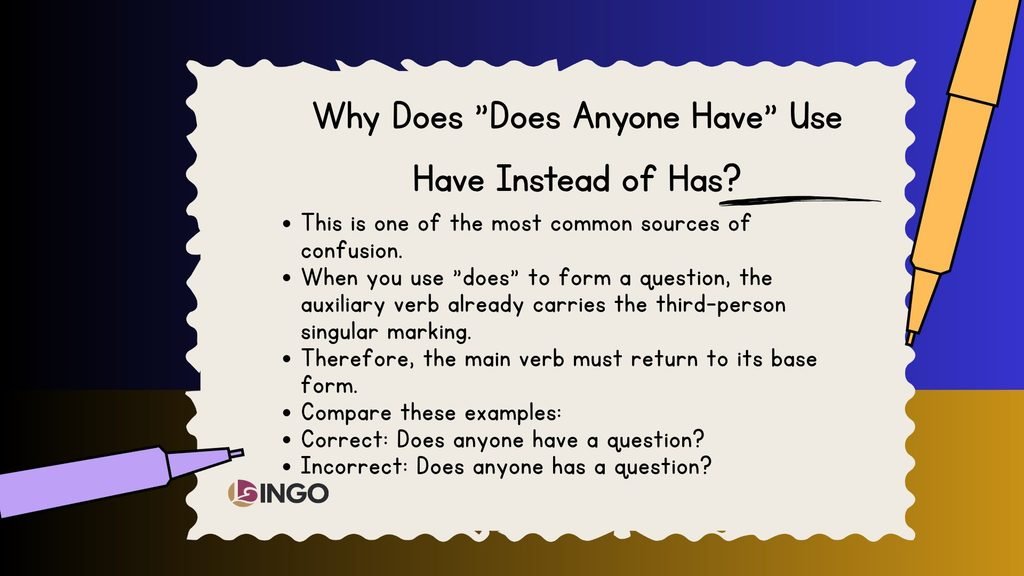
This is one of the most common sources of confusion.
When you use “does” to form a question, the auxiliary verb already carries the third-person singular marking.
Therefore, the main verb must return to its base form.
Compare these examples:
- Correct: Does anyone have a question?
- Incorrect: Does anyone has a question?
The first sentence is correct because “does” already shows the grammatical agreement.
The same rule applies to negative sentences:
- Correct: Anyone doesn’t have enough information.
- Incorrect: Anyone doesn’t has enough information.
The first sentence is grammatically structured correctly, although “Nobody has enough information” or “Not everyone has enough information” may sound more natural depending on the intended meaning.
Anyone Has vs Anyone Have: Examples in Different Situations
Understanding grammar rules is easier when you see how they work in everyday communication.
Here are practical examples from conversations, workplaces, education, and professional writing.
Examples in Everyday Conversations
People frequently use these expressions when asking questions or discussing possessions and opportunities.
Correct examples:
- Anyone has a spare phone charger.
- Does anyone have a spare phone charger?
- Anyone has a different opinion.
- Does anyone have a different opinion?
- Anyone has the keys to the house.
- Does anyone have the keys to the house?
Notice that the first and fifth examples are affirmative statements, while the others are questions requiring the auxiliary verb “does.”
Examples in Professional and Academic Writing
Subject-verb agreement is particularly important in professional emails, reports, academic assignments, and formal documents.
Consider these examples:
| Incorrect Sentence | Correct Sentence |
|---|---|
| Anyone have permission to enter. | Anyone has permission to enter. |
| Does anyone has an update? | Does anyone have an update? |
| Anyone have access to the files. | Anyone has access to the files. |
| Does anyone has additional information? | Does anyone have additional information? |
| Anyone have the authority to approve this. | Anyone has the authority to approve this. |
Using the correct verb form makes your writing more polished and professional.
Examples With Negative Sentences
Negative constructions can also create confusion because “has” and “have” change depending on the auxiliary verb.
Examples:
- Anyone doesn’t have the necessary documents.
- Does anyone not have an account?
- Nobody has submitted the assignment.
- Not everyone has received the invitation.
- Anyone who doesn’t have a ticket cannot enter.
Remember that “doesn’t” must be followed by the base form “have,” not “has.”
Real-Life Case Study: Avoiding an Anyone Has or Anyone Have Mistake
Imagine a marketing manager named Sarah who is preparing an important email for her company’s employees.
She wants to ask whether someone has additional information about an upcoming project.
Initially, she writes:
“Does anyone has the updated project schedule?”
At first glance, the sentence might seem correct because “anyone” is singular and usually takes “has.”
However, the sentence contains the auxiliary verb “does.” This changes the grammatical structure.
Her colleague notices the mistake and explains that when “does” appears before a subject, the following main verb must use its base form.
Sarah corrects the sentence:
“Does anyone have the updated project schedule?”
The revised version follows standard subject-verb agreement rules.
Later, Sarah writes another sentence in the same email:
“Anyone has access to the shared project folder.”
This sentence is grammatically correct because it is an affirmative statement without an auxiliary verb.
However, Sarah realizes that she actually wants to ask a question rather than make a statement. Therefore, she changes it to:
“Does anyone have access to the shared project folder?”
This example demonstrates why understanding sentence structure matters more than simply memorizing individual words.
The main lesson: Before choosing between “has” and “have,” identify whether the sentence is affirmative, negative, or interrogative. Then check whether an auxiliary verb is present.
This simple habit can help prevent grammatical mistakes in professional communication, academic writing, and everyday conversations.
Anyone Has or Anyone Have: 2025–2026 Grammar Evidence and Usage Insights
English grammar rules remain consistent even as communication styles evolve. During 2025–2026, established educational and language-reference resources continue to explain indefinite pronouns using the same subject-verb agreement principle.
Rather than presenting unsupported statistics about how many people make this mistake, it is more useful to examine the guidance provided by recognized language authorities.
What Do Current Grammar References Say?
Here is a comparison of three established educational resources.
| Grammar Authority | Guidance |
|---|---|
| Cambridge Dictionary | Anyone takes a singular verb. |
| University of Wisconsin–Madison Writing Center | Anyone and similar indefinite pronouns take singular verbs. |
| Government of Canada Language Portal | Indefinite pronouns ending in -one and -body are singular. |
These resources consistently support the use of singular verbs with “anyone” when it acts as the subject.
What Does This Mean for English Learners in 2026?
The practical takeaway is straightforward:
- Use “anyone has” in ordinary affirmative statements.
- Use “does anyone have” when asking questions.
- Use “doesn’t have” in negative constructions.
- Use “can have,” “will have,” and “should have” after modal verbs.
- Remember that the singular meaning of “anyone” does not change simply because it refers to an unspecified person.
These principles apply to standard written English, including American and British English.
There is no need to memorize complicated exceptions for ordinary sentences. Understanding how auxiliary verbs work will solve most problems involving anyone has or anyone have.
Common Mistakes to Avoid When Using Anyone Has or Anyone Have
Even people with good English skills sometimes make mistakes with indefinite pronouns.
Here are some common errors and their corrections.
Using Has After Does
Incorrect: Does anyone has a question?
Correct: Does anyone have a question?
Explanation: The auxiliary verb “does” already indicates third-person singular agreement. Therefore, use the base verb “have.”
Using Have in Affirmative Statements
Incorrect: Anyone have the right to express an opinion.
Correct: Anyone has the right to express an opinion.
Explanation: In a standard affirmative statement, “anyone” requires the singular verb “has.”
Confusing Anyone With They
The word “anyone” is grammatically singular, even though it can refer to a person whose identity or gender is unknown.
For example:
- Anyone has the opportunity to participate.
- If anyone needs help, they can contact the manager.
In the second example, “anyone” takes the singular verb “needs,” while “they” refers back to that person as a gender-neutral pronoun.
This is perfectly acceptable modern English.
Forgetting the Base Verb After Modal Verbs
Incorrect: Anyone can has a different opinion.
Correct: Anyone can have a different opinion.
Explanation: Modal verbs such as can, could, will, would, should, and might are followed by the base form of the main verb.
A Simple Checklist for Choosing the Correct Form

Use this checklist whenever you are unsure which expression to write.
- Is the sentence an affirmative statement? Use “anyone has.”
- Does the question begin with “does”? Use “anyone have.”
- Does the sentence contain “doesn’t”? Use “have.”
- Does the sentence contain a modal verb? Use “have.”
- Is “anyone” the subject? Treat it as singular.
Following these steps will help you use both expressions correctly.
Mini Quiz:Anyone Has or Anyone Have
1. Which sentence is grammatically correct?
A. Anyone have a question?
B. Anyone has a question.
C. Anyone having a question.
D. Anyone haves a question.
2. Choose the correct option:
Does anyone _____ a pen?
A. has
B. have
C. having
D. had
3. Complete the sentence:
Anyone _____ the right to express an opinion.
A. have
B. having
C. has
D. are having
4. Which sentence is correct?
A. Did anyone has my book?
B. Did anyone have my book?
C. Did anyone having my book?
D. Did anyone haves my book?
5. Complete the sentence:
Can anyone _____ the answer?
A. has
B. having
C. have
D. had
6. Which word is correct in this question?
_____ anyone have a suggestion?
A. Does
B. Do
C. Has
D. Having
7. Choose the correct sentence:
A. Anyone has submitted the assignment?
B. Does anyone has submitted the assignment?
C. Has anyone submitted the assignment?
D. Have anyone submitted the assignment?
8. Complete the sentence:
Anyone who _____ a ticket can enter.
A. have
B. has
C. having
D. are having
9. Which sentence is correct in standard formal English?
A. Does anyone have an idea?
B. Does anyone has an idea?
C. Do anyone has an idea?
D. Do anyone have an idea?
10. Complete the sentence:
Will anyone _____ time to help me?
A. has
B. having
C. have
D. had
11. Which sentence uses “anyone has” correctly?
A. Does anyone has a car?
B. Anyone has the opportunity to participate.
C. Did anyone has a meeting?
D. Can anyone has a seat?
12. Fill in the blank:
Should anyone _____ any questions, please ask.
A. has
B. have
C. having
D. had
13. Which is the correct informal question?
A. Anyone have a minute?
B. Anyone has a minute?
C. Anyone having a minute?
D. Anyone haves a minute?
14. Complete the sentence:
Nobody _____ permission to enter without authorization.
A. have
B. having
C. has
D. are having
15. Choose the correct option:
Does anyone _____ the new schedule?
A. knows
B. know
C. knowing
D. knew
16. Which sentence is grammatically correct?
A. Anyone have access to the files?
B. Has anyone access to the files?
C. Does anyone have access to the files?
D. Does anyone has access to the files?
17. Complete the sentence:
If anyone _____ a problem, contact the manager.
A. have
B. has
C. having
D. are having
18. Choose the correct past-tense question:
A. Did anyone has lunch?
B. Did anyone have lunch?
C. Does anyone had lunch?
D. Did anyone having lunch?
19. Which sentence is correct?
A. Anyone have their own responsibilities.
B. Anyone has their own responsibilities.
C. Anyone having their own responsibilities.
D. Anyone haves their own responsibilities.
20. Complete the sentence:
Would anyone _____ a different opinion?
A. has
B. have
C. having
D. had
21. Which sentence is correct?
A. Does anyone have any doubts?
B. Does anyone has any doubts?
C. Do anyone has any doubts?
D. Anyone has any doubts?
22. Fill in the blank:
Anyone who _____ a valid ID may register.
A. have
B. has
C. having
D. are having
23. Choose the correct sentence:
A. Has anyone finished the task?
B. Have anyone finished the task?
C. Does anyone has finished the task?
D. Did anyone has finished the task?
24. Complete the sentence:
Not everyone _____ the same opportunities.
A. have
B. having
C. has
D. are having
25. Which statement best explains the difference?
A. “Anyone have” is always correct.
B. “Anyone has” is always incorrect.
C. “Anyone” generally takes a singular verb, but questions with “does” use the base verb “have.”
D. “Anyone” always takes a plural verb.
Frequently Asked Questions About Anyone Has or Anyone Have
Q1: Is “Anyone has” grammatically correct?
Yes. “Anyone has” is grammatically correct in affirmative statements because “anyone” is a singular indefinite pronoun.
Example: Anyone has the opportunity to apply for the position.
Q2:Is “Anyone have” ever correct?
Yes. “Anyone have” is correct in questions and other constructions where an auxiliary or modal verb requires the base form of the main verb.
Example: Does anyone have a question?
Q3: Should I say “Does anyone have” or “Does anyone has”?
“Does anyone have” is correct.
The auxiliary verb “does” already indicates third-person singular agreement, so the main verb must remain in its base form.
Q4: Why does anyone take has instead of have?
Anyone is considered a singular indefinite pronoun in standard English grammar. Therefore, it follows the same present-tense verb pattern as he, she, and it.
Example: Anyone has a reason to participate.
Q5: Is “Anyone have a question?” correct in informal English?
Yes. In casual conversation, speakers sometimes omit the auxiliary verb “does.”
For example:
“Anyone have a question?”
This is an informal elliptical question. The complete grammatical version is:
“Does anyone have a question?”
For formal writing, use the complete question.
Q6: What is the difference between anyone has and does anyone have?
“Anyone has” is generally used in affirmative statements, while “does anyone have” is used in questions.
Examples:
- Anyone has access to the website.
- Does anyone have access to the website?
The difference comes from sentence structure and auxiliary verb usage.
Q7: Do everyone, someone, and anybody also take has?
Yes. Everyone, someone, anybody, and anyone are singular indefinite pronouns. They generally take “has” in affirmative present-tense statements.
Examples:
- Everyone has a responsibility.
- Someone has my notebook.
- Anybody has the opportunity to learn.
- Nobody has the correct answer.
Q8: Is “Anyone has” correct in American and British English?
Yes. Both American and British English generally treat “anyone” as a singular indefinite pronoun and use “has” in affirmative statements.
The same basic subject-verb agreement rule applies in both varieties.
Conclusion: Anyone Has or Anyone Have?
The difference between anyone has or anyone have becomes simple once you understand subject-verb agreement and auxiliary verbs.
Use “anyone has” in ordinary affirmative statements because “anyone” is a singular indefinite pronoun.
Use “anyone have” when the sentence requires the base form of the verb, such as after “does,” “can,” “will,” or “should.”
Here is the easiest way to remember:
- Anyone has a question. (Affirmative statement)
- Does anyone have a question? (Question)
- Anyone doesn’t have a question. (Negative statement)
Understanding this small grammatical distinction can make a significant difference in your everyday communication, professional emails, and academic writing.
For more clear explanations of commonly confused English words and grammar rules, explore the other language guides on Lingorixa.
External References
- Cambridge Dictionary – Anyone, Anybody or Anything?
- University of Wisconsin–Madison – Subject-Verb Agreement

Maimoona Asghar is a grammar enthusiast and language writer who creates clear, practical content to help learners improve English grammar, writing, punctuation, and communication skills through easy-to-understand explanations and examples.

