Introduction
If you have ever paused over focuses or focusses, you are not alone. The two spellings look almost identical, but the extra s can make writers wonder whether one version is incorrect.
The good news is that both “focuses” and “focusses” are recognized English forms. The difference is mainly connected with spelling conventions and regional usage. Oxford lists both focuses and focusses as present-tense forms of the verb focus, while Cambridge gives examples using focuses and records the verb with both single-s and double-s spellings.
So, focuses is correct, and focusses can also be correct. However, understanding where each form fits will help you write consistently and confidently.
What Is the Difference Between Focuses and Focusses?
Focuses
Focuses is the third-person singular present-tense form of the verb focus.
For example:
- She focuses on her studies.
- The article focuses on English grammar.
- The company focuses on customer service.
- The camera focuses on the subject.
The word focus means to direct attention, effort, or concentration toward something. Cambridge defines focus on as giving substantial attention to a particular person, subject, or thing.
Focusses
Focusses is an accepted spelling variant of the same verb form, particularly associated with British English.
For example:
- She focusses on her studies.
- The article focusses on English grammar.
- The research focusses on language development.
The meaning does not change. The difference is spelling rather than meaning.
Quick Comparison
| Form | Correct? | Main use |
|---|---|---|
| focuses | Yes | Widely used in English |
| focusses | Yes | Accepted variant, especially in British English |
| focused | Yes | Past tense/past participle |
| focussed | Yes | Variant past tense/past participle |
| focusing | Yes | Common -ing form |
| focussing | Yes | Variant -ing form |
Oxford specifically lists focuses/focusses, focused/focussed, and focusing/focussing among the verb forms of focus.
Focuses or Focusses: Which Spelling Should You Use?
When to Use “Focuses”
For most general writing, focuses is the straightforward choice.
Use it when:
- Writing in American English
- Writing for an international audience
- Following a style guide that uses single-s spelling
- Writing website content or general business material
- You want consistency with focused and focusing
Examples:
The course focuses on practical communication skills.
This guide focuses on common grammar mistakes.
The company focuses on improving customer experience.
When to Use “Focusses”
Use focusses when it matches the spelling convention of the English variety or editorial style you are following.
It is particularly associated with British English and is recognized as an alternative spelling.
Examples:
The research focusses on language development.
The program focusses on improving literacy.
The article focusses on punctuation rules.
The important point is that British English does not require focusses. Cambridge’s Business English Dictionary records the verb with both -s- and -ss- forms.
Consistency Matters
The biggest practical rule is to keep your spelling consistent.
For example, if your document uses:
- focuses
- focused
- focusing
there is usually little reason to suddenly switch to:
- focusses
- focussed
- focussing
Likewise, if a British publication follows a doubled-s convention, maintaining that convention throughout the document can make the writing look more polished.
How to Use Focuses and Focusses in a Sentence
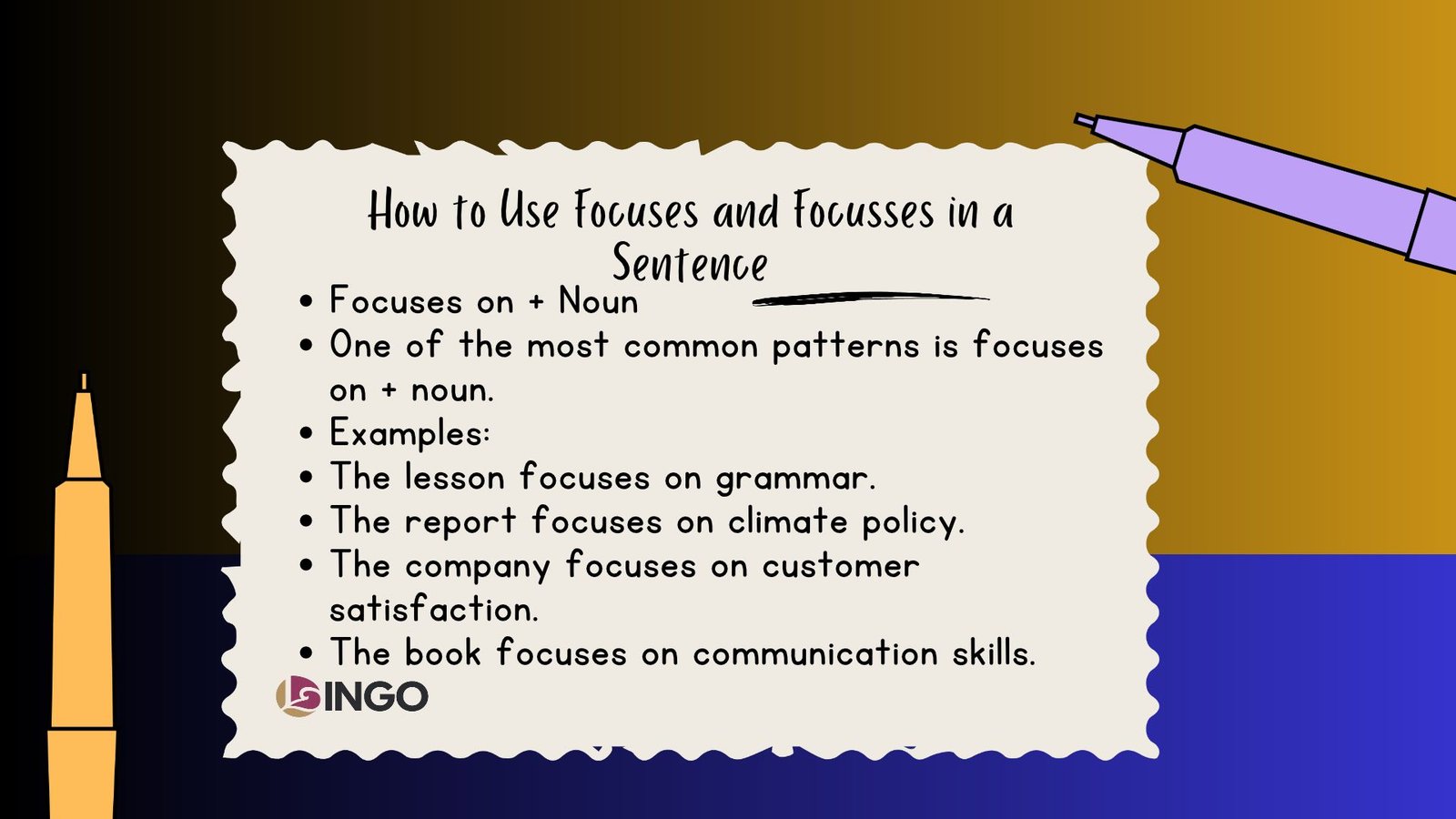
Focuses on + Noun
One of the most common patterns is focuses on + noun.
Examples:
- The lesson focuses on grammar.
- The report focuses on climate policy.
- The company focuses on customer satisfaction.
- The book focuses on communication skills.
Cambridge provides focus on as a standard construction meaning to give considerable attention to a particular subject or thing.
Focuses on + -ing Verb
You can also use focuses on + gerund (-ing form).
Examples:
- The course focuses on improving writing skills.
- The program focuses on teaching children to read.
- The article focuses on explaining difficult grammar rules.
- The research focuses on understanding language development.
The same sentence patterns work with focusses:
The course focusses on improving writing skills.
Focuses Attention on
Another useful construction is focuses attention on.
Examples:
- The report focuses attention on workplace safety.
- The campaign focuses attention on environmental issues.
- The article focuses attention on common spelling mistakes.
Here, focuses is clearly functioning as a verb.
Real-Life Example: Choosing the Right Spelling
Imagine an English-learning website is preparing an article for readers in the United States, United Kingdom, Canada, Australia, and other English-speaking countries.
The editor writes:
“This lesson focusses on common punctuation mistakes.”
A reviewer notices the spelling and wonders whether it should be changed.
The reviewer checks authoritative dictionaries and finds that focusses is recognized as an alternative form. Oxford lists focuses and focusses as present-tense forms of focus. Cambridge also records the verb with both spelling patterns.
The editor then considers the website’s overall style. If the site consistently uses American English, the editor may choose:
“This lesson focuses on common punctuation mistakes.”
If the site follows a British English style that uses doubled-s forms, the original sentence can remain:
“This lesson focusses on common punctuation mistakes.”
Neither sentence changes the meaning.
This example demonstrates an important lesson about English spelling: a spelling variant does not necessarily represent a grammar mistake. Instead, writers should consider dictionary recognition, regional convention, editorial style, and consistency.
For general web content intended for an international readership, focuses is a particularly straightforward form because it is widely recognized and avoids unnecessary regional ambiguity.
Focuses vs Focusses in American and British English
American English
In American English, focuses is the normal spelling used in the present tense.
Examples:
- She focuses on her work.
- The report focuses on sales.
- The camera focuses automatically.
Oxford’s American English dictionary lists focuses and focusses among the verb forms, while its entry demonstrates that both variants exist.
British English
British English allows both focuses and focusses.
Examples:
- The study focuses on education.
- The study focusses on education.
The meaning remains exactly the same.
Therefore, it is too simplistic to say:
“Focuses is American, and focusses is British.”
A more accurate explanation is that focuses is widely used in both varieties, while focusses is an accepted variant particularly associated with British English.
International English
If you are writing for an international audience, focuses is a practical choice.
For example:
Our website focuses on helping English learners improve their writing.
This spelling is immediately familiar to readers across different English varieties.
Focuses, Focused, and Focusing
Present Tense
With he, she, or it, use:
focuses
Examples:
- He focuses on his goals.
- She focuses on grammar.
- The program focuses on education.
Past Tense
The common spelling is:
focused
Example:
She focused on the main problem.
Focussed is also a recognized variant, particularly in British English.
-ing Form
The common form is:
focusing
Example:
She is focusing on her studies.
Focussing is also an accepted variant.
Oxford’s entry lists these corresponding forms together: focuses/focusses, focused/focussed, and focusing/focussing.
Focuses as a Noun: A Different Meaning
There is another reason focuses can appear in English: it can be the plural of the noun focus.
Cambridge gives focuses as a plural form and also identifies foci as the formal plural.
For example:
The discussion has several different focuses.
Here, focuses is not a verb. It is a plural noun.
Compare:
The article focuses on grammar.
In this sentence, focuses is a verb.
How to Tell the Difference
Look at what the word is doing in the sentence.
Verb:
The teacher focuses on pronunciation.
Plural noun:
The project has several focuses.
This distinction is useful because the same spelling can perform different grammatical roles.
2025–2026 Data and What It Tells Us About Online Content
There is no authoritative 2025–2026 statistic that meaningfully measures the percentage of English writers who choose focuses versus focusses. Claims giving a precise modern percentage should therefore be treated cautiously unless they identify a reliable corpus and methodology.
However, current content research shows why precise spelling and usage guidance still matters for online publishers. HubSpot’s 2026 marketing statistics report says blog posts were among the top five highest-ROI content formats in its 2026 State of Marketing data, while website/blog/SEO was reported as the leading ROI-generating channel among marketers.
HubSpot’s 2025 blogging research also reported that 65% of marketers worked at companies maintaining blogs, and 93% of those marketers rated blogging as important or very important to their marketing strategy.
For grammar and language websites, this reinforces a practical point: content quality involves more than choosing keywords. Correct spelling, clear explanations, appropriate examples, and consistency all contribute to useful educational content.
Common Mistakes With Focuses and Focusses
Mistake 1: Saying “Focusses” Is Always Wrong
This is incorrect.
Focusses is a recognized variant. Oxford lists it as a verb form of focus.
Mistake 2: Saying “Focusses” Is Required in British English
British English can use focusses, but it also uses focuses.
Therefore, the distinction is not an absolute US-versus-UK rule.
Mistake 3: Assuming They Have Different Meanings
They do not have different meanings when they are used as alternative forms of the verb focus.
Compare:
The article focuses on grammar.
The article focusses on grammar.
The meaning is the same.
Mistake 4: Mixing Spelling Styles
A writer might use:
The company focuses on quality, but last year it focussed on expansion.
This isn’t necessarily grammatically impossible, but it can create an inconsistent spelling style.
Choose a convention and maintain it throughout your writing.
A Simple Guide to Choosing the Correct Form
| Situation | Recommended form |
|---|---|
| American English | focuses |
| General international content | focuses |
| British English | focuses or focusses |
| Style guide specifies double-s | focusses |
| Style guide specifies single-s | focuses |
| Third-person singular verb | focuses/focusses |
| Plural noun | focuses or formal foci |
| Past tense | focused/focussed |
| -ing form | focusing/focussing |
The Easy Rule
If you are unsure, focuses is the simplest choice for general writing.
If your publication or style guide follows a British convention that uses double-s forms, focusses is also acceptable.
The most important thing is consistency.
Focuses or Focusses: Mini Quiz
1. Which spelling is widely used as the third-person singular form of “focus”?
A. Focuses
B. Focuss
C. Focuse
D. Focused
Answer: A. Focuses
2. Which spelling is an accepted variant of “focuses”?
A. Focuse
B. Focusses
C. Focuss
D. Focusess
Answer: B. Focusses
3. Which sentence is correct?
A. She focus on her studies.
B. She focuses on her studies.
C. She focuse on her studies.
D. She focusing on her studies.
Answer: B. She focuses on her studies.
4. What does “focuses on” mean?
A. Gives attention to
B. Moves away from
C. Disagrees with
D. Removes
Answer: A. Gives attention to
5. Which construction is standard?
A. Focuses at
B. Focuses to
C. Focuses on
D. Focuses by
Answer: C. Focuses on
6. Which sentence correctly uses “focusses”?
A. The study focusses on language.
B. The study focuss on language.
C. The study focuse on language.
D. The study focussing on language.
Answer: A. The study focusses on language.
7. Which spelling is a practical choice for general international content?
A. Focuss
B. Focuse
C. Focuses
D. Focussed
Answer: C. Focuses
8. Which is a correct past-tense form of “focus”?
A. Focused
B. Focuse
C. Focusded
D. Focuss
Answer: A. Focused
9. Which is an accepted alternative past-tense spelling?
A. Focussed
B. Focuss
C. Focuseed
D. Focussinged
Answer: A. Focussed
10. Which is the common -ing form of “focus”?
A. Focused
B. Focusing
C. Focuseing
D. Focuss
Answer: B. Focusing
11. Which is an accepted variant of “focusing”?
A. Focussing
B. Focussin
C. Focuseing
D. Focussingg
Answer: A. Focussing
12. In “The project has several focuses,” what is “focuses”?
A. Adjective
B. Adverb
C. Plural noun
D. Preposition
Answer: C. Plural noun
13. What is a formal plural of the noun “focus”?
A. Focusen
B. Foci
C. Focusses
D. Focusesed
Answer: B. Foci
14. Which sentence uses “focuses” as a verb?
A. The teacher focuses on pronunciation.
B. The project has several focuses.
C. The report contains three focuses.
D. The book discusses different focuses.
Answer: A. The teacher focuses on pronunciation.
15. Which statement is correct?
A. Only “focuses” is correct.
B. Only “focusses” is correct.
C. Both can be correct verb forms.
D. Neither form is correct.
Answer: C. Both can be correct verb forms.
16. What is the main difference between “focuses” and “focusses”?
A. Their basic meaning
B. Their spelling
C. Their tense
D. Their grammatical person
Answer: B. Their spelling
17. Which sentence is correct?
A. The course focuses on improving writing.
B. The course focuses on improve writing.
C. The course focus on improving writing.
D. The course focuses improving on writing.
Answer: A. The course focuses on improving writing.
18. Which statement about British English is accurate?
A. Only “focuses” is accepted.
B. Only “focusses” is accepted.
C. Both “focuses” and “focusses” can be used.
D. Neither is accepted.
Answer: C. Both “focuses” and “focusses” can be used.
19. What should writers prioritize when choosing between “focuses” and “focusses”?
A. Random variation
B. Consistency with their chosen style
C. Avoiding the word
D. Changing the spelling frequently
Answer: B. Consistency with their chosen style
20. Which sentence is grammatically correct?
A. The report focus on customer service.
B. The report focuse on customer service.
C. The report focuses on customer service.
D. The report focusing on customer service.
Answer: C. The report focuses on customer service.
21. Which spelling is particularly associated with British English as an alternative to “focuses”?
A. Focusses
B. Focuss
C. Focuse
D. Focusess
Answer: A. Focusses
22. Which sentence correctly uses “focuses” with a singular subject?
A. The company focuses on quality.
B. The company focus on quality.
C. The company focusing on quality.
D. The company focuse on quality.
Answer: A. The company focuses on quality.
23. Which sentence correctly uses “focusses”?
A. She focusses on her work.
B. She focuss on her work.
C. She focuse on her work.
D. She focussing on her work.
Answer: A. She focusses on her work.
24. Which sentence uses “focuses” correctly?
A. This guide focuses on English grammar.
B. This guide focus on English grammar.
C. This guide focuse on English grammar.
D. This guide focusing on English grammar.
Answer: A. This guide focuses on English grammar.
25. Which statement best summarizes the difference between “focuses” and “focusses”?
A. They always have different meanings.
B. “Focusses” is always incorrect.
C. Both can be correct, with “focusses” used as an accepted spelling variant.
D. “Focuses” is only used as a noun.
Answer: C. Both can be correct, with “focusses” used as an accepted spelling variant.
Frequently Asked Questions
Q1:Is “focusses” a correct spelling?
Yes. Focusses is a recognized spelling variant of the verb focus. Oxford lists it alongside focuses.
Q2:Is “focuses” or “focusses” correct?
Both can be correct when used as the third-person singular present form of focus. Focuses is widely used, while focusses is an accepted variant particularly associated with British English.
Q3:Is “focusses” British English?
It is particularly associated with British English, but it is not the only British spelling. British English also commonly uses focuses.
Q4:Which is correct in American English: focuses or focusses?
Focuses is the usual choice in American English. It is also widely understood internationally.
Q5:Does “focusses” mean something different from “focuses”?
No. When both are used as forms of the verb focus, they have the same meaning.
Q6:What is the past tense of focus?
Both focused and focussed are recognized forms. The single-s form is widely used in American English, while the double-s form is also used in British English.
Q7:Is “focusing” or “focussing” correct?
Both forms are recognized. Focusing is widely used, while focussing is an accepted variant.
Q8:What is the plural of “focus”?
The plural can be focuses or foci. Cambridge identifies focuses as a plural and foci as the formal alternative.
Conclusion
So, focuses or focusses? The answer is that both spellings can be correct when they are used as forms of the verb focus. Focuses is the broadly familiar form, particularly in American English, while focusses is an accepted variant associated especially with British English.
The key is not to treat the extra s as automatically wrong. Instead, consider your audience, follow the relevant style guide, and keep related forms consistent.
For most general-purpose English writing, focuses is a clear and widely recognized choice:
The article focuses on correct English usage.
If you are following a British spelling convention that permits or prefers the doubled-s form, you can write:
The article focusses on correct English usage.
Choose your spelling deliberately, use it consistently, and your writing will remain clear and professional.
For more clear explanations of commonly confused English words and grammar rules, explore the other language guides on Lingorixa.
References

Maimoona Asghar is a grammar enthusiast and language writer who creates clear, practical content to help learners improve English grammar, writing, punctuation, and communication skills through easy-to-understand explanations and examples.