Have you ever written jipped or gipped when you meant that someone was cheated, tricked, or given a bad deal? This spelling can be confusing because the word sounds like “jipt,” while its traditional spelling comes from gyp.
So, jipped or gipped which spelling is correct? The answer has an important nuance: jipped is generally treated as a nonstandard spelling of gypped, while gipped is a recognized variant form of gip. The more widely established form is gypped. However, there is also a usage issue worth knowing: dictionaries identify gyp and related forms as potentially offensive because of their historical association with stereotypes about Romani people.
In this guide, you’ll learn how to spell the word, what jipped, gipped, and gypped mean, why people confuse them, and which alternatives are better for modern writing
Jipped or Gipped: Which One Is Correct?
The short answer
If you mean cheated, tricked, or swindled, the traditional standard form is gypped.
Gipped is also found as a recognized variant of gip. American Heritage lists both gypped and gipped as forms of the verb, while Collins likewise gives gipped as a variant spelling.
Jipped, by contrast, is generally treated as a nonstandard or misspelled form of gypped. YourDictionary, for example, labels jipped a common misspelling of gypped.
| Spelling | Status | Meaning |
|---|---|---|
| gypped | Established form | Cheated or swindled |
| gipped | Recognized variant | Cheated or swindled |
| jipped | Nonstandard spelling | Usually intended to mean cheated or swindled |
Therefore, if you’re writing formal or edited English, gypped is the safest traditional spelling but there is an important reason you may want to choose a completely different word instead.
What Does “Gypped” or “Gipped” Mean?
Meaning of gypped
Gypped is the past tense and past participle of gyp. The verb means to cheat, trick, or swindle someone, particularly by taking money unfairly.
Oxford lists gyp as a verb meaning to cheat or trick someone, especially by taking their money, and gives gypped as its past tense and past participle.
For example:
The customer felt that the seller had gypped him.
This means the customer believed the seller had cheated him.
Meaning of gipped
Gipped can serve as the past tense and past participle of gip, which Collins identifies as a variant spelling of gyp.
For example:
We were gipped when the company charged us twice.
Here, gipped means cheated or unfairly charged.
What about jipped?
Jipped is commonly seen because the pronunciation can make the spelling seem logical. However, major dictionary evidence generally treats it as a nonstandard spelling rather than the established form.
For example:
I think I got jipped.
People will usually understand the intended meaning, but in edited writing, gypped or gipped would correspond more closely to dictionary-recognized forms. YourDictionary specifically identifies jipped as a common misspelling of gypped.
Why Do People Spell It “Jipped”?
Pronunciation causes the confusion
One major reason is pronunciation.
Gyp is pronounced /dʒɪp/, which sounds like the beginning of jip. Because English spelling does not always provide a straightforward guide to pronunciation, writers may naturally spell the past form as jipped.
Compare:
- gyp → /dʒɪp/
- gypped → /dʒɪpt/
- gipped → /dʒɪpt/
- jipped → /dʒɪpt/
The pronunciation can make all three spellings look plausible.
“Gip” is a recognized variant
The situation is more complicated because gip itself is recognized by some dictionaries.
American Heritage lists gyp and gip as variants and gives both gypped and gipped among the past-tense forms.
Collins similarly lists gip as a variant spelling of gyp and gives gipped as its past form.
That means gipped is not simply the same kind of error as jipped.
The easiest way to remember it
If you’re trying to reproduce the traditional spelling, remember:
gyp → gypped
But if you encounter gip → gipped, that spelling is also documented in dictionaries.
Jipped vs Gipped vs Gypped: A Clear Comparison
The spelling difference
The easiest way to understand these forms is to separate dictionary status from actual usage.
| Word | Dictionary status | Intended meaning | Formal-writing advice |
|---|---|---|---|
| Gypped | Established | Cheated or swindled | Recognized, but consider a neutral alternative |
| Gipped | Variant form | Cheated or swindled | Recognized, but consider a neutral alternative |
| Jipped | Generally nonstandard | Usually cheated or swindled | Avoid in edited writing |
| Cheated | Standard | Treated dishonestly | Clear alternative |
| Swindled | Standard | Defrauded or cheated | Clear alternative |
| Ripped off | Informal standard phrase | Charged too much/cheated | Good for casual writing |
Examples side by side
Gypped:
I felt gypped after discovering that I had paid twice as much.
Gipped:
The customers believed they had been gipped by the seller.
Jipped:
I feel like I got jipped.
The last example is understandable in informal communication, but it is not the spelling you should normally choose in polished writing.
A 2025–2026 Dictionary Evidence Snapshot
What current reference sources show
There is no reliable public statistic that establishes a precise percentage of English speakers who use jipped, gipped, or gypped in everyday communication. Therefore, claims such as “X% of people spell it this way” should not be presented as established fact.
Instead, a useful 2025–2026 evidence snapshot comes from comparing current dictionary entries:
- Oxford gives gyp as a verb and lists gypped as its past tense and past participle.
- Cambridge lists gyp as an informal, old-fashioned US verb meaning “to cheat someone” and uses gypped in its example.
- American Heritage recognizes gip as a variant and lists both gypped and gipped as past forms.
- Collins also recognizes gip as a variant and gives gipped as a past form.
- YourDictionary identifies jipped as a common misspelling of gypped.
This five-source snapshot shows an important distinction: gipped has dictionary support as a variant, while jipped is generally treated as a nonstandard spelling.
It is a dictionary-status comparison, not a statistical survey of English speakers.
A Real-Life Example: Why the Spelling Gets Confusing
A common writing situation
Imagine that Maya buys a used phone online. The seller advertises the phone as being in excellent condition, but when Maya receives it, the screen is damaged and several features do not work.
She tells her friend:
“I think I got jipped.”
Her friend understands immediately. The pronunciation makes the intended word obvious, even though jipped is not the standard spelling normally recommended in edited English.
Maya then checks a dictionary and discovers something unexpected: gypped is the established form, while gipped is also recognized as a variant in some dictionaries.
However, she also discovers another issue. Modern dictionary references flag gyp as potentially offensive because of its historical connection with stereotypes about Roma/Romani people. Dictionary.com explicitly labels the relevant sense “offensive” and explains the historical concern.
So instead of writing:
“I got gypped by the seller.”
Maya could simply say:
“I got cheated by the seller.”
Or:
“The seller ripped me off.”
The second set of sentences communicates exactly what happened without creating uncertainty about either spelling or terminology.
This example demonstrates why knowing the spelling is useful, but knowing the context and modern usage considerations is even more important.
Is “Gypped” Appropriate to Use?
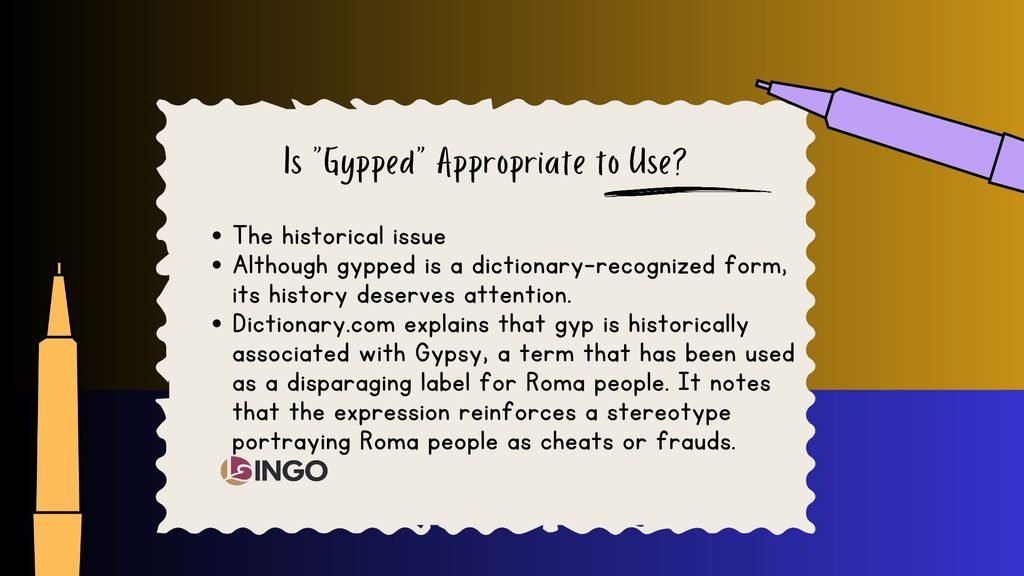
The historical issue
Although gypped is a dictionary-recognized form, its history deserves attention.
Dictionary.com explains that gyp is historically associated with Gypsy, a term that has been used as a disparaging label for Roma people. It notes that the expression reinforces a stereotype portraying Roma people as cheats or frauds.
American Heritage likewise describes the word as offensive slang and connects its historical development with prejudiced perceptions of Romani people.
Better alternatives for modern writing
If your goal is clear and respectful communication, you can usually replace the expression with a more precise word:
- cheated
- swindled
- defrauded
- scammed
- ripped off
- overcharged
- deceived
- taken advantage of
For example:
Instead of:
I got gypped at the store.
Write:
I was overcharged at the store.
Instead of:
They gypped me out of my money.
Write:
They cheated me out of my money.
These alternatives are often clearer because they tell the reader exactly what happened.
Common Mistakes With Jipped and Gipped
Mistake 1: Assuming “jipped” is the standard spelling
❌ I was jipped by the seller.
Better:
I was cheated by the seller.
Or, when discussing the traditional form specifically:
I was gypped by the seller.
Mistake 2: Assuming “gipped” is always wrong
This is more complicated.
Gipped is documented as a variant form of gip by reference dictionaries such as American Heritage and Collins.
Therefore, calling gipped simply “incorrect” would leave out an important dictionary distinction.
Mistake 3: Ignoring context
A spelling can be dictionary-recognized while still being unsuitable for some audiences.
Because dictionaries flag the gyp/gypped family as potentially offensive, choosing cheated, swindled, or scammed may be clearer and more appropriate.
How to Choose the Right Word
Step-by-step guide
Step 1: Decide what you mean.
Do you mean:
- cheated?
- overcharged?
- tricked?
- defrauded?
- scammed?
Step 2: Choose the precise word.
For example:
The mechanic charged me too much.
“Overcharged” may be more precise than a general expression meaning “cheated.”
Step 3: Consider your audience.
Formal writing, educational content, business communication, and professional correspondence usually benefit from straightforward vocabulary.
Step 4: If discussing spelling, distinguish the forms.
If your article is specifically about the word itself, explain that gypped is the established form and gipped is a documented variant, while jipped is generally treated as nonstandard.
Step 5: Prefer neutral alternatives when appropriate.
If you simply need to tell someone that you were treated unfairly, there is usually no reason to use a potentially offensive expression when cheated, swindled, or overcharged communicates the meaning directly.
Mini Quiz:Jipped or Gipped
- Which spelling is generally treated as the nonstandard spelling?
- A) Jipped
- B) Gypped
- C) Gipped
- D) Gyped
Answer: A) Jipped
- Which is the established past form of gyp?
- A) Jipped
- B) Gipped
- C) Gypped
- D) Gyped
Answer: C) Gypped
- What does gypped traditionally mean?
- A) Praised
- B) Cheated or swindled
- C) Relaxed
- D) Arrived
Answer: B) Cheated or swindled
- Which form is documented as a variant associated with gip?
- A) Jipped
- B) Gipped
- C) Gyped
- D) Gypping
Answer: B) Gipped
- Why do people commonly spell the word jipped?
- A) It reflects the pronunciation
- B) It changes the meaning
- C) It is the formal spelling
- D) It is a plural noun
Answer: A) It reflects the pronunciation
- Which spelling is generally recommended over jipped when referring to the traditional form?
- A) Gypped
- B) Jipped
- C) Gyped
- D) Jyppt
Answer: A) Gypped
- Which is a clear neutral alternative to gypped?
- A) Cheated
- B) Celebrated
- C) Relaxed
- D) Arrived
Answer: A) Cheated
- Which word precisely describes being charged too much?
- A) Overcharged
- B) Welcomed
- C) Entertained
- D) Congratulated
Answer: A) Overcharged
- Which spelling is generally treated as nonstandard in edited English?
- A) Jipped
- B) Gypped
- C) Gipped
- D) Cheated
Answer: A) Jipped
- Which statement about gipped is accurate?
- A) It is a documented variant form
- B) It is always a spelling error
- C) It means the opposite of cheated
- D) It is only a plural noun
Answer: A) It is a documented variant form
- Which word best completes the sentence: “The customer felt ______ after discovering the hidden fee.”
- A) Cheated
- B) Praised
- C) Relaxed
- D) Welcomed
Answer: A) Cheated
- Which spelling should a writer generally avoid when aiming for standard edited English?
- A) Jipped
- B) Gypped
- C) Gipped
- D) Cheated
Answer: A) Jipped
- Which word is most precise when someone was charged too much?
- A) Overcharged
- B) Celebrated
- C) Relaxed
- D) Arranged
Answer: A) Overcharged
- Which pair correctly identifies the traditional base verb and its past form?
- A) Gyp → Gypped
- B) Jip → Jipped
- C) Gype → Gyped
- D) Jyp → Jyped
Answer: A) Gyp → Gypped
- Which word means to deceive someone for personal gain?
- A) Swindle
- B) Compliment
- C) Welcome
- D) Assist
Answer: A) Swindle
- Which spelling is most likely to result from spelling the pronunciation?
- A) Jipped
- B) Gypped
- C) Gipped
- D) Cheated
Answer: A) Jipped
- Which sentence uses a neutral modern alternative?
- A) I was cheated by the seller.
- B) I was jipped by the seller.
- C) I was gypped by the seller.
- D) I was gipped by the seller.
Answer: A) I was cheated by the seller.
- Which form is associated with the variant verb gip?
- A) Gipped
- B) Jipped
- C) Gypped
- D) Gyped
Answer: A) Gipped
- Which word best describes being tricked in a dishonest transaction?
- A) Defrauded
- B) Admired
- C) Invited
- D) Comforted
Answer: A) Defrauded
- Which statement correctly distinguishes jipped from gipped?
- A) Jipped is generally nonstandard, while gipped is a documented variant.
- B) Jipped is formal, while gipped is never used.
- C) Both have completely unrelated meanings.
- D) Gipped is always incorrect, while jipped is standard.
Answer: A) Jipped is generally nonstandard, while gipped is a documented variant.
- Which word is appropriate when someone loses money because of deception?
- A) Swindled
- B) Applauded
- C) Repaired
- D) Invited
Answer: A) Swindled
- Which spelling should you use when specifically referring to the established past form of gyp?
- A) Gypped
- B) Jipped
- C) Gyped
- D) Jyped
Answer: A) Gypped
- Which sentence is most suitable for formal writing about an excessive purchase price?
- A) The customer was overcharged.
- B) The customer got jipped.
- C) The customer got gypped.
- D) The customer got gipped.
Answer: A) The customer was overcharged.
- Why might a writer choose cheated instead of gypped?
- A) It is a clear, neutral alternative.
- B) It has the same spelling pattern.
- C) It is a variant of gyp.
- D) It only differs in pronunciation.
Answer: A) It is a clear, neutral alternative.
- Which summary is accurate?
- A) Gypped is established, gipped is a documented variant, and jipped is generally nonstandard.
- B) Jipped is established, gipped is always wrong, and gypped is obsolete.
- C) All three are equally standard.
- D) Gipped and jipped are standard, while gypped is always incorrect.
Answer: A) Gypped is established, gipped is a documented variant, and jipped is generally nonstandard.
Frequently Asked Questions
Q1:Is “jipped” a correct spelling?
Jipped is generally considered a nonstandard spelling of gypped. It is used informally because it reflects the word’s pronunciation, but it is not the established spelling normally recommended in edited English.
Q2:Is “gipped” a real word?
Yes. Gipped is recognized as a variant past form of gip by dictionaries including American Heritage and Collins.
Q3:Is “gypped” the correct spelling?
Gypped is the established past tense and past participle of gyp. Oxford lists gypped as the past form of gyp.
Q4:What does “gypped” mean?
Traditionally, gypped means cheated, tricked, or swindled, especially in connection with money. Oxford defines gyp as cheating or tricking someone, particularly by taking their money.
Q5:Why do people spell it “jipped”?
The pronunciation of gyp is /dʒɪp/, which sounds like “jip.” This makes jipped seem like a logical phonetic spelling, especially for people who learned the word primarily through speech.
Q6:Should I use “gypped” in formal writing?
It is dictionary-recognized, but there is a significant usage consideration. Major dictionaries note that the word can be offensive because of its historical association with stereotypes about Roma/Romani people. In formal or respectful writing, alternatives such as cheated, swindled, defrauded, or overcharged are often preferable.
Q7:What is the difference between “gipped” and “gypped”?
Both can represent the past form of related dictionary entries: gypped comes from gyp, while gipped is listed as a variant past form of gip. Collins and American Heritage both document the variant relationship.
Q8:What should I write instead of “jipped”?
Choose a word that expresses the exact situation. Cheated, scammed, swindled, defrauded, overcharged, and ripped off can all work depending on the context.
Conclusion: Jipped or Gipped?
So, jipped or gipped which spelling is correct?
The traditional established form is gypped, the past tense and past participle of gyp. Gipped is also a recognized variant through gip, while jipped is generally treated as a nonstandard spelling.
However, spelling is only part of the story. Modern dictionaries also identify the gyp/gypped expression as potentially offensive because of its historical association with stereotypes about Roma/Romani people.
For everyday writing, you can often avoid the issue entirely by choosing a precise alternative such as cheated, swindled, scammed, or overcharged.
Remember: gypped is the established form, gipped is a recognized variant, and jipped is generally nonstandard. When clarity and respectful language matter, choose a more neutral alternative.
For more clear explanations of commonly confused English words and grammar rules, explore the other language guides on Lingorixa.
References
Collins Dictionary — Gipped
American Heritage Dictionary

Maimoona Asghar is a grammar enthusiast and language writer who creates clear, practical content to help learners improve English grammar, writing, punctuation, and communication skills through easy-to-understand explanations and examples.