Have you ever written cognisant or cognizant and stopped to wonder which spelling is correct? You’re not alone. These two forms look almost identical, have the same pronunciation in most varieties of English, and carry the same basic meaning.
The good news is that both cognisant and cognizant are correct spellings. The main difference is regional: cognizant is the standard form in American English, while cognisant is commonly used in British English.
Both words are adjectives meaning aware, informed, or having knowledge or understanding of something.
So, if you’re writing for an American audience, cognizant is generally the natural choice. If you’re following British English conventions, cognisant is commonly preferred.
Let’s examine the difference, meanings, examples, pronunciation, and usage so you can choose the right spelling confidently.
Cognisant or Cognizant: What Is the Difference?
The difference between cognisant and cognizant is primarily a matter of spelling convention rather than meaning.
Cognizant: The American English Form
Cognizant is the spelling commonly associated with American English.
It means being aware of something, understanding something, or having knowledge of a particular fact or situation.
Examples:
- The manager was cognizant of the potential risks.
- Students should be cognizant of the assignment deadline.
- She was fully cognizant of the consequences.
- The company is cognizant of changing customer expectations.
Notice that cognizant is normally followed by of when introducing the thing someone is aware of.
Cognisant: The British English Form
Cognisant is the spelling commonly used in British English and other varieties influenced by British spelling conventions.
It has the same meaning as cognizant.
Examples:
- The manager was cognisant of the potential risks.
- Students should be cognisant of the assignment deadline.
- She was fully cognisant of the consequences.
- The company is cognisant of changing customer expectations.
The important point is that changing s to z does not change the basic meaning.
Are Cognisant and Cognizant the Same Word?
Yes. In modern English, they are spelling variants of the same adjective.
| Word | Common regional usage | Meaning |
|---|---|---|
| cognizant | American English | Aware or informed |
| cognisant | British English | Aware or informed |
Major dictionaries support this relationship. Cambridge lists cognizant as the main form and notes that British English usually uses cognisant. Oxford similarly lists cognisant as a British English form.
Is Cognizant American or British English?
Cognizant in American English
If you’re writing in American English, cognizant is generally the spelling to use.
For example:
The employees were cognizant of the company’s updated policies.
This spelling fits naturally with American spelling conventions.
However, it would be misleading to say that cognizant is completely absent from British English. British dictionaries recognize the form too. The distinction is about which spelling is more typical within a particular variety of English.
Cognisant in British English
If you’re following British English, cognisant is commonly preferred.
For example:
The employees were cognisant of the company’s updated policies.
The meaning has not changed. Only the spelling differs.
This is similar to other regional spelling differences in English, where American and British conventions may use different letters while referring to the same word.
Which Spelling Should You Use?
The simplest rule is:
American English → cognizant
British English → cognisant
If you’re writing for an international audience, either form may be understood. What matters most is maintaining consistency throughout your writing.
What Does Cognizant or Cognisant Mean?
Definition of Cognizant
Cognizant means aware of, informed about, or having knowledge or understanding of something.
It is a relatively formal word and is often used in professional, academic, legal, and business writing.
For example:
The researchers were cognizant of the limitations of the study.
This means:
The researchers were aware of the limitations of the study.
Definition of Cognisant
Cognisant has the same basic definition:
aware, informed, or conscious of something.
For example:
She was cognisant of the importance of clear communication.
In simpler English:
She was aware of the importance of clear communication.
Cognizant vs. Aware
Although cognizant and aware can often be used interchangeably, they do not have exactly the same tone.
Aware is common and natural in everyday English.
Cognizant is more formal.
Compare:
- I am aware of the problem.
- I am cognizant of the problem.
Both sentences are grammatically correct, but the second sounds more formal.
For everyday communication, aware is usually simpler. In formal reports, professional writing, or academic contexts, cognizant or cognisant may be appropriate.
How to Use Cognisant and Cognizant Correctly
Use “Cognizant of” or “Cognisant of”
One of the most important usage patterns is cognizant of or cognisant of.
Examples:
- We are cognizant of the challenges ahead.
- We are cognisant of the challenges ahead.
- The teacher was cognizant of the student’s difficulties.
- The teacher was cognisant of the student’s difficulties.
A common mistake is to leave out of when the word is followed directly by the thing someone knows or understands.
Examples in Different Contexts
Workplace:
The team is cognizant of the project’s tight deadline.
Academic writing:
Researchers must be cognizant of potential limitations.
British English:
The committee was cognisant of the concerns raised by residents.
Everyday-style alternative:
The committee was aware of the concerns raised by residents.
When Should You Avoid It?
Because cognizant/cognisant is formal, it may sound unnecessarily complicated in casual conversation.
Instead of:
I am cognizant of your concern.
You could simply say:
I understand your concern.
Or:
I am aware of your concern.
Choosing a simpler word can make your writing clearer without changing the meaning.
A Real-Life Example: Choosing Between Cognisant and Cognizant
Imagine that a company has offices in both London and New York. The company is preparing an internal report about data privacy.
A writer in the United States might write:
The company is cognizant of the increasing importance of data privacy and is reviewing its internal procedures accordingly.
A British writer could write:
The company is cognisant of the increasing importance of data privacy and is reviewing its internal procedures accordingly.
Both sentences communicate the same idea. Neither writer has misunderstood the word. The spelling simply reflects the regional variety of English being used.
Now imagine that the report is being prepared for an international website with readers from the United States, United Kingdom, Canada, Australia, and other English-speaking regions. The editor has two sensible options. The first is to select one editorial style and use it consistently. The second is to follow the spelling convention of the publication’s primary audience.
The important lesson is that cognisant should not automatically be treated as a spelling mistake simply because cognizant is more familiar to an American reader. Likewise, an American writer does not need to change cognizant to cognisant merely because the British form exists.
The spelling should match the English variety and style guide you’re following. In professional editing, consistency is more important than trying to force one regional spelling onto every audience.
Cognisant vs. Cognizant: 2025–2026 Language Reference Data
Current dictionary references continue to recognize the two forms as regional variants rather than two words with different meanings.
What Current Dictionaries Show
As of 2026:
- Cambridge Dictionary lists cognizant and identifies cognisant as the usual British form.
- Oxford Advanced Learner’s Dictionary lists cognizant and notes that British English also uses cognisant.
- Collins English Dictionary identifies cognisant as the British form and defines both forms around the idea of being aware or informed.
- Collins also identifies a 2025 edition of Webster’s New World College Dictionary in its American English entry for cognizant.
These references provide current dictionary evidence for treating the two spellings as regional variants.
What About Usage Data?
Google Books Ngram Viewer is another useful tool for studying word usage in published books. Its current documentation explains that its corpus can be examined across different English varieties, including American and British English. The currently available Ngram data extends through 2022, so it should not be presented as 2025–2026 usage data.
That distinction matters: a 2025 or 2026 dictionary reference can establish current dictionary treatment, while older corpus data can show historical usage patterns. They measure different things.
Quick Comparison: Cognisant vs. Cognizant
| Feature | Cognisant | Cognizant |
|---|---|---|
| Part of speech | Adjective | Adjective |
| Meaning | Aware or informed | Aware or informed |
| British English | Commonly used | Also recognized |
| American English | Less typical | Commonly used |
| Typical construction | cognisant of | cognizant of |
| Formality | Formal | Formal |
| Meaning difference | None | None |
Easy Memory Trick
Think of the regional spelling this way:
Cognizant → Z → commonly associated with American English
Cognisant → S → commonly associated with British English
This is not a universal rule for every English word containing -ise/-ize, but it is a useful shortcut for remembering these two forms.
Common Mistakes With Cognisant and Cognizant
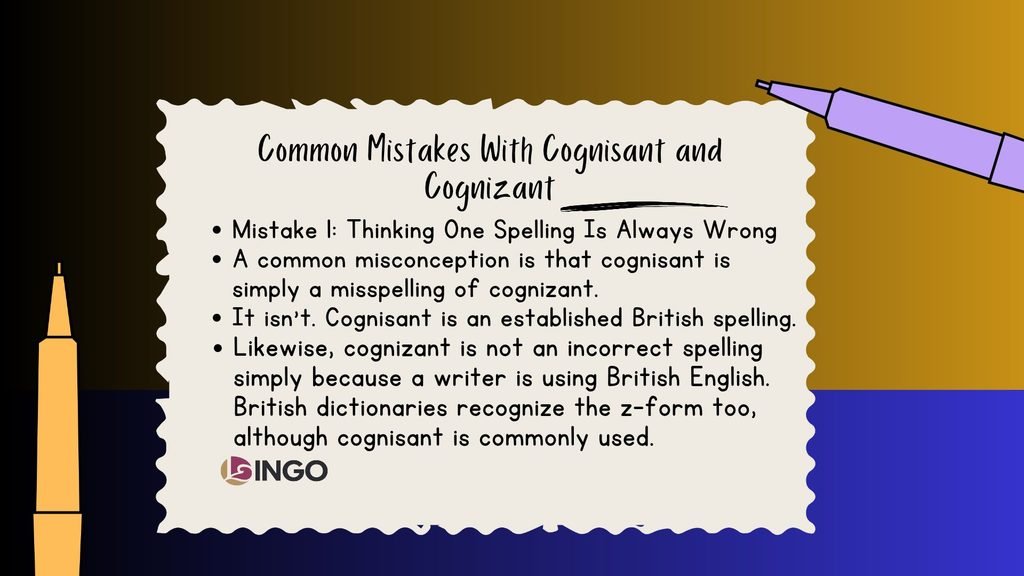
Mistake 1: Thinking One Spelling Is Always Wrong
A common misconception is that cognisant is simply a misspelling of cognizant.
It isn’t. Cognisant is an established British spelling.
Likewise, cognizant is not an incorrect spelling simply because a writer is using British English. British dictionaries recognize the z-form too, although cognisant is commonly used.
Mistake 2: Giving Them Different Meanings
There is no ordinary modern meaning distinction between the two spellings.
For example:
She was cognizant of the issue.
and
She was cognisant of the issue.
Both mean that she was aware of the issue.
Mistake 3: Using the Word When a Simpler Alternative Is Better
Because cognizant and cognisant are formal, they can sometimes make simple writing sound unnecessarily complicated.
Instead of:
Users should be cognizant of the changes.
You could write:
Users should be aware of the changes.
The second sentence is shorter and more conversational.
Mistake 4: Forgetting “Of”
The standard construction is generally:
cognizant of something
or
cognisant of something
For example:
The students were cognizant of the risks.
Not:
The students were cognizant the risks.
Mini Quiz:Cognisant or Cognizant
1. Which spelling is commonly preferred in American English?
A. Cognizant
B. Cognisant
C. Cognizent
D. Cognicent
Answer: A. Cognizant
2. Which spelling is commonly preferred in British English?
A. Cognizent
B. Cognisant
C. Cognicent
D. Cognizant
Answer: B. Cognisant
3. What does “cognizant” mean?
A. Aware or informed
B. Completely confused
C. Extremely energetic
D. Physically exhausted
Answer: A. Aware or informed
4. What does “cognisant” mean?
A. Uncertain or doubtful
B. Aware or informed
C. Angry or upset
D. Quick or immediate
Answer: B. Aware or informed
5. Which sentence uses “cognizant” correctly?
A. She was cognizant of the risks.
B. She was cognizant the risks.
C. She cognizant of the risks.
D. She was cognizant to the risks.
Answer: A. She was cognizant of the risks.
6. Which sentence uses “cognisant” correctly?
A. They were cognisant of the changes.
B. They were cognisant the changes.
C. They cognisant of the changes.
D. They were cognisant to the changes.
Answer: A. They were cognisant of the changes.
7. Are “cognisant” and “cognizant” different in meaning?
A. Yes, they have opposite meanings.
B. Yes, one means unaware.
C. No, they are spelling variants with the same basic meaning.
D. Yes, one is a noun.
Answer: C. No, they are spelling variants with the same basic meaning.
8. Which word is a simpler everyday alternative to “cognizant”?
A. Aware
B. Rapid
C. Silent
D. Heavy
Answer: A. Aware
9. Which sentence is grammatically correct?
A. The team was cognizant of the problem.
B. The team was cognizant the problem.
C. The team cognizant of the problem.
D. The team was cognizant with the problem.
Answer: A. The team was cognizant of the problem.
10. Which spelling would generally fit an American English report?
A. Cognisant
B. Cognizant
C. Cognizent
D. Cognisent
Answer: B. Cognizant
11. Which spelling would generally fit British English writing?
A. Cognizent
B. Cognicent
C. Cognisant
D. Cognizentt
Answer: C. Cognisant
12. Which sentence means that the manager was aware of the risks?
A. The manager was cognizant of the risks.
B. The manager was distant from the risks.
C. The manager was rapid with the risks.
D. The manager was silent about the risks.
Answer: A. The manager was cognizant of the risks.
13. Which sentence uses the British spelling?
A. She was cognizant of the issue.
B. She was cognisant of the issue.
C. She was cognizent of the issue.
D. She was cognicent of the issue.
Answer: B. She was cognisant of the issue.
14. Which part of speech is “cognizant”?
A. Adjective
B. Verb
C. Preposition
D. Conjunction
Answer: A. Adjective
15. Which part of speech is “cognisant”?
A. Adverb
B. Adjective
C. Verb
D. Pronoun
Answer: B. Adjective
16. Which sentence is most natural in formal writing?
A. The researchers were cognizant of the limitations.
B. The researchers were cognizant the limitations.
C. The researchers cognizant the limitations.
D. The researchers were cognizant on the limitations.
Answer: A. The researchers were cognizant of the limitations.
17. What is the main difference between “cognisant” and “cognizant”?
A. Pronunciation
B. Meaning
C. Regional spelling preference
D. Part of speech
Answer: C. Regional spelling preference
18. Which phrase is correctly formed?
A. Cognisant of the situation
B. Cognisant the situation
C. Cognisant to the situation
D. Cognisant at the situation
Answer: A. Cognisant of the situation
19. Which word is more conversational than “cognizant”?
A. Aware
B. Cognisant
C. Cognizant
D. Knowledgeable
Answer: A. Aware
20. Which sentence is correct in British-style spelling?
A. The committee was cognisant of public concerns.
B. The committee was cognisant public concerns.
C. The committee cognisant of public concerns.
D. The committee was cognisant for public concerns.
Answer: A. The committee was cognisant of public concerns.
21. Which sentence is correct in American-style spelling?
A. The company is cognizant of the issue.
B. The company is cognizant the issue.
C. The company cognizant of the issue.
D. The company is cognizant at the issue.
Answer: A. The company is cognizant of the issue.
22. Which sentence best uses a simpler alternative to “cognizant”?
A. We are aware of the changes.
B. We are rapid of the changes.
C. We are silent of the changes.
D. We are heavy of the changes.
Answer: A. We are aware of the changes.
23. If an editor chooses American English, which form should generally be used consistently?
A. Cognizant
B. Cognisant
C. Cognizent
D. Cognicent
Answer: A. Cognizant
24. If an editor chooses British English, which form is commonly preferred?
A. Cognizent
B. Cognizant
C. Cognisant
D. Cognicent
Answer: C. Cognisant
25. Which statement about “cognisant” and “cognizant” is accurate?
A. Only cognizant is correct.
B. Only cognisant is correct.
C. They have completely different meanings.
D. Both are correct regional spellings of the same adjective.
Answer: D. Both are correct regional spellings of the same adjective.
FAQs About Cognisant or Cognizant
Q1:Is “cognisant” or “cognizant” correct?
Both are correct. Cognizant is commonly used in American English, while cognisant is commonly used in British English. They have the same basic meaning.
Q2:Is cognisant British or American?
Cognisant is chiefly associated with British English. American English generally prefers cognizant.
Q3:Is cognizant American or British?
Cognizant is commonly associated with American English. British English also recognizes it, although cognisant is usually the more typical British spelling.
Q4:Do cognisant and cognizant mean the same thing?
Yes. Both mean aware of, informed about, or having knowledge of something.
Q5:How do you use cognizant in a sentence?
You can use it in the pattern cognizant of:
The manager was cognizant of the potential problems.
Q6:How do you use cognisant in a sentence?
Use it in the same way:
The manager was cognisant of the potential problems.
Q7:Which spelling should I use in academic writing?
Follow the English variety and style guide required by your institution, publisher, or audience. Use cognizant for American English and cognisant when following a British English convention.
Q8:Is cognizant a formal word?
Yes. Cognizant is generally considered formal. In casual writing, simpler alternatives such as aware or informed may sound more natural.
Final Verdict: Cognisant or Cognizant?
So, cognisant or cognizant—which spelling is correct?
Both are correct.
The main difference is regional spelling:
- Cognizant → commonly used in American English
- Cognisant → commonly used in British English
- Meaning → aware, informed, or having knowledge of something
- Typical construction → cognizant/cognisant of something
Therefore, don’t automatically mark cognisant as wrong if you see it in British English, and don’t assume cognizant is wrong simply because you’re reading British-style writing.
The best approach is to identify your audience and follow the appropriate style consistently.
If you’re writing for an American audience, choose cognizant. If you’re following British English conventions, cognisant is a natural choice.
For more clear explanations of commonly confused English words and grammar rules, explore the other language guides on Lingorixa.
References
Cambridge Dictionary — Cognizant
Oxford Learner’s Dictionary — Cognizant

Maimoona Asghar is a grammar enthusiast and language writer who creates clear, practical content to help learners improve English grammar, writing, punctuation, and communication skills through easy-to-understand explanations and examples.