If you have ever typed “puting” and wondered whether you had spelled it correctly, you are not alone. The correct spelling is “putting” with two t’s. So, when choosing between puting vs. putting, remember that putting is the standard English spelling.
“Putting” is the present participle and gerund form of the verb put. For example, we say, “She is putting the books on the shelf,” not “She is puting the books on the shelf.”
The extra t can look unusual because many English verbs form their -ing forms by simply adding -ing. However, put follows a spelling pattern that results in putting.
In this guide, you will learn why putting has two t’s, whether puting is a word, how to use putting correctly, and how to avoid this common spelling mistake.
Is It “Puting” or “Putting”?
“Putting” Is the Correct Spelling
Putting is the correct spelling in standard English.
The word comes from the verb put:
put + ting = putting
Examples:
- She is putting the dishes away.
- I am putting my keys on the table.
- They are putting together a new project.
- He keeps putting off his homework.
The spelling “puting” is generally a misspelling when the intended word is the present participle or gerund of put.
Why Does “Putting” Have Two Ts?
The spelling can be confusing because learners may expect:
put + ing = puting
However, standard English spells the form as:
put + ting = putting
The important point is that putting is an established form of put, and its spelling should be memorized.
Cambridge Dictionary identifies putting as the present participle of put, while its grammar guidance lists put as an irregular verb whose base, past, and past participle forms remain put.
Quick Answer
| Spelling | Correct? | Example |
|---|---|---|
| Putting | Yes | She is putting the book away. |
| Puting | No | She is puting the book away. |
If you are writing an email, essay, article, school assignment, or professional message, use putting.
What Does “Putting” Mean?
Putting as the -ing Form of “Put”
Putting is the present participle of put. It can be used with forms of be to create progressive tenses.
Examples:
- I am putting the groceries away.
- She was putting her coat on.
- They are putting the chairs outside.
- We were putting together the presentation.
The basic verb put can mean to move something into a particular place or position. Cambridge Dictionary gives examples such as putting clothes in a cupboard or placing an object on a table.
Putting as a Gerund
“Putting” can also function as a gerund, meaning the -ing form works as a noun.
For example:
Putting things off can create unnecessary stress.
Here, “putting” is part of the noun-like phrase “putting things off.”
Another example:
Putting the books in alphabetical order takes time.
Putting in Common Expressions
You will also see putting in many common expressions and phrasal verbs.
Examples include:
- putting on a jacket
- putting away clothes
- putting off a meeting
- putting together a plan
- putting in extra effort
- putting down a phone
- putting forward an idea
Therefore, recognizing the spelling of putting helps you write many everyday English expressions correctly.
Why Is “Puting” a Common Spelling Mistake?
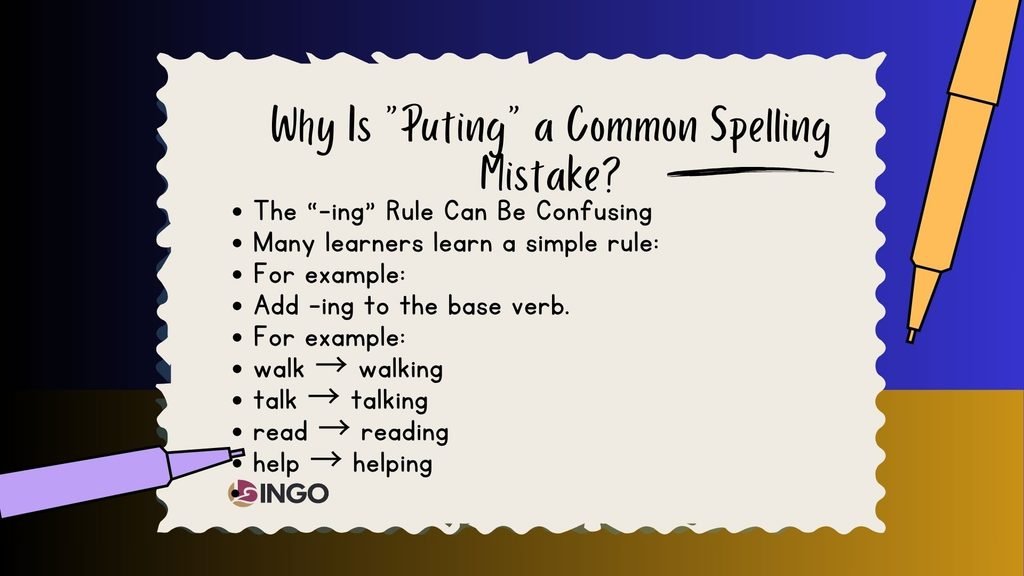
The “-ing” Rule Can Be Confusing
Many learners learn a simple rule:
Add -ing to the base verb.
For example:
- walk → walking
- talk → talking
- read → reading
- help → helping
This can lead someone to assume:
put → puting
But English spelling contains many irregularities, and not every word behaves exactly as a beginner might expect.
The safest approach is to remember the standard form:
put → putting
“Put” Is an Irregular Verb
Another reason “putting” can be confusing is that put is an irregular verb.
Its major forms are:
| Verb Form | Word |
|---|---|
| Base form | put |
| Past tense | put |
| Past participle | put |
| Present participle | putting |
For example:
- I put the bag here every morning.
- Yesterday, I put the bag here.
- I have put the bag here before.
- I am putting the bag here now.
Cambridge specifically notes that the past and past participle of put remain put, while putting is its present participle.
Pronunciation Does Not Make the Spelling Obvious
“Putting” is pronounced differently from what a learner might expect if they simply focused on the written letters. This can make spelling mistakes easier to make, especially when writing quickly.
That is why it helps to connect the word visually:
PUT + TING = PUTTING
Rather than:
PUT + ING = PUTING
Putting vs. Puting: Examples You Can Copy
Correct Sentences With “Putting”
Here are several natural examples:
- She is putting the groceries in the refrigerator.
- I am putting my phone on silent.
- He is putting his shoes by the door.
- They are putting together a presentation.
- We are putting the chairs in the meeting room.
- She keeps putting off the decision.
- He is putting a lot of effort into his studies.
- I am putting the documents on your desk.
- The teacher is putting the students into groups.
- They are putting the plan into action.
Incorrect Sentences With “Puting”
The following sentences contain the common spelling error:
- She is puting the book away.
- I am puting my clothes in the closet.
- They are puting together a new plan.
Correct them by changing puting to putting:
- She is putting the book away.
- I am putting my clothes in the closet.
- They are putting together a new plan.
A Simple Trick to Remember “Putting”
Remember “Put + Ting”
A quick memory trick is to think:
PUT + TING = PUTTING
This makes the double t easier to remember.
You can also connect the spelling with familiar expressions:
- putting on
- putting away
- putting off
- putting in
- putting together
Each one contains putting with two t’s.
Use the “Two-T Check”
Whenever you write the present participle of put, ask:
Does “puting” look right?
If you are unsure, remember:
Putting has two Ts.
This tiny spelling check can prevent an easy-to-miss error.
One-Line Memory Rule
The correct spelling is always “putting” when you mean the -ing form of “put.”
Real-Life Case Study: Catching “Puting” in Everyday Writing
Imagine a student writing an email to a teacher:
“I am puting the final changes into my assignment.”
The sentence is understandable, but puting is incorrectly spelled. The student may have created the error because they learned that many verbs simply take -ing after the base form. They therefore mentally constructed “put + ing” as “puting.”
After checking the word in a dictionary, the student changes the sentence to:
“I am putting the final changes into my assignment.”
The meaning has not changed. The important improvement is spelling accuracy.
Now consider the same situation in a professional setting. An employee might write:
“We are puting together the final report.”
A quick proofreading check catches the missing t:
“We are putting together the final report.”
This illustrates why spelling matters even when the reader can understand the intended meaning. In emails, reports, academic assignments, websites, and other professional writing, a small spelling error can make otherwise clear writing look less polished.
The practical lesson is simple: when the verb is put, its -ing form is putting, not puting. If you frequently type the incorrect version, add “putting” to your personal proofreading checklist until the correct spelling becomes automatic.
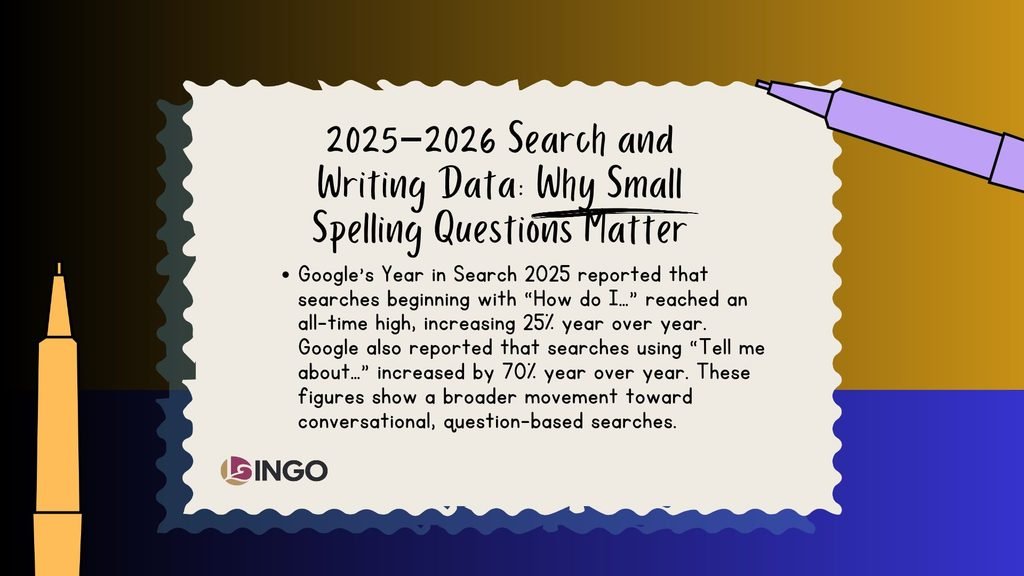
2025–2026 Search and Writing Data: Why Small Spelling Questions Matter
People Are Asking More Conversational Search Questions
Google’s Year in Search 2025 reported that searches beginning with “How do I…” reached an all-time high, increasing 25% year over year. Google also reported that searches using “Tell me about…” increased by 70% year over year. These figures show a broader movement toward conversational, question-based searches.
That matters for spelling and grammar content because users increasingly phrase simple language questions naturally, such as:
- “How do you spell putting?”
- “Is puting correct?”
- “Why does putting have two Ts?”
- “Is putting a word?”
Spelling Accuracy Still Matters in Digital Communication
In 2025, Grammarly’s research and case studies continued to focus on the importance of clear written communication. For example, Grammarly reported that Iterable users improved 93% of their communications and saved an average of 1.8 hours per week per user after adopting its writing assistance tools. These figures come from Grammarly’s own case study and should be understood as reported results for that organization, rather than a universal measurement of writing performance.
The lesson for individual writers is straightforward: even a single missing letter can be worth checking when accuracy and professionalism matter.
What This Means for “Putting”
A spelling question such as puting vs. putting may look small, but answering it clearly helps readers:
- avoid repeated spelling mistakes
- improve proofreading
- write more confidently
- understand verb forms
- communicate more professionally
Putting vs. Puting: Quick Comparison Checklist
| Question | Puting | Putting |
|---|---|---|
| Standard English spelling? | No | Yes |
| Present participle of “put”? | No | Yes |
| Used in “putting away”? | No | Yes |
| Used in “putting together”? | No | Yes |
| Appropriate for formal writing? | No | Yes |
| Has two consecutive Ts? | No | Yes |
The Three-Step Check
When you are unsure, follow these steps:
Step 1: Identify the base verb: put.
Step 2: Identify the intended form: -ing form.
Step 3: Write the standard form: putting.
That is all you need
Mini Quiz:.Puting vs. Putting
1. Which spelling is correct for the -ing form of “put”?
A. Puting
B. Putting
C. Puttin
D. Puteing
Answer: B. Putting
2. Choose the correctly spelled sentence.
A. She is puting the dishes away.
B. She is putting the dishes away.
C. She is puteing the dishes away.
D. She is puttin the dishes away.
Answer: B. She is putting the dishes away.
3. How many consecutive t’s are in “putting”?
A. One
B. Two
C. Three
D. None
Answer: B. Two
4. Complete the sentence: “They are ___ the chairs in the room.”
A. puting
B. putting
C. puttin
D. puteing
Answer: B. putting
5. Which is the correct present participle of “put”?
A. puting
B. putted
C. putting
D. puteing
Answer: C. putting
6. Which sentence uses “putting” correctly?
A. I am putting my keys on the table.
B. I am puting my keys on the table.
C. I am puteing my keys on the table.
D. I am puttin my keys on the table.
Answer: A. I am putting my keys on the table.
7. Which spelling should be used in formal English writing?
A. puting
B. putting
C. puttin
D. puteing
Answer: B. putting
8. Complete the sentence: “He is ___ off the meeting until Friday.”
A. puting
B. putting
C. puttin
D. puteing
Answer: B. putting
9. What is the base verb of “putting”?
A. put
B. putt
C. pote
D. place
Answer: A. put
10. Which sentence is spelled correctly?
A. She is putting on her coat.
B. She is puting on her coat.
C. She is puteing on her coat.
D. She is puttin on her coat.
Answer: A. She is putting on her coat.
11. Which spelling is incorrect when intended as the -ing form of “put”?
A. putting
B. putting together
C. putting away
D. puting
Answer: D. puting
12. Complete the sentence: “We are ___ together a new plan.”
A. puting
B. putting
C. puttin
D. puteing
Answer: B. putting
13. Is “putting” the past tense of “put”?
A. Yes, always
B. Yes, in formal English
C. No, it is the -ing form
D. Only in questions
Answer: C. No, it is the -ing form
14. Which word correctly completes: “She keeps ___ off her homework”?
A. puting
B. putting
C. puttin
D. puteing
Answer: B. putting
15. Which form shows the correct spelling?
A. put + ing = puting
B. put + ing = putting
C. put + ing = puteing
D. put + ing = puttin
Answer: B. put + ing = putting
16. Which sentence contains the correct spelling?
A. They are putting the books away.
B. They are puting the books away.
C. They are puttin the books away.
D. They are puteing the books away.
Answer: A. They are putting the books away.
17. Which word is the standard spelling for the -ing form of “put”?
A. puting
B. putting
C. puttin
D. puteing
Answer: B. putting
18. Which sentence is grammatically and orthographically correct?
A. We were putting the tables outside.
B. We were puting the tables outside.
C. We were puttin the tables outside.
D. We were puteing the tables outside.
Answer: A. We were putting the tables outside.
19. Which word is used in the expression “___ together”?
A. puting
B. putting
C. puttin
D. puteing
Answer: B. putting
20. Which spelling should replace “puting” in “I am puting my phone away”?
A. puttin
B. putting
C. puteing
D. puted
Answer: B. putting
21. Which word is correctly spelled in “Putting things off can cause delays”?
A. Putting
B. Puting
C. Puttin
D. Puteing
Answer: A. Putting
22. Complete the sentence: “She is ___ the files into folders.”
A. puting
B. putting
C. puttin
D. puteing
Answer: B. putting
23. Which statement about “putting” is correct?
A. It is the standard -ing form of put.
B. It is the past tense of put.
C. It is an alternate spelling of puting.
D. It is unrelated to the verb put.
Answer: A. It is the standard -ing form of put.
24. Which sentence is appropriate for a professional email?
A. I am puting together the report.
B. I am putting together the report.
C. I am puttin together the report.
D. I am puteing together the report.
Answer: B. I am putting together the report.
25. What is an easy way to remember the spelling of “putting”?
A. Remember one t
B. Remember two t’s
C. Remove the final g
D. Add an extra e
Answer: B. Remember two t’s
Quick Answer Key
1-B, 2-B, 3-B, 4-B, 5-C, 6-A, 7-B, 8-B, 9-A, 10-A, 11-D, 12-B, 13-C, 14-B, 15-B, 16-A, 17-B, 18-A, 19-B, 20-B, 21-A, 22-B, 23-A, 24-B, 25-B
Frequently Asked Questions About Puting vs. Putting
Is “puting” a correct spelling?
No. When you mean the -ing form of the verb “put,” the standard spelling is putting, with two t’s.
How do you spell putting?
The correct spelling is putting:
P-U-T-T-I-N-G
It contains two consecutive t’s.
Why does putting have two Ts?
Putting is the standard present participle of put. The correct spelling is established as putting, rather than the incorrectly formed puting.
Is putting a verb?
Yes. Putting is the present participle of put. It can appear in progressive verb constructions, such as:
She is putting the books away.
It can also function as a gerund:
Putting things off can cause problems.
Is “putting” the past tense of put?
No. The past tense of put is put, not putting.
For example:
- Present: I put the book here.
- Past: I put the book here yesterday.
- Progressive: I am putting the book here now.
What is the difference between put and putting?
Put is the base form and also the past and past participle form. Putting is the -ing form.
Examples:
Please put the keys on the table.
She is putting the keys on the table.
How can I remember the spelling of putting?
Use the simple memory aid:
Put + ting = putting
Remember that putting has two Ts.
Is putting used in both American and British English?
Yes. Putting is standard English in both American and British usage when it is the present participle or gerund of put.
Conclusion: Puting vs. Putting
When comparing puting vs. putting, the answer is clear: putting is the correct spelling.
The word is the -ing form of “put” and appears in sentences such as:
“She is putting the books away.”
“They are putting together a new plan.”
“He keeps putting off the meeting.”
The incorrect form puting is a common spelling mistake, but it is easy to avoid once you remember that putting has two Ts.
If you are writing an email, essay, blog post, school assignment, or professional document, take a second to check this word before publishing or sending your work.
For more clear explanations of commonly confused English words and grammar rules, explore the other language guides on Lingorixa.
References
Cambridge Dictionary – Putting
Cambridge Dictionary – Put

Maimoona Asghar is a grammar enthusiast and language writer who creates clear, practical content to help learners improve English grammar, writing, punctuation, and communication skills through easy-to-understand explanations and examples.