Introduction
Vendor or vender? If you have ever stopped while writing an email, report, contract, or article because you were unsure which spelling to use, you are not alone. The two words look and sound almost identical, but their usage is not equally common.
The simple answer is: vendor is the standard and preferred spelling in modern English, while vender is a recognized but much less common variant. Cambridge lists vender as a U.S. commerce form that points readers to vendor, while its Business English dictionary gives vendor as the main form.
In this guide, you will learn what vendor means, whether vender is technically correct, how the two forms differ, which spelling is best for professional writing, and how to use the word naturally in sentences.
Vendor or Vender: Which Spelling Is Correct?
Vendor is the preferred spelling
Vendor is the spelling you should normally use in modern English.
A vendor is a person or company that sells goods or services. Cambridge defines the word as someone who sells something and also gives the business meaning of a company or person selling a particular product.
For example:
- We found a reliable vendor for office supplies.
- The software vendor released a new update.
- A food vendor was selling sandwiches outside the stadium.
- The company signed a contract with a new vendor.
The word works in both everyday and professional contexts.
Is vender a correct word?
Yes. Vender is a real word, but it is much less common.
Cambridge’s Business English Dictionary lists vender as a U.S. commerce form and directs readers to vendor. Merriam-Webster’s current entry likewise lists vender among the variants of vendor.
Therefore, saying that vender can never be correct would be too strong. It exists, but vendor is the better default choice for contemporary writing.
The quick answer
Vendor = standard and preferred spelling
Vender = legitimate but less common variant
If you are writing a business email, website, report, academic assignment, or professional document, choose vendor.
What Does Vendor Mean?
Definition of vendor
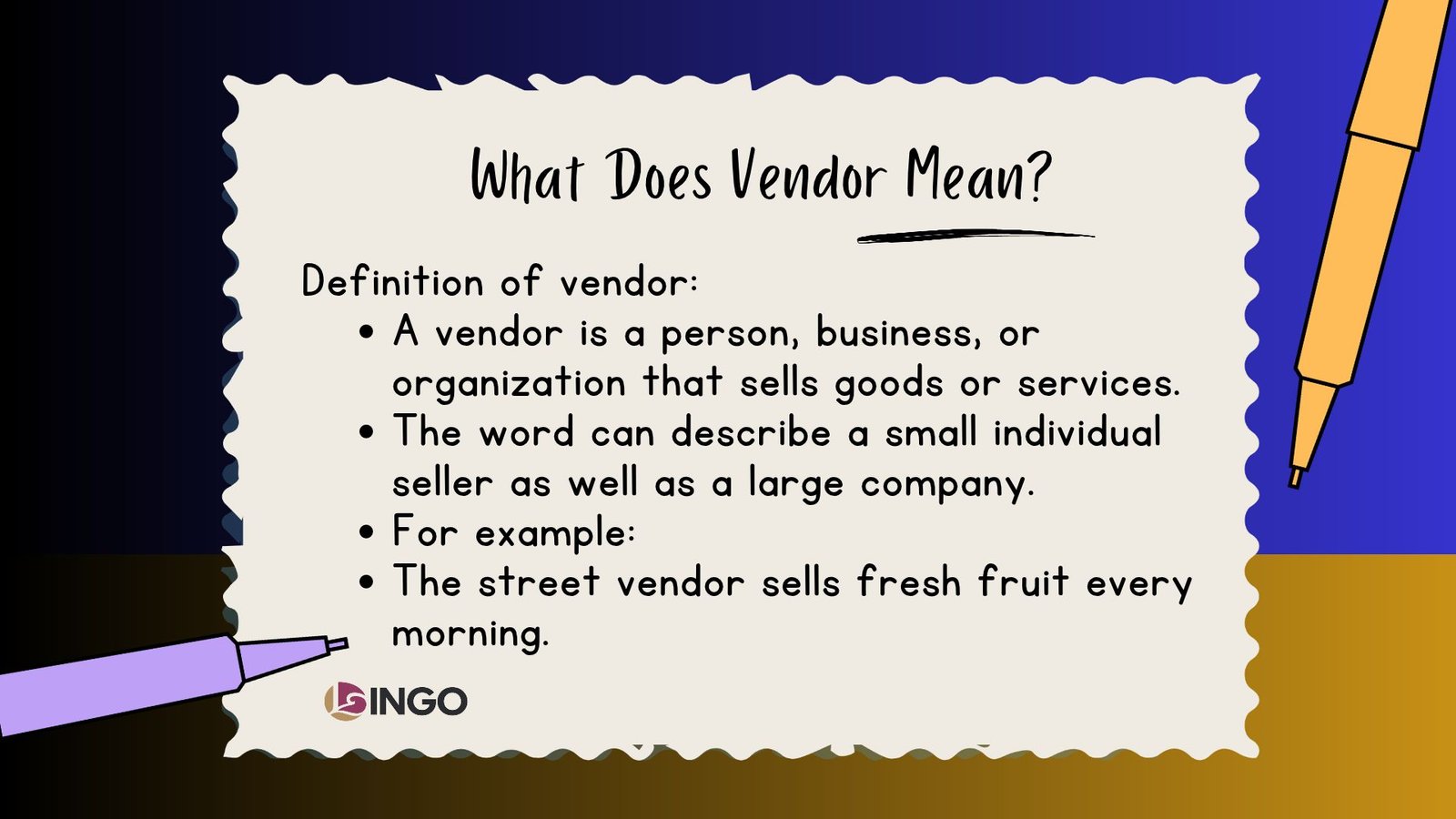
A vendor is a person, business, or organization that sells goods or services.
The word can describe a small individual seller as well as a large company.
For example:
The street vendor sells fresh fruit every morning.
Here, vendor refers to an individual seller.
Now consider:
Our company uses a cloud software vendor.
Here, vendor refers to a business that provides a service.
Cambridge gives examples involving street vendors, software vendors, and companies that sell products.
Common types of vendors
You may see vendor used in many different contexts:
- Food vendor — someone who sells food
- Street vendor — someone who sells goods from a street location
- Software vendor — a company that sells software
- Technology vendor — a company supplying technology products or services
- Online vendor — a seller operating through the internet
- Retail vendor — a business selling products
- Property vendor — a person selling property, especially in legal or real-estate contexts
For example:
We compared three software vendors before making our decision.
The meaning is clear: three companies that provide software were considered.
Vendor example sentences
Here are several natural examples:
- The vendor delivered the equipment on Monday.
- We are looking for a reliable vendor.
- Several food vendors attended the festival.
- The company changed its primary technology vendor.
- The buyer negotiated directly with the vendor.
- Our approved vendor offers better pricing.
- The online vendor shipped the order within two days.
Vendor vs. Vender: What’s the Difference?
Vendor or vender in modern English
The biggest difference between vendor and vender is not their basic meaning. Both can refer to someone who sells something.
The major difference is usage and frequency.
| Feature | Vendor | Vender |
|---|---|---|
| Meaning | A person or company that sells | A person or business that sells |
| Dictionary status | Standard word | Recognized variant |
| Modern usage | Very common | Much less common |
| Business writing | Preferred | Uncommon |
| Technology | Very common | Rare |
| E-commerce | Common | Rare |
| Professional documents | Recommended | Usually avoided |
| Best choice today | Vendor | Usually vendor |
Cambridge specifically gives vendor as the main Business English form and identifies vender as a U.S. variant.
Why does vender look so natural?
The confusion is understandable because both forms have the same pronunciation in common usage.
The word is also related to vend, which means “to sell.” Cambridge defines vend as a formal commerce verb meaning to sell something.
That connection can make vender look perfectly logical. However, spelling is not always determined simply by adding an ending to a verb. English contains many historical spellings that have developed different levels of popularity over time.
Which one should you use?
A useful rule is:
When in doubt, write vendor.
For example:
Preferred:
We need to contact the vendor about the delayed shipment.
Less common:
We need to contact the vender about the delayed shipment.
The first version is the natural choice for modern business English.
When Should You Use Vendor?
Use vendor in professional writing
Vendor is especially appropriate in professional communication.
Use it in:
- Business emails
- Contracts
- Procurement documents
- Reports
- Invoices
- Company websites
- Software documentation
- Academic writing
- Marketing materials
For example:
Please send the completed form to the approved vendor.
This sounds natural and professional.
Use vendor for people and companies
A vendor does not have to be a large corporation.
For example:
A local vendor supplied the decorations for the event.
Here, vendor refers to a local business.
Similarly:
The street vendor sold handmade bracelets.
The word can therefore cover a broad range of sellers.
Common phrases with vendor
Some common combinations include:
- vendor agreement
- vendor management
- vendor list
- vendor payment
- vendor relationship
- approved vendor
- preferred vendor
- software vendor
- hardware vendor
- local vendor
- online vendor
- food vendor
These established combinations are another reason vendor is the safest spelling for professional communication.
Case Study: Choosing Vendor in a Business Email
A practical vendor or vender example
Imagine that a purchasing manager is preparing an email for a company’s finance department. The company works with several suppliers and needs to review its contracts before the next financial quarter.
The manager initially writes:
“We need to review the agreements with all our current venders before Friday.”
At first glance, the sentence seems fine. The meaning is obvious, and vender is not simply a meaningless collection of letters. It is a recognized variant found in dictionaries.
However, the manager is preparing a formal business email. The audience includes senior managers, accountants, and external business partners. In this situation, vendor is the more conventional choice:
“We need to review the agreements with all our current vendors before Friday.”
The revised version immediately fits standard business usage.
The same principle applies throughout the company’s documents. A procurement spreadsheet might contain headings such as Vendor Name, Vendor ID, and Vendor Payment Status. A contract might use Vendor Agreement, while a technology report could discuss Software Vendors.
None of this means that vender is incomprehensible. Rather, the issue is consistency and modern convention. When a writer has a choice between a very common standard form and a much less common variant, the standard form usually provides the clearest experience for readers.
That is why vendor is the practical choice for contemporary professional writing. It communicates the intended meaning immediately and avoids making readers wonder whether the spelling is accidental.
Vendor Usage: What Current Evidence Shows
Dictionary evidence in 2026
Current dictionary entries provide useful evidence about the status of these spellings.
Merriam-Webster’s entry for vendor was updated in March 2026 and identifies vender among its variants. It also records the first known use of vendor in the relevant sense as 1594.
Cambridge currently lists vendor as the primary word and separately lists vender as a U.S. commerce variant that points back to vendor.
2025–2026 usage snapshot
There is no authoritative 2025–2026 global word-count dataset that establishes an exact percentage split between vendor and vender. Therefore, it would be misleading to invent a precise usage percentage.
However, the current dictionary evidence is clear:
- Cambridge’s main English and Business English entries are headed vendor.
- Cambridge lists vender separately as a U.S. commerce variant pointing to vendor.
- Merriam-Webster’s 2026 entry lists vender as a variant of vendor.
- Merriam-Webster records 1594 as the first known use of vendor in the defined sense.
This evidence supports a practical conclusion: vendor is the established modern form, while vender remains a recognized but less common alternative.
What the data means for writers
For content creators, students, and professionals, the lesson is simple.
You do not need to avoid vender because it is impossible to understand. Instead, choose vendor because it is the form readers are most accustomed to seeing in modern commercial and professional contexts.
How to Remember Vendor vs. Vender
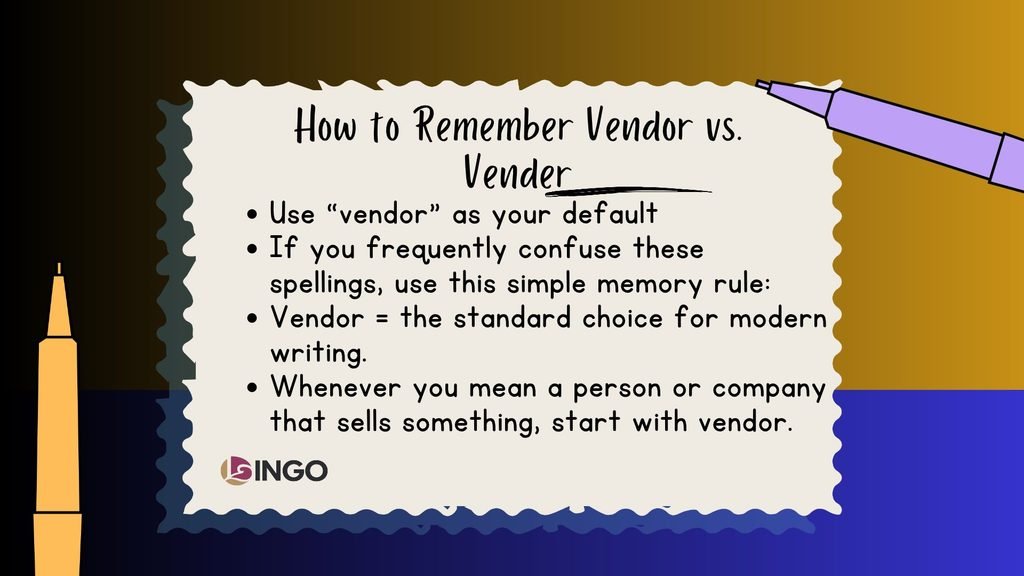
Use “vendor” as your default
If you frequently confuse these spellings, use this simple memory rule:
Vendor = the standard choice for modern writing.
Whenever you mean a person or company that sells something, start with vendor.
For example:
We selected a new vendor for our office furniture.
Think of common business phrases
Another useful trick is to remember familiar phrases:
- vendor contract
- vendor management
- vendor payment
- vendor list
- software vendor
- approved vendor
You will rarely see these expressions written with vender in contemporary professional communication.
Check before sending important writing
If you are preparing an important document and hesitate, take a second to check the spelling.
A quick proofreading step can prevent unnecessary distractions in:
- Resumes
- Business proposals
- Emails
- Reports
- Website content
- Contracts
- Academic work
The goal is not simply to avoid mistakes. It is to make your writing look natural and polished.
Mini Quiz:Vendor or Vender
1. Which spelling is preferred in modern English for a person or company that sells goods or services?
A. Vendor
B. Vender
C. Vandor
D. Vendur
Answer: A. Vendor
2. Which sentence uses the preferred spelling correctly?
A. We contacted the vendor about the shipment.
B. We contacted the vandor about the shipment.
C. We contacted the vendur about the shipment.
D. We contacted the vendar about the shipment.
Answer: A. We contacted the vendor about the shipment.
3. What does the noun “vendor” generally mean?
A. A person or company that sells goods or services
B. A person who only buys products
C. A person who only repairs machines
D. A person who only transports packages
Answer: A. A person or company that sells goods or services
4. Which spelling is most appropriate in a formal business report?
A. Vendor
B. Vender
C. Vandor
D. Vendar
Answer: A. Vendor
5. Which phrase uses the standard spelling?
A. Software vendor
B. Software vender
C. Software vandor
D. Software vendur
Answer: A. Software vendor
6. Is “vender” a recognized English word?
A. Yes, as a less common variant
B. No, it is never recognized
C. Only as a verb
D. Only as a plural noun
Answer: A. Yes, as a less common variant
7. Which word is the safest default when writing for a modern general audience?
A. Vendor
B. Vender
C. Vandor
D. Vendar
Answer: A. Vendor
8. Which sentence correctly refers to several sellers?
A. Several vendors attended the market.
B. Several vandors attended the market.
C. Several vendurs attended the market.
D. Several vendars attended the market.
Answer: A. Several vendors attended the market.
9. Which spelling is especially common in technology business terminology?
A. Vendor
B. Vender
C. Vandor
D. Vendar
Answer: A. Vendor
10. Which sentence is written with the preferred spelling?
A. The company selected a new vendor.
B. The company selected a new vender.
C. The company selected a new vandor.
D. The company selected a new vendur.
Answer: A. The company selected a new vendor.
11. Which phrase is normally preferred in procurement writing?
A. Vendor agreement
B. Vender agreement
C. Vandor agreement
D. Vendar agreement
Answer: A. Vendor agreement
12. Which word is closely related to “vendor” and means “to sell”?
A. Vend
B. Lend
C. Mend
D. Send
Answer: A. Vend
13. Which spelling should generally be used in a professional email about a supplier?
A. Vendor
B. Vender
C. Vandor
D. Vendur
Answer: A. Vendor
14. Which sentence uses the word in a natural everyday context?
A. The street vendor sells fresh fruit.
B. The street vender sells fresh fruit.
C. The street vandor sells fresh fruit.
D. The street vendar sells fresh fruit.
Answer: A. The street vendor sells fresh fruit.
15. What is the main practical difference between “vendor” and “vender”?
A. Usage frequency and preference
B. One means buyer and one means seller
C. One is always a verb and one is always a noun
D. One refers only to online businesses
Answer: A. Usage frequency and preference
16. Which form is commonly used in the phrase “vendor management”?
A. Vendor
B. Vender
C. Vandor
D. Vendar
Answer: A. Vendor
17. Which statement about “vender” is accurate?
A. It is a recognized but uncommon variant of vendor.
B. It is always a spelling error.
C. It means the opposite of vendor.
D. It is used only as a plural form.
Answer: A. It is a recognized but uncommon variant of vendor.
18. Which spelling would usually look most natural on a company website?
A. Vendor
B. Vender
C. Vandor
D. Vendar
Answer: A. Vendor
19. Which sentence uses the standard spelling for multiple suppliers?
A. The vendors submitted their proposals.
B. The venders submitted their proposals.
C. The vandors submitted their proposals.
D. The vendurs submitted their proposals.
Answer: A. The vendors submitted their proposals.
20. Choose the correct word:
“We need a reliable _____ for our office supplies.”
A. Vendor
B. Vender
C. Vandor
D. Vendar
Answer: A. Vendor
21. Which term refers to a company that provides or sells software?
A. Software vendor
B. Software vender
C. Software vandor
D. Software vendar
Answer: A. Software vendor
22. Which spelling is recommended for most students writing an English assignment?
A. Vendor
B. Vender
C. Vandor
D. Vendur
Answer: A. Vendor
23. What is the plural of “vendor”?
A. Vendors
B. Vendor’s
C. Vendories
D. Vendoren
Answer: A. Vendors
24. Which statement best summarizes the relationship between “vendor” and “vender”?
A. They have essentially the same meaning, but vendor is preferred.
B. They have completely opposite meanings.
C. Vendor is a verb and vender is an adjective.
D. Vender is the only accepted modern form.
Answer: A. They have essentially the same meaning, but vendor is preferred.
25. If you are unsure whether to write “vendor” or “vender,” which is the best general rule?
A. Use vendor.
B. Always use vender.
C. Use vandor.
D. Use vendar.
Answer: A. Use vendor.
Frequently Asked Questions
Q1:Is vendor or vender correct?
Vendor is the standard and preferred spelling in modern English. Vender is also recognized as a variant, but it is much less common.
Q2:Is “vender” a real word?
Yes. Vender is a recognized English noun meaning a person who sells something. Cambridge lists it as a U.S. commerce variant of vendor.
Q3:Is vendor the correct spelling in business English?
Yes. Vendor is the preferred choice in business English. Cambridge’s Business English Dictionary uses vendor as the main form and lists vender as a U.S. variant.
Q4:What is the difference between vendor and vender?
Both words can refer to a person or business that sells goods or services. The main difference is that vendor is much more common and is the preferred modern spelling, while vender is a less common variant.
Q5:Should I use vendor or vender in a formal email?
Use vendor. It is the conventional spelling for professional and business communication.
For example:
We are reviewing proposals from three vendors.
Q6:Is vender an American spelling?
Cambridge specifically labels vender as a U.S. commerce variant. However, vendor remains the main form in modern English.
Q7:What is the plural of vendor?
The plural is vendors.
Example:
Several vendors submitted bids for the project.
The plural form of vender would be venders, but that spelling is much less common.
Q8:Does vendor mean seller?
Yes. A vendor is essentially a seller, although in business contexts the word often refers to a person or company supplying products or services to another organization. Cambridge gives both general selling and business meanings.
Conclusion
So, vendor or vender? The best answer for modern writing is vendor.
A vendor is a person, company, or organization that sells goods or services. Although vender is a legitimate variant recognized by major dictionaries, it is much less common and is not normally the spelling you should choose for everyday or professional writing.
If you are writing an email, report, contract, blog post, website, or business document, stick with vendor. It is clear, familiar, and widely accepted.
Remember: Vendor is the preferred modern spelling; vender is a less common variant.
If this guide helped you solve the vendor or vender spelling question, explore more practical English usage guides to strengthen your writing and avoid common spelling mistakes.
For more clear explanations of commonly confused English words and grammar rules, explore the other language guides on Lingorixa.
References
Cambridge Dictionary — Vendor
Cambridge Dictionary — Vender

Maimoona Asghar is a grammar enthusiast and language writer who creates clear, practical content to help learners improve English grammar, writing, punctuation, and communication skills through easy-to-understand explanations and examples.