Have you ever typed “spicey” and then wondered whether it should actually be “spicy”? You are not alone. The spelling can be confusing because the noun spice ends with the letter e, so it may seem logical to add -y and write spicey.
However, the standard spelling is spicy.
Whether you are writing about spicy food, a spicy sauce, or even a “spicy” conversation, spicy is the form you should normally use in modern English. Major dictionaries such as Cambridge and Oxford list spicy as the standard adjective. Merriam-Webster also records spicey as a variant spelling, which helps explain why you may occasionally encounter it.
This guide explains spicy vs. spicey, what the word means, why the spelling causes confusion, how to remember the correct form, and how to use it naturally in sentences.
Spicy or Spicey: Which Spelling Is Correct?
The correct and preferred spelling in standard modern English is spicy.
Spicy is an adjective used to describe something that contains or has the strong flavor of spices. It can also describe something exciting, bold, surprising, or slightly provocative depending on the context. Cambridge and Oxford both give these broader uses in addition to the food-related meaning.
The Correct Spelling Is “Spicy”
Use spicy in school assignments, professional writing, articles, recipes, menus, emails, and everyday communication.
Examples:
- The curry is very spicy.
- I ordered a spicy chicken sandwich.
- This sauce has a spicy flavor.
- She loves spicy food.
- That was a spicy comment.
Is “Spicey” Wrong?
Spicey is not the spelling you should normally choose in standard modern writing.
There is an important nuance, though. Merriam-Webster records spicey as a variant spelling of spicy. Therefore, calling it a completely nonexistent form would be too strong. It does appear in dictionaries and real-world usage, but spicy is the established form you should use when you want conventional modern English.
| Spelling | Recommended? | Example |
|---|---|---|
| Spicy | ✅ Yes | This soup is spicy. |
| Spicey | ⚠️ Variant form | This soup is spicey. |
Quick answer: When in doubt, choose spicy.
Why Is It Spicy, Not Spicey?
The confusion comes from the word spice.
At first glance, it seems natural to form the adjective like this:
spice + y = spicey
But English spelling does not always work by simply attaching a suffix to the complete spelling of a noun.
In this case, the final e is dropped:
spice → spicy
The Simple “Drop the E” Pattern
A useful way to remember the spelling is to compare spicy with other familiar words:
- ice → icy
- juice → juicy
- shine → shiny
- noise → noisy
- spice → spicy
These examples show why spicy looks different from the noun spice.
The important point is that you should remember the adjective as its own spelling rather than trying to construct it every time from spice.
Why Does “Spicey” Look So Natural?
English contains many words where a final e remains before another ending, so writers may naturally assume that spicey follows the same pattern.
The visual connection between spice and spicey is especially strong. A reader can immediately recognize the base word, which makes the extra e feel reasonable.
However, the standard adjective is spelled:
SPICY
not:
SPICEY
That small difference is responsible for many spelling mistakes.
An Easy Memory Trick
Think:
Spice loses its E before becoming spicy.
You can remember it as:
SPICE − E + Y = SPICY
Once you memorize that simple pattern, the spelling becomes much easier.
What Does “Spicy” Mean?
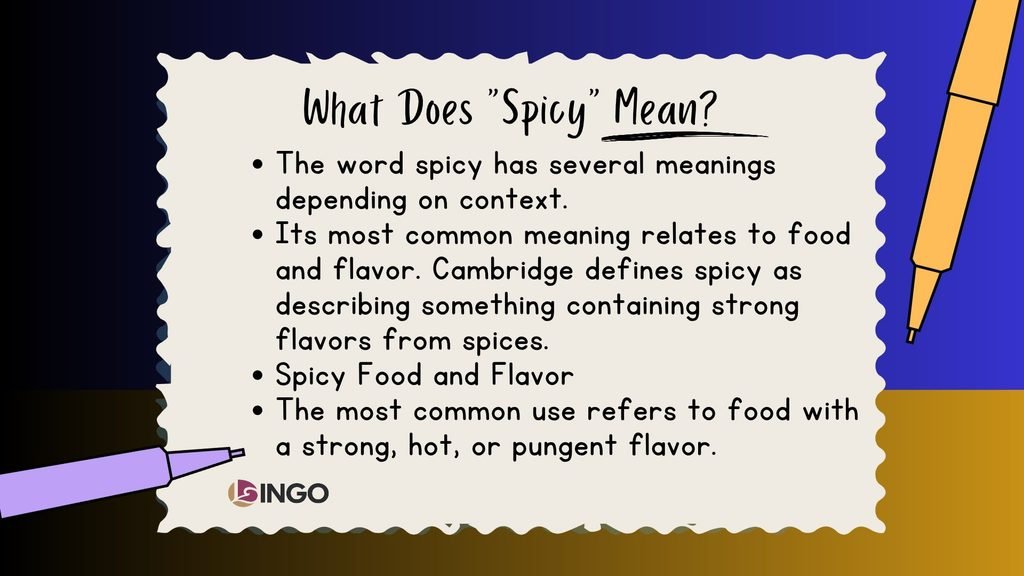
The word spicy has several meanings depending on context.
Its most common meaning relates to food and flavor. Cambridge defines spicy as describing something containing strong flavors from spices.
Spicy Food and Flavor
The most common use refers to food with a strong, hot, or pungent flavor.
Examples:
- I love spicy noodles.
- This curry is too spicy for me.
- She prepared a spicy tomato sauce.
- The restaurant serves spicy chicken wings.
- Would you like your food mild or spicy?
Notice that spicy describes the food, sauce, dish, or flavor.
Spicy Can Mean Exciting or Bold
The meaning is not limited to food.
English speakers can also use spicy informally to describe something exciting, surprising, dramatic, or provocative. Oxford gives an informal sense involving a story or piece of news that is exciting and slightly shocking.
For example:
- The interview contained some spicy details.
- That was a spicy debate.
- She made a spicy comment during the meeting.
- The movie has a few spicy scenes.
The exact meaning depends on the context.
Spicy vs. Hot
The words spicy and hot can overlap when talking about food, but they are not always identical.
Hot can describe temperature:
The soup is hot.
Spicy usually describes flavor or heat caused by ingredients such as chili peppers or other spices:
The soup is spicy.
Therefore, a soup can be hot but not spicy, or spicy but served cold.
For example, a cold salsa can still be extremely spicy.
Spicy vs. Spicey: Examples You Can Use
The easiest way to learn the difference is to see the correct spelling in real sentences.
Correct “Spicy” Examples
Here are several natural examples:
- This curry is incredibly spicy.
- I cannot eat very spicy food.
- She ordered a spicy chicken burger.
- The sauce has a spicy garlic flavor.
- We made the noodles less spicy for the children.
- He enjoys spicy Mexican food.
- That was a surprisingly spicy comment.
- The restaurant is famous for its spicy dishes.
Incorrect “Spicey” Examples
These sentences use the nonpreferred spelling:
- ❌ This curry is very spicey.
- ❌ I love spicey noodles.
- ❌ The restaurant serves spicey chicken.
- ❌ This sauce is too spicey.
In standard writing, change them to:
- ✅ This curry is very spicy.
- ✅ I love spicy noodles.
- ✅ The restaurant serves spicy chicken.
- ✅ This sauce is too spicy.
Comparison at a Glance
| Incorrect or nonpreferred | Correct and preferred |
|---|---|
| spicey food | spicy food |
| spicey sauce | spicy sauce |
| spicey curry | spicy curry |
| spicey chicken | spicy chicken |
| spicey comment | spicy comment |
The meaning does not normally change. The main issue is the spelling.
A Real-Life Example: Why the Mistake Happens
Imagine that Sara is writing a restaurant review for her blog. She wants to describe a new chicken curry she tried.
She types:
“The curry was delicious but extremely spicey.”
Before publishing, she pauses. She knows that the noun is spice, so spicey looks logical. She also knows that words such as icy are spelled without an extra e, but she is unsure whether the same rule applies here.
She checks a dictionary and finds spicy as the standard adjective. Cambridge lists spicy as an adjective meaning that food contains strong flavors from spices, while Oxford likewise gives spicy as the standard form.
Sara therefore changes her sentence to:
“The curry was delicious but extremely spicy.”
This is a useful real-life lesson because the mistake is not caused by misunderstanding the meaning. Sara knows exactly what she wants to say. The problem is simply that spicey looks like a logical spelling based on the noun spice.
This is why the best solution is not to overthink the rule every time. Instead, memorize the standard adjective:
spice → spicy
The same strategy works for many spelling questions. When a word looks familiar but something feels uncertain, checking a reputable dictionary is safer than relying entirely on what “looks right.”
2025–2026 Usage and Dictionary Snapshot
Current dictionary evidence continues to show spicy as the established form.
Merriam-Webster’s spicy usage page was updated on March 4, 2026 and contains numerous real-world examples of spicy from published sources. Its examples include uses from 2025 and 2026, demonstrating that the spelling remains actively used in contemporary English.
There is also evidence that spicy remains productive beyond traditional food descriptions. In February 2026, Cambridge Dictionary’s language blog discussed new words such as fricy, meaning a combination of fruity and spicy flavors, and spour, referring to spicy-and-sour flavor combinations.
What the Recent Evidence Shows
A simple 2025–2026 snapshot is:
- 2025: Merriam-Webster’s examples include contemporary uses such as “spicy salsa” and other food-related descriptions.
- 2026: Merriam-Webster’s current example set includes spicy in contemporary food and descriptive contexts.
- 2026: Cambridge discussed new compounds built around the concept of spicy, including fricy and spour, showing continued linguistic productivity around the word.
- Current dictionaries: Cambridge and Oxford continue to present spicy as the standard adjective.
This is not a claim that spicey has never appeared. In fact, Merriam-Webster records it as a variant spelling. The practical takeaway is simply that spicy is the safest and most widely expected spelling for modern standard writing.
How to Remember the Correct Spelling of Spicy
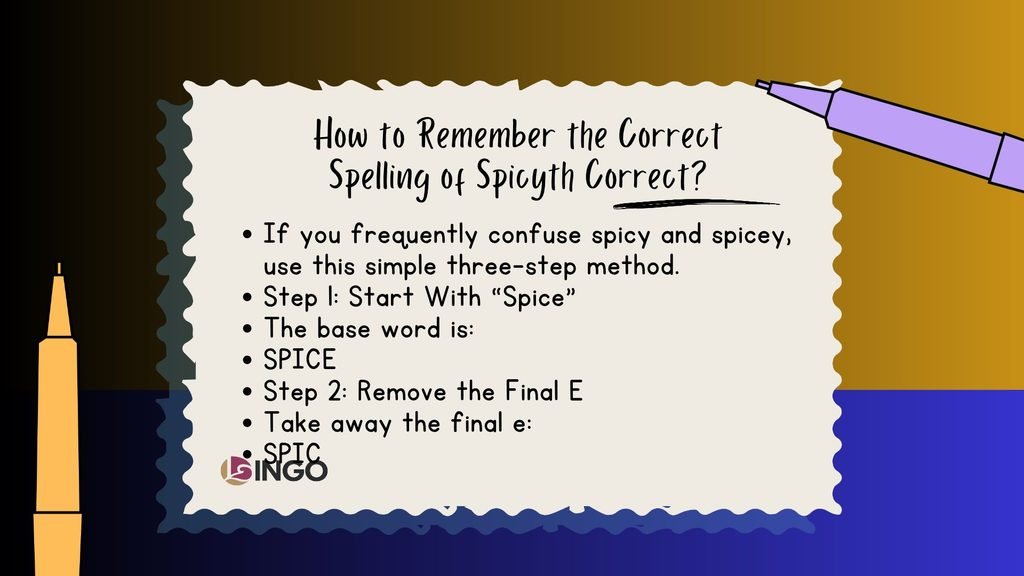
If you frequently confuse spicy and spicey, use this simple three-step method.
Step 1: Start With “Spice”
The base word is:
SPICE
Step 2: Remove the Final E
Take away the final e:
SPIC
Step 3: Add Y
Now add y:
SPIC + Y = SPICY
That gives you the standard spelling.
Use This Memory Line
Spice loses the E and becomes spicy.
You can also remember these pairs:
| Base word | Adjective |
|---|---|
| ice | icy |
| juice | juicy |
| noise | noisy |
| shine | shiny |
| spice | spicy |
This isn’t a rule that should be applied mechanically to every English word, but it is a helpful memory device for this particular spelling.
Mini Quiz:Spicy or Spicey
- Which spelling is correct?
- A) Spicey
- B) Spicy
- C) Spicie
- D) Spicee
Answer: B) Spicy
- Which sentence is correct?
- A) The curry is very spicey.
- B) The curry is very spicy.
- C) The curry is very spicie.
- D) The curry is very spicey-y.
Answer: B) The curry is very spicy.
- What does spicy usually describe?
- A) A strong or hot flavor
- B) A cold temperature
- C) A sweet smell only
- D) A large size
Answer: A) A strong or hot flavor
- Which word is closely related to spicy?
- A) Space
- B) Spice
- C) Slice
- D) Spoke
Answer: B) Spice
- Which phrase is correct?
- A) Spicy food
- B) Spicey food
- C) Spicie food
- D) Spicyy food
Answer: A) Spicy food
- What happens to the final e in spice when forming spicy?
- A) It is doubled.
- B) It is removed.
- C) It becomes an o.
- D) It stays unchanged.
Answer: B) It is removed.
- Which sentence is correctly spelled?
- A) I love spicey noodles.
- B) I love spicy noodles.
- C) I love spicie noodles.
- D) I love spice noodlesy.
Answer: B) I love spicy noodles.
- Which spelling is preferred in formal writing?
- A) Spicey
- B) Spicy
- C) Spicie
- D) Spice-y
Answer: B) Spicy
- Which sentence uses spicy correctly?
- A) She ordered a spicy pizza.
- B) She ordered a spicey pizza.
- C) She ordered a spicie pizza.
- D) She ordered a spicey-y pizza.
Answer: A) She ordered a spicy pizza.
- What is the comparative form of spicy?
- A) Spiceyer
- B) Spicyer
- C) Spicier
- D) Spiceier
Answer: C) Spicier
- What is the superlative form of spicy?
- A) Spiciest
- B) Spicyest
- C) Spiceyest
- D) Spiceiest
Answer: A) Spiciest
- Which sentence is correct?
- A) This sauce is too spicey.
- B) This sauce is too spicy.
- C) This sauce is too spicie.
- D) This sauce is too spice-y.
Answer: B) This sauce is too spicy.
- Why does spicey look like a logical spelling?
- A) It resembles the noun “spice” with “y” added.
- B) It comes from “space.”
- C) It contains a silent double consonant.
- D) It is formed from “spicy” plus “e.”
Answer: A) It resembles the noun “spice” with “y” added.
- Which spelling should you normally use in a school assignment?
- A) Spicey
- B) Spicie
- C) Spicy
- D) Spice-y
Answer: C) Spicy
- Which sentence is correct?
- A) This curry is spicier than that one.
- B) This curry is spicyer than that one.
- C) This curry is spiceyer than that one.
- D) This curry is spiceier than that one.
Answer: A) This curry is spicier than that one.
- Which phrase is correctly spelled?
- A) A spicey sauce
- B) A spicie sauce
- C) A spicy sauce
- D) A spice saucey
Answer: C) A spicy sauce
- Can spicy describe something other than food?
- A) Yes
- B) No
- C) Only in recipes
- D) Only in British English
Answer: A) Yes
- Which sentence uses the informal non-food meaning of spicy?
- A) That was a spicy comment.
- B) That was a spicey comment.
- C) That was a spicie comment.
- D) That was a spices comment.
Answer: A) That was a spicy comment.
- Which is the correct spelling?
- A) Spicie
- B) Spicey
- C) Spicy
- D) Spiceey
Answer: C) Spicy
- Which sentence is correct?
- A) I cannot eat very spicey food.
- B) I cannot eat very spicy food.
- C) I cannot eat very spicie food.
- D) I cannot eat very spicey-y food.
Answer: B) I cannot eat very spicy food.
- Which word correctly completes the sentence: “The restaurant is famous for its ___ dishes.”
- A) spicey
- B) spicie
- C) spicy
- D) spice-y
Answer: C) spicy
- Which is the easiest way to remember the spelling?
- A) Spice → Spicey
- B) Spice → Spicy
- C) Spice → Spicie
- D) Spice → Spicesy
Answer: B) Spice → Spicy
- Which sentence contains the standard spelling?
- A) This is the spiciest curry I’ve tried.
- B) This is the spiceyest curry I’ve tried.
- C) This is the spicyest curry I’ve tried.
- D) This is the spiceiest curry I’ve tried.
Answer: A) This is the spiciest curry I’ve tried.
- Is spicey sometimes found as a variant spelling?
- A) Yes
- B) No, it has never appeared in English.
- C) Only in mathematical writing.
- D) Only as a verb.
Answer: A) Yes
- Which sentence gives the best general rule for standard writing?
- A) Always write “spicey.”
- B) Always write “spicie.”
- C) Use “spicy” as the standard preferred spelling.
- D) Use either spelling without considering context.
Answer: C) Use “spicy” as the standard preferred spelling.
Frequently Asked Questions About Spicy or Spicey
Q1:Is it “spicy” or “spicey”?
Spicy is the standard and preferred spelling in modern English. Use it in formal, academic, professional, and everyday writing. Merriam-Webster records spicey as a variant spelling, but spicy is the safer standard choice.
Q2:Is “spicey” a real word?
Spicey is a recorded variant spelling, so it does appear in dictionary and historical usage. However, it is not the form you should normally choose in standard modern writing. Merriam-Webster specifically identifies it as a variant of spicy.
Q3:Why is spicy spelled without an e?
The standard spelling is spicy, not spicey. A useful way to remember it is to think of the spelling as spice → spicy, with the final e removed before the y.
Q4:What does spicy mean?
Spicy most commonly means having a strong or hot flavor because of spices. It can also describe something exciting, bold, surprising, or slightly provocative depending on context.
Q5:Is spicy the same in British and American English?
Yes. Spicy is used in both British and American English. There is no standard British-versus-American spelling difference such as colour versus color.
Q6:Can spicy describe something other than food?
Yes. Although its most common meaning relates to food, spicy can also describe a story, comment, debate, situation, or other content that is exciting, provocative, or surprising.
Q7:What is the comparative form of spicy?
The comparative form is spicier, and the superlative form is spiciest.
Examples:
- This curry is spicier than yesterday’s.
- That is the spiciest sauce on the menu.
Q8:What is the easiest way to remember spicy?
Remember:
SPICE → SPICY
Think: drop the final E, then add Y.
Conclusion: Choose Spicy, Not Spicey
So, spicy or spicey which spelling is correct?
The answer is spicy.
Use spicy when describing food with a strong or hot flavor, such as spicy curry, spicy noodles, or spicy sauce. The word can also describe something exciting, bold, or provocative. While spicey is a recorded variant spelling, spicy is the standard form you should use in normal modern English writing.
The easiest memory trick is:
spice → spicy
Drop the final e and add y.
If you have ever written spicey, don’t worry the confusion is understandable because the spelling looks logical. Just remember SPICY for your next email, article, assignment, recipe, or social media post.
For more clear explanations of commonly confused English words and grammar rules, explore the other language guides on Lingorixa.
References
Cambridge Dictionary: Spicy
Oxford Learner’s Dictionaries: Spicy

Maimoona Asghar is a grammar enthusiast and language writer who creates clear, practical content to help learners improve English grammar, writing, punctuation, and communication skills through easy-to-understand explanations and examples.