Poopie or poopy? If you have come across both spellings, you may wonder whether they mean the same thing and which one is correct. The answer is simple: “poopy” is the more established spelling for the adjective, while “poopie” is an alternative, playful, or childish form.
Both forms are connected to the informal word poop, but they can sound different in terms of tone and usage. In this guide, we will explain the difference between poopie and poopy, show you real examples, and help you choose the right form for everyday writing.
What Is the Difference Between Poopie and Poopy?
Poopie or poopy: the quick answer
If you need the conventional spelling, poopy is generally the better choice.
Poopy is an informal adjective associated with poop. It can mean covered with feces, related to feces, or, in childish language, simply connected with the act of pooping.
For example:
- The baby has a poopy diaper.
- The puppy has a poopy paw.
- There is a poopy smell in the room.
Poopie, on the other hand, is an alternative form. It can be used intentionally to make speech sound cute, childish, humorous, or playful.
For example:
“The baby made a poopie.”
Here, poopie sounds more like baby talk than ordinary edited English.
Why do both spellings exist?
English frequently creates informal variations by adding endings to familiar words.
The spelling poopy follows the familiar -y pattern:
poop + y = poopy
The spelling poopie uses -ie, an ending often associated with cute or childish expressions.
Compare:
- dog → doggie
- kitty → kitty
- aunt → auntie
- poop → poopie
Therefore, seeing poopie does not automatically mean that the writer made a spelling mistake. The writer may deliberately be using a playful form.
Is Poopy the Correct Spelling?
Poopy is the standard choice for the adjective
When you need an adjective in ordinary informal English, poopy is the safer choice.
Examples include:
The baby has a poopy diaper.
The dog stepped on something poopy.
The bathroom has a poopy smell.
The word is informal, so it would not normally be appropriate in a formal academic paper or professional report.
For example, instead of:
The laboratory floor was poopy.
A formal report would use more precise language such as:
The laboratory floor was contaminated with fecal matter.
Is poopy a real English word?
Yes. Poopy is an established informal word, although its tone is casual and often childish.
Current dictionary resources also recognize the broader poop word family. Cambridge Dictionary identifies poop as an informal US term for solid bodily waste and as a verb meaning to pass solid waste. It gives poo as the corresponding UK informal term.
So the underlying vocabulary is not simply internet slang. It is part of established informal English.
What does “poopy” mean?
Depending on context, poopy can mean:
- Related to poop
- Covered with or containing feces
- Resembling feces
- Informally unpleasant or bad
- Needing to poop, particularly in childish speech
For example:
The puppy has a poopy bottom.
Here, the meaning is literal.
But:
This computer is being poopy today.
Here, the speaker is using the word humorously to mean that something is performing badly or being annoying.
Poopie vs. Poopy: Examples and Usage
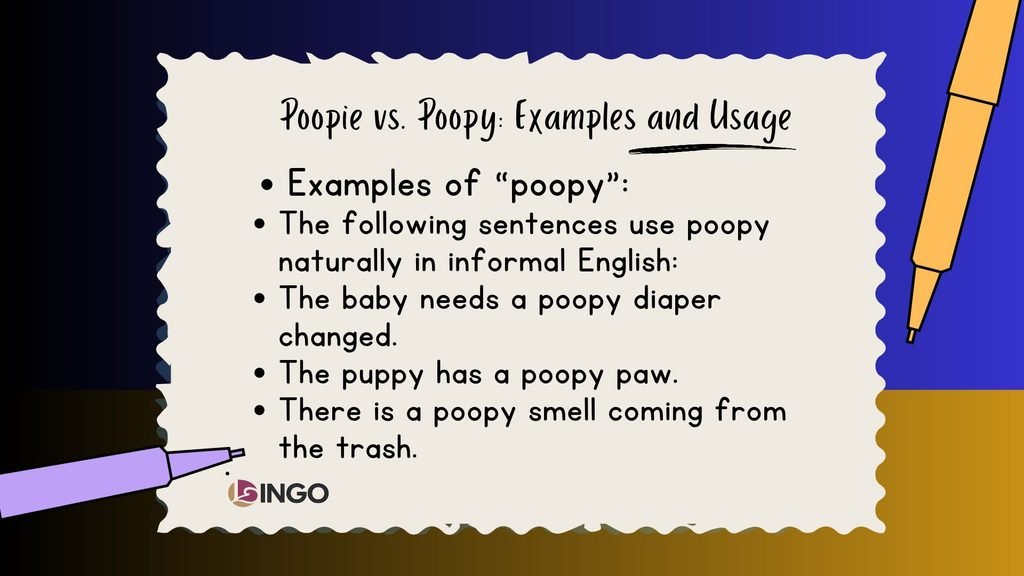
Examples of “poopy”
The following sentences use poopy naturally in informal English:
- The baby needs a poopy diaper changed.
- The puppy has a poopy paw.
- There is a poopy smell coming from the trash.
- The toddler got his shoes poopy.
- The dog left a poopy mess outside.
- That was a poopy excuse.
The last example is figurative and humorous rather than literal.
Examples of “poopie”
Poopie is more suitable when the speaker intentionally wants to sound childish, cute, or silly.
For example:
- “Mommy, I made a poopie!”
- “Uh-oh! That’s a poopie diaper.”
- The toddler laughed when she heard the word poopie.
- The cartoon character calls it a poopie.
In these examples, the unusual spelling contributes to the tone.
Which one should you use?
Use this simple rule:
Use “poopy” for normal informal adjective use. Use “poopie” when you intentionally want a playful or childish effect.
| Situation | Better choice |
|---|---|
| Normal informal writing | Poopy |
| Describing something related to poop | Poopy |
| Children’s dialogue | Poopy or poopie, depending on tone |
| Baby talk | Poopie can work |
| Humorous writing | Either, depending on intended effect |
| Formal writing | Use a more precise formal term |
| Academic writing | Avoid both unless discussing the words themselves |
A Real-Life Example: Choosing the Right Form
A parent talking to a young child
Imagine a parent is toilet-training a three-year-old. The child has an accident and tells the parent what happened.
The parent might say:
“It’s okay. Let’s clean your poopy clothes and put on some clean ones.”
In this situation, poopy works naturally. It is simple, informal, and appropriate for a conversation with a young child.
Now imagine the child repeats the word in a playful way:
“I made a poopie!”
The parent might write this exact sentence in a family story or social media post because the spelling is meant to reproduce the child’s playful speech.
However, if the same event were recorded in a professional setting, the vocabulary would change. A medical or educational report might refer to fecal soiling, an accident, or another appropriate formal description rather than using poopy or poopie.
This example shows why context matters. The question is not always whether one spelling is absolutely “allowed” and the other is “wrong.” Instead, you should consider standard spelling, grammatical function, audience, and tone.
For everyday informal writing, poopy is the stronger choice. For intentionally childish dialogue, poopie can be effective because it visually and stylistically sounds playful. The important thing is to use the spelling deliberately rather than assuming the two forms have identical levels of formality.
What Current 2025–2026 Reference Data Shows
Current dictionary evidence
There is an important distinction between dictionary evidence and search-volume statistics.
Reliable dictionaries establish whether a word or form is documented, but they do not necessarily publish annual Google search-volume percentages for every informal word. Therefore, it would be misleading to invent a “2026 usage percentage” for poopy or poopie.
Current reference evidence is nevertheless useful.
- A current Cambridge Dictionary entry identifies poop as informal US vocabulary and poo as mainly UK informal vocabulary.
- Wiktionary currently lists poopie as an alternative form of poopy.
- The Wiktionary poopie entry records both adjective and noun uses and shows that the page was last edited on May 9, 2026.
- The poopy entry records several informal meanings, including being dirty with feces and being unpleasant or worthless.
This evidence supports a practical conclusion: poopy is the more useful general form for adjective usage, while poopie has a stronger alternative, playful, or childish character.
What the data does not prove
Current dictionary documentation does not prove that poopy is universally more frequent than poopie in every country, community, or online platform.
That distinction matters for trustworthy SEO content. Search frequency, dictionary inclusion, and grammatical correctness are three different things.
Why Does “Poopie” Sound More Childish?
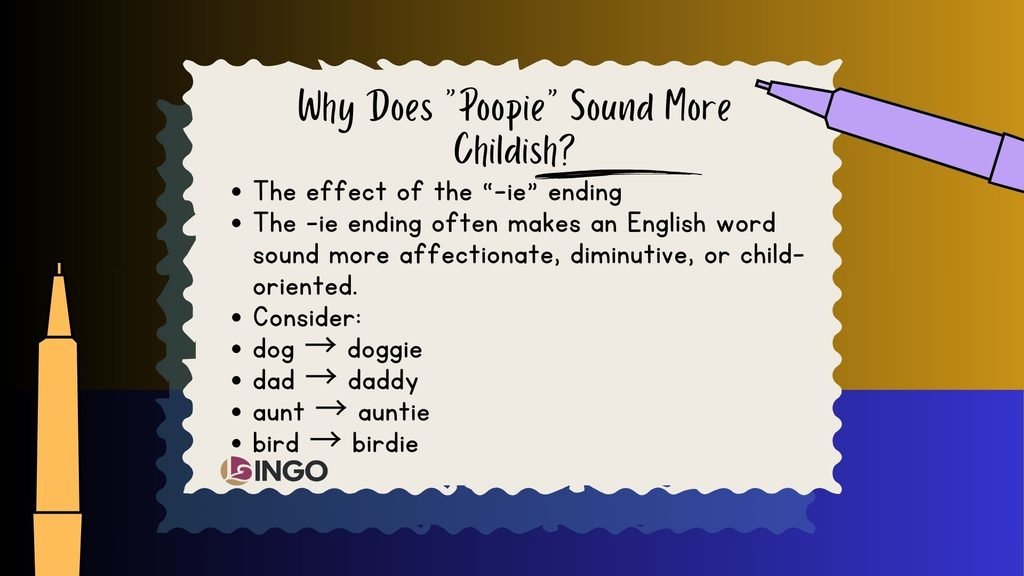
The effect of the “-ie” ending
The -ie ending often makes an English word sound more affectionate, diminutive, or child-oriented.
Consider:
- dog → doggie
- dad → daddy
- aunt → auntie
- bird → birdie
When speakers use poopie, they can create a similar effect.
That is why:
“I need to poop.”
sounds straightforward and informal, while:
“I need to make a poopie.”
sounds noticeably more childish.
Tone can change the meaning
The spelling itself can communicate personality.
Compare:
The dog has a poopy paw.
with:
“Oh no! Your little paw is all poopie!”
The first sentence is a straightforward description. The second deliberately uses a cute, playful tone.
Therefore, poopie is not necessarily an accidental misspelling. Sometimes it is a stylistic choice.
Poopy, Poopie, Poo, and Poop Compared
A simple comparison
| Word | Main role | Typical tone | Example |
|---|---|---|---|
| poop | Noun/verb | Informal | The dog will poop outside. |
| poo | Noun/verb | Mainly UK informal | The child needs to do a poo. |
| poopy | Adjective/noun in slang | Informal/childish | The baby has a poopy diaper. |
| poopie | Alternative playful form | More childish/playful | The child said, “I made a poopie.” |
Cambridge confirms the regional distinction between poop in US English and poo in UK English.
A quick decision checklist
Ask yourself:
- Am I describing something related to poop? → Poopy
- Am I using normal informal English? → Poopy
- Am I deliberately copying baby talk? → Poopie can work
- Am I writing formally? → Use a more precise expression
- Am I writing dialogue for a child? → Choose according to the character’s voice
Mini Quiz:Poopie or Poopy
1. Which spelling is the more conventional informal adjective?
A. Poopy
B. Poopie
C. Poopiey
D. Pooply
Answer: A. Poopy
2. Which sentence uses “poopy” naturally?
A. The baby has a poopy diaper.
B. The baby has a pooply diaper.
C. The baby has a poopiey diaper.
D. The baby has a pooped diaper.
Answer: A. The baby has a poopy diaper.
3. What is the usual tone of “poopie”?
A. Formal
B. Technical
C. Playful
D. Academic
Answer: C. Playful
4. Which word is normally used as an informal noun or verb?
A. Poopy
B. Poop
C. Poopiey
D. Pooply
Answer: B. Poop
5. Which word is best for ordinary informal adjective use?
A. Poopie
B. Poopy
C. Poopiey
D. Pooply
Answer: B. Poopy
6. Which sentence intentionally sounds childlike?
A. I need to use the restroom.
B. I need to make a poopie.
C. I need to visit the bathroom.
D. I need to go to the toilet.
Answer: B. I need to make a poopie.
7. Which word is an adjective in “The puppy has a poopy paw”?
A. Puppy
B. Has
C. Poopy
D. Paw
Answer: C. Poopy
8. Which spelling can be used when reproducing playful baby talk?
A. Poopie
B. Pooply
C. Poopiey
D. Poopedly
Answer: A. Poopie
9. Which term is mainly informal and associated with British English?
A. Poo
B. Poopy
C. Poopie
D. Fecal
Answer: A. Poo
10. Which sentence uses “poopy” figuratively?
A. The puppy has a poopy paw.
B. The baby has a poopy diaper.
C. The dog made a poopy mess.
D. My internet connection is being poopy today.
Answer: D. My internet connection is being poopy today.
11. Which word is least suitable for a formal professional report?
A. Contaminated
B. Fecal
C. Poopy
D. Affected
Answer: C. Poopy
12. What does “poopy” most directly relate to?
A. Poop
B. Puppy
C. Poppy
D. Puffy
Answer: A. Poop
13. Which statement best describes “poopie”?
A. It is always formal.
B. It is a playful alternative form.
C. It is a scientific term.
D. It is the only correct spelling.
Answer: B. It is a playful alternative form.
14. Which sentence best suits a playful children’s story?
A. The character shouted, “I made a poopie!”
B. The laboratory documented fecal contamination.
C. The report recorded fecal matter.
D. The clinical record described fecal soiling.
Answer: A. The character shouted, “I made a poopie!”
15. Which spelling should you generally choose in an ordinary blog article about this word?
A. Poopie
B. Poopy
C. Poopiey
D. Pooply
Answer: B. Poopy
16. Which pair correctly matches the word with its grammatical role?
A. Poop — noun or verb
B. Poopy — conjunction
C. Poopie — preposition
D. Poo — article
Answer: A. Poop — noun or verb
17. Which sentence uses “poopy” as a description?
A. There is poop on the floor.
B. The floor has a poopy smell.
C. The dog will poop outside.
D. The child said poop.
Answer: B. The floor has a poopy smell.
18. Why might a writer choose “poopie” instead of “poopy”?
A. To sound more technical
B. To sound more formal
C. To create a playful tone
D. To make it scientific
Answer: C. To create a playful tone
19. Which is the safest general rule for choosing between the two spellings?
A. Always use poopie.
B. Generally use poopy; use poopie for intentional playful or childish speech.
C. Never use either form.
D. Use poopie in formal reports.
Answer: B. Generally use poopy; use poopie for intentional playful or childish speech.
20. Which word would usually be preferred in a formal context instead of “poopy”?
A. Fecal
B. Poopie
C. Pooply
D. Poopiey
Answer: A. Fecal
21. Which sentence contains the conventional spelling?
A. The puppy looks poopy.
B. The puppy looks poopiey.
C. The puppy looks pooply.
D. The puppy looks poopiee.
Answer: A. The puppy looks poopy.
22. What does “poopie” often communicate that “poopy” does not emphasize as strongly?
A. Scientific precision
B. Formality
C. Childlike playfulness
D. Academic seriousness
Answer: C. Childlike playfulness
23. Which sentence is most appropriate for casual family conversation?
A. The baby has a poopy diaper.
B. The fecal material requires laboratory analysis.
C. The specimen demonstrates fecal contamination.
D. The report documents excremental contamination.
Answer: A. The baby has a poopy diaper.
24. Which word is the base form related to “poopy”?
A. Poppy
B. Poop
C. Puffy
D. Puppy
Answer: B. Poop
25. Complete the sentence: “If you are unsure which spelling to use, choose _____ for ordinary informal writing.”
A. Poopie
B. Poopiey
C. Poopy
D. Pooply
Answer: C. Poopy
FAQs About Poopie or Poopy
Q1:Is “poopie” a correct word?
Poopie is an established alternative form of poopy, particularly in informal or playful usage. However, it is not the best general choice when you simply need the ordinary adjective.
Q2:Is “poopy” the correct spelling?
Yes. Poopy is the preferred general spelling when using the word as an informal adjective related to poop.
Q3:What is the difference between poopy and poopie?
The main difference is spelling and tone. Poopy is the more conventional adjective, while poopie often sounds more childish, cute, or playful.
Q4:Is poopy a formal word?
No. Poopy is informal vocabulary. It is common in casual conversations involving children and pets but is generally unsuitable for formal professional or academic writing.
Q5:Is poopie a misspelling of poopy?
Not necessarily. Poopie can be an intentional alternative form. Writers may use it to imitate baby talk or create a humorous, childish tone.
Q6:Can I use poopy in a sentence?
Yes. For example:
“The puppy has a poopy paw.”
The sentence is grammatically understandable, but the vocabulary is informal.
Q7:Is “poo” the same as “poop”?
They have essentially the same basic meaning, but their regional usage differs. Cambridge identifies poop as the usual US informal term and poo as mainly UK informal vocabulary.
Q8:Which should I use: poopie or poopy?
For ordinary informal writing, choose poopy. Choose poopie when you specifically want a playful, cute, or childlike tone.
Conclusion: Poopie or Poopy?
So, poopie or poopy which spelling should you use?
In most cases, poopy is the better choice. It is the more conventional form when you want an informal adjective describing something related to poop.
Poopie is still understandable and can be useful when you intentionally want a childish, cute, humorous, or playful tone. It should not automatically be treated as a simple spelling mistake.
The easiest rule to remember is:
Poopy = the general informal choice.
Poopie = a playful or childish alternative.
If you’re writing an article, blog post, general message, or ordinary informal sentence, poopy is usually the safer option. If you’re reproducing a child’s speech or creating deliberately playful dialogue, poopie can make sense.
For more clear explanations of commonly confused English words and grammar rules, explore the other language guides on Lingorixa.
References
Cambridge Dictionary – Poop
Cambridge Dictionary – Poo

Maimoona Asghar is a grammar enthusiast and language writer who creates clear, practical content to help learners improve English grammar, writing, punctuation, and communication skills through easy-to-understand explanations and examples.