Have you ever typed “writting” and wondered whether it looks right? You are not alone. Writing or writting is a common spelling confusion because the verb write ends in a silent e, while its -ing form follows a special spelling rule.
The correct spelling is writing. The spelling writting is incorrect in standard English.
In this guide, you will learn why writing is correct, why writting is wrong, how the spelling rule works, and how to remember it permanently. You will also see practical examples that make the difference easy to understand.
Writing or Writting: Which One Is Correct?
The correct spelling is writing, with only one t:
Correct: writing
Incorrect: writting
Writing is the -ing form of the verb write. It can refer to the action of putting words into written form, as well as the written material or style produced by someone. Cambridge Dictionary defines writing as the activity of creating written work and also as something that has been written or printed.
Why “Writing” Is Correct
The base verb is:
write → writing
When write changes into its -ing form, the final silent e is removed before -ing is added:
write + ing → writing
The final e does not remain, and the t is not doubled.
Why “Writting” Is Wrong
Writting incorrectly doubles the t:
writ + ting → writting
English does sometimes double a final consonant before adding -ing, but that rule does not apply to write.
Therefore:
- write → writing ✅
- writting ❌
Quick Answer
If you need a simple answer, remember this:
Writing is correct. Writting is incorrect.
Why Do People Spell “Writing” as “Writting”?
The confusion usually comes from pronunciation and familiar spelling patterns.
The Double-Consonant Rule Causes Confusion
English has many verbs where the final consonant is doubled before -ing:
- run → running
- sit → sitting
- swim → swimming
- stop → stopping
Because learners see these patterns frequently, they may assume that write should work in the same way.
However, write follows a different pattern.
Compare:
| Base Verb | Correct -ing Form |
|---|---|
| write | writing |
| run | running |
| sit | sitting |
| make | making |
| take | taking |
| come | coming |
| stop | stopping |
The important point is that spelling rules depend on the structure of the base word. You cannot simply double the final consonant of every verb.
The Silent “E” Is the Key
The verb write ends in a silent e.
When the -ing suffix is added, that silent e is dropped:
write → writing
The same pattern appears in other verbs:
- make → making
- take → taking
- come → coming
- give → giving
- use → using
- drive → driving
This gives you a useful pattern to remember:
Silent e + -ing → usually remove the e.
Think “Write Without E”
One of the easiest memory tricks is:
WRITE − E + ING = WRITING
So:
write → writ + ing → writing
Do not add another t.
Writing vs. Writting: The Simple Spelling Rule
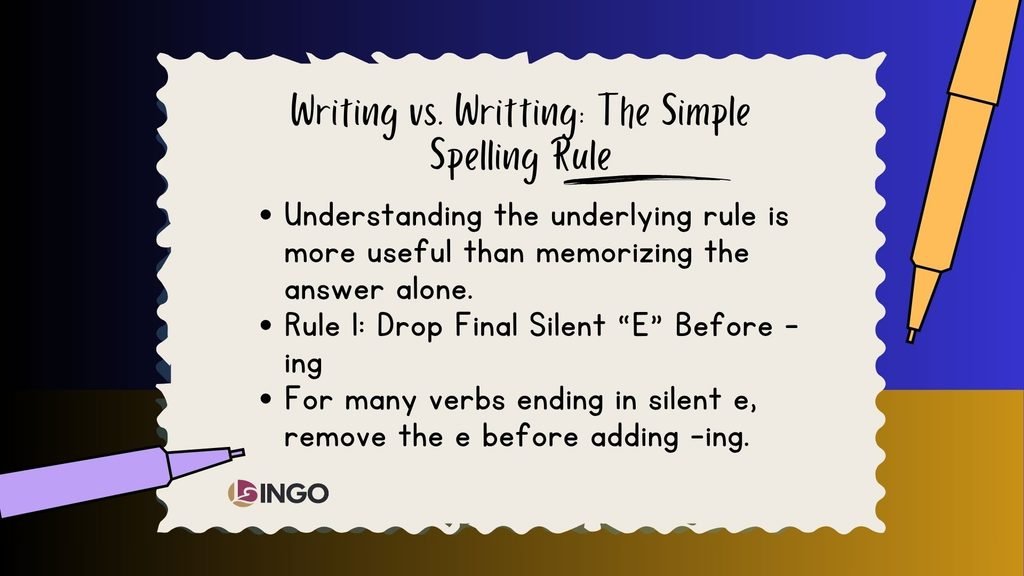
Understanding the underlying rule is more useful than memorizing the answer alone.
Rule 1: Drop Final Silent “E” Before -ing
For many verbs ending in silent e, remove the e before adding -ing.
Examples:
- write → writing
- bake → baking
- smile → smiling
- dance → dancing
- hope → hoping
- move → moving
This explains why write becomes writing.
Rule 2: Some Short Verbs Double the Final Consonant
A different pattern applies to certain short verbs.
Examples include:
- run → running
- sit → sitting
- get → getting
- plan → planning
- swim → swimming
This is why learners sometimes incorrectly transfer the double-consonant pattern to write.
But write does not belong to this group.
Rule 3: Don’t Double the “T” in Writing
The word already contains a t:
w r i t e
Remove the silent e:
w r i t
Add -ing:
w r i t i n g
The result is:
writing
Not:
writting
How to Use “Writing” Correctly
The word writing can be used in several different ways.
Writing as an Activity
You can use writing to describe the act of producing words.
Examples:
- I enjoy writing in my journal.
- She is writing an email.
- He spends several hours writing every day.
- They are writing a report for school.
Writing as Written Work
Writing can also refer to something that has been written.
Examples:
- Her writing is easy to understand.
- I enjoyed his writing.
- The student’s writing has improved.
- Your writing is very clear.
Writing as a Skill or Profession
The word can also describe writing as a skill, field, or professional activity.
Examples:
- Writing requires practice.
- Creative writing can be challenging.
- She wants to pursue professional writing.
- Good writing communicates ideas clearly.
Common Examples of “Writing” vs. “Writting”
Seeing the words in context makes the spelling difference easier to remember.
Correct Examples
- I am writing a letter.
- She enjoys writing stories.
- He is writing a book.
- They are writing an article.
- Good writing takes practice.
- I am writing down the instructions.
- She improved her writing skills.
- We spent the afternoon writing emails.
Incorrect Examples
These forms should be avoided in standard English:
- I am writting a letter. ❌
- She enjoys writting stories. ❌
- He is writting a book. ❌
- Good writting takes practice. ❌
Replace writting with writing in each case.
A Real-Life Example: Why the Mistake Happens
Imagine a university student named Sara preparing an important assignment. She writes the sentence:
“I am writting my final report.”
At first glance, the word may seem reasonable because Sara has learned that some English verbs double their final consonant when -ing is added. She remembers examples such as run → running, sit → sitting, and plan → planning.
Before submitting her assignment, however, she checks the spelling and notices that dictionaries use writing, not writting.
Sara then breaks the word down:
write + ing
She remembers that write ends in a silent e. The e is removed before –ing is added:
write → writing
She also compares it with another familiar verb:
make → making
This comparison helps her understand that the spelling pattern is not simply about doubling the last consonant. Instead, different verbs follow different spelling rules.
After correcting the sentence to:
“I am writing my final report.”
Sara applies the same rule throughout her assignment. She catches other possible mistakes such as writting, replacing them with writing.
This is a useful real-life lesson: when a spelling looks uncertain, do not rely only on how it sounds. Break the word into its base form and suffix. Identifying the base verb often makes the correct spelling much easier to remember.
A Simple Checklist to Remember “Writing”
Use this three-step method whenever you are unsure.
Step 1: Find the Base Verb
Ask:
What is the original verb?
For writing, the base verb is:
write
Step 2: Identify the Suffix
The ending is:
-ing
Step 3: Remove the Silent E
Take:
write
Remove the final e:
writ
Add:
-ing
Result:
writing
The 3-Second Test
Whenever you see writting, mentally ask:
“What is the base verb?”
The answer is write.
Then remember:
write → writing
That immediately eliminates the extra t.
Writing or Writting: Comparison Table
| Feature | Writing | Writting |
|---|---|---|
| Correct spelling | ✅ Yes | ❌ No |
| Base verb | write | write |
| Formation | write + ing | Incorrect formation |
| Meaning | The act or result of writing | No standard English meaning |
| Example | I am writing a letter. | I am writting a letter. ❌ |
| Standard English | Yes | No |
The important difference is simple: writing has one “t” before “ing,” while writting incorrectly has two.
2025–2026 Data and What It Means for Online Writing
There is no authoritative 2025–2026 statistic showing exactly how many people misspell writing as writting. It would be misleading to invent a percentage for this specific error.
However, current Google guidance provides useful evidence about why spelling and content quality still matter for publishers.
Google’s current Search documentation, updated in December 2025, says its systems prioritize helpful, reliable, people-first content. Its self-assessment guidance specifically asks publishers whether their content contains spelling or stylistic issues and whether the content appears carefully produced rather than sloppy or hastily created.
Google’s Search Essentials documentation, also updated in 2025, recommends creating helpful, reliable, people-first content and using the words people search for in prominent areas such as titles and headings.
Google also stated in a May 2025 Search Central update that the same people-first principles apply to newer AI-powered search experiences: publishers should focus on unique, useful, satisfying content rather than creating material primarily to manipulate search rankings.
Key Takeaways From the Current Data
- December 2025: Google updated its people-first content documentation.
- 2025: Google continued emphasizing helpful, reliable, original content.
- 2025: Google explicitly included spelling and stylistic quality among content-quality considerations.
- 2026: The practical lesson remains the same: clear, accurate writing helps create a better experience for readers.
So, while there is no reliable statistic specifically measuring writing vs. writting, current search-quality guidance reinforces the importance of proofreading and accurate spelling.
Easy Memory Tricks for “Writing”
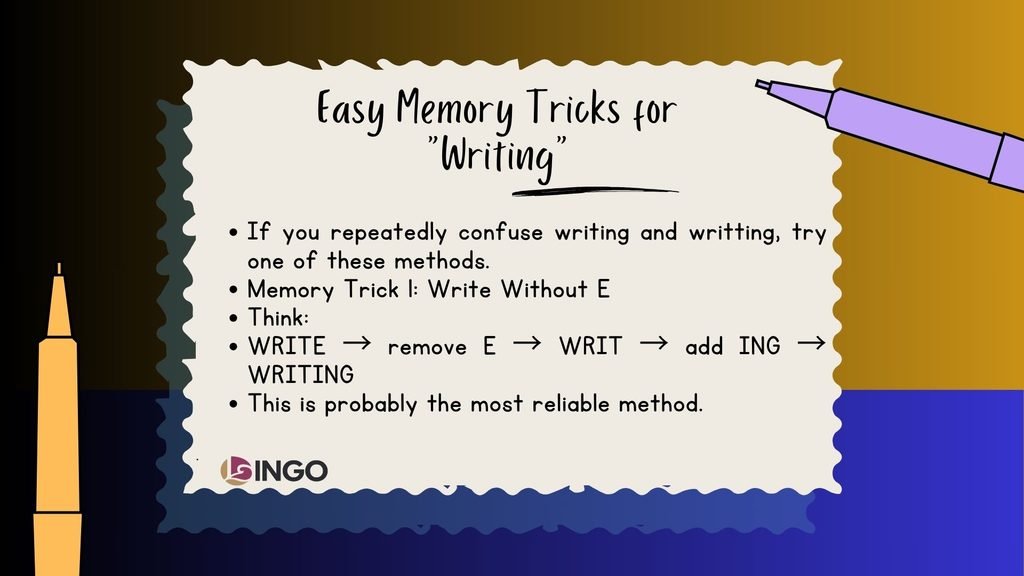
If you repeatedly confuse writing and writting, try one of these methods.
Memory Trick 1: Write Without E
Think:
WRITE → remove E → WRIT → add ING → WRITING
This is probably the most reliable method.
Memory Trick 2: One T Is Enough
Remember:
Writing has one T.
You can write this mentally as:
WRI + T + ING = WRITING
Memory Trick 3: Compare “Write” and “Writing”
Look at the transformation:
write → writing
The silent e disappears, but the t does not double.
Memory Trick 4: Connect It With “Making”
Compare:
make → making
and:
write → writing
Both lose the final silent e before -ing.
Mini Quiz:Writing or Writting
1. Which spelling is correct?
A. Writting
B. Writing
C. Writeing
D. Writteing
Answer: B. Writing
2. Which sentence is correct?
A. She is writting a letter.
B. She is writeing a letter.
C. She is writing a letter.
D. She is writinng a letter.
Answer: C. She is writing a letter.
3. What is the base verb of “writing”?
A. Wrote
B. Writer
C. Write
D. Written
Answer: C. Write
4. What happens to the final “e” in “write” before adding “-ing”?
A. It is doubled.
B. It is removed.
C. It becomes “t.”
D. It remains unchanged.
Answer: B. It is removed.
5. How many “t” letters are in the correct spelling of “writing”?
A. One
B. Two
C. Three
D. None
Answer: A. One
6. Which sentence uses “writing” correctly?
A. I enjoy writting stories.
B. I enjoy writeing stories.
C. I enjoy writing stories.
D. I enjoy writinng stories.
Answer: C. I enjoy writing stories.
7. Which is the correct spelling?
A. Writing
B. Writting
C. Writeing
D. Writtingg
Answer: A. Writing
8. Complete the sentence: “He is ______ an email.”
A. writting
B. writeing
C. writing
D. writinng
Answer: C. writing
9. Which spelling is incorrect?
A. Writing
B. Writer
C. Written
D. Writting
Answer: D. Writting
10. Which spelling rule applies to “write → writing”?
A. Double the final consonant.
B. Keep the final e.
C. Drop the final silent e before -ing.
D. Change the t to d.
Answer: C. Drop the final silent e before -ing.
11. Which sentence is correct?
A. Writing takes practice.
B. Writting takes practice.
C. Writeing takes practice.
D. Writteing takes practice.
Answer: A. Writing takes practice.
12. What is the simple past form of “write”?
A. Writing
B. Written
C. Wrote
D. Writes
Answer: C. Wrote
13. What is the past participle of “write”?
A. Wrote
B. Written
C. Writing
D. Writes
Answer: B. Written
14. Which sentence is spelled correctly?
A. I am writting a report.
B. I am writeing a report.
C. I am writing a report.
D. I am writinng a report.
Answer: C. I am writing a report.
15. Which word is related to “write” and means a person who writes?
A. Writer
B. Wroter
C. Writing
D. Writting
Answer: A. Writer
16. Which option shows the correct transformation?
A. Write → writting
B. Write → writeing
C. Write → writing
D. Write → writinng
Answer: C. Write → writing
17. Which sentence contains a spelling mistake?
A. She is writing a poem.
B. He is writing a report.
C. They are writting an article.
D. I enjoy writing.
Answer: C. They are writting an article.
18. Complete the sentence: “Good ______ requires practice.”
A. writting
B. writing
C. writeing
D. writinng
Answer: B. writing
19. Which is the correct spelling in both British and American English?
A. Writting
B. Writing
C. Writeing
D. Writteing
Answer: B. Writing
20. Which memory trick helps you spell “writing” correctly?
A. Write doubles T.
B. Write keeps E.
C. Write drops E, not T.
D. Write changes T to E.
Answer: C. Write drops E, not T.
21. Choose the correct sentence.
A. Maria is writting her assignment.
B. Maria is writing her assignment.
C. Maria is writeing her assignment.
D. Maria is writinng her assignment.
Answer: B. Maria is writing her assignment.
22. Which word correctly completes the sentence: “I love ______ in my journal.”
A. writting
B. writeing
C. writing
D. writinng
Answer: C. writing
23. Why is “writting” incorrect?
A. It has an extra t.
B. It has an extra r.
C. It has an extra i.
D. It has an extra n.
Answer: A. It has an extra t.
24. Which sentence contains the correct form of “write”?
A. She has writting three pages.
B. She has writeing three pages.
C. She has written three pages.
D. She has writing three pages.
Answer: C. She has written three pages.
25. Which sentence is completely correct?
A. He enjoys writting stories.
B. He enjoys writeing stories.
C. He enjoys writing stories.
D. He enjoys writinng stories.
Answer: C. He enjoys writing stories.
Quick reminder: ✅ Writing is correct. ❌ Writting is incorrect.
Memory trick: Write drops E, not T.
Frequently Asked Questions About Writing or Writting
Q1:Is “writing” or “writting” correct?
Writing is correct. Writting is an incorrect spelling in standard English.
Q2:Why is “writting” wrong?
Writting incorrectly doubles the t. The correct formation is write + -ing, with the final silent e removed: writing.
Q3:Is writing a verb?
Yes. Writing is the present participle and gerund form of the verb write. Depending on the sentence, it can function as part of a verb phrase or as a noun.
Q4:What is the past tense of write?
The past tense of write is wrote.
For example:
- Present: I write every day.
- Past: I wrote yesterday.
- -ing form: I am writing now.
Q5:Is “writting” ever correct?
No. Writting is not the standard spelling of the English word writing.
Q6:How do you spell writing correctly?
Spell it:
W-R-I-T-I-N-G
The word contains only one t.
Q7:Why does write become writing?
The final silent e in write is removed before –ing is added:
write → writing
This is a common spelling pattern with verbs ending in silent e.
Q8:How can I remember the spelling of writing?
Use the formula:
WRITE − E + ING = WRITING
This prevents the unnecessary double t.
Final Verdict: Writing or Writting?
The answer is clear:
Writing is correct. Writting is incorrect.
The confusion happens because English contains many verbs that double their final consonant before -ing, such as run → running and sit → sitting. However, write follows the silent-e pattern.
Simply remove the final e and add -ing:
WRITE → WRITING
So the next time you are unsure, remember:
One T. No E. Writing.
Good spelling makes your writing clearer and more professional, especially in emails, assignments, articles, resumes, and online content. If you want to improve your English further, keep checking the base form of a word whenever an -ing spelling seems confusing.
For more clear explanations of commonly confused English words and grammar rules, explore the other language guides on Lingorixa
References
Cambridge Dictionary — Writing
Cambridge Dictionary — Write

Maimoona Asghar is a grammar enthusiast and language writer who creates clear, practical content to help learners improve English grammar, writing, punctuation, and communication skills through easy-to-understand explanations and examples.