Introduction
If you are wondering about the plural of chief, you may have encountered two possible forms: chiefs and chieves. At first glance, “chieves” may seem logical because English has several words ending in -f or -fe that change when pluralized.
However, the correct plural form is chiefs.
For example:
- Singular: The chief addressed the community.
- Plural: The chiefs addressed the community.
So, is chieves ever correct? In standard modern English, chieves is not the standard plural of chief. The accepted plural is chiefs.
In this guide, you will learn why we say chiefs, how to use the word correctly, how it differs from other -f plural patterns, and how to remember the spelling easily.
What Is the Plural of Chief?
The plural of chief is chiefs.
The word follows a regular plural pattern: simply add -s to the singular noun.
| Singular | Plural |
|---|---|
| chief | chiefs |
| one chief | two chiefs |
| a chief | several chiefs |
Why Is the Plural of Chief “Chiefs”?
The important point is that not every English noun ending in –f changes to –ves in the plural.
Some nouns do:
- leaf → leaves
- wolf → wolves
- knife → knives
- wife → wives
But other nouns simply take -s:
- roof → roofs
- belief → beliefs
- proof → proofs
- chief → chiefs
Therefore, the spelling of chief should not be changed from –f to -ves.
Example Sentences With Chiefs
Here are some natural examples:
- The tribal chiefs gathered for a meeting.
- Several police chiefs attended the conference.
- The department chiefs discussed the new policy.
- The village chiefs welcomed the visitors.
- The military chiefs released a joint statement.
In each sentence, chiefs is the correct plural noun.
Chiefs or Chieves: Which One Is Correct?
The correct choice is chiefs, not chieves.
Is “Chieves” a Correct Plural?
Chieves is not the standard plural form of chief in modern English.
The spelling can look reasonable because words such as thief → thieves and leaf → leaves use a similar spelling change. However, English pluralization is not completely predictable based only on the final letter.
For chief, the standard form is:
chief → chiefs
Not:
chief → chieves
Why “Chieves” Looks Confusing
The confusion usually comes from other nouns that end in -f.
Compare these forms:
- thief → thieves
- leaf → leaves
- wife → wives
- knife → knives
- chief → chiefs
- roof → roofs
- belief → beliefs
This shows why it is better to learn the plural form of commonly used nouns rather than assuming every -f noun follows the same rule.
A Simple Memory Trick
Think:
Chief keeps the F.
chief → chiefs
The f stays in the plural, and you simply add -s.
Why Does Chief Take “-s” Instead of “-ves”?
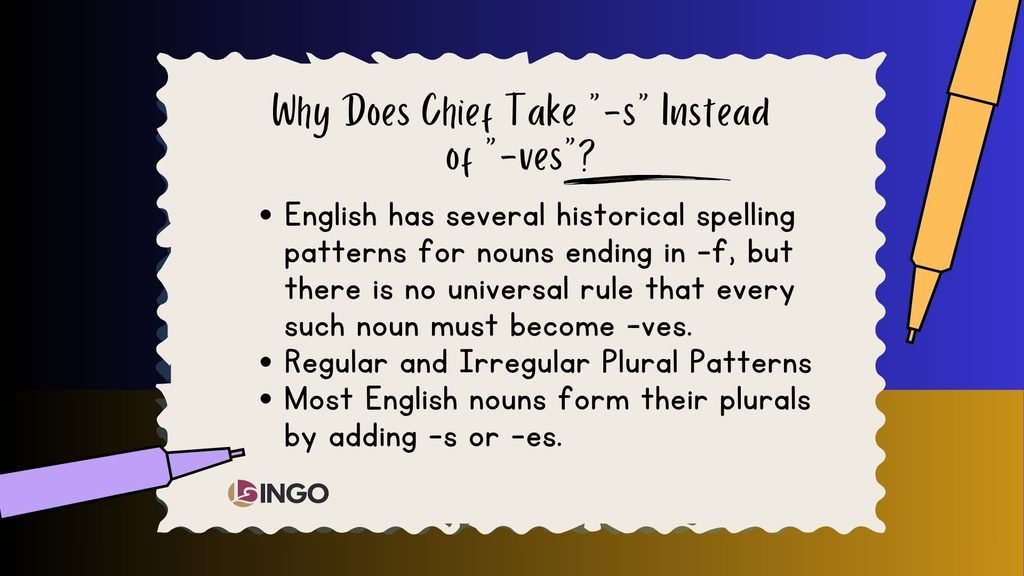
English has several historical spelling patterns for nouns ending in -f, but there is no universal rule that every such noun must become -ves.
Regular and Irregular Plural Patterns
Most English nouns form their plurals by adding -s or -es.
Examples include:
- book → books
- car → cars
- teacher → teachers
- chief → chiefs
Other nouns have irregular plural forms:
- man → men
- child → children
- mouse → mice
- person → people
Some nouns ending in -f or -fe have a spelling change:
- half → halves
- life → lives
- knife → knives
But chief belongs to the group that uses the regular -s ending.
Does Pronunciation Change?
The pronunciation also follows the regular plural pattern.
Chief is pronounced approximately like “cheef.”
Chiefs is pronounced approximately like “cheefs.”
The plural ending is an /s/ sound because the final sound in chief is voiceless.
This is another reason not to assume that chieves is correct simply because some other -f nouns change to -ves.
Chiefs in Real-Life English
The word chief is widely used for people who hold a leading or senior position.
Common Expressions With Chief
You will frequently see chief in titles and job descriptions such as:
- police chief
- fire chief
- chief executive
- chief engineer
- chief officer
- chief of staff
- tribal chief
- department chief
When referring to more than one person, the plural is chiefs.
For example:
Several police chiefs met to discuss public safety.
Or:
The company appointed new department chiefs.
Chiefs as Leaders
The noun chief can refer to a leader of a group, organization, community, or tribe.
For example:
The village chief welcomed the guests.
When there is more than one:
The village chiefs welcomed the guests.
Notice that nothing changes inside the word. We simply add -s.
Chiefs vs. Other -F Plurals: A Quick Comparison
One of the easiest ways to understand the rule is to compare chiefs with other nouns ending in -f.
| Singular | Correct plural | Pattern |
|---|---|---|
| chief | chiefs | Add -s |
| roof | roofs | Add -s |
| belief | beliefs | Add -s |
| proof | proofs | Add -s |
| thief | thieves | Change -f to -ves |
| leaf | leaves | Change -f to -ves |
| knife | knives | Change -fe to -ves |
| wife | wives | Change -fe to -ves |
The important lesson is that -f does not automatically become -ves.
A Useful Rule of Thumb
If you are unsure about a noun ending in -f, do not rely solely on a spelling rule.
Instead:
- Check a reliable dictionary.
- Look at examples of the word in context.
- Learn the common plural form.
For chief, the answer is straightforward:
chief → chiefs
2025–2026 Data Snapshot: What Major Dictionaries Show
Current dictionary evidence provides a simple answer.
As a 2025–2026 reference check, three major English dictionary resources—Merriam-Webster, Cambridge Dictionary, and Oxford Learner’s Dictionaries—support “chiefs” as the standard plural usage or provide examples showing the noun in its plural form.
That gives us a useful 3-out-of-3 dictionary check for the standard form:
- Merriam-Webster: identifies chief as a noun meaning a leader or head of a group and provides current examples of the word.
- Cambridge Dictionary: uses chiefs in multiple corpus examples, including “police chiefs” and “traditional chiefs.”
- Oxford Learner’s Dictionaries: provides examples such as “army/police chiefs” and “industry chiefs.”
This is not a claim that every historical or specialized use of chieves is impossible; rather, for standard modern English writing, editing, education, and everyday communication, “chiefs” is the form to use.
For SEO and educational content, this distinction matters because readers generally want the standard contemporary form rather than a rare historical possibility.
A Real-Life Example: Choosing “Chiefs” in Professional Writing
Imagine that you are writing a news report about a meeting involving several police department leaders.
You might initially write:
“Five police chieves attended the meeting.”
The sentence looks plausible if you are familiar with words such as thieves or leaves. However, an editor would normally change it to:
“Five police chiefs attended the meeting.”
Why? Because chief does not form its standard plural by changing -f to -ves.
Now imagine the same issue appearing in a school assignment. A student might write:
“The village had three powerful chieves.”
The intended meaning is clear, but the spelling is incorrect in standard modern English. The corrected sentence is:
“The village had three powerful chiefs.”
The same principle applies in business writing. Suppose a company has several senior leaders responsible for different departments. You could write:
“The department chiefs met to review the company’s annual strategy.”
Again, chiefs is the natural and standard plural.
This example demonstrates an important lesson about English spelling: familiar patterns can sometimes lead us in the wrong direction. Because thief becomes thieves, it is tempting to apply the same transformation to chief. But English contains many exceptions and word-specific plural patterns. When accuracy matters, the dictionary form is the safest guide.
Common Mistakes With the Plural of Chief
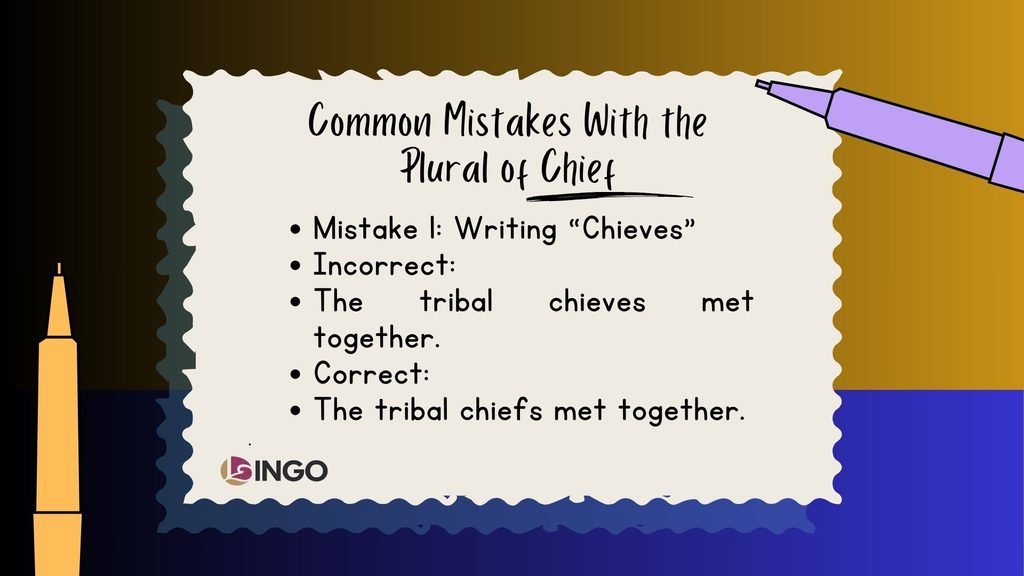
Mistake 1: Writing “Chieves”
Incorrect:
The tribal chieves met together.
Correct:
The tribal chiefs met together.
Mistake 2: Assuming Every -F Word Uses -VES
English does not have a single rule that changes every final f into ves.
For example:
- chief → chiefs
- roof → roofs
- belief → beliefs
But:
- thief → thieves
- wolf → wolves
- leaf → leaves
Mistake 3: Confusing Chief With Thief
The words chief and thief look somewhat similar, but their plural forms are different.
- chief → chiefs
- thief → thieves
The spelling of one word should not be used as a template for the other.
How to Remember “Chiefs” Easily
If you frequently forget whether the plural is chiefs or chieves, use this simple rule:
The Chief Keeps the F
Remember:
Chief keeps F → chiefs
You can also memorize this short pair:
One chief, two chiefs.
Repeat it a few times and the correct spelling becomes much easier to recall.
Another useful comparison is:
One thief → two thieves
One chief → two chiefs
The first changes; the second does not.
Mini Quiz:Plural of Chief
1. What is the correct plural of “chief”?
A. Chiefs
B. Chieves
C. Chiefes
D. Chieffs
Answer: A. Chiefs
2. Which sentence is correct?
A. The chiefs met together.
B. The chieves met together.
C. The chiefes met together.
D. The chieffs met together.
Answer: A. The chiefs met together.
3. Complete the sentence: “Several police _____ attended the meeting.”
A. chieves
B. chiefs
C. chiefes
D. chieffs
Answer: B. chiefs
4. Which pair is correct?
A. Chief → Chiefs
B. Chief → Chieves
C. Chief → Chiefes
D. Chief → Chieffs
Answer: A. Chief → Chiefs
5. Which word is NOT the standard plural of “chief”?
A. Chiefs
B. Chieves
C. Police chiefs
D. Tribal chiefs
Answer: B. Chieves
6. What should you write for more than one chief?
A. Chief
B. Chiefs
C. Chieves
D. Chiefes
Answer: B. Chiefs
7. Which spelling is correct in standard English?
A. Chiefs
B. Chieves
C. Chieffs
D. Chiefves
Answer: A. Chiefs
8. Which sentence is grammatically correct?
A. Three chiefs spoke at the event.
B. Three chieves spoke at the event.
C. Three chiefes spoke at the event.
D. Three chieffs spoke at the event.
Answer: A. Three chiefs spoke at the event.
9. Which plural form keeps the letter “f” from “chief”?
A. Chieves
B. Chiefs
C. Chiefes
D. Chieffs
Answer: B. Chiefs
10. Which is the correct plural phrase?
A. Tribal chieves
B. Tribal chiefes
C. Tribal chiefs
D. Tribal chieffs
Answer: C. Tribal chiefs
11. Which word has a similar regular plural pattern to “chief”?
A. Knife → Knives
B. Leaf → Leaves
C. Roof → Roofs
D. Wife → Wives
Answer: C. Roof → Roofs
12. Which statement is correct?
A. The plural of chief is chiefs.
B. The plural of chief is chieves.
C. Chief has no plural form.
D. The plural of chief is chiefes.
Answer: A. The plural of chief is chiefs.
13. Which sentence contains the correct plural spelling?
A. The department chiefs met.
B. The department chieves met.
C. The department chiefes met.
D. The department chieffs met.
Answer: A. The department chiefs met.
14. What happens to the final “f” when “chief” becomes plural?
A. It changes to “v.”
B. It remains “f.”
C. It disappears.
D. It changes to “ph.”
Answer: B. It remains “f.”
15. Which pair correctly contrasts “chief” and “thief”?
A. Chief → Chiefs; Thief → Thieves
B. Chief → Chieves; Thief → Thiefs
C. Chief → Chiefes; Thief → Thieves
D. Chief → Chieffs; Thief → Thiefes
Answer: A. Chief → Chiefs; Thief → Thieves
16. Complete the sentence: “The village _____ welcomed the visitors.”
A. chieves
B. chiefes
C. chiefs
D. chieffs
Answer: C. chiefs
17. Which plural form would you use in formal English writing?
A. Chieves
B. Chiefs
C. Chiefes
D. Chieffs
Answer: B. Chiefs
18. Which sentence uses “chiefs” correctly?
A. Several chiefs attended the conference.
B. Several chieves attended the conference.
C. Several chiefes attended the conference.
D. Several chieffs attended the conference.
Answer: A. Several chiefs attended the conference.
19. Which word follows a different plural pattern from “chief”?
A. Roof → Roofs
B. Proof → Proofs
C. Thief → Thieves
D. Belief → Beliefs
Answer: C. Thief → Thieves
20. Which is a useful way to remember the plural of “chief”?
A. The chief keeps the F.
B. Every F becomes V.
C. Chief loses the F.
D. Chief always takes -es.
Answer: A. The chief keeps the F.
21. Which plural is spelled correctly?
A. Chiefs
B. Chieves
C. Chiefves
D. Chiefes
Answer: A. Chiefs
22. If one person is a chief, what do you call two or more?
A. Chief
B. Chieves
C. Chiefs
D. Chiefes
Answer: C. Chiefs
23. Which sentence is correct in standard English?
A. The military chieves issued a statement.
B. The military chiefs issued a statement.
C. The military chiefes issued a statement.
D. The military chieffs issued a statement.
Answer: B. The military chiefs issued a statement.
24. Why can’t you assume “chief” becomes “chieves”?
A. Not every noun ending in “-f” changes to “-ves.”
B. Chief is always uncountable.
C. Chief can only describe one person.
D. Chief must always take “-es.”
Answer: A. Not every noun ending in “-f” changes to “-ves.”
25. Choose the correct sentence.
A. The chiefs discussed the issue.
B. The chieves discussed the issue.
C. The chiefes discussed the issue.
D. The chieffs discussed the issue.
Answer: A. The chiefs discussed the issue.
FAQs About the Plural of Chief
Q1:What is the plural of chief?
The plural of chief is chiefs. For example: “Several chiefs attended the meeting.”
Q2:Is “chieves” correct?
No. Chieves is not the standard modern plural of chief. Use chiefs instead.
Q3:Why is it chiefs and not chieves?
Not every noun ending in -f changes to -ves. The noun chief forms its plural regularly by adding -s.
Q4:Is chief a regular or irregular plural?
Chief has a regular plural form: chiefs. It simply takes the plural ending -s.
Q5:What is the difference between chief and chiefs?
Chief refers to one person or thing, while chiefs refers to more than one.
Example:
- One chief attended.
- Three chiefs attended.
Q6:Is “chiefs” pronounced differently from “chief”?
Yes. Chief ends with the sound /f/, while chiefs adds the plural /s/ sound. The plural is approximately pronounced “cheefs.”
Q7:What are examples of the plural of chief?
Examples include:
- police chiefs
- tribal chiefs
- department chiefs
- military chiefs
- village chiefs
- company chiefs
Q8:How can I remember the plural of chief?
Use the simple memory trick: “The chief keeps the F.” Therefore, chief → chiefs, not chieves.
Conclusion
The answer is simple: the plural of chief is chiefs, not chieves.
Although words such as thief → thieves and leaf → leaves can make chieves look tempting, chief follows a different plural pattern. Simply add -s:
chief → chiefs
Whether you are writing a school assignment, professional document, article, email, or social media post, chiefs is the standard form to use.
When in doubt, remember: the chief keeps the F.
For more clear explanations of commonly confused English words and grammar rules, explore the other language guides on Lingorixa
References
Merriam-Webster Dictionary
Oxford Learner’s Dictionaries

Maimoona Asghar is a grammar enthusiast and language writer who creates clear, practical content to help learners improve English grammar, writing, punctuation, and communication skills through easy-to-understand explanations and examples.