Confused about of vs off? You are not alone. These two short words look and sound somewhat similar, but they perform very different jobs in English. Using the wrong one can change the meaning of a sentence or make your writing sound unnatural.
The easiest way to remember the difference is this: of usually shows a relationship, connection, possession, amount, material, or origin, while off often expresses separation, movement away, removal, or a state of being inactive.
For example:
- The cover of the book is blue.
- Please take your shoes off.
In this guide, you’ll learn exactly when to use of and off, see clear examples, compare their grammatical functions, and discover an easy trick for remembering the difference.
What Is the Difference Between Of and Off?
The main difference between of and off is their meaning and grammatical function.
Of is most commonly used as a preposition to show a relationship between two things. It can indicate possession, origin, material, quantity, association, or connection.
Off can function as a preposition, adverb, adjective, or verb. It commonly indicates movement away from something, separation, removal, interruption, or a state in which something is not operating.
Compare these sentences:
- The handle of the door is broken.
- The handle fell off the door.
In the first sentence, of connects handle with door. It identifies which handle is being discussed.
In the second sentence, off shows separation. The handle is no longer attached to the door.
Merriam-Webster defines of as a preposition with uses involving relationships such as location, origin, cause, possession, material, and contents.
Meanwhile, off has several grammatical roles and commonly conveys ideas such as being away from a position, separated from a surface, or discontinuing something.
A Quick Rule for Of vs Off
A useful memory trick is:
Of = connection or relationship
Off = separation or movement away
For example:
- a bottle of water → relationship/content
- take the bottle off the table → movement/removal
This simple distinction will help you recognize many common uses.
When Should You Use Of?
Use of when you need to express a relationship between nouns, possession, material, quantity, origin, or another type of connection.
Of for Possession and Relationships
One of the most common uses of of is to show that something belongs to, relates to, or is associated with something else.
Examples:
- The roof of the house needs repair.
- The beginning of the movie was exciting.
- The name of the school is difficult to pronounce.
- The color of the car is unusual.
In these examples, of creates a relationship between two nouns.
You can often think of the structure as:
noun + of + noun
For example:
the pages of the book
Here, pages are connected to book.
Of for Material and Contents
Of can also identify what something contains or what it is made from.
Examples:
- a glass of water
- a bowl of soup
- a piece of cake
- a ring of gold
- a box of chocolates
Consider the difference:
- I drank a glass of water.
- I knocked the glass off the table.
The first sentence tells us what the glass contains. The second tells us that the glass moved away from the table.
Of for Amounts and Quantities
Another common use is to express quantities.
Examples:
- a lot of people
- a cup of tea
- a pair of shoes
- three kilos of rice
- a group of students
Here, of connects the quantity or container with what is being counted or measured.
When Should You Use Off?
Use off when you want to express separation, movement away, removal, or a change from an active or connected state.
Off for Movement or Separation
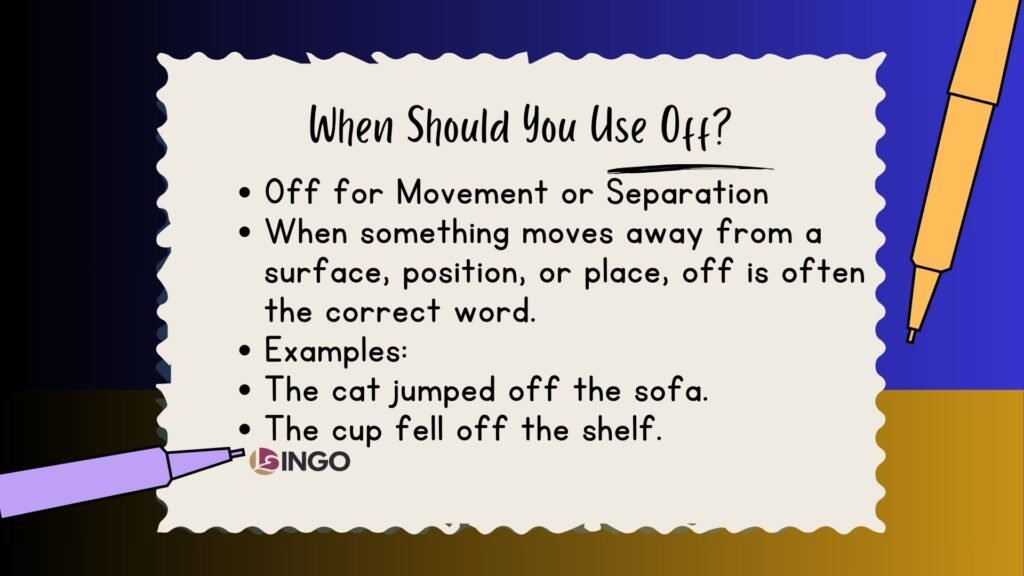
When something moves away from a surface, position, or place, off is often the correct word.
Examples:
- The cat jumped off the sofa.
- The cup fell off the shelf.
- She stepped off the bus.
- The bird flew off the roof.
The key idea is away from or separated from.
Merriam-Webster includes this sense of off in definitions involving movement from a place or position and separation from support or contact.
Off for Removal
Off is also frequently used when something is removed from another thing.
Examples:
- Take your jacket off.
- Please wipe the dirt off the table.
- He pulled the sticker off the box.
- She took the lid off the container.
The word tells us that something is being separated or removed.
Compare:
- The label of the bottle is red.
- The label fell off the bottle.
The first sentence describes a relationship. The second describes separation.
Off for Inactive States
Off is also used to describe something that is not operating.
Examples:
- The television is off.
- Please turn off the lights.
- The computer suddenly went off.
- The alarm is off now.
This meaning is very different from the usual relationship meanings of of.
Of vs Off: A Simple Comparison
| Word | Common Function | Basic Idea | Example |
|---|---|---|---|
| of | Preposition | Relationship or connection | the cover of the book |
| of | Preposition | Material/content | a cup of coffee |
| of | Preposition | Quantity | a group of students |
| off | Preposition | Separation | the book fell off the desk |
| off | Adverb | Movement away | The dog ran off. |
| off | Adjective | Not operating | The lights are off. |
| off | Verb | Remove/separate | Please off the device. |
The last example deserves caution: although off has many grammatical uses, using off as a verb is not standard in ordinary modern English in the same way as turn off or switch off. Therefore, learners should normally say turn off, switch off, or take off depending on the intended meaning.
Of vs Off in Common Sentences
Because the words are so short, context is extremely important.
Compare These Pairs
1. Possession vs separation
- The door of the room is open.
- The door came off its hinges.
2. Contents vs movement
- I need a bottle of water.
- The bottle fell off the table.
3. Relationship vs removal
- The cover of the book is damaged.
- She took the cover off the book.
4. Association vs movement
- The name of the company is familiar.
- The employee walked off the job.
5. Quantity vs separation
- A group of children was playing outside.
- One child ran off.
These examples demonstrate why replacing of with off can completely change a sentence.
A Useful Test
When you’re unsure whether to use of or off, ask yourself:
Does the word show a relationship or connection?
If yes, of is often correct.
Does it show movement away, separation, removal, or inactivity?
If yes, off is likely correct.
For example:
The pages ___ the book are torn.
The sentence describes the relationship between pages and book, so the answer is of.
The book fell ___ the desk.
The sentence describes movement away from the desk, so the answer is off.
Case Study: How One Small Word Changes the Meaning
Imagine a student writing an email to a teacher about a damaged textbook.
The student writes:
“The cover off the textbook is torn.”
The intended meaning is that the cover belongs to or is part of the textbook. Therefore, the correct sentence is:
“The cover of the textbook is torn.”
Now imagine the student writes:
“The cover of the textbook fell the desk.”
That sentence does not communicate the intended movement. If the cover fell away from the desk, the correct expression would be:
“The cover fell off the desk.”
The distinction becomes even clearer in a real-life workplace situation. Suppose an employee writes, “Please remove the document of the folder.” The reader may understand the general idea, but the preposition is wrong because the action involves separation. A better sentence is, “Please remove the document from the folder.” If the intended meaning is that something is physically positioned on a surface and needs to be removed, off may work: “Please take the document off the desk.”
This illustrates an important lesson: of and off cannot simply be chosen because they sound similar. Their meanings depend on the relationship expressed by the sentence. Of generally links ideas, while off frequently describes distance, separation, or movement away. Understanding the underlying meaning is much more reliable than trying to memorize isolated sentences.
Common Mistakes With Of and Off
Mistake 1: Writing “Off” Instead of “Of”
Incorrect:
- a cup off tea
- the end off the road
- a group off students
Correct:
- a cup of tea
- the end of the road
- a group of students
The mistake often occurs because of and off can sound similar in rapid speech.
Mistake 2: Writing “Of” Instead of “Off”
Incorrect:
- The phone fell of the table.
- Take your shoes of.
- The child jumped of the bed.
Correct:
- The phone fell off the table.
- Take your shoes off.
- The child jumped off the bed.
Here, off indicates removal or movement away.
Mistake 3: Confusing “Of” With “From”
Learners sometimes assume that of and from are interchangeable.
They are not always interchangeable.
For example:
- She is from Canada. → origin
- the capital of Canada → relationship
Similarly:
- He took the book off the shelf. → movement away from a surface
- He took the book from the library. → source or origin
Choosing the correct preposition depends on the precise relationship being expressed.
“Off Of” vs “Off”: Is “Off Of” Correct?
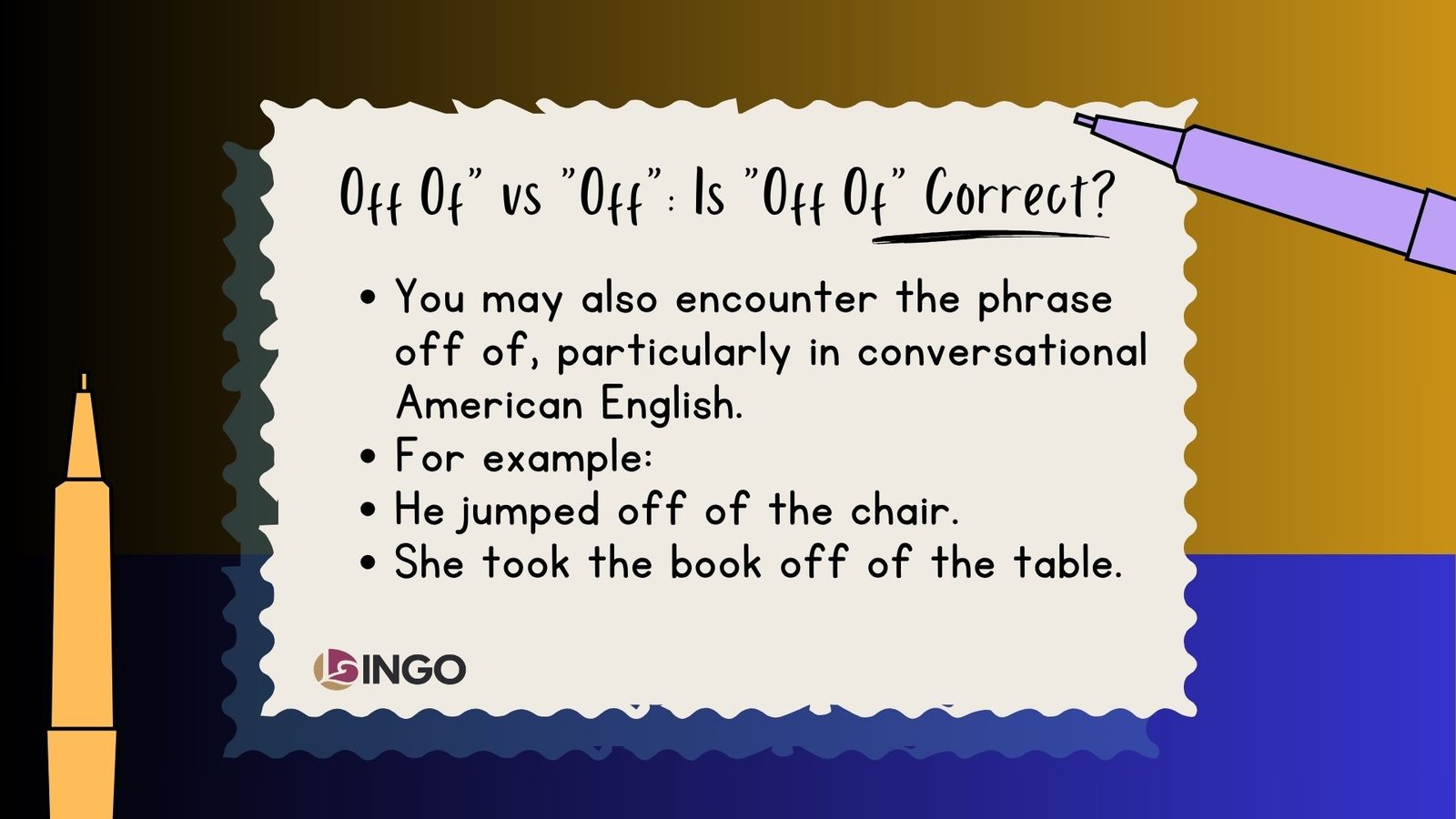
You may also encounter the phrase off of, particularly in conversational American English.
For example:
- He jumped off of the chair.
- She took the book off of the table.
Off of is used in speech and is recognized as an idiomatic expression, although many editors prefer the shorter off in formal writing:
- He jumped off the chair.
- She took the book off the table.
Merriam-Webster notes that off of is much more common in speech than edited writing and is more common in American English than British English.
Therefore, off of is not automatically wrong, but off is often the cleaner choice in concise formal writing.
What Current 2025–2026 Guidance Says About Grammar Content
There is no reliable 2025–2026 statistic showing that a particular number of grammar articles or a particular word count guarantees a Google ranking. In fact, Google’s current guidance explicitly says creators should not write to a predetermined word count simply because they believe Google prefers a particular length.
Google’s current Search Essentials emphasize helpful, reliable, people-first content and recommend using the language readers actually use when searching.
Google also states that its former Helpful Content System was incorporated into its core ranking systems in March 2024. Current guidance therefore focuses on producing useful content for readers rather than treating “helpful content” as a separate optimization trick.
For grammar content such as of vs off, that means the strongest approach is not artificially repeating the keyword. Instead, a useful page should:
- Give the answer quickly.
- Explain the grammatical distinction accurately.
- Provide natural examples.
- Address common mistakes.
- Use trustworthy references.
- Satisfy the reader without requiring another search.
Google’s 2025 guidance similarly emphasizes original, satisfying content that provides unique value to visitors.
A Quick Step-by-Step Guide to Choosing Of or Off
Use this five-step method whenever you’re unsure.
Step 1: Look at the Meaning
Ask what you are trying to express.
Is it a relationship, possession, amount, material, or connection?
Choose of.
Is it separation, movement away, removal, or inactivity?
Consider off.
Step 2: Check the Words Around It
Look at the entire phrase instead of focusing only on the two words.
For example:
- a piece of paper
- fall off the chair
- the color of the wall
- take off your coat
The surrounding words often make the answer obvious.
Step 3: Ask “Connected or Separated?”
This is one of the fastest tests.
Connected → of
the handle of the suitcase
Separated → off
the handle came off the suitcase
Step 4: Read the Complete Sentence
Never choose based only on pronunciation.
Compare:
- The top of the box is blue.
- The top came off the box.
The same nouns appear, but the meanings are different.
Step 5: Read It Aloud
If you’re still uncertain, read the complete sentence naturally.
This can help you recognize familiar English patterns such as:
- a lot of
- one of
- the end of
- take off
- fall off
- turn off
However, use meaning and grammar not pronunciation alone to make the final choice.
Mini Quiz:Of vs Off
1. She drank a glass ___ water.
A) of
B) off
C) on
D) from
2. The cat jumped ___ the sofa.
A) of
B) off
C) by
D) to
3. The color ___ the wall is beautiful.
A) off
B) from
C) of
D) over
4. Please take your shoes ___.
A) of
B) off
C) from
D) by
5. A group ___ students entered the room.
A) off
B) of
C) on
D) away
6. The book fell ___ the table.
A) of
B) off
C) with
D) into
7. She bought a piece ___ cake.
A) off
B) of
C) from
D) under
8. Turn ___ the television before leaving.
A) of
B) off
C) from
D) over
9. The pages ___ the book are torn.
A) off
B) of
C) toward
D) outside
10. The plane took ___ at noon.
A) of
B) off
C) from
D) on
11. Which sentence is correct?
A) She drank a cup of tea.
B) She drank a cup off tea.
C) She drank a cup away tea.
D) She drank a cup outside tea.
12. Which sentence is correct?
A) The child jumped of the bed.
B) The child jumped off the bed.
C) The child jumped of the room.
D) The child jumped of the floor.
13. The handle ___ the door is broken.
A) off
B) of
C) away
D) toward
14. He wiped the dirt ___ the table.
A) of
B) off
C) under
D) beside
15. The beginning ___ the story was exciting.
A) off
B) of
C) away
D) under
16. Which sentence correctly uses of?
A) The roof of the house is red.
B) The roof off the house is red.
C) The roof away the house is red.
D) The roof on the house is red.
17. Which sentence correctly uses off?
A) The phone fell of the desk.
B) The phone fell off the desk.
C) The phone fell of the desk.
D) The phone fell away the desk.
18. A pair ___ shoes was on the floor.
A) of
B) off
C) from
D) away
19. The boy fell ___ the bicycle.
A) of
B) off
C) from
D) under
20. In “The lights are off,” what does off mean?
A) Connected
B) Not operating
C) Increasing
D) Nearby
21. The cover ___ the book is damaged.
A) off
B) of
C) away
D) under
22. Which statement is correct?
A) Of commonly shows a relationship, while off commonly shows separation.
B) Of and off always have the same meaning.
C) Off is mainly used to show possession.
D) Of always describes movement away.
23. Which sentence is correct?
A) He took the picture off the wall.
B) He took the picture of the wall.
C) He took the picture away the wall.
D) He took the picture on the wall.
24. Which sentence uses of correctly?
A) One of my friends called me.
B) One off my friends called me.
C) One away my friends called me.
D) One on my friends called me.
25. Which sentence correctly uses both words?
A) The handle of the bag fell off the bag.
B) The handle off the bag fell of the bag.
C) The handle of the bag fell of the bag.
D) The handle off the bag fell of the bag.
Answer Key
- A — of
- B — off
- C — of
- B — off
- B — of
- B — off
- B — of
- B — off
- B — of
- B — off
- A — of
- B — off
- B — of
- B — off
- B — of
- A — of
- B — off
- A — of
- B — off
- B — Not operating
- B — of
- A — Of shows a relationship; off commonly shows separation.
- A — off
- A — of
- A — The handle of the bag fell off the bag.
Frequently Asked Questions About Of vs Off
Q1:Is “of” and “off” the same thing?
No. Of and off have different meanings and grammatical functions. Of commonly expresses relationships, possession, material, quantity, or association. Off commonly expresses separation, movement away, removal, or an inactive state.
Q2:What is the easiest way to remember of vs off?
Remember: of usually connects; off usually separates.
For example, the pages of the book shows a relationship, while the book fell off the table shows separation.
Q3:Is it “a cup of tea” or “a cup off tea”?
The correct phrase is “a cup of tea.” Here, of connects the container or quantity with its contents.
Q4:Is it “fall off the chair” or “fall of the chair”?
The correct expression is “fall off the chair.” Off indicates movement away from or separation from the chair.
Q5:Is “take off” correct English?
Yes. Take off is a standard expression. Depending on context, it can mean removing something, leaving a place, or describing an aircraft leaving the ground.
Examples:
- Take off your shoes.
- The plane took off at noon.
Q6:Is “off of” grammatically correct?
Off of is an established expression, especially in conversational American English. However, off alone is often preferred in edited or formal writing: She took the book off the table.
Q7:How can I tell whether to use of or off?
Ask what the sentence means. If you’re expressing a relationship or connection, of is often appropriate. If you’re expressing separation, movement away, or removal, off is often appropriate.
Q8:Why do “of” and “off” sound similar?
They are historically related words, and their pronunciations can become particularly similar in rapid speech. This is one reason English learners frequently confuse them in writing. Looking at the meaning and grammatical pattern is more reliable than listening for the difference alone.
Final Takeaway: Of vs Off
The difference between of vs off becomes much easier once you focus on meaning rather than pronunciation.
Use of when you are showing a relationship, possession, material, quantity, content, or association:
- the roof of the house
- a glass of water
- a group of students
Use off when you are expressing separation, movement away, removal, or an inactive state:
- fall off the chair
- take off your shoes
- turn off the light
The simplest rule to remember is:
Of connects; off separates or moves away.
Keep that distinction in mind, and you’ll be able to use these commonly confused words much more confidently.
For more clear explanations of commonly confused English words and grammar rules, explore the other language guides on Lingorixa.
References
Merriam-Webster: Of
Merriam-Webster: Off

Maimoona Asghar is a grammar enthusiast and language writer who creates clear, practical content to help learners improve English grammar, writing, punctuation, and communication skills through easy-to-understand explanations and examples.